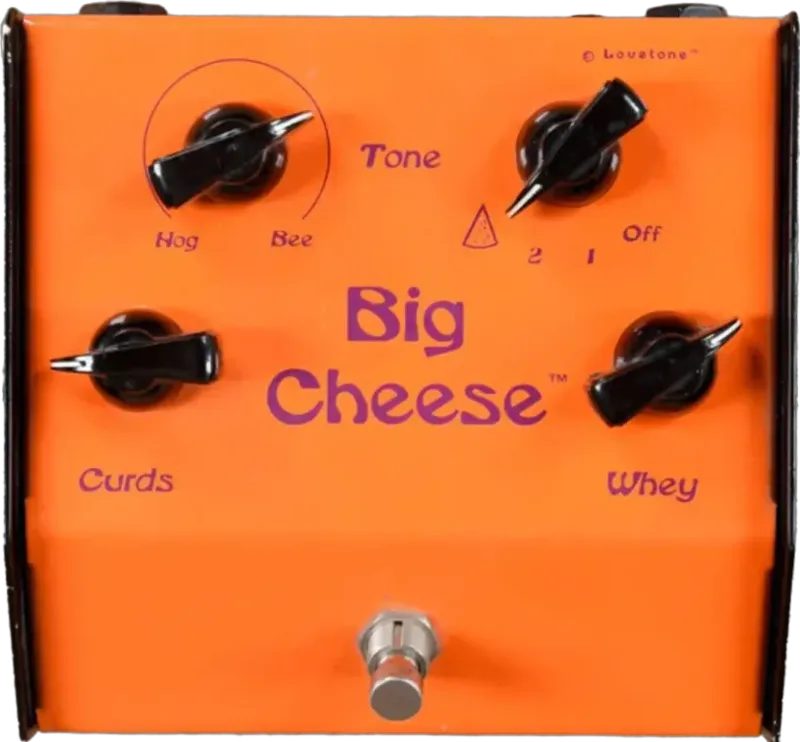
| Type | Analog fuzz pedal1 |
| Maker | Lovetone, England1 |
| Released | Mid 1990s, 199515 |
| Status | Discontinued; Lovetone ceased pedal production in 20012 |
| Circuit | Three silicon transistors, either 3 x BC549 or 3 x 2N3904 depending on the unit4 |
| Controls | Volume, sustain, tone, and a four-mode rotary selector13 |
| Power | 9V DC, center negative1 |
| Enclosure | Lovetone's large steel enclosure with multiple footswitches and status indicators1 |
The Lovetone Big Cheese is an analog fuzz pedal produced in England in the mid 1990s, and it is perhaps the most famous pedal the Lovetone company ever made12. It is built around a multi-stage transistor fuzz circuit with a wide gain range, and its design allows both smooth sustain and aggressive, compressed tones depending on the selected setting1. What set it apart from most fuzzes of its era was a rotary selector offering four distinct modes, including a gated "Cheese" setting that produces spluttering, dying-amp textures32.
The Big Cheese was only available for a handful of years4. That short run is a big part of why so many makers have since built pedals based on its circuit4.
How the circuit works
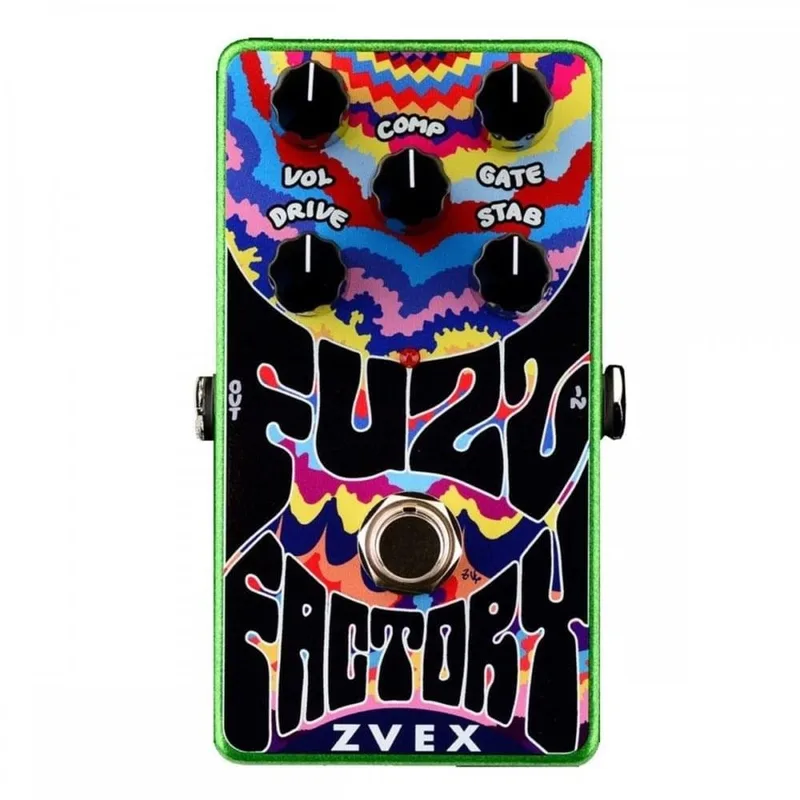
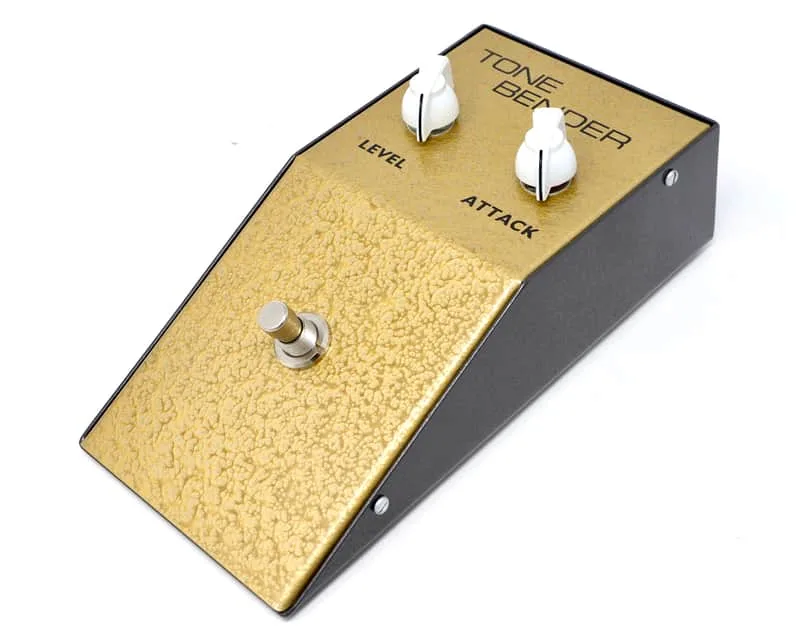
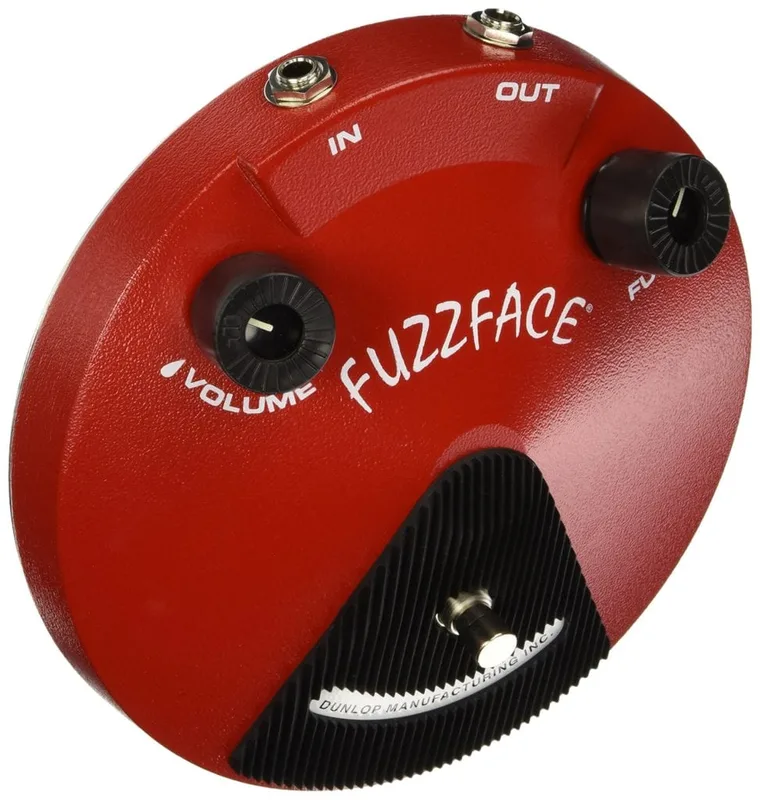
The Big Cheese is a three-transistor silicon fuzz. Aion FX, which has documented the circuit in detail, describes its lineage as a silicon transistor fuzz resembling a Fuzz Face or Tone Bender, followed by diode clipping and a Big Muff-style tone control3. The gated "Cheese" mode comes from intentional misbiasing of the transistor fuzz, an approach Aion FX compares to the Zvex Fuzz Factory or Cornish NG-33.
Original units variously used either three BC549 or three 2N3904 transistors, so the silicon in any given pedal can differ from unit to unit4. The original can also get well above unity gain at max volume, worth knowing if you are running one into a hot amp input3.
For a player, that lineage means the Big Cheese sits somewhere between the classic two-transistor fuzzes of the 1960s and the saturated, tone-shaped sounds of the Big Muff family, with a bias trick on top that no stock Fuzz Face or Tone Bender offers3.
The controls and the four-mode rotary selector
The pedal provides controls for volume, sustain, tone, and a rotary selector for the fuzz modes1. On the original pedals, the knobs carried playful labels: "Whey," "Hog/Bee," and "Curds"67. JHS recounts the original control set in the same dairy terms:
"You have a 'curds' knob, a 'whey' knob, plus a 'hog' and 'bee' knob."2
The rotary selector is where the pedal's range lives. Aion FX documents the four positions3:
| Mode | What it does |
|---|---|
| Tone bypass | Takes the tone stack out of the signal path |
| Scooped mids | Big Muff-style tone stack with scooped midrange |
| Flat mids | Same tone stack with flat mid response |
| Cheese | Changes the bias on the transistor fuzz, delivering gated "amp death" tones |
RockBoard's description of the available modes matches: tighter distortion sounds as well as heavily gated and spluttering fuzz textures1. In practice, the first three positions shape the EQ of the fuzz, while the fourth changes its character entirely, collapsing the signal into a gated, sputtering texture rather than a sustaining lead tone.
Versions and the original control labels
The Big Cheese was produced in the mid 1990s and was only available for a handful of years before Lovetone ceased production in 200112. Beyond the standard version, JHS spoke with Dan Coggins, the designer, about a rare variant:
"I talked to Dan Coggins (the designer), who said there were two of these ever made for a dealer in England."2
That refers to a Blackout version, of which only two were ever made2. For collectors, the practical takeaway is that nearly every Big Cheese on the used market is the standard version, and the blackout units are effectively unobtainable.
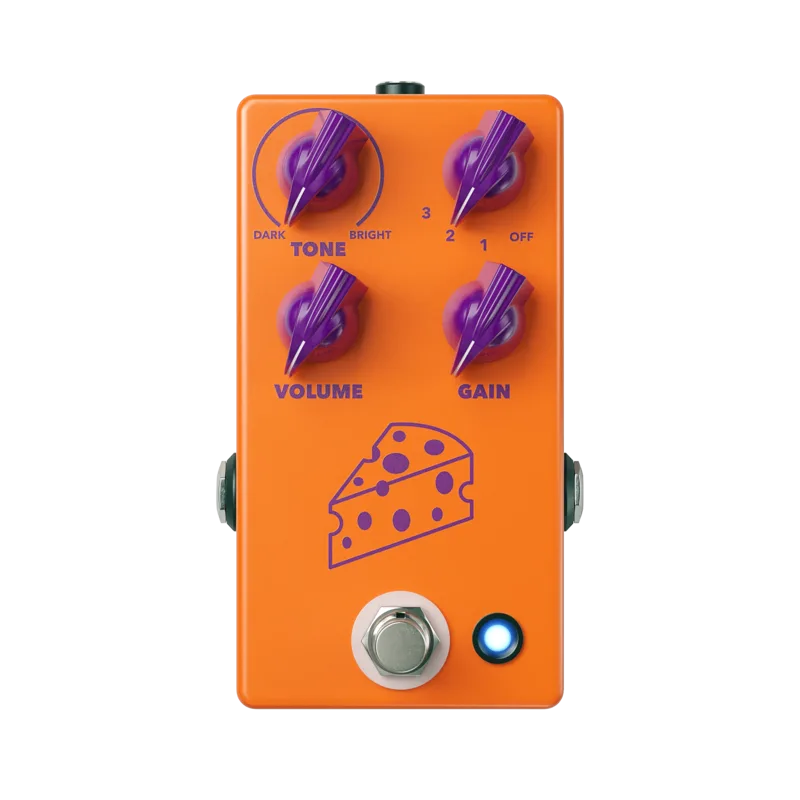
The original knob labels, Whey, Hog/Bee and Curds, were the markings on the original pedals7. Later recreations, such as the JHS Cheese Ball, keep the four-mode rotary switch but use conventional labeling8.
Who used it
JHS notes that the Big Cheese is on a lot of famous records and lists the guitarists who have used it2:
- Radiohead
- Jeff Tweedy of Wilco
- Pavement
- U2
What an original is worth
Because the pedal was discontinued in 2001, prices come from the used market, and they have been strong. In 2019, Guitar World reported paying "the $649 or so that original offerings command these days"92, and MusicRadar the same year described "an original pedal currently commanding around £649"5. By June 2020, Guitar Pedal X noted a second-hand example on eBay going for the equivalent of £580, with examples generally fetching in the region of £600 or more4. JHS has since put a vintage unit at about a grand4.
These are used-market figures from 2019 and 2020, not a list price. Lovetone never reissued the Big Cheese, so no new-unit price exists.
That cost is exactly the gap the clone market filled. When JHS launched its Cheese Ball at $179 in 2019, Josh Scott framed the price against "about a grand for a vintage Lovetone Big Cheese"96.
Pedals based on the Big Cheese
Since Lovetone retired, a number of pedals have copied or adapted the circuit4. The best known is the JHS Cheese Ball, but several others draw on the same design.
| Pedal | Maker | Relationship to the Big Cheese |
|---|---|---|
| Cheese Ball | JHS Pedals | Faithful, extremely accurate recreation of the original circuit10 |
| Field Marshal MKII | ThorpyFX | Described by its maker as "a MKII version of the Lovetone Big Cheese fuzz"11 |
| MK2 Small Cheese | Gigahearts | A Lovetone Big Cheese derivative12 |
| KGB Fuzz | Valco | Fuzz operation similar to that of a Lovetone Big Cheese13 |
The JHS Cheese Ball
JHS describes the Cheese Ball as "our faithful and extremely accurate recreation of the original circuit" of an out-of-production 1990s English pedal10. Josh Scott reverse-engineered it from scratch using three original units; MusicRadar reported the clone was "meticulously replicated" from an original 1995 LoveTone Big Cheese, and that Scott "did it with precise detail" without using online schematics5. Gearnews covered the 2019 release as an attempt to clone the original circuit of the popular '90s fuzz14.
GuitarPlayer's review confirmed that the rotary switch is present and selects between four different modes, just as on the original8. Pedal of the Day described it as painstakingly recreated from the original Big Cheese itself7.
Other derivatives
ThorpyFX states plainly that its Field Marshal MKII is a MKII version of the Lovetone Big Cheese fuzz11. Gigahearts' MK2 Small Cheese is another derivative, and Guitar Pedal X's reviewer, owning three Big Cheese derivatives including the Cheese Ball and the Field Marshal, called the MK2 Small Cheese "the most expansive / granular of the 3"12. Valco's KGB Fuzz brings fuzz operation similar to that of a Big Cheese to keys, guitar and bass13.
DIY layouts that copy it
The Big Cheese has also become a staple of the DIY fuzz community, with several projects offering the circuit as a printed circuit board or kit151617.
- Aion FX Monolith: A documented silicon fuzz project based on the Big Cheese circuit, sold as a PCB for $12.503
- PedalPCB CheeseMonger Fuzz: A PCB project listed for comparison to the Lovetone Big Cheese; PedalPCB notes the product is not licensed, manufactured, or distributed by Lovetone Pedals15
- General Guitar Gadgets Great Cheddar: A replica of the Big Cheese distortion offered as a DIY project16
For a builder, these projects make the circuit accessible at a fraction of vintage cost, though none carries Lovetone's blessing. Aion FX's project pages also document the circuit's design in depth, which is where much of the public technical understanding of the pedal comes from3.
Pedals on this page
Questions
Who designed the Lovetone Big Cheese?
Dan Coggins, who is identified as the pedal's designer2. One writer has called the Big Cheese the most widely-known pedal Lovetone ever put out2.
What transistors are in the Lovetone Big Cheese?
It is a three-transistor silicon fuzz. Original units variously used either three BC549 or three 2N3904 transistors, so the exact transistors vary from unit to unit4.
What does the Cheese mode do?
The fourth rotary position changes the bias on the transistor fuzz, producing gated "amp death" tones. Aion FX describes this as intentional misbiasing, similar in spirit to the Zvex Fuzz Factory or Cornish NG-33.
Who used the Lovetone Big Cheese?
JHS lists Radiohead, Jeff Tweedy of Wilco, Pavement, and U2 among the guitarists who have used it2.
How much is a Lovetone Big Cheese worth?
Original units commanded around $649 or £649 in 2019, and £580 to over £600 on the second-hand market by 2020495. JHS has since put a vintage unit at about a grand4.
Is the JHS Cheese Ball a Big Cheese clone?
Yes. JHS describes it as a faithful and extremely accurate recreation of the original circuit, reverse-engineered by Josh Scott from three original units and released in 2019 at $1799146.
Why did Lovetone stop making pedals?
The Big Cheese was only available for a handful of years4.
Who designed the Lovetone Big Cheese?
Dan Coggins, who was Lovetone's chief engineer and circuit designer. He left his BBC night shifts to found the company in England in 1995, and the Big Cheese followed that same year. JHS has described it as the most widely known pedal Lovetone ever released.
What transistors are in the Lovetone Big Cheese?
It is a three-transistor silicon fuzz. Original units variously used either three BC549 or three 2N3904 transistors, so the exact transistors vary from unit to unit. The circuit is a multi-stage transistor fuzz with a wide gain range.
What does the Cheese mode do?
The fourth position on the rotary selector changes the bias on the transistor fuzz, producing gated "amp death" tones. Aion FX describes this as intentional misbiasing, similar in spirit to the Zvex Fuzz Factory or Cornish NG-3. The result is heavily gated, spluttering fuzz textures.
Who used the Lovetone Big Cheese?
JHS notes that it appears on a lot of famous records and lists Radiohead, Jeff Tweedy of Wilco, Pavement, and U2 among the guitarists who have used it.
How much is a Lovetone Big Cheese worth?
Original units have commanded strong used prices: around $649 or £649 in 2019, and £580 to over £600 on the second-hand market by 2020. JHS has put a vintage unit at about a grand, which is why its $179 Cheese Ball replica found an audience.
Is the JHS Cheese Ball a Big Cheese clone?
Yes. JHS describes the Cheese Ball as a faithful and extremely accurate recreation of the original circuit. Josh Scott reverse-engineered it from scratch using three original units, without relying on online schematics, and released it in 2019 at $179.
Why did Lovetone stop making pedals?
Lovetone ceased production of its pedals in 2001, after roughly six years of trading. The Big Cheese was only available for a handful of years, which is part of why it became so sought-after on the second-hand market afterward.
Sources (17)
- Big Cheese by Lovetone, RockBoard (www.rockboard.de), 2026
- THE LEGEND OF LOVETONE, JHS Pedals
- Monolith Silicon Fuzz / Lovetone Big Cheese, Aion FX, 2021-07-02
- Guitar Pedal X, Guitar Pedal X, 2020-06-11
- JHS Pedals has a tasty treat for your pedalboard with its Big Cheese clone, MusicRadar, 2019-09-30
- WORST JHS PEDALS EVER MADE, JHS Pedals
- JHS Pedals Cheese Ball Distortion Fuzz, Pedal of the Day, 2019-10-19
- JHS Pedals Cheese Ball review, GuitarPlayer (www.guitarplayer.com), 2020-07-15
- JHS just recreated the legendary Lovetone Big Cheese, Guitar World, 2019-09-27
- CHEESE BALL, JHS Pedals
- FIELD MARSHAL, ThorpyFX
- Guitar Pedal X, Guitar Pedal X, 2026-06-04
- Valco’s KGB Fuzz brings blended Big Cheese tones to keys, guitar and bass, Guitar.com, 2021-08-11
- JHS Cheese Ball Fuzz: Cloning the boutique '90s Lovetone Big Cheese, gearnews.com, 2019-09-30
- CheeseMonger Fuzz, PedalPCB.com
- Lovetone™ Big Cheese™ Clone (Great Cheddar): Fuzz Schematic, General Guitar Gadgets, 2014-05-14
- Midnight 30 Music Sequel 6 Fuzz - Pedal of the Day, Pedal of the Day (pedal-of-the-day.com), 2014-06-14