

The Ampeg Scrambler is an octave-up fuzz pedal originally released in 1969 and discontinued after only a few thousand units were built12. It was not a commercial success at the time, but it developed a cult following in later decades, and today originals typically sell for over $1,000 on the used market2. What sets it apart from other vintage fuzzes is its character: Guitar World described its two controls as generating "a mutated rainbow of fuzz tones ranging from metallic ring modulation with buzzing octave-up overtones to the flatulence of a 400-pound chili cook-off judge"3.
An octave-up fuzz with a ring-mod edge
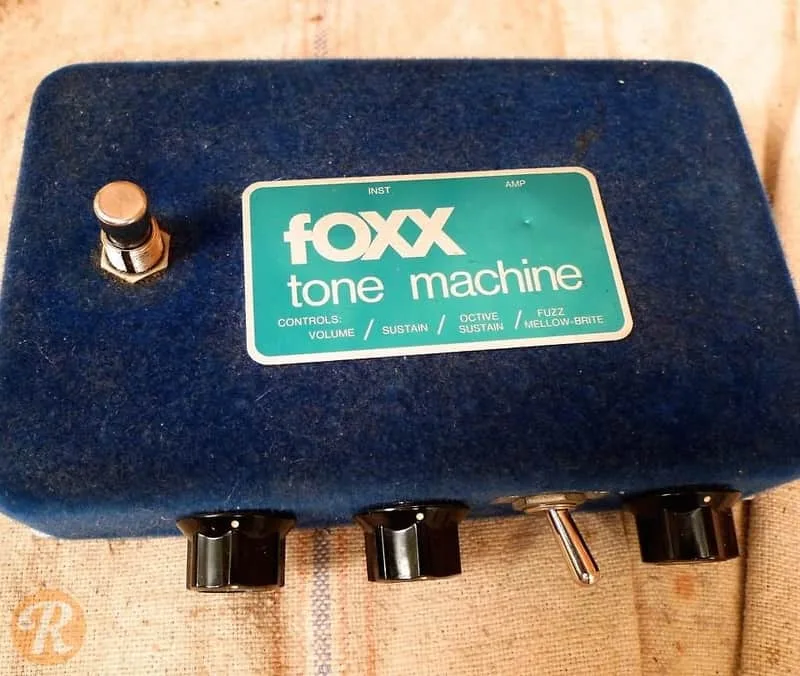
Aion FX places the Scrambler in the same family as the Superfuzz, fOXX Tone Machine and Octavia: all four are octave-up fuzzes, but each generates the octave with its own technique, so they all sound different1. MusicRadar's review calls it "a unique and sought after upper octave fuzz sound"7. Premier Guitar notes the original was known for being a very unruly pedal at times2.
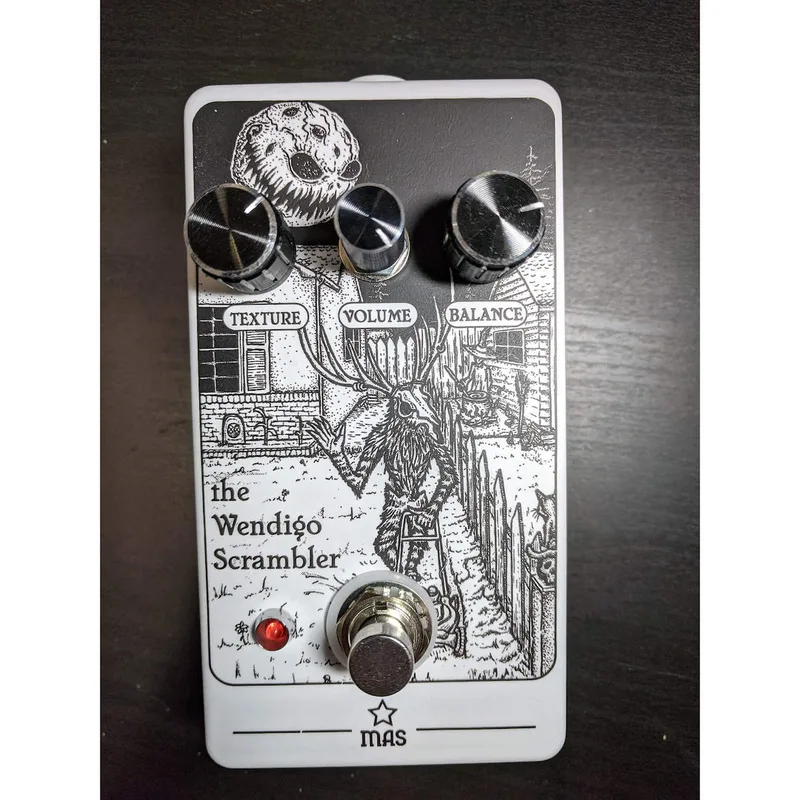
Part of the Scrambler's mystique is literal: Ampeg gooped the originals, meaning the circuit was coated in epoxy to hide it, and JHS Pedals calls it "one of the first, if not the first pedal to have a gooped circuit"8. That gooping has made a 100% accurate representation of the circuit challenging, though clones of the Scrambler exist around, from DIY projects to modern builds like the MAS Effects Wendigo Scrambler, an octave fuzz based on the Scrambler circuit with an added Volume control96.
The enclosures themselves have held up well. Guitar World wrote that "they were built to withstand nuclear war, so units that turn up are usually in fine working condition"3.
The controls
The original Scrambler has two knobs, Texture and Blend2.
| Control | What it does |
|---|---|
| Texture | Controls the octave-up level; the equivalent of the newer Scrambler's DRIVE knob210 |
| Blend | Balances the effected signal with the dry signal2 |
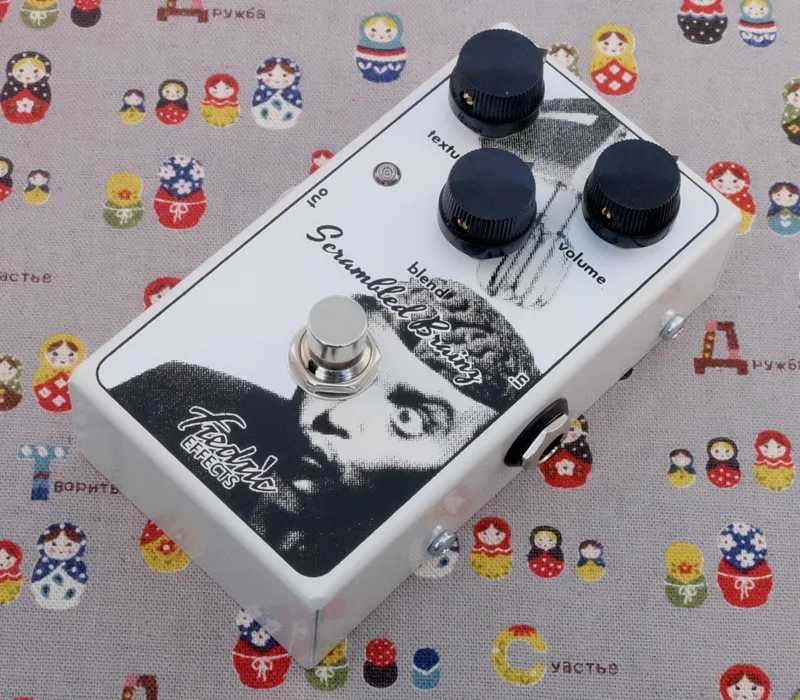
The original unit suffers from excessively low volume: the circuit has a unity gain output and no volume control, so it neither boosts nor cuts your level111. Cloners have treated this as the circuit's main flaw. Fredric Effects, for instance, built its Scrambled Brainz clone so "you no longer have to make do with the unity gain of the original circuit"11, and MAS Effects added a Volume circuit to its version6.
The reissues: 2005, 2015 and 2017
Ampeg has brought the Scrambler back more than once, and the versions differ in ways a buyer should know19.
| Version | Year | What changed |
|---|---|---|
| Original | 1969 | Two knobs (Texture and Blend), unity gain output, gooped circuit12 |
| Reissue | 2005 | Vintage-style enclosure; per Analogman, very faithful to the originals but not identical1 |
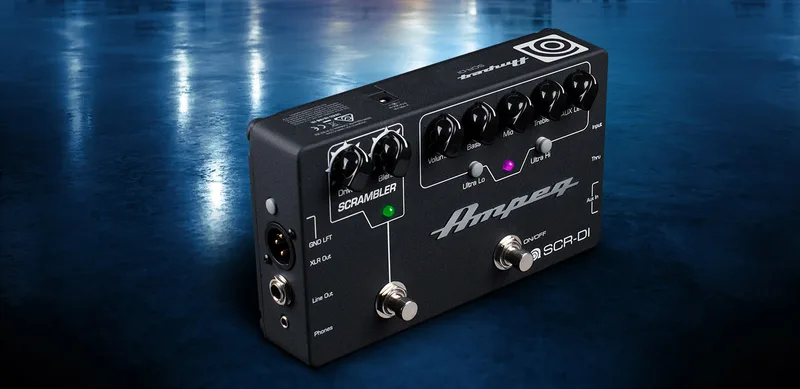
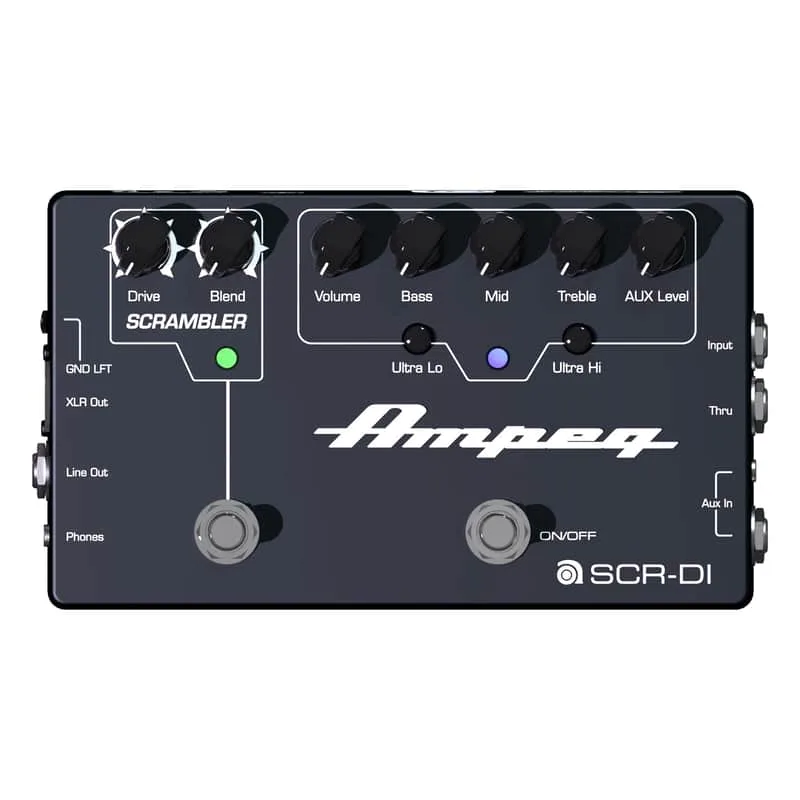
| SCR-DI Bass DI | 2015 | Bass DI pedal combining an Ampeg preamp, EQ and a Scrambler overdrive12 |
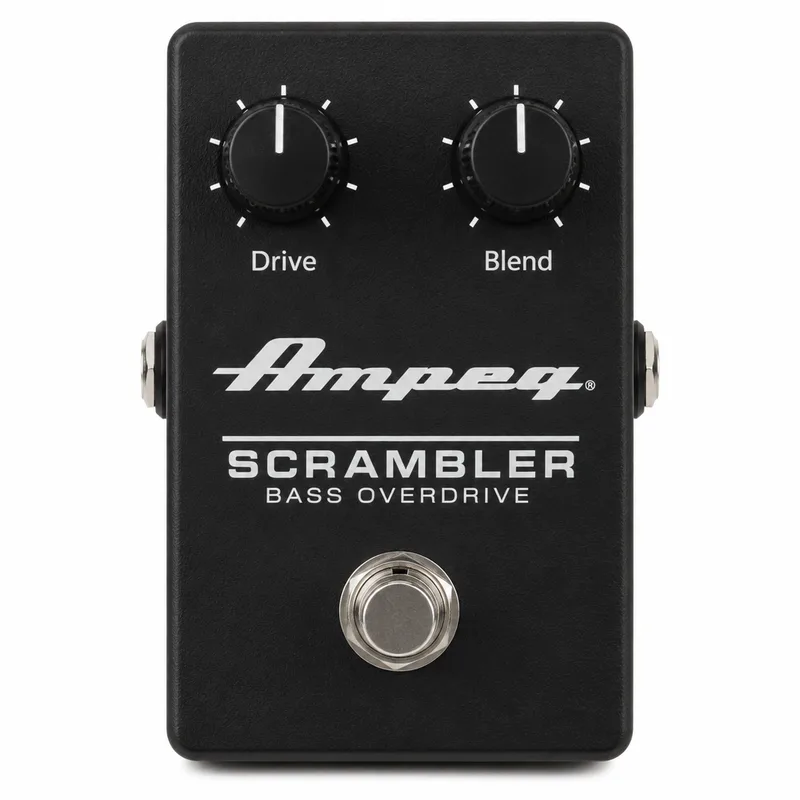
| Scrambler Bass Overdrive | 2017 | Modernized enclosure, added treble control and output volume, marketed as a bass overdrive with no mention of fuzz1 |
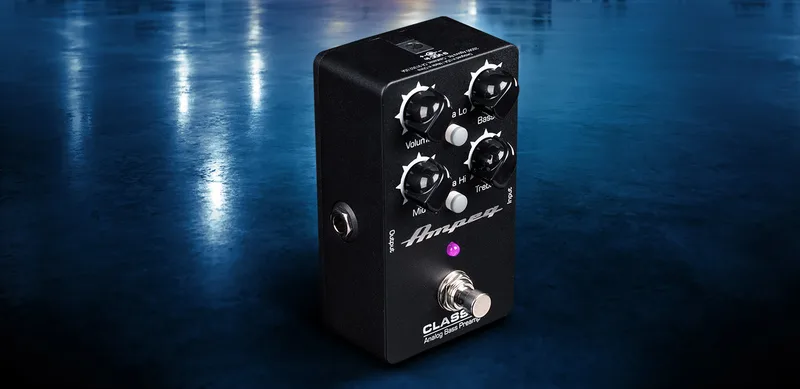
The 2017 Scrambler Bass Overdrive, made in China, comes in a roadworthy all-metal chassis with a flat-black finish and white lettering for dimly lit stages1310. It carries four knobs: volume, treble, drive and blend13. Ampeg describes the separate Drive and Blend (wet/dry) controls as making it easy to dial in your ideal sound14, and the Blend control is what makes it work for bass, since clean low end can be mixed back in against the distorted signal. Both the 2017 Scrambler and the Classic Analog Bass Preamp were derived from the existing SCR-DI Bass DI15, which itself offered a 3-band EQ with Ampeg's Ultra-Hi and Ultra-Lo circuits, a headphone out and aux in, and connection options for driving any bass rig and feeding an effected signal to front-of-house12. The 2017 pedals were due in April of that year at a street price of $100 each1610.
The 2017 Scrambler is a different animal from the 1969 original. Aion FX reports it has received mixed reviews and is not regarded to sound like either the old ones or the 2005 reissues, so the resemblance is likely in name only1.
What reviewers said
Reviews of the various Scramblers run from enthusiastic to blunt.
- MusicRadar's review of the Scrambler SCP-OD praised its "solid build quality" and "great sounds," calling it a great investment with unique and gorgeous sounds, while noting Ampeg resisted the temptation to add an on/off LED7.
- Guitar World's reviewer found the 2017 Scrambler Bass Overdrive has "a unique and harmonically rich sound" and called it a superb addition for the price for players who like sound-mangling distortion pedals101.
- On the vintage market, JHS Pedals was harsher on price than on tone, scoring the original 2/8: "The Ampeg Scrambler Fuzz is a great pedal, no question, but unless you're the kind of obsessive freak that..." has to have one, it is probably not worth two grand8.
"The Ampeg Scrambler Fuzz is a great pedal, no question, but unless you're the kind of obsessive freak that..."
Who uses it
Two players are documented with the original. MusicRadar notes it was notably used by the late John Cipollina of San Francisco's Quicksilver Messenger Service7. Premier Guitar's review of the Build Your Own Clone Scrambled Octave pedal recounts that Jorma Kaukonen used a Scrambler and a Gibson ES-345 to drive the Jefferson Airplane's fuzzier excursions17.
Videos
Sweetwater
Ampeg
Ampeg
Questions
Why is the original Ampeg Scrambler so quiet?
The original 1969 unit suffers from excessively low volume. Its circuit has a unity gain output and no volume control, so the pedal does not boost your signal at all. Cloners have addressed this by adding a volume circuit to their versions of the circuit.
How much is an original Ampeg Scrambler worth?
Originals in working condition typically sell for over $1,000 on the used market, and JHS Pedals reports vintage units going for as much as $2,000. Analogman notes originals have gone for $1,000 on eBay. Prices vary with condition and demand.
How many original Ampeg Scramblers were made?
Production lasted only about a year, with between 2,000 and 2,500 units built. It is rumored that it took Ampeg half a decade to sell through that initial run. The pedal was never a commercial success at the time.
What is the difference between the 2005 and 2017 Scrambler reissues?
The 2005 reissue came in a vintage-style enclosure and, per Analogman, is very faithful to the original but not identical. The 2017 version came in a modernized enclosure, added a treble control and output volume, and was marketed as a bass overdrive with no mention of fuzz.
Does the 2017 Ampeg Scrambler work on bass?
Yes. The 2017 Scrambler Bass Overdrive was designed for bass, with separate Drive and Blend controls that let you mix clean low end with the distorted signal. It was derived from Ampeg's SCR-DI Bass DI, which carried the same overdrive circuit.
Sources (17)
- Aperture Octave Fuzz / Ampeg® Scrambler, Aion FX, 2021-07-02
- Creepy Fingers Effects Pink Elephant Pedal Review, Premier Guitar, 2010-10-20
- Weird Science: The 10 Strangest Vintage Effects of All Time, Guitar World, 2018-01-12
- Ampeg™ Scrambler™ Clone: Octave Fuzz Kit, PCB & Schematic, General Guitar Gadgets, 2014-05-18
- Wendigo Scrambler, MAS Effects
- Wendigo Scrambler, MAS Effects
- Ampeg Scrambler SCP-OD review, MusicRadar, 2007-10-31
- THOUSAND DOLLAR PEDALS, JHS Pedals
- Seminal, Vintage Pedals: Ampeg's Scrambler, Delicious Audio, 2016-09-28
- Ampeg Classic Analog Bass Preamp and Scrambler Bass Overdrive review, Guitar World, 2020-01-08
- Scrambled Brainz improved Ampeg Scrambler, fredric.co.uk
- NAMM 2015: Ampeg releases the SCR-DI Bass DI with Scrambler Overdrive, MusicRadar, 2015-01-23
- Ampeg Scrambler Bass Overdrive Review, Premier Guitar, 2017-09-10
- Ampeg | Pedal Series :: Preamps and Effects, Ampeg
- NAMM 2017: Ampeg announce Classic pedal bass preamp, and Scrambler bass overdrive, MusicRadar, 2017-01-23
- Ampeg debuts two familiar-looking pedals, gearnews.com, 2017-01-23
- Build Your Own Clone Scrambled Octave Pedal Review, Premier Guitar, 2011-10-20