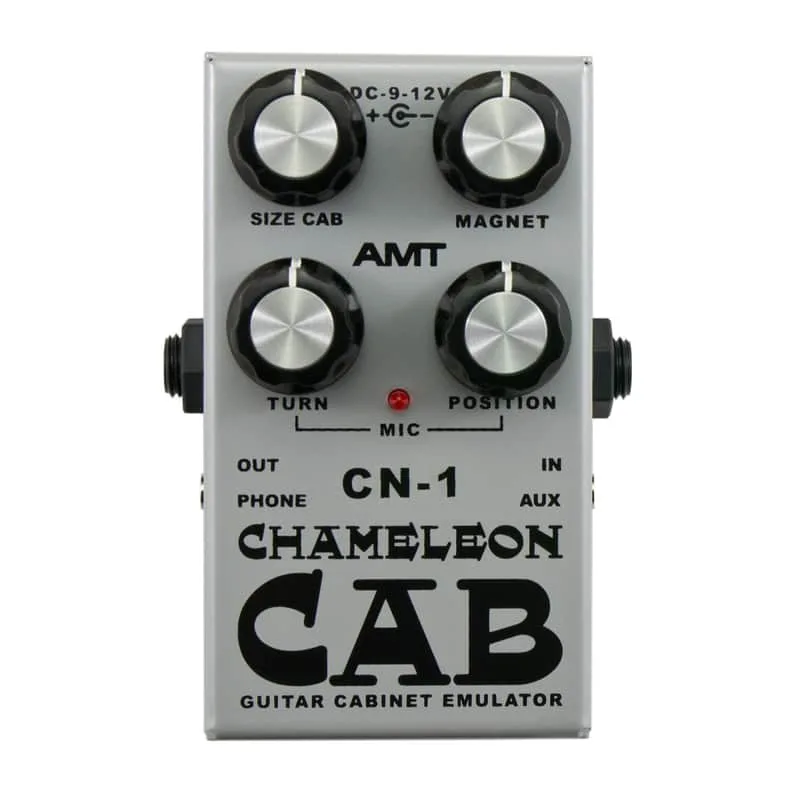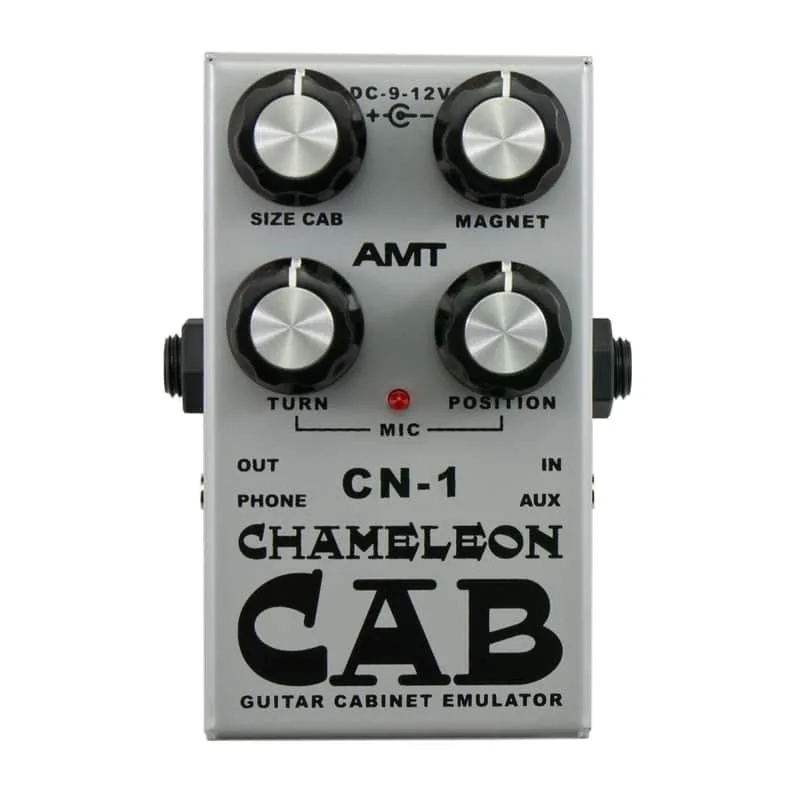


The AMT CAB CN-1, sold by AMT Electronics as the Chameleon CAB CN-1, is a speaker cabinet emulator in pedal form. Its job is to reproduce the limited frequency response of a guitar speaker cabinet, the response a microphone picks up off a real cab, so that a distorted guitar signal sounds right when it is played through broadband systems: a PA, a computer sound card, a DAW or headphones12. Without something like it, a preamp or distortion pedal run straight into full-range gear sounds harsh and fizzy, because guitar speakers roll off the high frequencies that a hi-fi system reproduces faithfully.
The pedal uses AMT's Speaker Emulation Circuitry, and AMT describes it as a tool that lets guitarists play their favorite distortion and overdrive preamps directly into a computer, PA or DAW2. It is listed as available now1.
What it does, and how close it gets
A real guitar cabinet does two things to a signal: it emphasizes the midrange and it cuts the highs and lows beyond what the speakers can reproduce. The CN-1 models that behavior with analog circuitry so a broadband system receives something that sounds like a mic'd cab rather than a raw preamp output12.
On the question of realism, AMT is straightforward. The maker states that because of the many factors involved, absolute sound identity of the simulation is practically unattainable, and that the CN-1 offers a close approximation of real guitar speakers and tube amplifiers rather than an exact match12. That is a fair description of where cab sims in general sit: a good approximation is the goal, not a clone.
"Due to many factors the absolute sound identity of the simulation is practically unattainable."
The controls: Size Cab, Magnet, Position and Turn
The CN-1 has four knobs, and each one models a different physical variable in the speaker-and-microphone relationship12.
| Control | What it does |
|---|---|
| SIZE CAB | Adjusts the overall size of the cabinet being emulated, from smaller 1 x 10" style cabinets up to a 4 x 12"12 |
| MAGNET | Adjusts the frequency cutoff response of the speaker magnets12 |
| POSITION | Emulates moving the microphone closer to the center of the speaker cone, or further away from the center12 |
| TURN | Emulates the rotational axis of the microphone, from straight on to an angled away facing microphone12 |
The four controls map onto the decisions a recording engineer makes with a real cab: which cabinet to use, which speakers are in it, where the mic sits on the cone, and at what angle it points. SIZE CAB is the broadest stroke, sweeping between the tighter low end of a small combo-style cab and the bigger, looser feel of a 4 x 12". POSITION and TURN are the fine adjustments, doing in knob turns what sliding a mic a few inches along a cone does in a room21.
Inputs, outputs and headphones
The CN-1 is built as a small practice and recording hub as well as a cab sim, with three ways in and three ways out12.
- IN (1/4"): connects external devices such as preamp guitar amplifiers1
- AUX (1/8"): connects external audio devices such as an MP3 player, so you can play along with backing tracks1
- OUT (1/4"): connects to the line input of a mixer, a home amplifier, a computer sound card and similar devices1
- AUX output (1/8"): passes signal to other various devices12
- PHONE: a headphone output for headphones with an impedance of 16 Ohms or higher; plugging headphones in automatically switches on the built-in headphone power amplifier1
The headphone behavior is worth noting for silent practice: the CN-1 is not just passing signal to the phones, it powers them with its own amplifier, which is why the current draw jumps from 10mA to 60mA when headphones are connected2. Feed it from a preamp pedal, plug headphones into the PHONE jack and an MP3 player into the AUX input, and the pedal works as a complete silent rig.
The headphone output requires headphones of 16 Ohms or higher impedance. Plugging them in switches on the internal power amplifier, which raises current draw from 10mA to 60mA12.
Power
The CN-1 runs on a 9V battery or an external DC adapter from 9V to 12V, negative center12. At 10mA without headphones, it is light on power for a pedalboard; with headphones it draws 60mA2.
The CN-1 Chameleon Cab in AMT's media center
AMT's media center lists a CN-1 Chameleon Cab with a feature set that goes beyond the pedal's four knobs: an analog preamp with Clean, Low gain and High gain modes, a Power Amp section with 9 types, an IR cabsim with 1 IR for both L/R channels per preset, and a Parametric Pre/Post EQ3. That listing describes the CN-1 as a cabinet simulator in a broader configuration than the product page and manual present, so a player comparing the two should read the pedal's own documentation for what the shipping unit does.
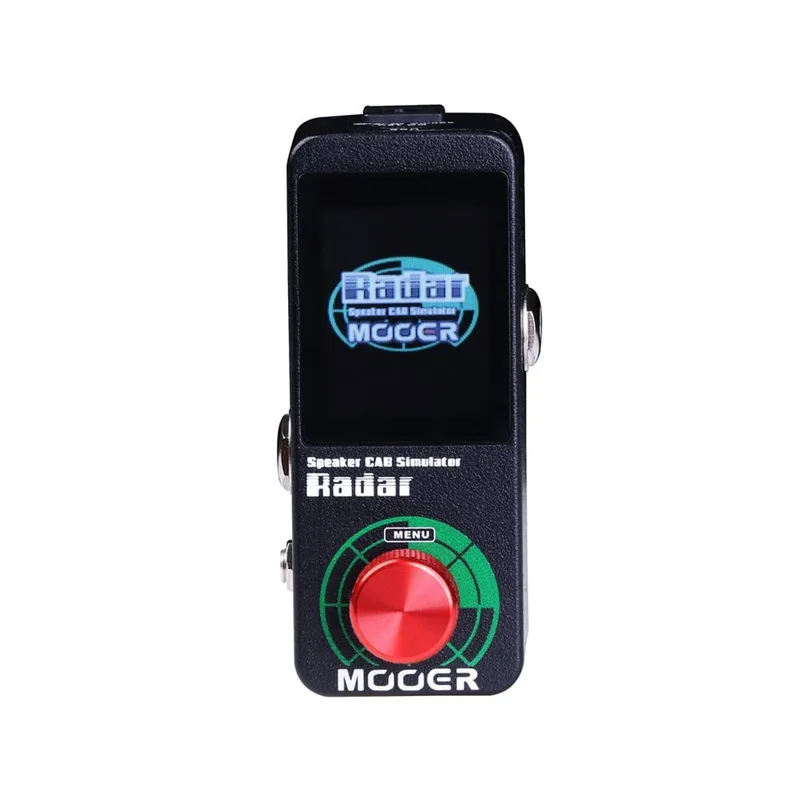
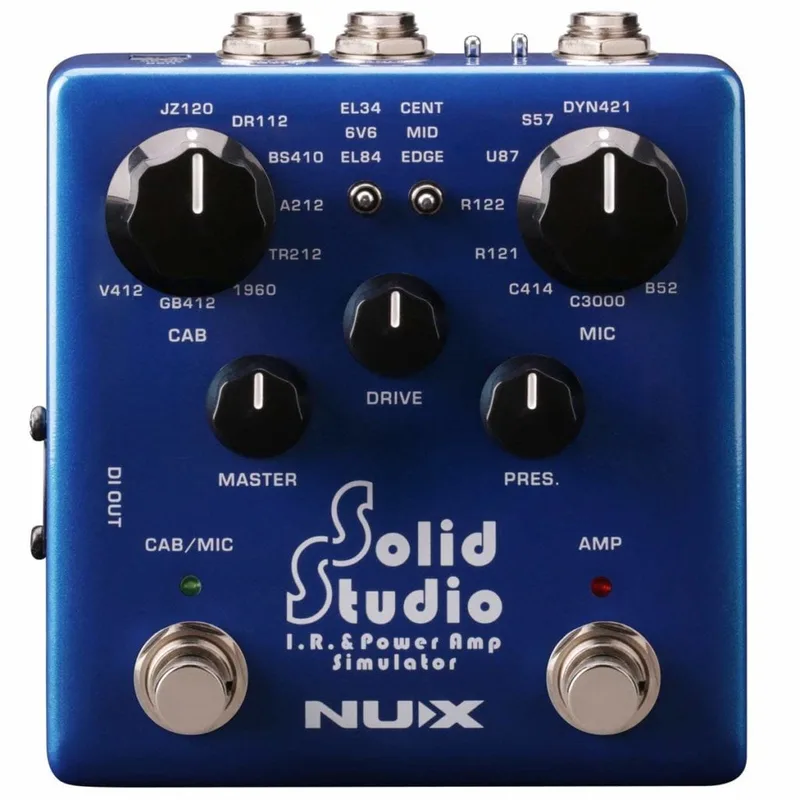
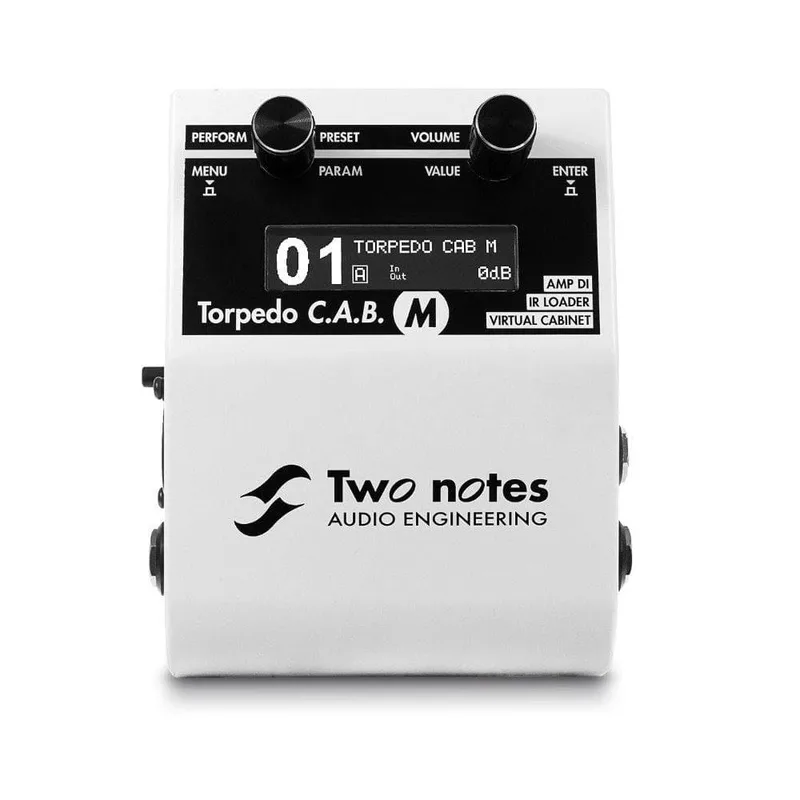
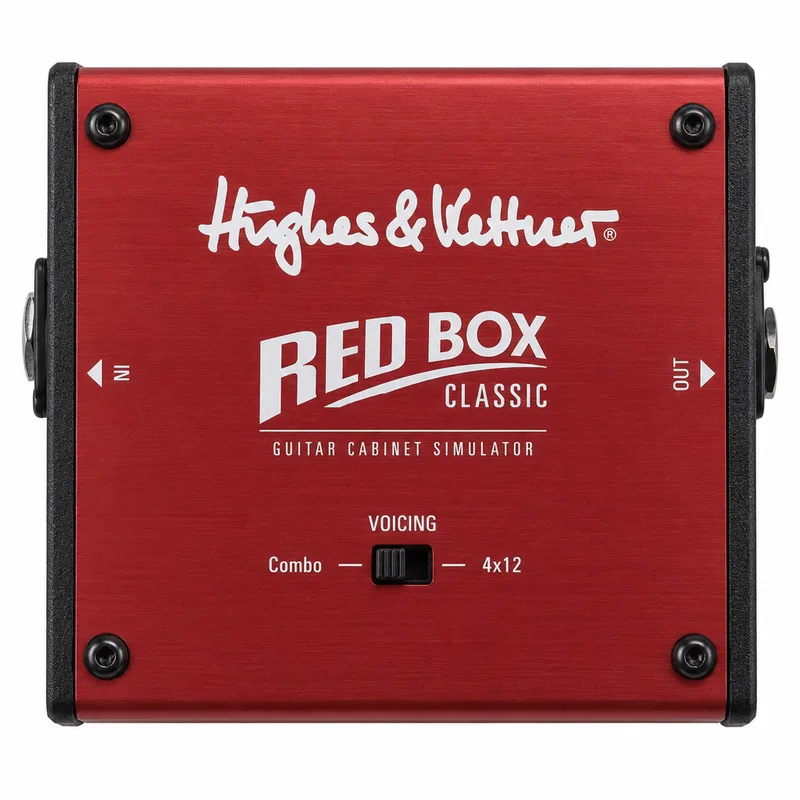
For players comparing cab sims more widely, the CN-1 sits among analog and IR-based options such as the MOOER Radar, the NUX Solid Studio, the Two Notes Torpedo C.A.B. M and the Hughes & Kettner Red Box Classic, all covered elsewhere in the speaker simulation section.
Videos
Brett Kingman
Kairon Music®
Gonzalo Diaz
Questions
Can the AMT CAB CN-1 run on a battery?
Yes. AMT powers the CAB CN-1 from a 9V battery or from an external DC adapter in the 9V to 12V range, center negative. Current draw is 10mA without headphones and 60mA with headphones, so a battery is workable for quiet practice.
What voltage does the AMT CAB CN-1 need?
The CAB CN-1 runs on 9 to 12V DC with a negative center pin. A 9V battery works too. With headphones connected it draws 60mA, and without headphones it draws 10mA.
Can I plug headphones into the CAB CN-1?
Yes. The PHONE output takes headphones with an impedance of 16 Ohms or higher, and plugging them in automatically switches on the built-in headphone power amplifier. That makes the pedal a silent practice rig when fed from a preamp.
What is the difference between the CAB CN-1 and the Chameleon CAB CN-1?
They are the same product. AMT's product page and manual both name it the Chameleon CAB CN-1, a speaker cabinet emulator pedal. AMT's media center also lists a CN-1 Chameleon Cab with a larger feature set including an analog preamp, nine power amp types, an IR cabsim and parametric EQ.
Does the CAB CN-1 sound exactly like a real speaker cabinet?
No, and AMT says so directly. The maker states that absolute sound identity of the simulation is practically unattainable because of the many factors involved, and positions the CN-1 as a close approximation of real guitar speakers rather than an exact copy.
Sources (3)
- AMT CAB CN-1, AMT Electronics, 2026
- AMT_CN-1_Description_ENG_V2.pdf, AMT Electronics
- AMT Electronics: CN-1 Chameleon Cab (Cabinet Simulator) (ENG), Media center of AMT Electronics