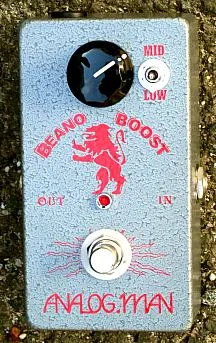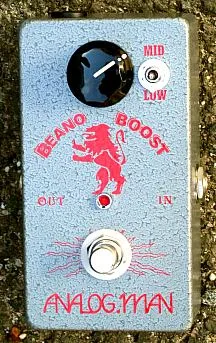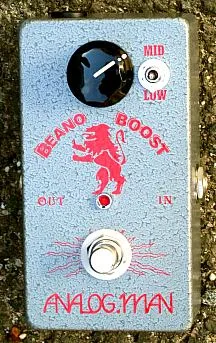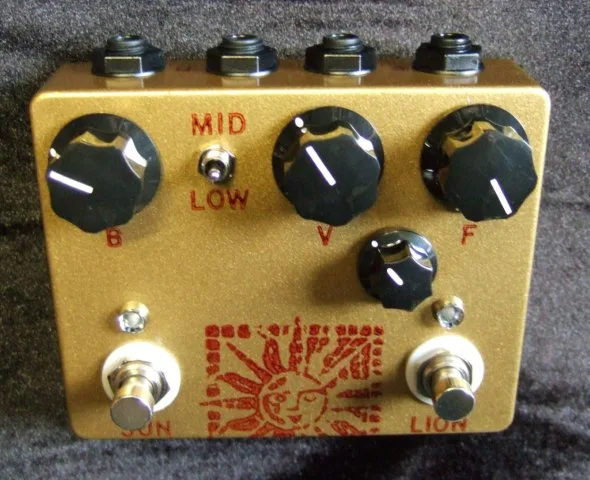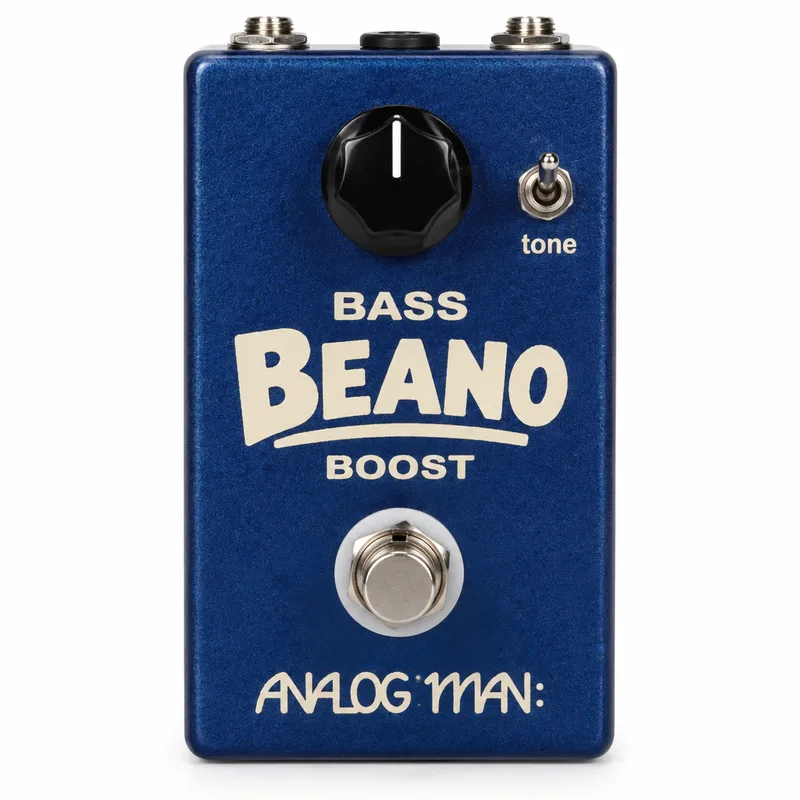

The Analog Man Bass Beano Boost is a bass version of the Analog Man Beano Boost, a germanium treble booster that Analog Man describes as "an awesome, improved recreation of that pedal," meaning the Dallas Rangemaster Treble Booster1. Where the standard Beano Boost is voiced to push treble and upper mids into a guitar amp, the Bass version shifts its tone switch range downward so a bass signal keeps its low end while still driving an amp harder.
Analog Man made the first Bass Beano Boost for Tony Levin in late 2007, and offers it as a version of the standard pedal2. Like the rest of the Beano line, it is hand made in the USA2.
A treble booster set up for bass
The original Dallas Rangemaster was a treble booster, and JHS Pedals describes the Beano Boost plainly: "The AnalogMan Beano Boost is a really nice germanium treble booster"3. Treble boosters cut low end and lift highs, which is why they became associated with players pushing dark British amps into breakup. Analog Man notes that Rory Gallagher and Brian May used Rangemasters with VOX AC30 amps, and that Brian May "used one or a modified version on nearly all his guitar parts in Queen"2.
That voicing is a problem for bass. A stock treble booster thins out the fundamental frequencies a bass player needs. The Bass Beano Boost answers this by moving the tone switch range down rather than changing the pedal into a full-range clean boost. Analog Man explains: "The tone selections start about at the normal LOW setting and get lower, the lowest setting has no low end loss at all but also not as much CRUNCH"2. So the trade-off is explicit: the lowest position preserves the full low end of the instrument but gives up some of the grit that makes a treble booster into an amp driver.
Analog Man also points to a practical use that applies to the family as a whole: when a small amp is cranked and the low end turns flubby, "a pedal like the Beano Boost tightens it up and makes it work a lot better"2. For a bass player pushing an amp into distortion, that tightening effect is the main reason to reach for one of these rather than a clean boost pedal.
The tone switch and volume
The standard Beano Boost carries a three-position toggle tone switch, with up as MID, middle as TREBLE (the standard Rangemaster setting), and down as LOW5. A push/pull switch on the volume pot, offering treble or full range boost, is available as an option instead of the toggle6.
| Tone switch position | Standard Beano Boost | Bass Beano Boost |
|---|---|---|
| Up | MID, more of a full range boost, great for Fender guitars2 | Lower than the standard LOW setting2 |
| Middle | HI, standard Dallas Rangemaster tone, treble enhanced2 | About the normal LOW setting2 |
| Down | LOW, full range sound with a bit more bassy setting2 | No low end loss at all, but not as much crunch2 |
On That Pedal Show, Dan and Mick described the switch on the Beano family in similar terms: "this switch on here gives you lots of bass or at least a lot more low mid... the middle position is the original"7.
The volume knob sets how hard the pedal pushes what follows it:
- At 9:00, the pedal has about the same output level switched on and off, so it behaves close to unity gain2.
- At 12:00, there is a 13dB boost2.
- All the way up, it is about an 18dB boost, which Analog Man notes is nearly twice as loud as it was at 11:002.
That range is the working tool of the pedal: set low it fattens and tightens, set high it slams the front of the amp into distortion.
Power and connections
The pedal runs on a 9V internal battery, which is disconnected when the input cord is removed or when the optional power jack is plugged in5. A Boss style power jack is optional for $10 on the standard pedal and standard on the Beano Boost Mini2. When the jack is added, Analog Man also adds power filter circuitry to reduce power supply noise2.
Grounding depends on how the pedal is built. Beano Boosts with the DC jack option are negative ground, like a normal effect, so a standard center negative plug works and daisy chaining the power cord is no problem5. Older Beano Boosts, or some built without the adaptor jack, are positive ground in the British tradition and cannot share an adaptor with another effect6. The 2006 manual describes how to tell them apart: if the black battery wire goes to the input jack it is the negative ground version; a red battery wire to the input jack marks the positive ground version6.
Connections are straightforward: Switchcraft input jack on the right side and output jack on the left, with a 3PDT stomp switch for true bypass6.
Where it came from and what reviewers said
The Beano Boost's circuit follows the Dallas Rangemaster, and Analog Man notes one design choice that separates it from boosters like the Orange and Apollo: "we left that feature off, like the original Dallas Rangemaster," meaning there is no tone control knob, and tone shaping instead comes through the input capacitors selected by the tone switch2. The name and the Rangemaster lineage tie the pedal to the British blues-rock era the original served.
The Bass version has its own origin story: Analog Man made it for Tony Levin in late 20072. Steve Hackett is another documented Beano Boost user, using his for clean picking2.
Reviews of the standard Beano Boost give a sense of what the bass version builds on. Pedal of the Day's reviewer wrote4:
"I would recommend this pedal for any player looking to beef up a Strat tone or add some punch to their guitar for rhythm and lead work."4
That reviewer's verdict was aimed at guitarists, but the same logic, a pedal that adds punch and drives an amp, is what the Bass version offers a bassist who does not want the low end carved away4.
Players comparing versions within the family have a few options: the standard Beano Boost, the smaller Mini introduced in 2013, and the Silicon Beano Boost, whose sound Analog Man describes as "a bit more open, and clearer, with a bit less of the 'cocked wah' sounds" than the germanium version2.
Videos
roknfnrol
Questions
Does the Bass Beano Boost cost more than the regular Beano Boost?
No. Analog Man states that they can make the Bass version for the same price as the normal Beano Boost. The Mini Beano Boost is also sold for the same price as the normal Beano with power jack.
How is the Bass Beano Boost tone switch different?
On the standard Beano Boost the three tone switch positions are MID, TREBLE and LOW. On the Bass version the selections start at about the normal LOW setting and get lower from there. The lowest setting has no low end loss at all, though it also gives up some of the crunch.
Can you use a regular Beano Boost with bass guitar?
You can, but the standard pedal is a treble booster voiced for guitar, and its lowest tone setting still trims low end. The Bass version was created specifically so the lowest settings keep the full low end of a bass signal.
Who was the Bass Beano Boost made for?
Analog Man made the first Bass Beano Boost for Tony Levin in late 2007. Levin is the longtime bassist known for his work with Peter Gabriel and King Crimson, and the pedal has been offered as a bass version of the standard Beano Boost since.
Does the Bass Beano Boost have a power jack?
A Boss style power jack is optional on the standard Beano Boost for $10 and standard on the Mini. Units built with the DC jack are negative ground, so a standard center negative 9V supply works and daisy chaining is fine.
Sources (7)
- SunLionManual.pdf, Analog Man, 2020
- aNaLoG.MaN Beano Boost treble booster effects pedal, aNaLoG.MaN (analogman.com), 2025
- SMALL PEDALS, BIG SOUND, JHS Pedals
- Analog Man Beano Boost, Pedal of the Day, 2015-07-01
- BeanoManual2020.pdf, Analog Man Guitar Effects, 2020-10
- Beano Boost manual (2006), Analog Man Guitar Effects
- The New King Of Tone? Chase Bliss x Analog Man Brothers AM Plus Prince Of Tone & MXR Duke of Tone, That Pedal Show (YouTube), 2025-04-24