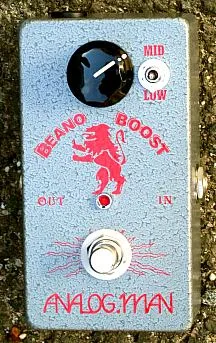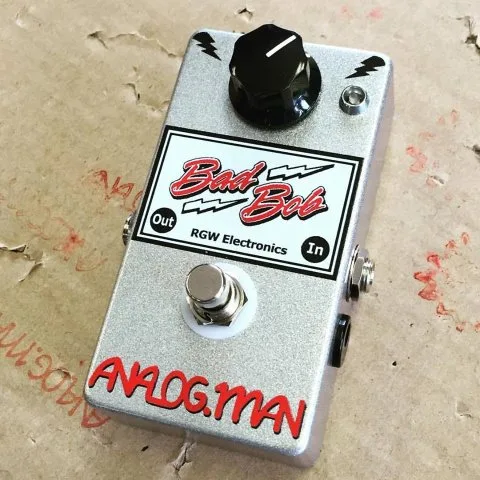



The Analog Man Beano Boost is a treble booster pedal, a hand-wired recreation of the 1960s Dallas Rangemaster Treble Booster, which Analog Man describes as "an awesome, improved recreation of that pedal"12. It is a type of booster rather than a distortion pedal or a clean boost: it pushes the upper mids and treble into an amp, which is why Analog Man says it "is spectacular into an amp that is already cranked up pretty well"2. Where a cranked small amp can get flubby in the low end, the maker says a pedal like the Beano Boost "tightens it up and makes it work a lot better"2.
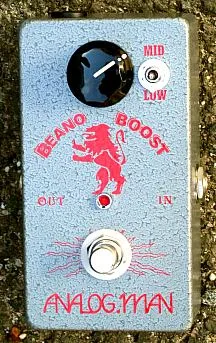
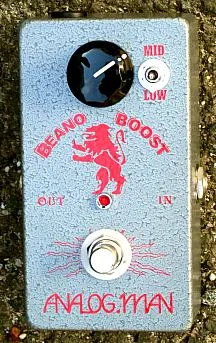
Analog Man came up with its own version in early 2003, and the pedal is hand made in the USA, with circuitry hand wired just like the original and a powder coated gray hammer finish enclosure23.
A Rangemaster-style treble booster
The Dallas Rangemaster was a germanium treble booster, and the Beano Boost follows that circuit. Guitar Pedal X identifies it simply as "the Beano Boost (Treble Booster)"4. The name and the circuit point at the same tradition: players like Eric Clapton-era bluesbreakers put a Rangemaster in front of a cranked British amp to cut through, and the Beano Boost recreates that effect with a few modern improvements, including power filter circuitry to reduce power supply noise when the power jack is fitted2.
The manual notes the pedal "sounds awesome with a guitar with humbucking pickups, run into an old british style amp with closed back speaker cabinet"3, which is the classic Rangemaster pairing.
The controls: boost knob and three-position tone switch
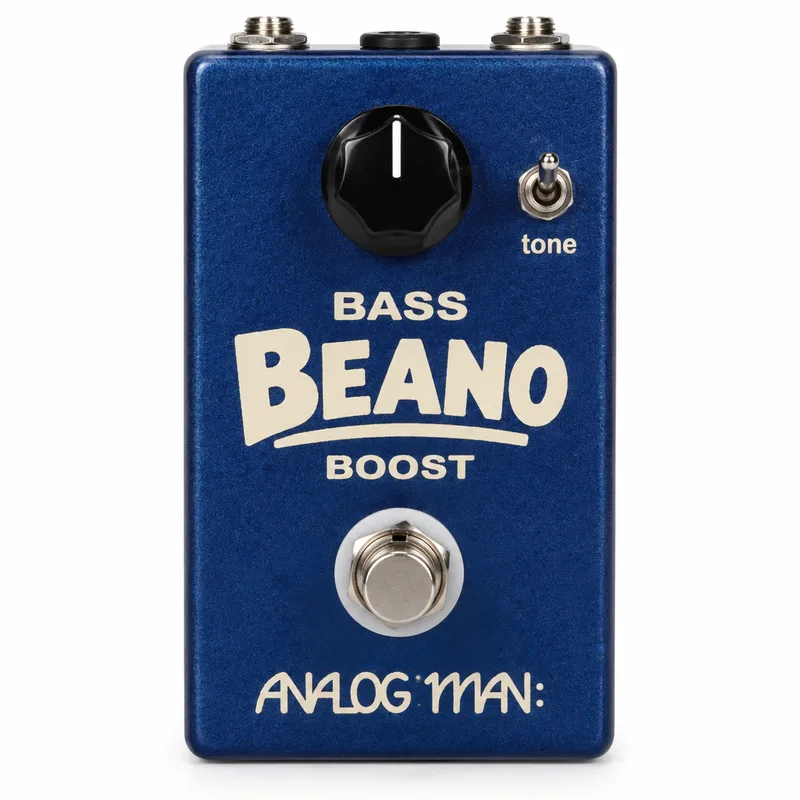
The Beano Boost keeps its control set deliberately small: one BOOST knob and a three-position tone switch563.
| Control | Position | What it does |
|---|---|---|
| BOOST knob | 9:00 | About the same output level on and off27 |
| BOOST knob | 11:00 | About a 10dB boost, which sounds twice as loud7 |
| BOOST knob | 12:00 | About a 13dB boost7 |
| BOOST knob | Full up | About an 18dB boost, nearly twice as loud as 11:002 |
| Tone switch | Up (MID) | More of a full range boost, great for Fender guitars2 |
| Tone switch | Middle (TREBLE) | Standard Dallas Rangemaster tone, treble enhanced2 |
| Tone switch | Down (LOW) | Full range sound with a bit more bassy setting2 |
The middle position is the original Rangemaster setting3. On That Pedal Show, Dan and Mick walked through the switch: "this switch on here gives you lots of bass or at least a lot more low mid... But the middle position is the original"8.
An optional push/pull volume pot allows two tone settings, though Analog Man marks it "not recommended"2. It is not available on the Mini, since there is no battery to save by turning it off2.
Power and connections
The standard Beano Boost runs on a 9V internal battery or a 9V DC adaptor, with the adaptor jack optional at extra charge3. With the power jack added, it can use any normal Boss-type 9V power supply with no reverse polarity issues2.
When the power jack is added, Analog Man fits power filter circuitry to reduce power supply noise, and the pedal can use any normal Boss type 9V power supply with no reverse polarity issues2. Without the jack, the standard version runs on a 9V battery3.
The battery disconnects when the input cord is removed or when a power supply is plugged in3. Current draw when off is very low, under .2mA3.
History: transistors, grounding and the Mini
The transistor story is a big part of this pedal's history. Analog Man ran out of the NKT275 transistors, the classic Rangemaster part, in 20112. Since then the company has used several transistor types, including 1960s USA-made General Electric transistors, NOS parts pulled from 40-year-old Baldwin organ tone generator boards2. In 2019 they got a batch of "Black Bullet" transistors, probably made in the 1960s for Amperex in the USA and in Holland by Mullard/Philips: OC71 transistors with the US part number 2N2802. In 2025 they found silicon PNP Motorola transistors from 1980 with great specs for the pedal2.
The standard germanium transistors are the quietest option; the sometimes available optional British ones can be a bit noisier2. The silicon version has no temperature dependency, and Analog Man says its sound "is a bit more open, and clearer, with a bit less of the 'cocked wah' sounds"2. That silicon version has its own page: the Analog Man Silicon Beano Boost.
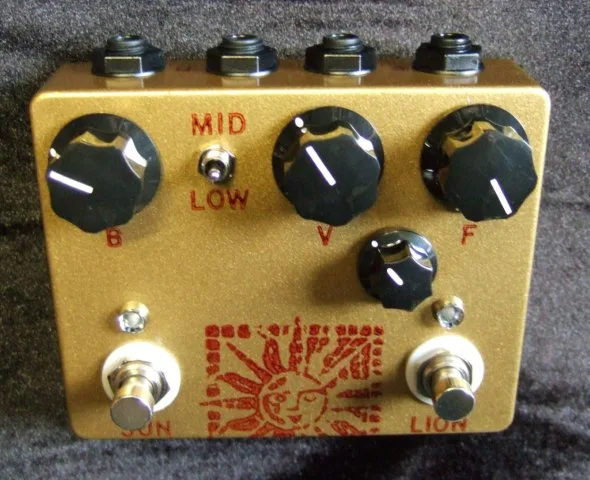
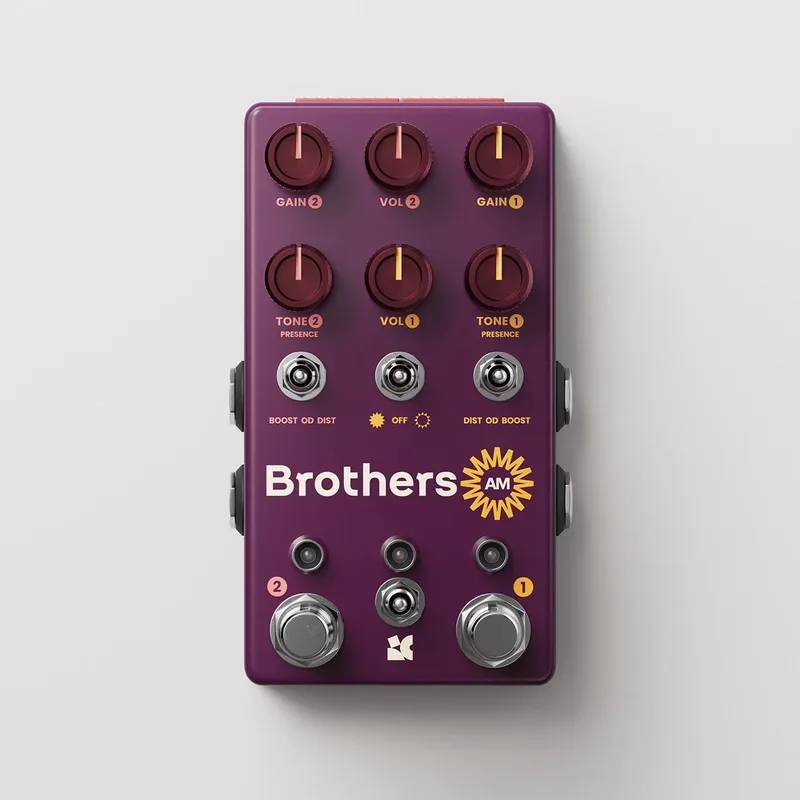
The Mini Beano Boost measures 1.75" wide x 3.75" long x 1.25" tall not including the knob, and the Boss style power jack is standard on the Mini2. It is covered on its own page: the Analog Man Beano Boost Mini. The Beano Boost circuit also lives on inside the Analog Man Sun Lion7, and in the Chase Bliss x Analog Man Brothers AM4.
What reviewers said
One reviewer found that "this pedal really loves humbuckers and will add some beef to a skinny single coil tone"9. Another reviewer called the Beano Boost "the best kind of pedal replica"10.
A demo of the pedal covers its voice switch, with the presenter explaining: "this switch on here gives you lots of bass or at least a lot more low mid... the middle position is the original"8.
Who uses it
Analog Man documents several players connected to the Rangemaster tradition the Beano Boost recreates2:
- Brian May used one, or a modified version, on nearly all his guitar parts in Queen, and with Rory Gallagher used them with VOX AC30 amps2
- Ritchie Blackmore of Deep Purple used these quite a bit2
- George Lynch used one, and said so in an interview2
- Steve Hackett used his Beano Boost for clean picking2
Among current players, Vinnie Moore of UFO uses a Beano Boost live: "which I'm loving right now when playing live," he told Guitar World in June 202411. Analog Man's own Alex uses a Mini Beano Boost on his board, "as that is all the room I have"2.
Videos
TheToneShack
gearmanndude
Jimmy Burkard
Questions
Is the Beano Boost true bypass?
Yes. The Beano Boost uses true bypass switching with a 3PDT stomp switch, so when it is off the guitar signal passes through without the circuit in the way. Analog Man also fits Switchcraft input and output jacks, with the input on the right side and the output on the left.
Does the Beano Boost run on a battery?
The standard Beano Boost can use a 9V internal battery, which disconnects when you pull the input cord or plug in a power supply. The Mini Beano Boost has no room for a battery and is meant to run on a good power supply. A Boss-style 9V power jack is a $10 option on the standard version and standard on the Mini.
Is the Beano Boost positive or negative ground?
It depends on the unit. Beano Boosts with the DC jack option are built with negative ground like a normal effect, so you can use a standard center-negative plug and daisy chain it with other pedals. Older Beano Boosts, and some without the adaptor jack, are positive ground in the British tradition and cannot share a power supply with other effects.
Germanium or silicon Beano Boost: what is the difference?
The standard version uses an NOS germanium transistor chosen for low noise and best tone, but it depends on temperature. The optional silicon version has no temperature dependency, and Analog Man says its sound is a bit more open and clearer, with less of the cocked-wah character. In 2025 they found 1980 Motorola silicon PNP transistors with great specs for the pedal.
How much boost does the Beano Boost give?
With the boost knob at 9:00 the output level is about the same on and off. At 11:00 you get about a 10dB boost, at 12:00 about 13dB, and full up about 18dB, which is nearly twice as loud as the 11:00 setting. Analog Man says it is spectacular into an amp that is already cranked up.
Does the Beano Boost work with single coil pickups?
Yes. The up position on the tone switch is a more full-range boost that Analog Man calls great for Fender guitars, and the pedal will add beef to a skinny single coil tone. The original Rangemaster circuit was used with single coils by players like Rory Gallagher and Brian May with VOX AC30 amps.
Sources (11)
- SunLionManual.pdf, Analog Man, 2020
- aNaLoG.MaN Beano Boost treble booster effects pedal, aNaLoG.MaN (analogman.com), 2025
- BeanoManual2020.pdf, Analog Man Guitar Effects, 2020-10
- Guitar Pedal X, Guitar Pedal X, 2025-04-15
- Microsoft Word - beano.doc/beano.pdf), Analog Man Guitar Effects
- Microsoft Word - beano.doc, Analog Man Guitar Effects
- Analog Man Sun Lion Fuzz Booster Pedal, Analog Man (analogman.com), 2019
- The New King Of Tone? Chase Bliss x Analog Man Brothers AM Plus Prince Of Tone & MXR Duke of Tone, That Pedal Show (YouTube), 2025-04-24
- Analog Man Beano Boost, Pedal of the Day, 2015-07-01
- ANALOG MAN'S BEST PEDALS, JHS Pedals
- “You can barely hear the delay when I play live, but it's my security blanket”: Vinnie Moore reveals what's on his ever-changing pedalboard, Guitar World, 2024-06-19