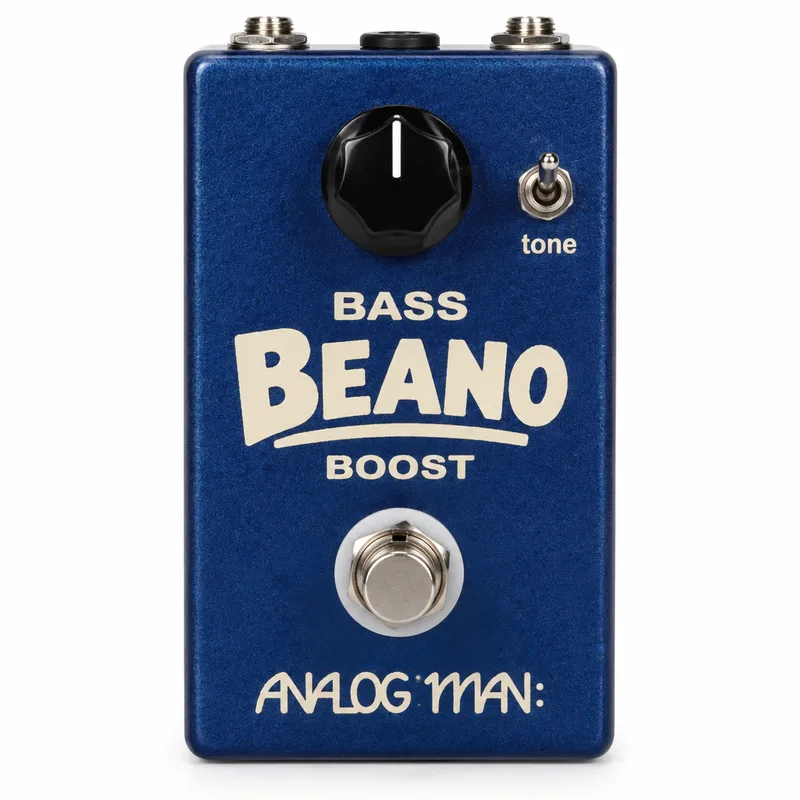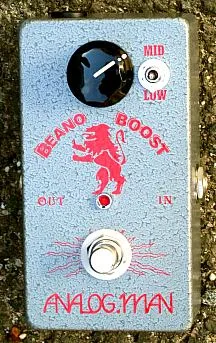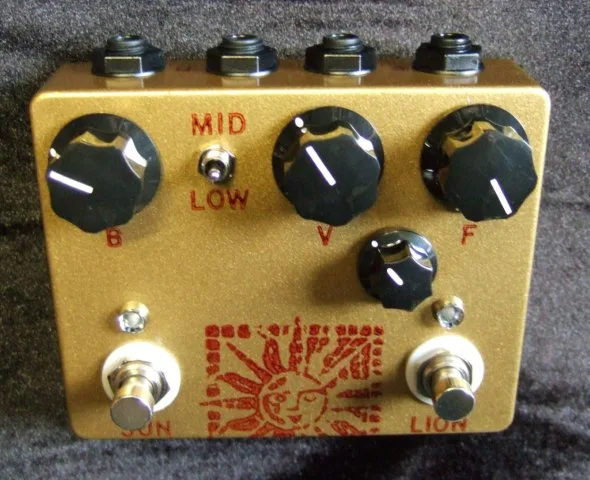


The Analog Man Sun Lion is a fuzz booster pedal that puts two of Analog Man's best known circuits in one enclosure: the Sunface germanium fuzz and the Beano Boost treble booster. Analog Man combined the two pedals in early 2005, wiring the Sunface into the Beano Boost in that order, and describes the result as a Tri-Germanium fuzz and treble boost that turned out to be more than the sum of its parts12.
Each side has its own 3PDT stomp switch, so you can use the fuzz alone, the boost alone, or both stacked. The circuits are built with various germanium transistors, selected for best tone and low noise on both effects, and the Beano Boost side is hand wired just as the original was, where other Rangemaster clones use circuit boards1.
Sunface and Beano Boost in one pedal
The Sunface side is Analog Man's take on the germanium Fuzz Face, a circuit Premier Guitar has described as iconic and one Analog Man is known for3. The Beano Boost side is a treble booster based on the Dallas Rangemaster, the pedal associated with Eric Clapton's "Beano" tone. In early 2005 Analog Man combined the two into the Sun Lion, and announced it that year as a new fuzz booster pedal24.
Analog Man chose to wire the Sunface into the Beano Boost rather than the reverse, because that order is quieter and gives a less subtle, more cutting sound. The other order, they say, is more of a classic rock tone, while the Sunface into Beano Boost order can get more extreme sounds1.
"We find the Sunlion an excellent alternative as it can get the same sounds with both sides on, plus MANY MORE sounds and so much more flexible."
With both sides on, RockBoard's PedalPedia says the pedal can get the same sounds as a Tonebender MK-II, plus more sounds and more flexibility than either pedal alone2. For players weighing a dedicated fuzz against a dedicated boost pedal, the Sun Lion covers both bases in one box.
The controls on each side
The two sides are controlled separately, and the Sunface side carries a few extras beyond its main knobs1.
| Control | Side | What it does |
|---|---|---|
| FUZZ knob | Sunface | Analog Man says it is best kept up or almost up all the way, with the guitar's volume knob or the internal trimmer used to control the amount of fuzz1 |
| SUN knob (Sun Dial) | Sunface | Bias adjustment in the center of the sun face graphic; set by Analog Man to the sweet spot, just under 5 volts on the high transistor at about 70 degrees, with the mark at 12:00. Turned down it gives a stuttering weak fuzz, turned up a harder, less fuzzy sound1 |
| Internal trimmer | Sunface | White knob on the circuit board, turnable by fingers; the normal setting is full counter-clockwise for full fuzz availability. It works like the guitar volume control, interactively cleaning up the fuzz, and fully up (counter-clockwise) it is completely out of the circuit1 |
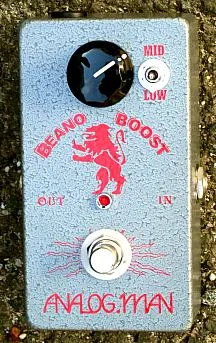
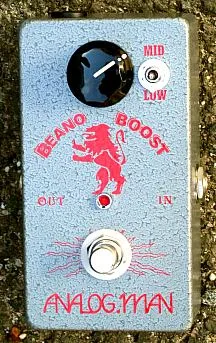
| BOOST knob | Beano Boost | Volume of the Beano Boost; controls the amount of crunch by driving the amp harder1 |
| TONE switch | Beano Boost | Three-position toggle: up is midrange, center is treble, down is low range boost1 |
The SUN knob is the bias adjustment, and it is the one control on the Sunface side that responds to temperature. Germanium transistors shift with temperature, so the bias point moves as the pedal warms up or cools down. Analog Man sets the SUN knob at the factory to the sweet spot, just under 5 volts on the high transistor at about 70 degrees, with the mark at 12:00. The knob is turned down (counter-clockwise) at higher temperatures and up (clockwise) at lower temperatures. Turned down it produces a stuttering weak fuzz, and turned up a harder, less fuzzy sound1.
An optional ON/OFF power switch can be fitted to the FUZZ knob, and the new version can carry an ON/OFF battery switch so you do not have to unplug the pedal when it is mounted on a pedalboard1.
Power and connections
The Sun Lion runs on a battery that disconnects when the input cord is removed; the input jack is on the right. An optional power jack is available, but Analog Man warns it can be detrimental to the ultimate tones, or dangerous, because the circuit uses a positive ground. External power must be isolated1.
The Sun Lion's positive ground means it cannot share a daisy-chained supply with standard negative ground pedals. Use an isolated output, one dedicated to this pedal, or run it on its battery.
Current draw is low: about 2mA when off, 5mA with either side on, and 8mA with both sides on1. RockBoard's PedalPedia listing gives the same 8mA figure for the pedal2.
The standard build uses top jacks, though some units have side jacks. A 4-jack version is available for switching systems, or for inserting other pedals between the two effects, since the Sunface and Beano Boost circuits are in series inside the box1.
Versions and artwork
The Sun Lion's enclosure artwork shows a colored lion eating the sun with red blood dripping from it, a design Analog Man discussed in a 2019 Stompbox Book interview5. Earlier color labels did not hold up well, so later pedals were made again in cases with color-printed graphics, and a 2012 version with hand-stamped graphics exists1.
Players documented with the Sun Lion
Analog Man documents a number of players using the Sun Lion1:
- Marc Ford: his most steady pedal; he has used one since he joined the Black Crowes for their reunion, and continues with his solo bands1
- J Mascis: got one in 2007 and used it on his late 2007 tours with Dinosaur Jr.; got another in very late 2008 with the Beano Boost side tuned for high, higher, and highest range1
- John Wesley: solo artist and Porcupine Tree1
- Mark Karan: upgraded from a Sunface he had used for years1
- Jason Isbell: got the number 1 Sun Lion from Marc Ford1
- Chuck Garvey: of moe.1
- Paul Tobias: of Guns N' Roses1
Videos
roknfnrol
Parkway Music
fuzzz
Questions
What is the difference between the Sun Lion, Sunface and Beano Boost?
The Sunface is Analog Man's germanium fuzz, based on the 1968 Fuzz Face circuit, and the Beano Boost is a treble booster based on the Dallas Rangemaster. The Sun Lion puts both circuits in one enclosure, with the Sunface feeding into the Beano Boost. Each side has its own footswitch, so you can use either one alone or both together.
Is the Analog Man Sun Lion true bypass?
Yes. Analog Man states the Sun Lion has true bypass on both sides, so with both footswitches off the signal passes through without the circuits loading it down. Each side is switched independently with its own 3PDT stomp switch.
Can the Sun Lion run on a standard power supply?
It can run on a battery, and an optional power jack is available, but the pedal uses a positive ground circuit, so any external supply must be isolated. Analog Man warns that non-isolated power can be detrimental to the tone or dangerous. A daisy chain shared with negative ground pedals will not work.
Why does the Sun Lion need isolated power?
The germanium circuits use a positive ground, which is the opposite polarity from most modern pedals. Sharing a supply with negative ground pedals shorts the two grounds together, which Analog Man says can harm the tone or be dangerous. An isolated output, one per pedal, avoids this.
How much current does the Sun Lion draw?
According to Analog Man, the Sun Lion draws about 2mA when off, 5mA with either side switched on, and 8mA with both sides on. That is low enough that a battery lasts a long time, and any isolated 9V supply output can feed it comfortably.
Can I use only one side of the Sun Lion?
Yes. The two 3PDT stomp switches are independent, so you can run the Sunface fuzz alone, the Beano Boost alone, or both together. Analog Man notes that with both sides on you can get the same sounds as a Tonebender MK-II, plus many more sounds and more flexibility.
Sources (5)
- Analog Man Sun Lion Fuzz Booster Pedal, Analog Man (analogman.com), 2019
- Sun Lion by Analogman, RockBoard PedalPedia, 2026
- State of the Stomp: Journey to the Center of the Fuzz Face, Premier Guitar, 2023-09-27
- ANALOG MAN'S BEST PEDALS, JHS Pedals
- Analog Man, Stompbox Book, 2019-10-20
 J Mascis