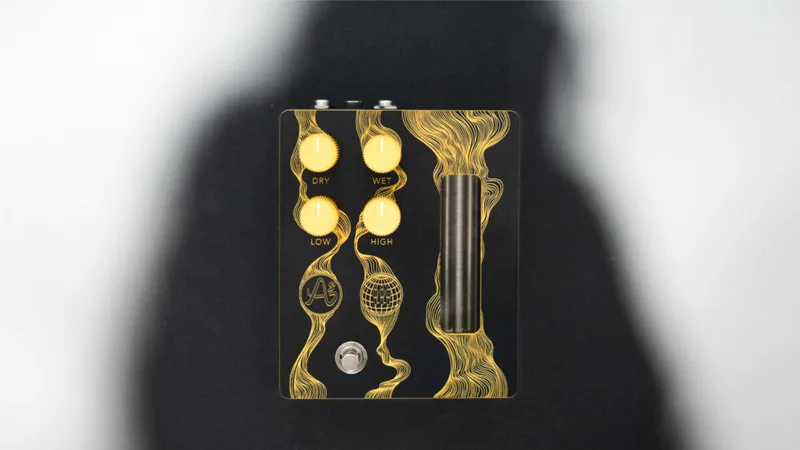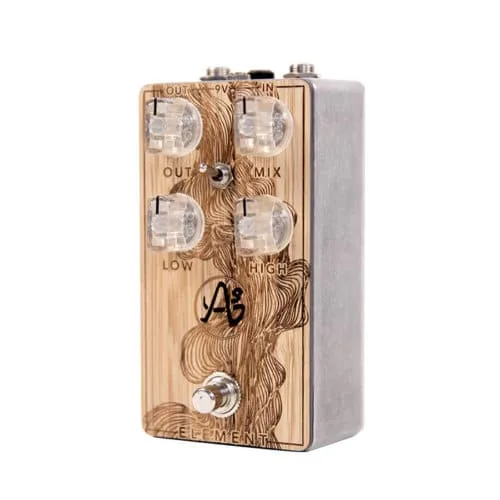


The Anasounds Element Spring Reverb is an analog spring reverb pedal that uses real springs, housed in separate tank boxes you connect by cable. Anasounds describes it as a pedal that "takes back the very essence of the analogue reverb," obtained by physically stimulating springs with the guitar signal, coupled to analog signal processing1. The company says the project grew out of research that began in 2017 with the aim of offering "a reverb with the tone of the legendary Fender Twin Reverb"1. All Anasounds pedals are handmade in France1.
Unlike most reverb pedals, which model reverb digitally, the Element is 100% analog1. The trade-off is physical: the springs live outside the pedal, in a tank box you plug in, so the Element is really a two-piece system rather than a single stompbox.
What it is and how it works
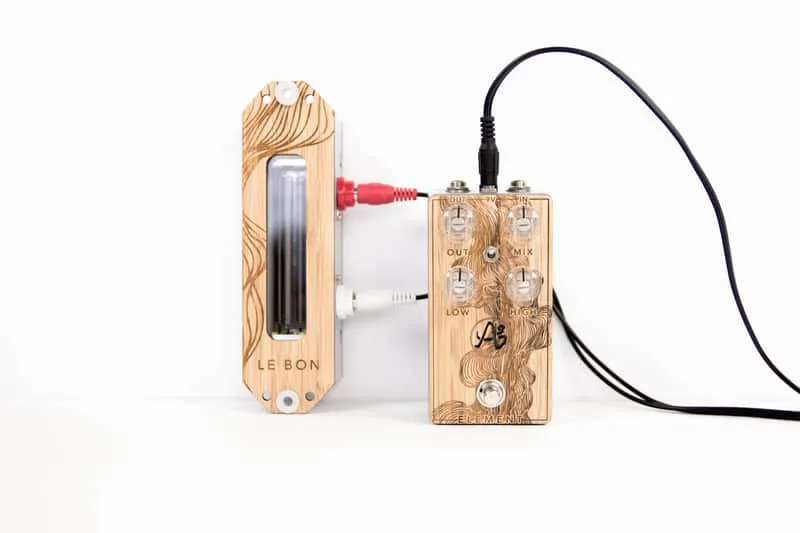
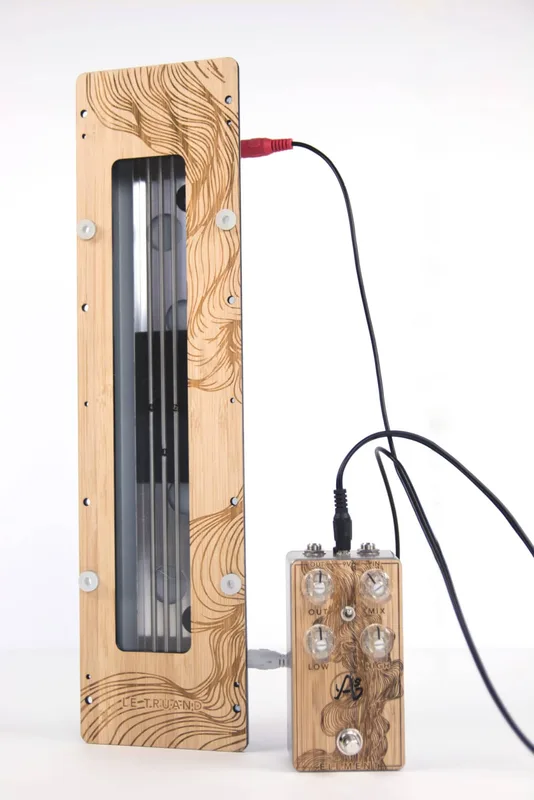
Spring reverb works by sending the guitar signal into actual metal springs; their wobble and reflections become the reverb that is mixed back with your dry sound. The Element does this literally. There is a mini jack on the back of the pedal, which connects to the box full of springs, called a tank, through RCA connectors1. Pedal of the Day describes the same arrangement as an 1/8 inch to RCA cable, which lets you easily swap different tanks4.
The pedal itself always has an input jack, an output jack and a 9V power jack1. That means the pedal is the control and processing unit, and the tank is the reverb generator, connected by a single cable.
The controls
The Element has four knobs and a switch. Anasounds describes them as follows1:
| Control | What it does |
|---|---|
| MIX | Sets the dry/wet ratio of the signal. At minimum it is 100% dry, 0% wet; at maximum it is 0% dry, 100% wet. |
| OUT | Sets the volume of the wet branch only. At maximum the reverb gains about +9dB, or +18dB in spring saturation mode. |
| LOW | Low side of a 2-band active EQ. At minimum it removes the basses completely; at maximum it gains +6dB. |
| HIGH | The same setting as LOW but for the trebles. |
| Spring saturation | A switch that puts the springs in saturation mode. Switched down, the spring saturates and the output level increases significantly, producing a kind of fuzz/overdrive from the spring. |
The spring saturation switch is the unusual one. JHS Pedals describes it as "a switch that overdrives the reverb signal in a really nice, natural way"5. Since it drives the wet signal only, it pushes the reverb into fuzz- or overdrive-like territory without touching your dry tone.
Pedal of the Day's review of the bundle lists the same control set in plainer terms: Output, Mix and Low/High EQ knobs to control your reverb4.
Power and connections
Power comes from a 9V power jack on the pedal1. The signal connections are an input jack and an output jack on the pedal, plus the mini jack on the back that runs to the tank's RCA connectors1. The tank-to-pedad link is a 1/8 inch to RCA cable, which is what makes tank swapping simple4.
The Element is a two-piece system: the pedal and its spring tank are separate boxes joined by a cable. If you are building a pedalboard, plan space for both the pedal and the tank you choose, and for the cable between them.
The three tanks: Le Bon, La Brute and Le Truand
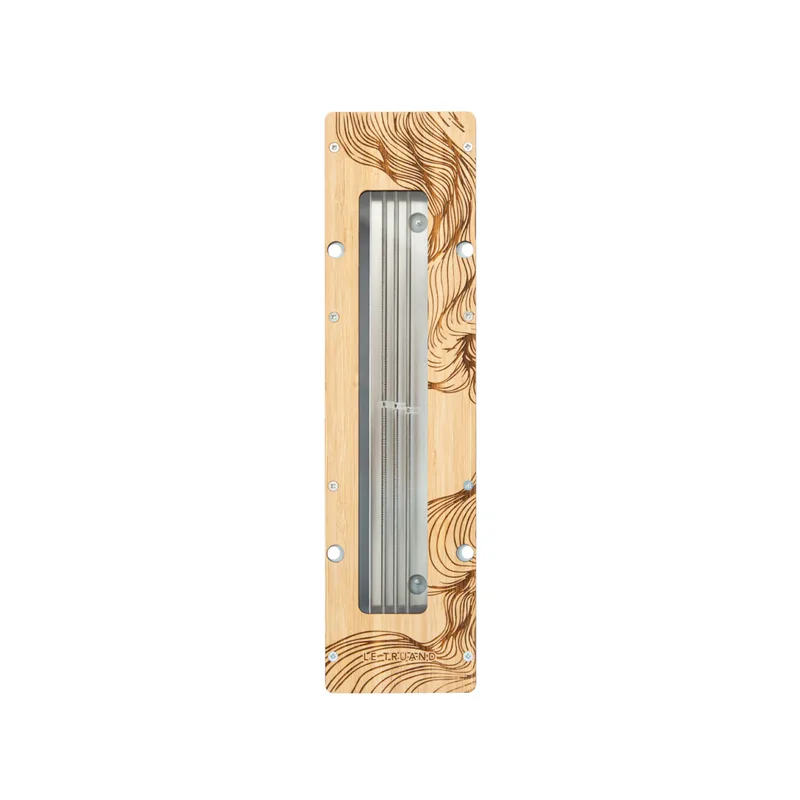
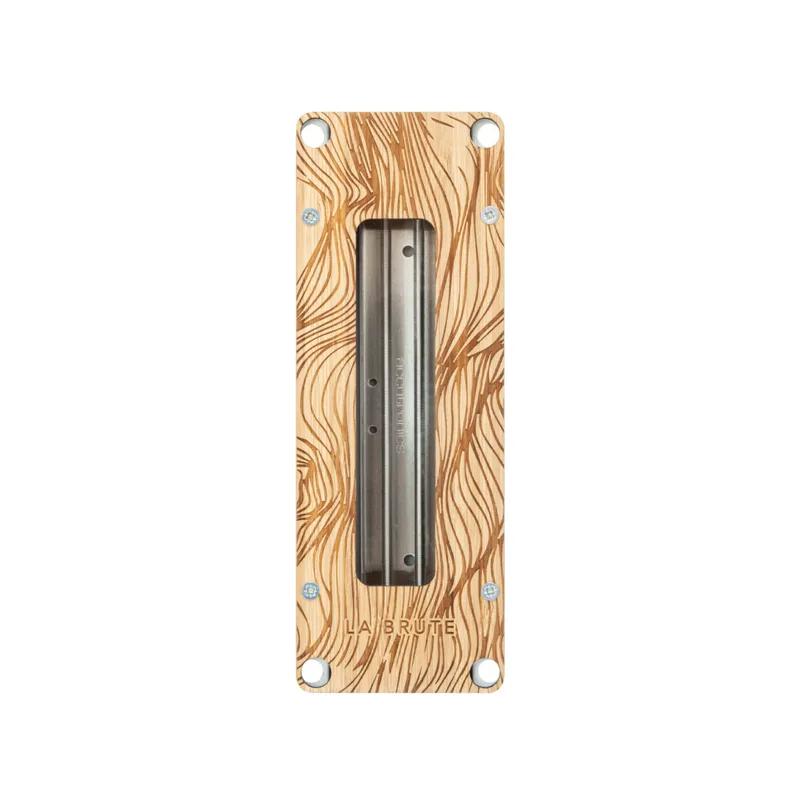
The Element is offered with three different tank sizes, named after the three protagonists of the film The Good, the Bad and the Ugly: Le Bon, La Brute and Le Truand1. Guitar Pedal X lists them from the smallest, Le Bon, then mid-size La Brute, and on to the largest, Le Truand6. The tanks vary in size, as do their springs, to create a wide sonic reverberated palette4.
- Le Bon: the smallest tank6
- La Brute: the mid-size tank6
- Le Truand: the largest tank6, reckoned by Anasounds to be the best-sounding of all674
Pedal of the Day notes you might need a big board for Le Truand4. Because the tanks connect by cable, you can own more than one and swap them as you like4.
The premium bundle includes the Element pedal, the mini jack to RCA cable, all three tanks, and six self-drilled screws2.
Where it came from
Anasounds makes all of its pedals by hand in France1, and the Element Spring Reverb follows that approach. Pricing in euros has been published at several bundle levels: €190.83 for the pedal only, €207.50 for the pedal with the Le Bon tank, €232.50 with La Brute, €249.17 with Le Truand, and €290.83 for the premium bundle with the pedal and all three tanks3. A later Guitar.com review of La Grotte listed the Element at €349, describing it as the most compact option8.
The Element remains part of a wider Anasounds spring reverb range. In a 2024 Guitar.com review of the La Grotte pedal, the Element Spring Reverb was named as the most compact option in that range, at €3498.
What reviewers said
Pedal of the Day reviewed the bundle in June 2020 and summed it up as4:
"Easy setup, incredible sounds, real spring reverb anywhere you need it."4
The same review found that the all-analog circuitry provides classic, vintage tones, and that the three tanks of varying sizes produce varying tones to explore4.
JHS Pedals, writing in 2026 about favorite reverbs, took a more measured view5:
"there is one spring reverb that stands apart: The Anasounds Element Spring Reverb"5
The JHS writer found it sounds incredible but is not easy to deal with or convenient for a live show5, a fair summary of the two-box design's trade-off: you get genuine spring reverb in a pedal-sized control unit, at the cost of carrying and cabling a separate tank.
Element versus La Grotte
Within Anasounds' own range, the Element Spring Reverb sits alongside La Grotte. A 2024 Guitar.com review of La Grotte described the Element as the most compact option, at €3498, while the Element's own bundles have been priced in euros from €190.83 for the pedal only up to €290.83 for the premium bundle with the pedal and three tanks3.
Videos
Anasounds
Anasounds
Anasounds
Questions
Does the Anasounds Element use real springs?
Yes. The Element is a 100% analog spring reverb that works by physically stimulating real springs with the guitar signal, coupled to analog signal processing. The springs live in a separate tank box that you connect to the pedal with a cable, rather than being built into the pedal enclosure.
Which tank size should go with the Anasounds Element?
There are three tanks: Le Bon is the smallest, La Brute is mid-size and Le Truand is the largest. Anasounds reckons Le Truand is the best-sounding of all, but it is also the biggest and may need a large pedalboard. The premium bundle includes all three so you can compare them.
How does the Element connect to its spring tank?
A mini jack on the back of the pedal runs to the tank's RCA connectors via a 1/8 inch to RCA cable. Because the tank is a separate box connected by cable, you can easily swap between different tanks without changing the pedal itself.
Is the Anasounds Element practical for live use?
It depends on your rig. Reviewers praise its sound, with Pedal of the Day calling it easy setup with incredible sounds, but JHS Pedals notes it is not easy to deal with or convenient for a live show, since the pedal and its external tank box are two separate pieces to carry and connect.
What is the difference between the Element and La Grotte?
The Element separates the control pedal from its spring tank. La Grotte, the later Jack White and Third Man Hardware collaboration, combines the Le Bon spring tank and the control unit in one box with a third spring added, making it a single-unit solution priced at $299 standard.
Sources (8)
- Element Spring Reverb, Anasounds, 2021-02-04
- element spring reverb, Anasounds, 2026-07-01
- Anasounds debuts Element Spring Reverb, Guitar.com, 2019-02-14
- Anasounds Element Analog Spring Reverb, Pedal of the Day, 2020-06-06
- MY FIVE FAVORITE REVERBS (FOR NOW), JHS Pedals
- Guitar Pedal X, Guitar Pedal X, 2024-08-29
- Anasounds' Element is a spring reverb pedal that uses actual spring tanks, MusicRadar, 2019-03-05
- Anasounds/Third Man Hardware La Grotte review, Guitar.com, 2024-10-07