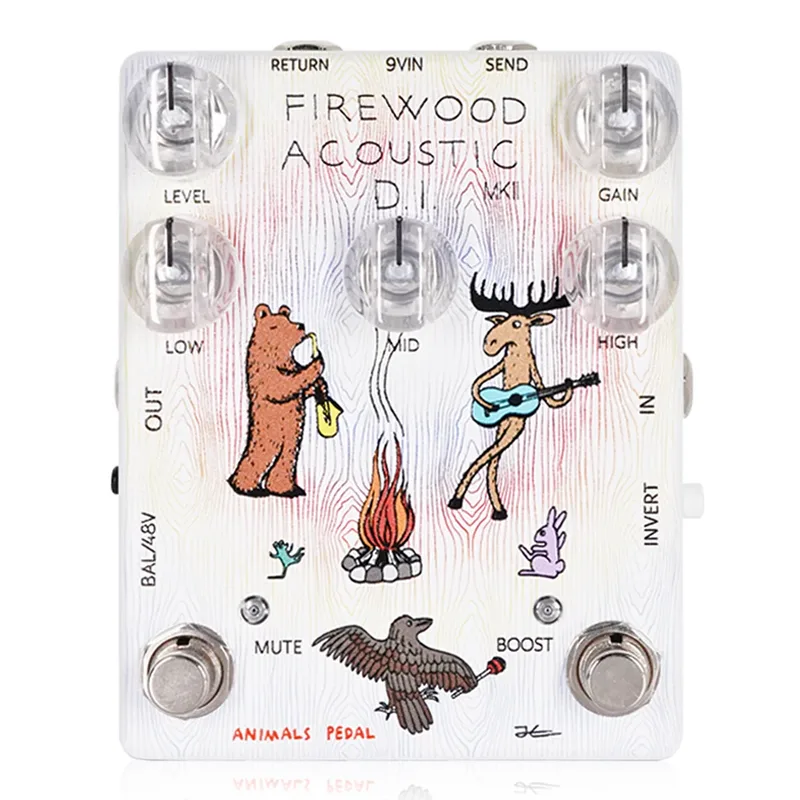

The Firewood Acoustic D.I. MKII is an acoustic preamp and direct box made by Animals Pedal. It sits between an acoustic instrument and the rest of a rig: it shapes the tone with a three-band EQ, adds a boost footswitch with a gain control that can push the sound into light saturation, and sends a balanced XLR signal straight to a mixing console. It also carries an always-active effects loop, so time-based pedals can be placed after the EQ and boost rather than in front of the whole chain1.
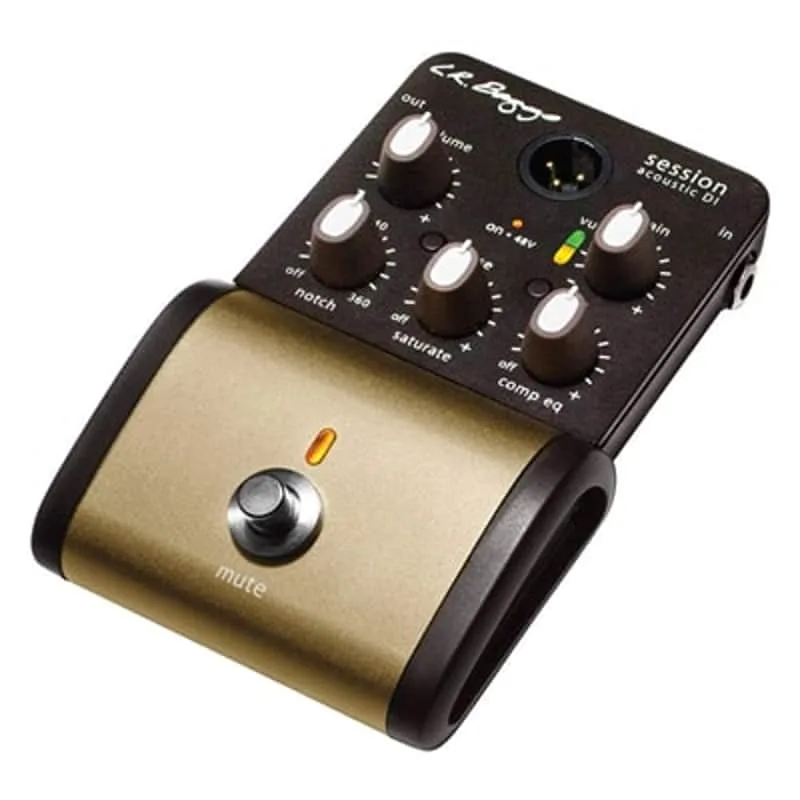
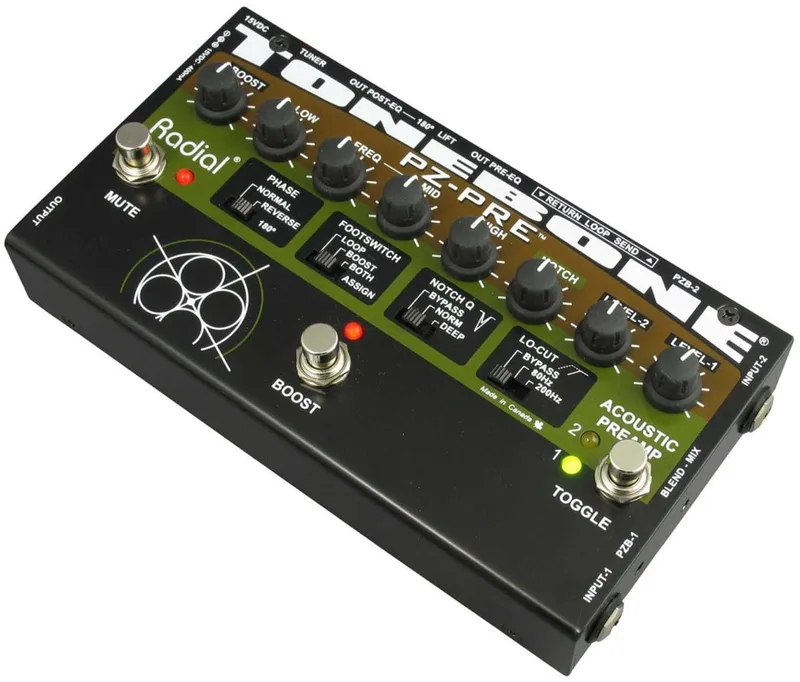
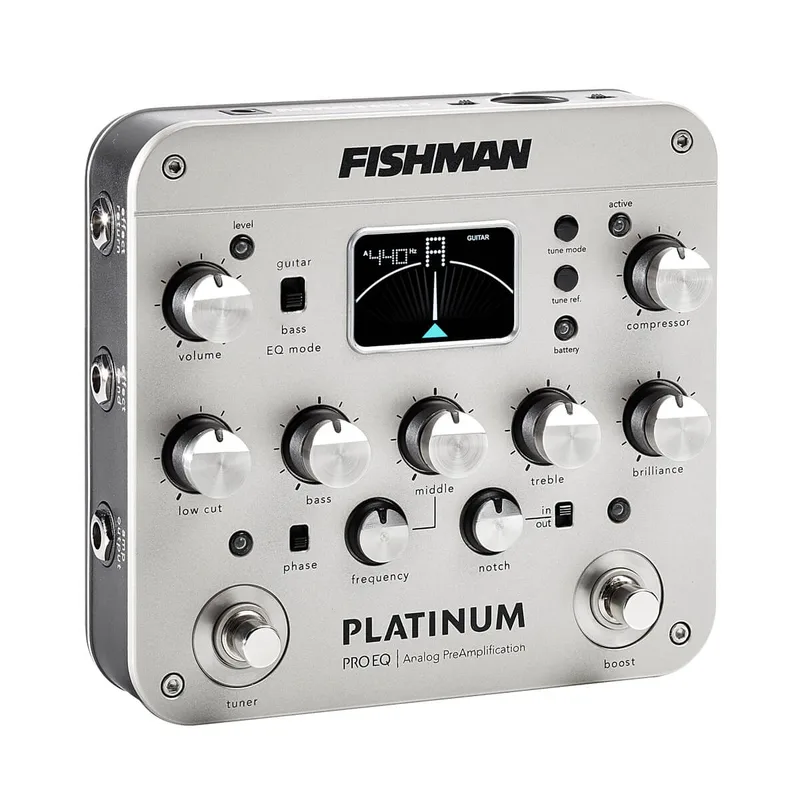
It is one of a family of acoustic pedals built for plugged-in acoustic players, alongside units like the LR Baggs Session DI and the Radial Tonebone PZ-Pre.
Controls and what they do
The front panel is built around three EQ knobs, a gain control and two footswitches. The EQ is a three-band design with a cut or boost range of ±15dB, with the LOW band centered on 180Hz, the MID band on 800Hz, and the HIGH band on 3.5kHz, which makes it usable both for correcting a pickup's quirks and for shaping a sound on stage1.
| Control | What it does |
|---|---|
| LOW | Cuts or boosts the low band by up to ±15dB, centered on 180Hz |
| MID | Cuts or boosts the mid band by up to ±15dB, centered on 800Hz |
| HIGH | Cuts or boosts the high band by up to ±15dB, centered on 3.5kHz |
| GAIN | Sets the output level when Boost is on and controls saturation across the sound; can add a light overdrive |
| INVERT | Inverts the phase of the signal |
| BOOST footswitch | Raises the volume; the boost level is fixed and is set with the GAIN knob |
The ±15dB range on each band is generous compared with many acoustic preamps, and the three center frequencies, 180Hz, 800Hz and 3.5kHz, cover the areas where undersaddle pickups most often need help: mud in the lows, honk in the mids and harshness up top13.
The BOOST footswitch works differently from a normal boost pedal. The boost level itself is fixed, and the GAIN knob is what sets how loud the boosted sound is. That same knob also controls how saturated the whole sound becomes, so pushing it gives more level and more warmth at the same time. Animals Pedal describes the result as adding "crisp power and presence" to the sound when Boost is on1. The INVERT switch flips the signal's phase, which is useful when combining the pedal's XLR output with other sources, such as a mic on the guitar body, that may be out of phase.
Power and connections
The pedal can be powered two ways: a standard 9V center-negative DC adapter into the DC9V jack, or 48V phantom power supplied by a mixing console. When phantom power is used, it arrives through the BAL/48V XLR jack, the same jack used for the balanced output, so a single XLR cable carries both the signal to the mixer and the power back to the pedal14.
Because phantom power is supplied through the BAL/48V XLR jack, running the pedal on phantom power requires connecting it to a console or other source that provides 48V phantom on that line. The 9V adapter path is the one to use with a normal pedalboard power supply.
The full set of connections:
- IN: instrument input2
- DC9VIN: standard center-negative DC 9V adapter341
- SEND/RETURN: always-active effects loop; SEND feeds the input of effects in the loop, RETURN takes their output12
- OUT: unbalanced output to a guitar amp2
- BAL/48V: balanced XLR output for connecting directly to a mixer, and the point where phantom power is supplied413
The effects loop is always active, meaning everything in the pedal, including the EQ and boost, feeds the loop. SEND has an output impedance of 1K and RETURN an input impedance of 200K, figures that sit in normal pedal-friendly territory1.
Specifications
| Specification | Value |
|---|---|
| Input impedance | 470K |
| Output impedance (unbalanced) | 2.2K |
| Output impedance (balanced) | 470 ohm |
| Effects loop impedance | 1K (SEND), 200K (RETURN) |
| Max output level | 4V p-p |
| S/N ratio | 68dB (input 0.2V p-p, output 4V p-p, at 1kHz) |
| Current draw | 18mA |
| Size | 100(W) x 122(D) x 54(H)mm1; the maker also lists 125 x 95 x 57mm and 100 x 122 x 57mm including protrusions2 |
| Weight | 400g1; the maker also lists 360g2 |
The maker's own pages give differing size and weight figures, so both are listed here as stated12.
Buying from the maker's store
Animals Pedal sells the Firewood Acoustic D.I. MKII through its own web store at a regular price of £95.69 GBP, with a 10% discount to £86.12 GBP running until 26 October at 16:0024. For United States orders, the store ships via Yamato with delivery by UPS, and customs duties, taxes and fees are invoiced separately before shipment rather than at checkout4.
Videos
Pedal of the Day
Questions
Can the Firewood Acoustic D.I. MKII run on phantom power?
Yes. It runs on a standard 9V center-negative DC adapter or on 48V phantom power from a mixing console. When phantom power is used, it is supplied through the BAL/48V XLR jack, the same jack used for the balanced output to the mixer.
Is the Firewood boost level adjustable?
The BOOST footswitch raises the volume by a fixed amount, so the boost level itself is not adjustable. Instead, the GAIN knob sets the output level when Boost is on, and it also controls the amount of saturation in the sound.
Does the Firewood Acoustic D.I. have an effects loop?
Yes. It has an always-active SEND/RETURN loop. SEND feeds the input of the effects placed in the loop, and RETURN takes the output of those effects back into the pedal.
Can the Firewood Acoustic D.I. overdrive?
Lightly, yes. The GAIN control adjusts the output level when Boost is on and controls the saturation of the whole sound, and Animals Pedal says it can be used to add a light overdrive character.
Sources (4)
- Custom Illustrated FADIMK2 s!on #01, Animals Pedal
- 【10/26(月)16:00まで10%OFF】Animals Pedal Firewood Acoustic D.I. MKII, Animals Pedal (www.animalspedal.jp)
- [Custom Illustrated FA DI / まつだひかり #02
- 【10/26(月)16:00まで10%OFF】【限定デザイン】Animals Pedal Firewood Acoustic D.I. MK, Animals Pedal (animalspedal.jp)