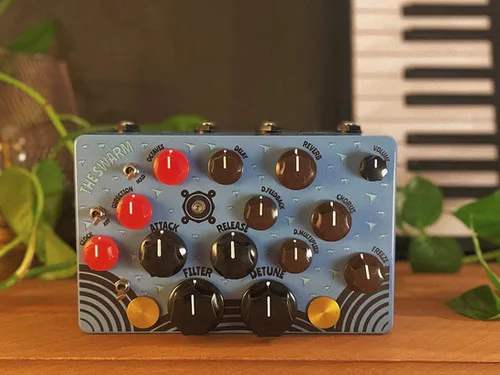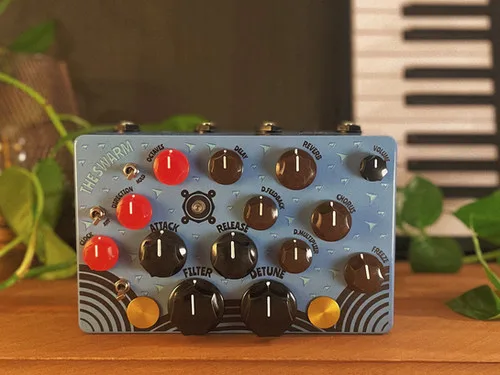


The Swarm is a synth pedal from Artium Instruments, the maker behind the Hungry Robot line. At its core is a SuperSaw oscillator with eight-note polyphony, and the pedal works through two distinct control modes: Polyphonic Mode, where you can play up to eight notes simultaneously, and Arpeggiator Mode1. Around that synth core sit four onboard stereo effects that can also process external audio, so a guitar, bass or any other source plugged into the rear jacks gets mixed with the synth and sent through the same effects2.
The design philosophy is knob-based rather than menu-driven. Artium Instruments describes it plainly1:
"Every feature of The Swarm is directly mapped to a knob, button, switch, or jack, ensuring effortless control"1
What The Swarm is and what it does
The Swarm puts a polyphonic synthesizer in a pedal enclosure. The SuperSaw oscillator is the engine, and the two modes shape how you play it: Polyphonic Mode for chords and held clusters of up to eight notes, Arpeggiator Mode for sequenced runs1. The onboard delay is a digital delay with a subtle touch of warmth, and its length synchronizes with the arpeggiator clock, so repeats stay locked to whatever the arpeggiator is doing1.
Because the effects can process external audio, The Swarm works two ways at once: as a standalone synth voice and as an effects processor for your existing signal. Simply plug an external audio source into the rear input jacks and The Swarm mixes that external audio with the synth core1.
Controls, inputs and outputs
The rear panel carries the audio connections, and the manual spells out how stereo and mono routing work1:
| Jack | What it does |
|---|---|
| In(L) | Audio input for external audio through the onboard effects; mono sources use In(L) and route to both sides |
| In(R) | Right audio input for stereo external sources |
| Out(L) | Left output; doubles as a stereo headphone jack or TRS output when Out(R) is unconnected |
| Out(R) | Right output |
For output, you can run stereo with two TS cables into Out(L) and Out(R), or use a single TRS cable or headphone plug in Out(L) with nothing in Out(R)1. That makes The Swarm usable directly with headphones, which is unusual for a pedal and handy for quiet practice or desktop use.
USB-C power and MIDI
Power and MIDI both arrive over USB-C. The rear panel has a USB-C power input fed by the included power supply brick, so no standard 9V pedal supply is involved1. This is worth noting if you are used to conventional pedals: The Swarm does not run off a typical daisy chain or center-negative 9V supply.
MIDI comes in through a USB-C MIDI host, which the maker chose "for simplicity and ease of use"1. The host also powers the controller, and class-compliant USB MIDI controllers work with zero setup1. In practice that means most off-the-shelf USB keyboard controllers plug straight in and play, with no drivers or configuration.
The effects and how they compare in the range
The four onboard effects are stereo and can process external audio routed through the rear inputs, mixed with the synth core2. The delay is the one effect the manual describes in detail: a digital delay with subtle warmth, synchronized to the arpeggiator clock1.
The Swarm's reverb also lives on elsewhere in the maker's line. The Doppler, a desktop polyphonic synth with the same 8-note polyphony and DIN and USB MIDI integration, carries two onboard stereo effects, and its manual says of its reverb45:
"It's the same rich, organic reverb found in The Swarm, now with expanded control over both the level and feedback."4
So a player who wants The Swarm's reverb as a standalone unit with more control over level and feedback can find it in the Doppler, which likewise processes external audio through its effects4.
The Swarm's delay is a digital delay with a subtle touch of warmth, and its delay length synchronizes with the arpeggiator clock1. It carries a list price of $322.24 USD3.
Where it sits among synth pedals
Compared with pitch-tracking guitar synths that convert your guitar's signal into synth tones, The Swarm is a self-contained synth voice you play from a MIDI controller, with your guitar as an optional guest in the mix. Its closest sibling in the maker's own catalog is the Doppler, which shares the 8-note polyphony, the USB-C MIDI host with power and communication for a USB MIDI controller, and the same reverb, in a desktop format with two effects instead of four45.
Videos
Duskmos
JAde Wii
Questions
How many notes can The Swarm play at once?
In Polyphonic Mode, The Swarm plays up to eight notes simultaneously. It also has an Arpeggiator Mode, and the two modes are the main ways you interact with the synth core.
Can you run a guitar through The Swarm's effects?
Yes. Plug any external audio source, including a guitar, into the rear In(L) and In(R) jacks and The Swarm mixes it with the synth core while running it through the onboard effects. Mono sources go into In(L) and are routed to both sides.
Does The Swarm work with a USB MIDI controller?
Yes. The Swarm has a USB-C MIDI host that also powers the controller. Class-compliant USB MIDI controllers work with zero setup, so most plug-and-play keyboards connect without configuration.
Are The Swarm's effects stereo?
Yes. The four onboard effects are stereo, and they can also process external audio routed through the rear input jacks, mixed with the synth core.
Who makes The Swarm?
The Swarm is made by Artium Instruments, the maker behind the Hungry Robot line, and is sold through the Hungry Robot Pedals website. The company describes itself as committed to knob-for-knob functionality.
Sources (5)
- SWARM MANUAL, Hungry Robot
- The Swarm, Hungry Robot
- The Swarm, Hungry Robot (www.hungryrobotpedals.com)
- DOPPLER MANUAL, Hungry Robot Pedals
- The Doppler, Hungry Robot