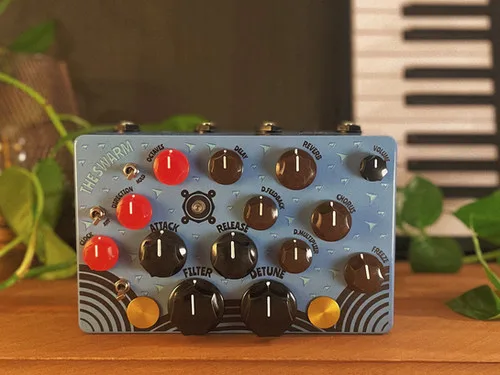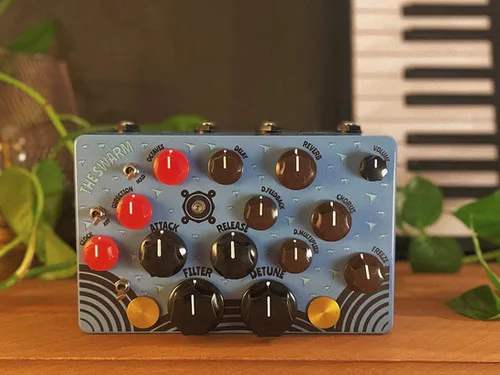
Hungry Robot The Swarm is a synth pedal with onboard effects, built around a SuperSaw oscillator with 8-note polyphony1. It is a pedal-format unit rather than a desktop synth, and its four onboard stereo effects can also process external audio, so a guitar or other source can be run through the same effects as the synth core2. The delay effect is a digital delay with a subtle touch of warmth, and its length synchronizes with the arpeggiator clock1.
Playing it: modes and polyphony
The Swarm works in two control modes: Polyphonic Mode and Arpeggiator Mode1. In Polyphonic Mode, you can play up to eight notes simultaneously, which is what makes the SuperSaw core suitable for full chords rather than single lines1. The manual describes the design philosophy as knob-for-knob: "Every feature of The Swarm is directly mapped to a knob, button, switch, or jack, ensuring effortless control"1.
Running guitar and other external audio through it
The rear panel carries In(L) and In(R) audio inputs for sending external audio through the onboard effects, mixed with the synth core. A mono source, such as a guitar, uses In(L) and is routed to both sides1. The manual puts it plainly: "Simply plug an external audio source into the rear input jacks, and The Swarm will seamlessly mix the external audio" with the synth1.
Outputs and stereo
Stereo output is available two ways, both from the rear panel1:
- Two TS cables, one into Out(L) and one into Out(R)
- A single TRS cable into Out(L)
Out(L) is the left output and doubles as a stereo headphone jack, or as a TRS output when Out(R) is unconnected. Out(R) is the right output1.
Power and USB-C MIDI
The Swarm is powered by a USB-C plug from an included power supply brick, connected at the rear panel1. It is also a USB-C MIDI host: class-compliant USB MIDI controllers work with zero setup, and the host port provides power to the connected controller1.
Because the MIDI host port supplies power to the controller, a separate powered USB hub is not part of the setup described in the manual; the Swarm itself powers the controller over USB-C1.
Price and buying
Hungry Robot's product page lists The Swarm at $322.24 USD3. The pedal is sold as a synth pedal with onboard effects, including a digital delay with a subtle touch of warmth that synchronizes with the arpeggiator clock1.
Where it sits in the Hungry Robot line
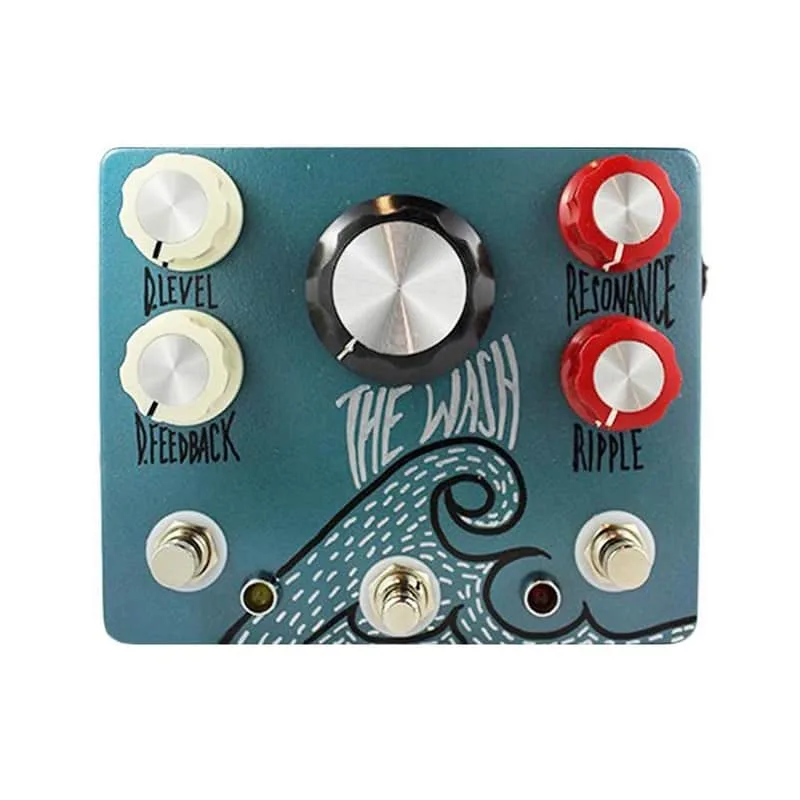
Hungry Robot is known for delay and reverb pedals, including The Wash, The Kármán Line, and the Moby Dick Multihead Tape Style Delay V3. The Swarm extends that into synth territory, and its synchronized digital delay ties it back to the delay pedal tradition the maker is known for. Players looking at synth-in-a-pedal formats more broadly can compare it with other synth pedals1.
Questions
How many notes can The Swarm play at once?
In Polyphonic Mode, The Swarm can play up to eight notes simultaneously, according to the manual. It uses a SuperSaw oscillator with 8-note polyphony, and it also offers a second control mode, Arpeggiator Mode, for sequenced patterns.
Can I run a guitar through The Swarm's effects?
Yes. The onboard effects can process external audio routed through the rear input jacks, mixed with the synth core. A mono source uses the In(L) jack and is routed to both sides.
Are The Swarm's effects stereo?
Yes. The Swarm has four onboard stereo effects that can also process external audio, and it provides stereo outputs via two TS cables or a single TRS cable into the Out(L) jack.
How is The Swarm powered?
The Swarm is powered by a USB-C plug from an included power supply brick, connected at the rear panel.
Does The Swarm work with a USB MIDI controller?
Yes. The Swarm uses a USB-C MIDI host and provides power to the connected controller. Class-compliant USB MIDI controllers work with zero setup, according to the manual.
Who makes The Swarm?
The Swarm is made by Hungry Robot, and the manual credits the team at Artium Instruments, which states a commitment to knob-for-knob functionality.
Sources (3)
- SWARM MANUAL, Hungry Robot
- The Swarm, Hungry Robot
- The Swarm, Hungry Robot (www.hungryrobotpedals.com)