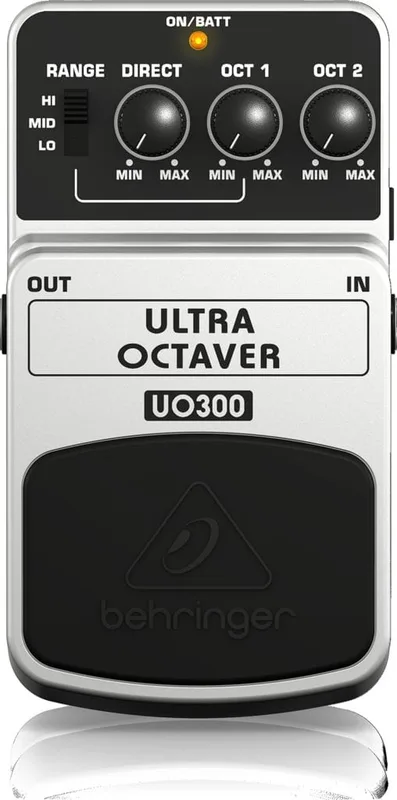


The Behringer Ultra Octaver UO300 is a 3-mode octaver effects pedal from Behringer that generates notes one and two octaves below what you play1. Behringer describes it as a pedal that "underpins your sound with added muscle, with the deep, rich impact of guitar and bass lines joined at the hip"1. It sits in the octave and pitch pedal family, and its dedicated Range control lets you add beef to the high, middle or low frequencies1.
What it does and how you control it
The UO300 gives you two octave-down voices with individual level controls, so you can dial in one octave down, or one octave down plus an additional octave down2. Behringer's own description of the workflow starts with the Range control:
"First, use the dedicated Range control to specify whether you want to add beef to the high, middle or low frequencies."
A Voice switch then adjusts the pedal's response to suit the particular tone of your instrument, which is what allows it to work with both bass and guitar2.
| Control | What it does |
|---|---|
| Range knob | Sets whether the added octaves beef up the high, middle or low frequencies1 |
| Voice switch | Matches the pedal's response to bass or guitar2 |
| Two octave voice controls | Independent levels for one octave down and two octaves down2 |
| Status LED | Shows when the pedal is active1 |
Where the circuit came from
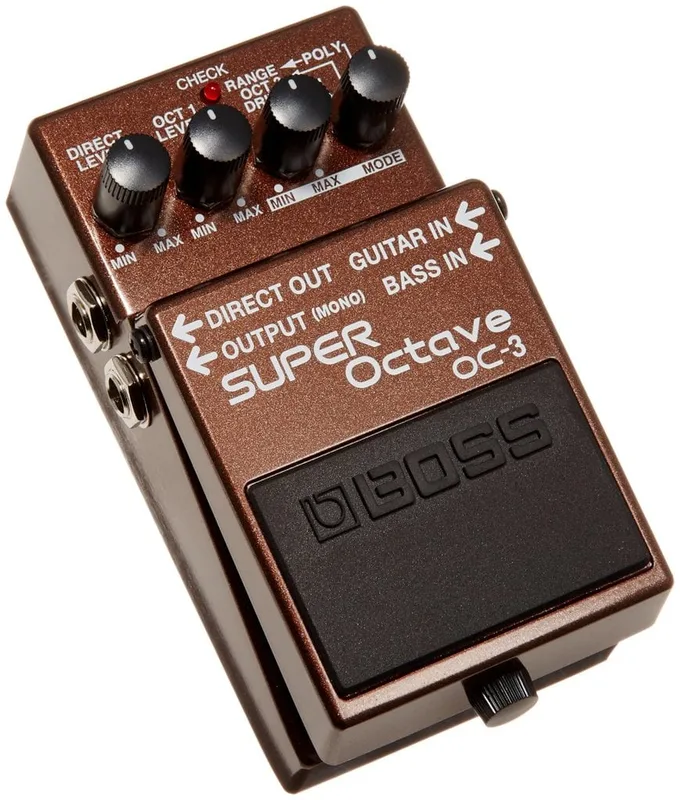
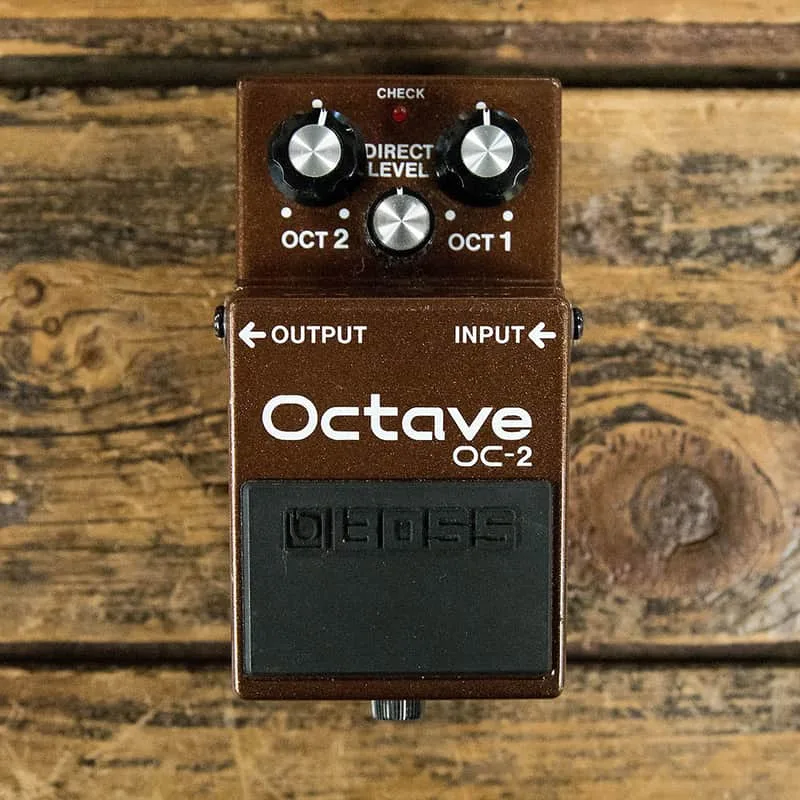
The UO300's circuit has a documented lineage, though the press does not fully agree on which Boss pedal it follows. JHS Pedals' Josh Scott calls it a slightly tweaked copy of the Boss OC-2, with a side switch covering high, mid and low ranges3. Guitar World's editors describe it as "allegedly a clone of the Boss OC-3"2. Both accounts point to Boss's octave line rather than a fresh design.
The Boss OC-2 itself, as Boss describes it, offers independent level controls for the dry signal, one octave down, and two octaves down4, the same three-voice layout the UO300 carries. Boss's own buying guide credits the OC-2 with a warm analog character5, and TONEHOME notes the original pedal got a darker shade of brown about a year after its introduction6.
How it tracks, and how it handles bass
Guitar World's reviewers tested the UO300's tracking and found clear limits:
"It copes with single notes particularly well and will stretch to power chords dependent on the settings, but anything more complex than that can result in artifacts."
That is typical of analog-style octave circuits, which read the pitch of a single note far more reliably than a chord. For players who want octave lines under single-note riffs, that is the use case the reviewers point to.
On bass, the news is good. The Voice switch adjusts the response for the instrument2, and Josh Scott adds from his own experience:
"Coincidentally, it works great on bass guitar as well."
Bass players can treat it as a sub-octave tool for bass rather than a guitar-only unit32.
Power
Behringer says you can run the UO300 from either a 9 V battery or the PSU-SB DC power supply, which is not included with the pedal1. No separate power supply is needed to get started, and the battery option suits small boards or players without a multi-output supply.
Videos
Behringer
Patrick Hunter
Gear4music Guitars
Questions
Does the Behringer Ultra Octaver work on bass?
Yes. A Voice switch adjusts the pedal's response to suit either bass or guitar, and JHS Pedals' Josh Scott notes that it works great on bass guitar. Bass players get the same two octave-down voices with the response tailored to the instrument.
Does the UO300 take a 9V battery?
Yes. Behringer says you can power the UO300 with either a 9 V battery or the PSU-SB DC power supply, which is not included. That makes it usable without a pedalboard power supply.
What power supply does the Behringer UO300 use?
Behringer's own PSU-SB DC power supply, sold separately, or a 9 V battery. The power supply is not included with the pedal.
Can the UO300 track chords?
Up to a point. Guitar World's reviewers found it copes with single notes particularly well and stretches to power chords depending on the settings, but anything more complex can result in tracking artifacts. Single-note lines are its strength.
Sources (6)
- Behringer ULTRA OCTAVER UO300 product page, Behringer
- Best Octave Pedals, Guitar World, 2025-03-27
- What's the Deal with Behringer?, JHS Pedals, 2026-10-25
- Timeless Boss Pedals Reborn, BOSS, 2026-09-29
- How to Choose a Pitch Pedal, BOSS, 2025-12-20
- Boss OC-2 Octaver, TONEHOME, 2026-10-26