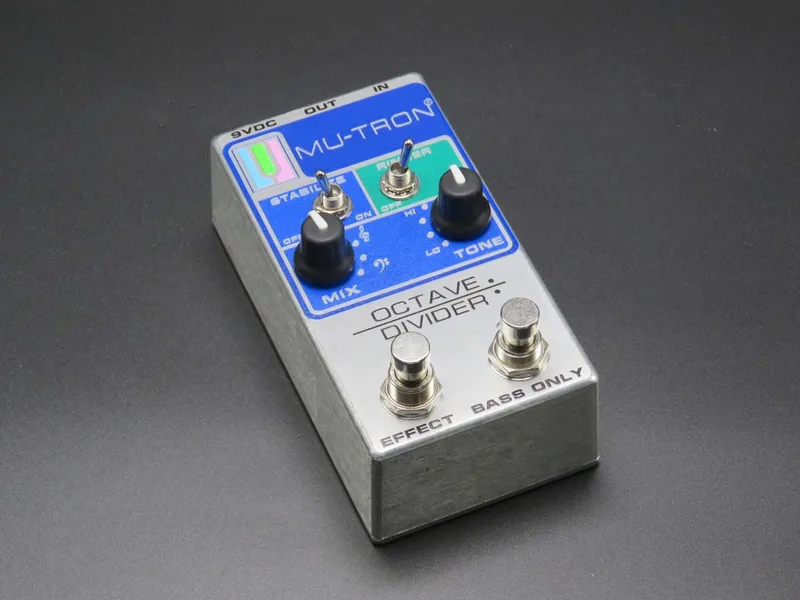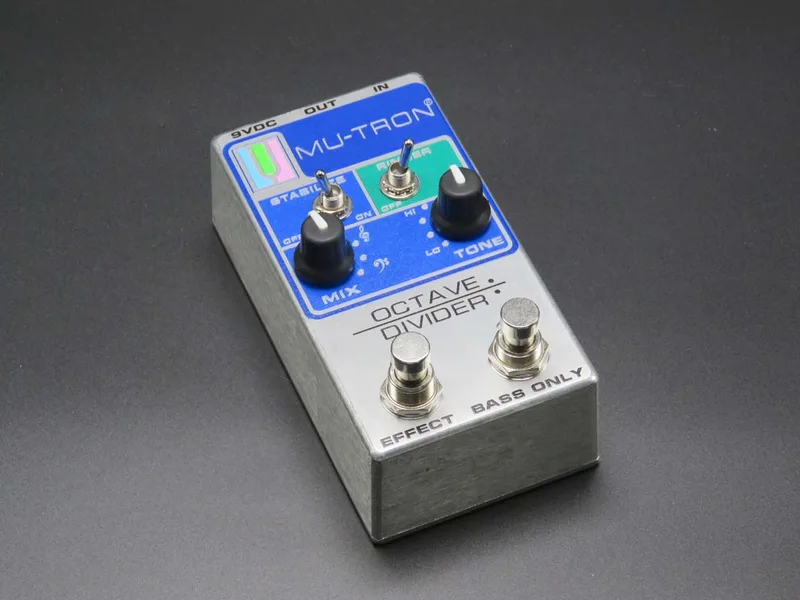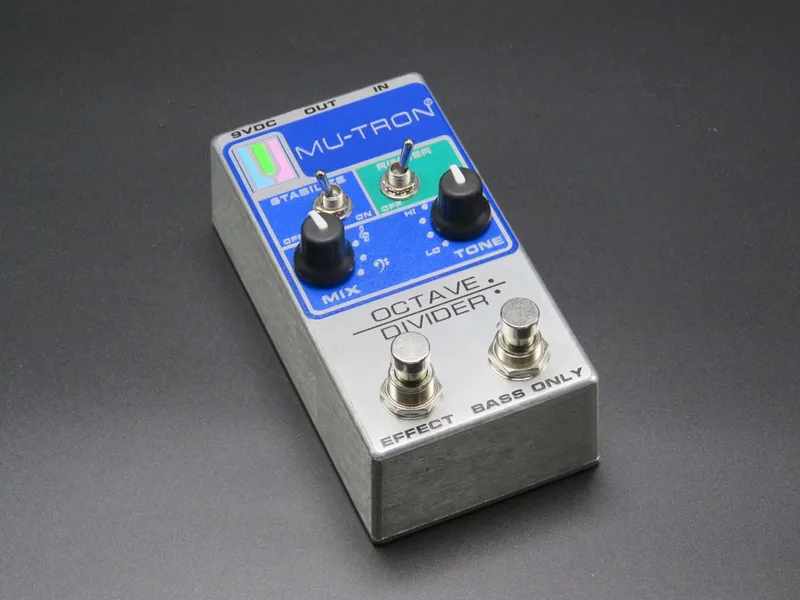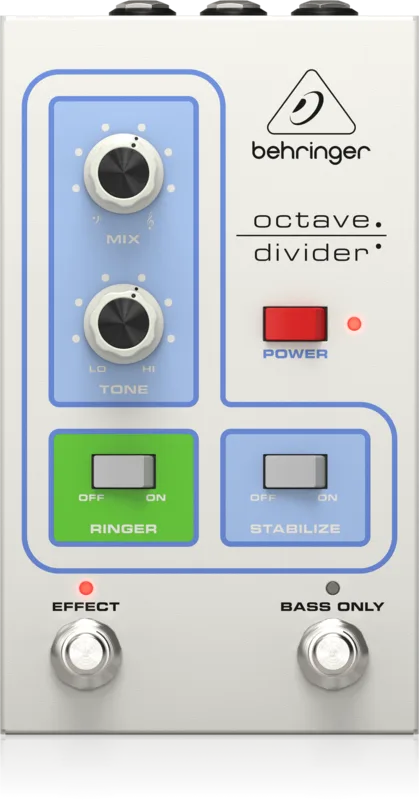


The Behringer Octave Divider is an analog octave-down pedal with a built-in ring modulator, an authentic recreation of the popular Octave Divider from the '70s made by Musitronics under the Mu-Tron name1. It produces a sub-octave one octave below what you play, with its own MIX and TONE controls for blending the dry and sub-octave signal or shaping the tone while preserving dynamics and harmonics1. On top of the sub-octave it carries a Ringer function, a ring modulator that adds harmonic emphasis on the upper tones and special multi-note effects1.
Behringer released the pedal at the end of 202123, and Guitar World reported it as available now at launch, priced at $993. Gearnews later listed it at $42.00 USD (£37.00 / 45.00€) as of February 20254.
A sub-octave with a ring modulator
The pedal combines two circuits in one box. The first is the octave divider itself: a sub-octave effect with MIX and TONE controls, so you can blend your dry and sub-octave signal or shape the sub-octave's tone color17. The second is the Ringer, a ring modulator that Behringer says adds "just the right amount of harmonic emphasis on the upper tones" plus special multi-note effects1.
The Ringer traces back to the Green Ringer, a ring modulator originally released by Dan Armstrong that was paired with the octave-down effect in the original Mu-Tron Octave Divider89. Premier Guitar describes the Mu-FX reissue of that pedal as "an octave-down effect paired with the Green Ringer ring modulator originally released by Dan Armstrong"9, and the Behringer version carries the same pairing forward.
Behringer suggests the pedal for players who want to create jazzy riffs with a tight bassline underneath, add top-end sizzle for a guitar solo, or add funkiness to bass, keyboards and other instruments1.
Controls
| Control | What it does |
|---|---|
| MIX | Blends the dry and sub-octave signal1 |
| TONE | Shapes the sub-octave's tone color while preserving dynamics and harmonics17 |
| Ringer | Engages the ring modulator for upper-tone harmonic emphasis and multi-note effects1 |
| Stabilize | On/off switch that improves note tracking1 |
| Bass Only | Cuts the dry signal completely, leaving only the sub-octave1 |
| Effect footswitch | Engages the pedal3 |
| Bass Only footswitch | Switches to sub-octave only3 |
The BASS ONLY switch is the standout feature for creative use: it completely cuts out the dry signal, leaving only the sub-octave, so a guitar line can sit on top of a bassline you generate yourself16. Gearnews called it "a great feature, as it will completely cut out the dry signal leaving only the sub-octave"6.
The Stabilize switch helps improve note tracking, which is the practical concern with any analog octave divider: the circuit has to follow your notes cleanly, and stabilizing the tracking makes the sub-octave more reliable1. The Mu-Tron and Mu-FX versions carry the same switch, where it improves tracking reliability for guitar and other plucked instruments108.
Power and connections
The pedal runs on standard 9 to 12 volt DC power1, drawing 300mA5. There is no battery option: the unit runs from an external power supply only6. That current draw is high for a single analog pedal, so it is worth planning for on a power supply with isolated outputs.
No battery, external power supply only6. The original 1970s Octave Divider also had to be plugged into a wall outlet1, so the Behringer version is actually more pedalboard-friendly than the pedal it recreates.
Connections are a jack instrument input plus Amp and Aux outputs3. The enclosure is metal, which Behringer describes as rugged and reliable, made to withstand the rigors of the road1.
A clone of the Mu-Tron Octave Divider
Behringer presents the pedal as an authentic recreation of the popular Octave Divider from the '70s1, and Guitar World found that "the control layout is in fact a like-for-like replica of the original Mu-Tron"3. The original was made by Musitronics, whose product pages describe it as a sophisticated accessory producing a sub-octave11.
Mu-Tron itself has not welcomed the copy. Gearnews reported that Mu-Tron publicly stated the Behringer Octave Divider was a total copy of its Octavider design, and that Behringer had even used its copy to advertise the pedal2. Mu-Tron's own current lineup includes the Mu-Tron Octave Divider, the Mu-Tron Octave Divider Vintage Silver, and the Mu-FX Octave Divider, a reissue by designer Mike Beigel's venture Mu-FX with modern updates1089.
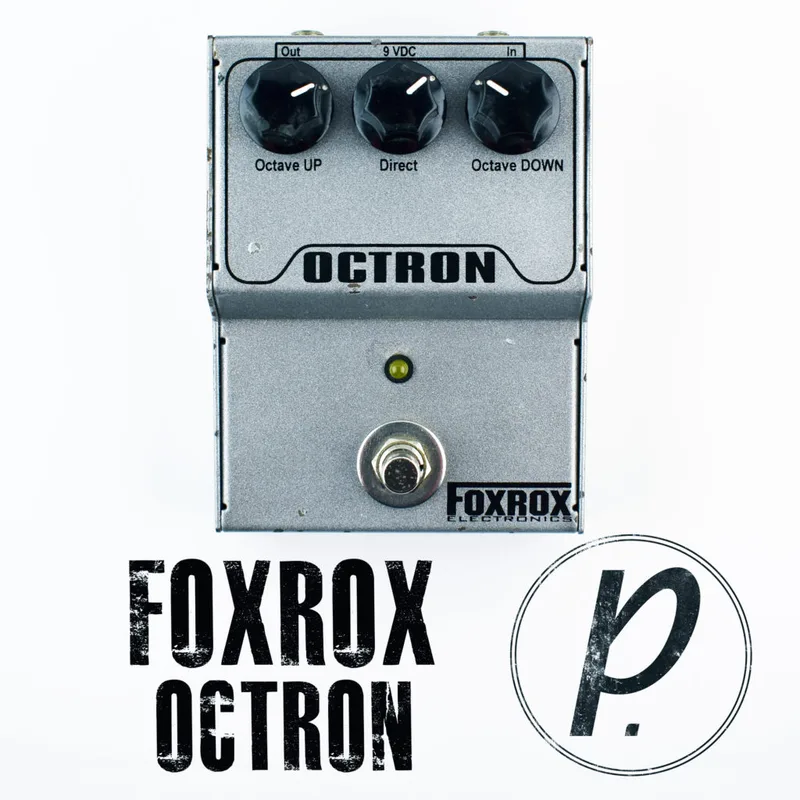
The original design has also echoed elsewhere in the pedal world: the Foxrox Electronics Octron Octave Divider includes an octave-down section based on classic Mu-Tron, OC-2 and Octaplus sounds of the past12.
Gearnews' overall verdict on the Behringer version was positive for what it is6:
"This could be a great little product for anyone that wants that classic '70s effect but just can't find or afford a Mu-Tron original"6
Videos
Behringer
Pedal Experiments
THE PEDAL COUPLE
Questions
Does the Behringer Octave Divider take a battery?
No. The pedal runs from an external power supply only, using standard 9 to 12 volt DC. The original 1970s Mu-Tron Octave Divider also had to be plugged into a wall outlet, so the Behringer version follows the same approach, just at pedalboard-friendly voltages.
Does the Behringer Octave Divider work on bass?
Yes. Behringer describes it as suitable for electric guitars, bass guitars and keyboards, and the BASS ONLY switch cuts the dry signal completely so only the sub-octave remains. The Mu-Tron original it recreates also tracks on keyboards and horns, and pairs well with the Micro-Tron IV envelope filter.
What does the Stabilize switch do?
It improves note tracking. Flipping the Stabilize switch on helps the octave-down circuit follow your playing more reliably, which matters most on guitar and other plucked instruments where tracking an octave divider can otherwise glitch.
What does the Ringer function do?
The Ringer is a built-in ring modulator that adds harmonic emphasis on the upper tones and special multi-note effects. It comes from the Green Ringer ring modulator originally released by Dan Armstrong, which was paired with the octave-down circuit in the original Mu-Tron Octave Divider.
Sources (12)
- OCTAVE DIVIDER, Behringer
- Behringer DUAL-PHASE: Clone of the Legendary Mu-Tron Bi-Phase Now With 54% Off!, gearnews.com, 2025-06-03
- Behringer endeavors to emulate Mu-Tron's classic octave circuit with the faithfully spec'd Octave Divider, Guitar World, 2021-12-10
- Guitar Journal: QOTSA, Mu-Tron vs Behringer, & Black Sabbath, gearnews.com, 2025-02-11
- Octave Divider by Behringer, RockBoard (PedalPedia), 2026
- Behringer Octave Divider: A clone of the classic 1970s Mu-Tron Octave Divider, gearnews.com, 2021-12-09
- Octave Divider, Musitronics Mu-Tron
- Octave Divider Vintage Silver, Musitronics Mu-Tron (mu-tron.com)
- Mu-FX Octave Divider Review, Premier Guitar, 2015-06-09
- Mu-FX Octave Divider, Musitronics Mu-Tron (mu-tron.com)
- Mu-Tron Octave Divider, Musitronics Mu-Tron
- Foxrox Electronics Octron Octave Divider, Pedal of the Day (www.pedal-of-the-day.com), 2017-02-08