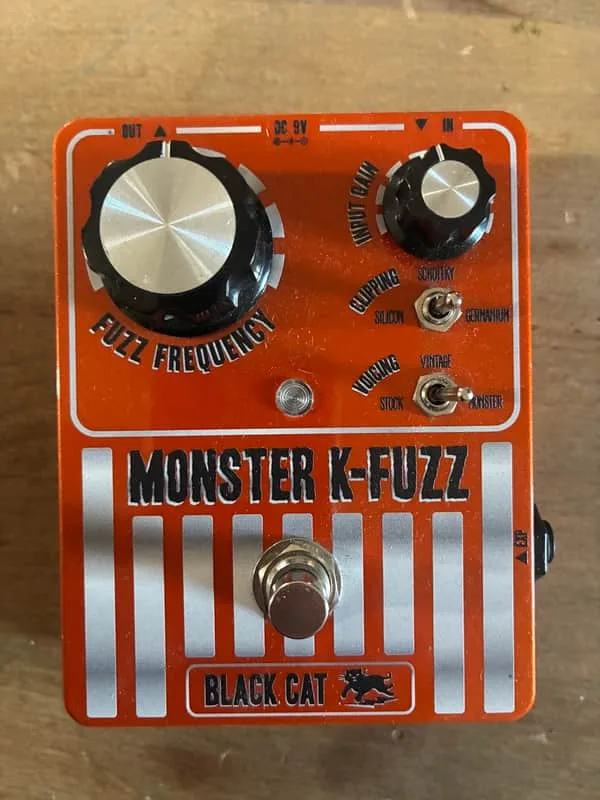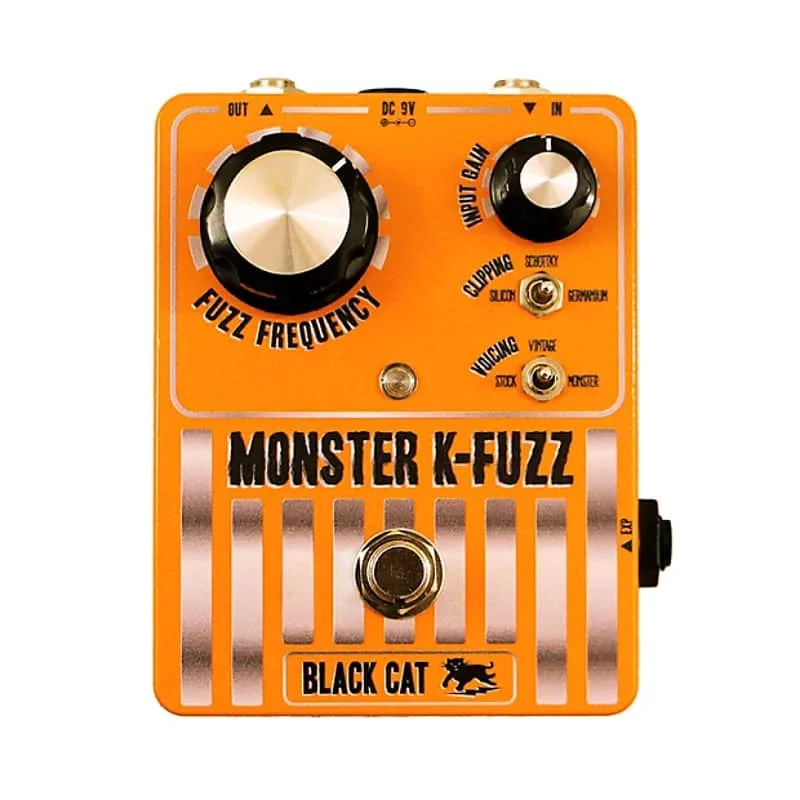


The Black Cat Monster K-Fuzz is an octave fuzz stompbox from Black Cat, designed by Tom Hughes and built on the circuit of the 1960s Kay Fuzztone. Delicious Audio calls it "an octave fuzz that is capable of complete sonic mayhem"1. What sets it apart from most octave fuzzes is that its fuzz frequency, the filter point that shapes the effect, can be swept in real time with a standard expression pedal, recreating the treadle action of the original Kay unit12.
The pedal was announced at Summer NAMM 2016 as a "pedalboard friendly" stompbox, hand-built in the USA, retailing for $1952. Premier Guitar's 2021 review listed the street price at $1953.
An octave fuzz built on the Kay Fuzztone
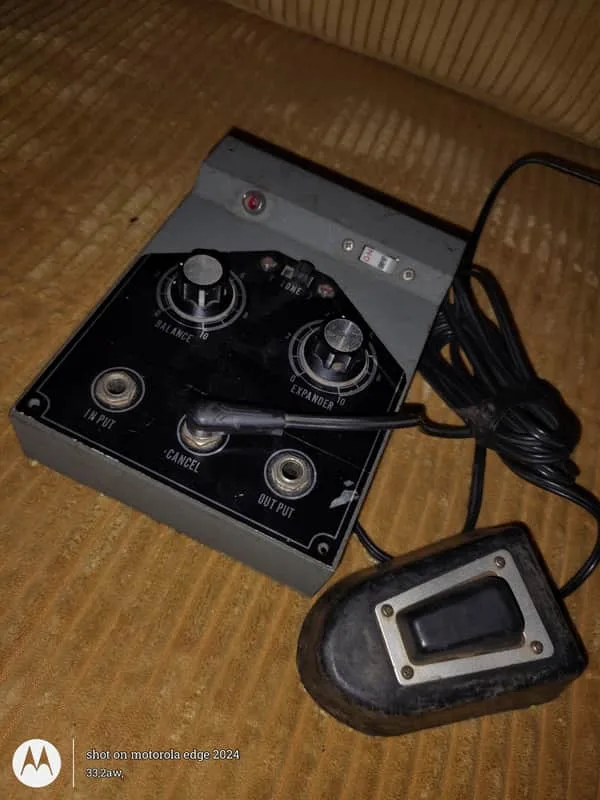
The Kay Fuzztone was, in Delicious Audio's words, "a quirky, cheap looking, treadle-based fuzz pedal from the 60's"1. Rather than a stompbox, it was a treadle unit you rocked with your foot, like a wah, and its fuzz character changed as you swept it.
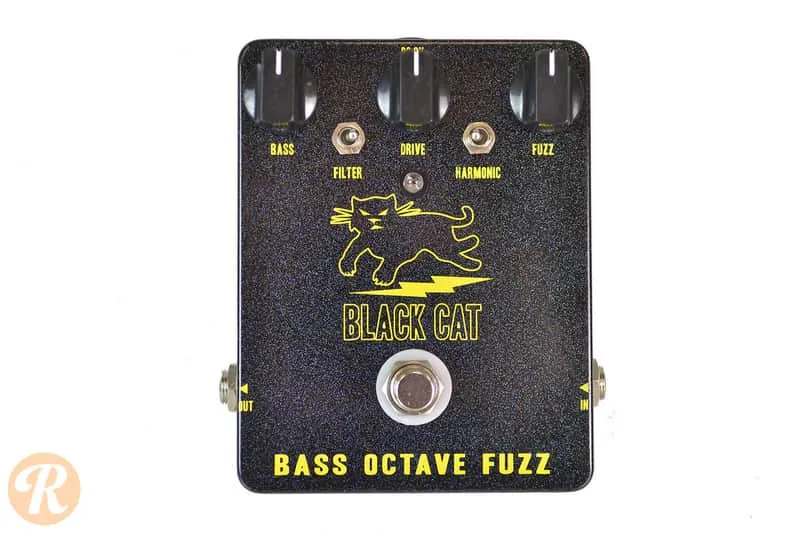
Tom Hughes of Black Cat Pedals was, in Premier Guitar's description, "one of the first to nail the Kay Fuzz sound and functionality when he built a clone into a standard wah enclosure"3. Premier Guitar introduced him as an effects guru when the pedal was announced at Summer NAMM 20164. Black Cat's first take was the Custom K-Fuzz, a clone of the Kay design, and the Monster K-Fuzz developed the idea further1.
Expression pedal control of the fuzz frequency
The core of the pedal is the fuzz frequency control. The signal first hits an input gain control, then moves to the voicing section1. The fuzz frequency knob sets the point where high and high-mid content is filtered relative to the low-end output, and you can create the classic Kay effect by parking that knob in the right place relative to your guitar's output3.
The same control can be manipulated via an external expression pedal, which Delicious Audio describes as enabling "real-time madness"1. Guitar.com's announcement noted that expression pedal control of the fuzz frequency "allows the same functionality as the former treadle based versions"2.
The input gain control also shapes the feel of the frequency sweeps and pick attack, taking on an almost compressed quality at maximum settings3.
Premier Guitar's reviewer lists the need for an expression pedal as a con: you'll need to use or invest in one "to get true Kay Fuzz-style performance"3. The pedal works without one, but the treadle-style sweep is the point of the design.
Clipping and voicing modes
The Monster K-Fuzz offers three clipping settings and three voicing modes that can be mixed and matched3:
| Setting | What it does |
|---|---|
| Germanium clipping | Like the original Kay Fuzztone1 |
| Silicon clipping | Adds extra cut and definition, suited to a loud band setting3 |
| Schottky clipping | Ridiculously loud, a little less harmonically complex and dynamic, but can rise above the loudest band3 |
| Vintage voicing | With germanium clipping, approximates the sound of the original Kay Fuzz3 |
| Monster voicing | Provides a nice boost to the bottom end3 |
Premier Guitar's reviewer loved "the warm glow and softer edges of the germanium diode setting mixed with the vintage-voicing mode"3.
How it handles chords and single notes
As with most fuzz pedals, the Monster K-Fuzz tracks much better on single notes than with chords1. Premier Guitar's reviewer found the sustain impressive and unusual, even with small amps, especially using the neck pickup above the 9th fret3.
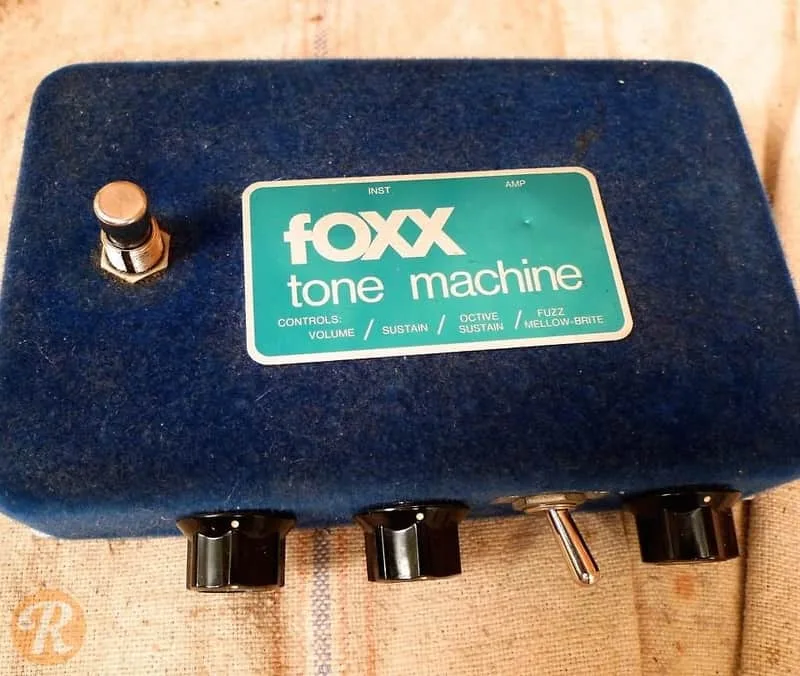
Compared with other octave-up pedals, the reviewer found the Monster K-Fuzz "much smoother, less clipped, and less likely to glitch out in the high-mid range at most settings" than pedals like the Shin-Ei Super Fuzz and Foxx Tone Machine3.
From treadle to stompbox
The Monster K-Fuzz has gone through two versions. The first-generation pedal, as Premier Guitar's reviewer described it, was very limited and expensive, and sported a treadle13. Delicious Audio characterizes that first version as "the horrific byproduct of nefarious experiments conducted by crossbreeding the Black Cat Custom K-Fuzz with our Deluxe Mona Wah"1.
The current version, presented at NAMM in a simple case, drops the treadle entirely1. Guitar.com announced it as a stompbox in a pedalboard-friendly enclosure, more affordable than the previous version, with the expression pedal input carrying the functionality the treadle used to provide2.
What reviewers said
Premier Guitar's 2021 review was positive overall, calling the pedal "an agreeable, adaptable, capable, and unique octave fuzz"3:
"This could be the most versatile Kay Fuzz-inspired pedal ever."
The reviewer's pros included a "dazzlingly smooth, dynamic, and expressive octave fuzz voice" and the useful, mix-and-match clipping and voice modes; the sole con was the expression pedal requirement3.
Videos
ProGuitarShopDemos
Premier Guitar
Coolpapabear
Questions
Do you need an expression pedal for the Monster K-Fuzz?
You can use the pedal on its own with the fuzz frequency knob, but Premier Guitar's reviewer found you need an expression pedal plugged into the fuzz frequency input to get true Kay Fuzz-style performance and the most authentic Kay Fuzz effects. The expression pedal sweeps the fuzz frequency in real time, replacing the treadle of the original.
Is the Black Cat Monster K-Fuzz true bypass?
Yes. The stompbox version uses a 3PDT true-bypass switch, along with Switchcraft jacks, and is hand-built in the USA. When the pedal is off, your signal passes through without buffering.
How does the Monster K-Fuzz handle chords?
Like most fuzz pedals, it tracks much better on single notes than with chords, according to Delicious Audio's review. For the strongest octave effect and sustain, single-note lines, especially on the neck pickup above the 9th fret, work best.
Who designed the Black Cat Monster K-Fuzz?
Tom Hughes of Black Cat Pedals. Premier Guitar describes him as an effects guru who was one of the first to nail the Kay Fuzz sound and functionality, having originally built a clone into a standard wah enclosure.
How is the Monster K-Fuzz different from the Black Cat K-Fuzz?
The Custom K-Fuzz is Black Cat's straight clone of the Kay design. The first-generation Monster K-Fuzz was effectively that clone crossed with Black Cat's Deluxe Mona Wah treadle, while the current stompbox version drops the treadle and adds switchable clipping and voicing modes in a pedalboard-friendly enclosure.
Sources (4)
- Black Cat Monster K-Fuzz, Delicious Audio, 2017-04-27
- Summer NAMM 2016: Black Cat announces Monster K-Fuzz, Guitar.com, 2016-06-21
- Black Cat Monster K-Fuzz Review, Premier Guitar, 2016-11-24
- Black Cat K-Fuzz & Vibe Stereo Demos, Premier Guitar, 2016-07-05