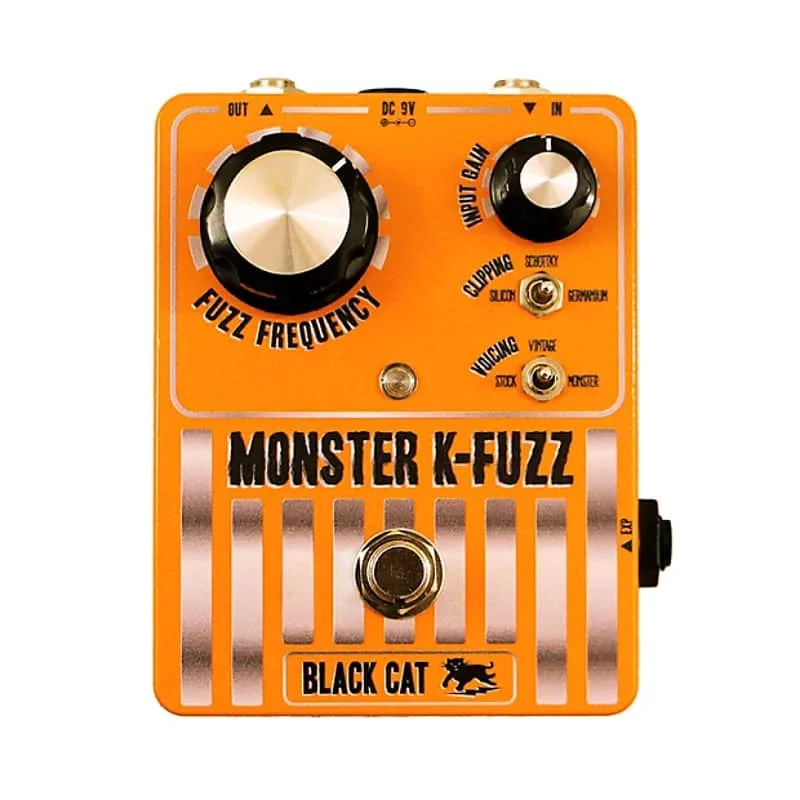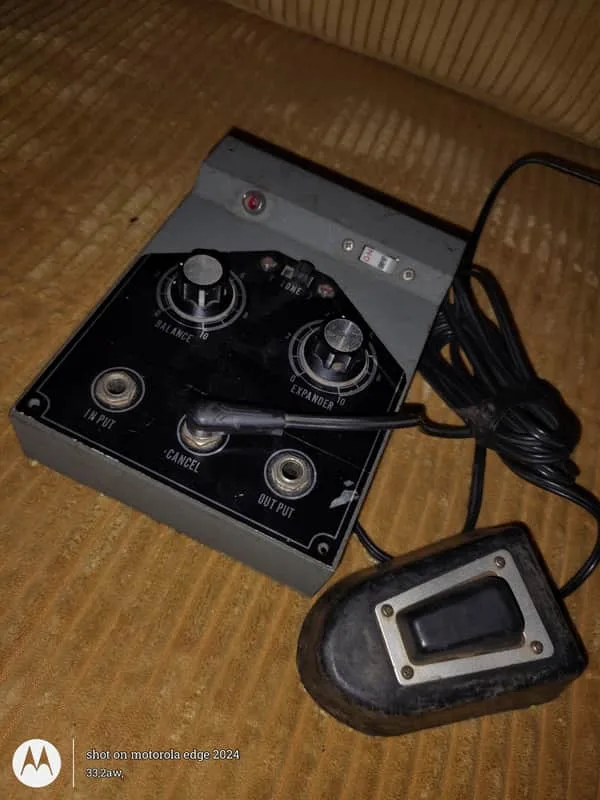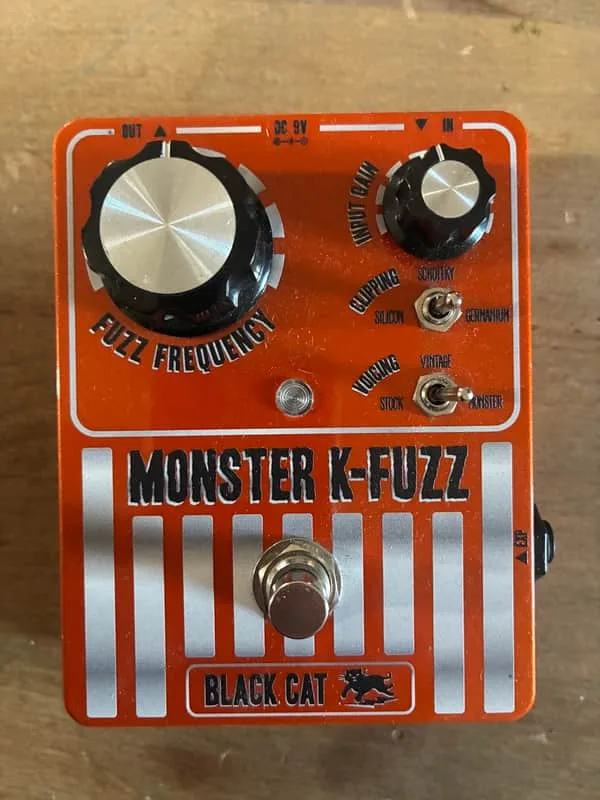


The Black Cat Monster K-Fuzz is an octave fuzz stompbox from Black Cat Pedals, built as a modern recreation of the 1960s Kay Fuzztone. The Kay was, as Delicious Audio's Paolo De Gregorio put it, "a quirky, cheap looking, treadle-based fuzz pedal from the 60's," and Black Cat's Tom Hughes was, in Premier Guitar's words, "one of the first to nail the Kay Fuzz sound and functionality when he built a clone into a standard wah e[nclosure]"1. The Monster K-Fuzz carries that circuit into a compact box with switchable clipping, voicing modes, and expression-pedal control of the fuzz frequency.
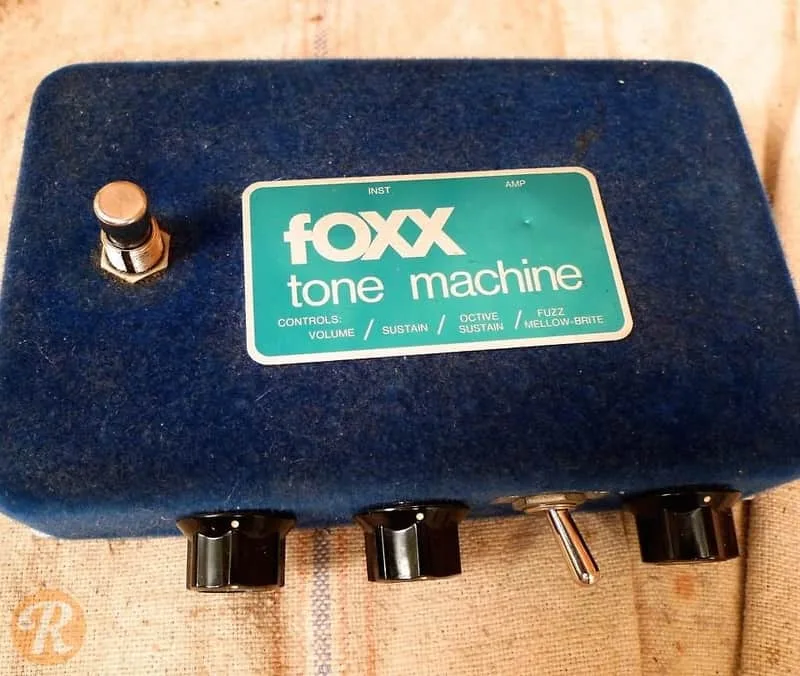
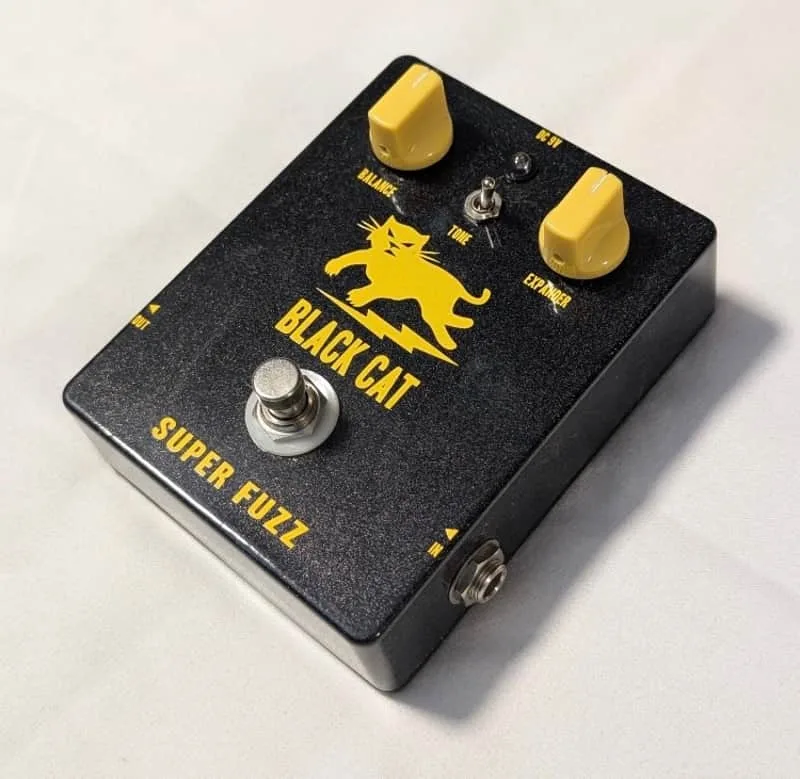
The pedal sits in the fuzz family but works differently from most octave-up boxes. Where pedals like the Shin-Ei Super Fuzz and Foxx Tone Machine can get harsh in the upper mids, Premier Guitar's reviewer found "the Monster K is much smoother, less clipped, and less likely to glitch out in the high-mid range at most settings"1.
An octave fuzz in the Kay Fuzztone style
The original Kay Fuzz Tone delivered what Premier Guitar calls "the rich, searing octave fuzz of the Kay Fuzz Tone"4, and the Monster K-Fuzz is built to bring that sound back. Delicious Audio describes the result as "an octave fuzz that is capable of complete sonic mayhem"3.
The lineage runs through Black Cat's own Custom K-Fuzz, a clone of the Kay design. The first Monster K-Fuzz was, in De Gregorio's telling, "the horrific byproduct of nefarious experiments conducted by crossbreeding the Black Cat Custom K-Fuzz with our Deluxe M[ona Wah]"3. Premier Guitar notes that this first-generation pedal "was very limited and expensive," and that the pedal later returned in a more accessible form1.
Like most fuzz pedals, it favors single-note work. De Gregorio found that "as with most fuzz pedals it tracks much better on single notes than with chords"3. On the plus side, Premier Guitar's reviewer found the sustain notable: "The sustain at these settings is also impressive and unusual, even with small amps," especially with the neck pickup above the 9th fret1.
Controls and expression input
The signal path starts with an input gain control before moving to the voicing section3. Premier Guitar's reviewer found the input gain control shapes the feel of the frequency sweeps and pick attack, with "an almost compressed quality at maximum settings"1.
| Control | What it does |
|---|---|
| Input gain | First stage of the signal path; alters the feel of frequency sweeps and pick attack, nearly compressed at maximum13 |
| Voicing switch | Selects voicing modes; the "Monster" position provides a nice boost to the bottom end3 |
| Clipping switch | Germanium position, like the original Kay, or silicon3 |
| Fuzz Frequency knob | Sets the point where high and high-mid content is filtered relative to low-end output1 |
| Expression input | Lets an external expression pedal control Fuzz Frequency in real time3 |
The Fuzz Frequency control is the heart of the pedal. Premier Guitar's reviewer explains that "you can create this effect by parking the fuzz frequency knob in the right place relative to the output from your guitar"1. Delicious Audio adds that the control "can be manipulated via external expression pedal for real-time madness"3.
Premier Guitar's review lists "Requires expression pedal to get the most authentic Kay Fuzz effects" among the pedal's cons. The pedal works without one, but the treadle-style sweep of the original Kay is only fully available with an expression pedal attached1.
Clipping and voicing options
The clipping switch offers two diode types3:
- Germanium: "like in the original" Kay, per Delicious Audio3. Premier Guitar found that germanium diode clipping with the vintage voicing mode approximates the sound of the original Kay Fuzz1.
- Silicon: Premier Guitar found it "adding extra cut and definition that's fine in a loud band setting" when paired with the vintage and stock voicing modes1.
The voicing switch includes a "Monster" position, which "provides a nice boost to the bottom end"3. Premier Guitar's reviewer called the clipping and voice modes "useful, mix-and-match" in combination1.
Treadle and stompbox versions
The Monster K-Fuzz has existed in two forms. The first version sported a treadle, in the manner of the original Kay Fuzztone3. The version announced at Summer NAMM 2016 is a stompbox without the treadle, hosted in a simple case that Guitar.com described as a "pedalboard friendly" enclosure, and more affordable than the previous version32.
The treadle's function did not disappear. Guitar.com reported that "Expression pedal control of the Fuzz Frequency allows the same functionality as the former treadle based versions"2. Premier Guitar also notes that the latest version "comes with new clipping, voicing, and gain features that broaden its usability" beyond the first generation1.
What reviewers said
Premier Guitar's 2021 review was positive on the whole, listing as pros a "dazzlingly smooth, dynamic, and expressive octave fuzz voice" and the mix-and-match clipping and voice modes, and concluding that "This could be the most versatile Kay Fuzz-inspired pedal ever"1. Its verdict on the pedal overall: "Black Cat's Monster K-Fuzz is an agreeable, adaptable, capable, and unique octave fuzz"1. The listed cons were the expression pedal requirement for the most authentic Kay effects1.
Delicious Audio's 2017 review framed the pedal as the idea of the Kay Fuzztone ushered "into the modern era (and developed it further)"3.
Price
The stompbox version retailed for $195 at its 2016 launch2, and Premier Guitar listed the street price as $195 in its 2021 review1. The earlier first-generation version was limited and more expensive1.
Videos
ProGuitarShopDemos
Premier Guitar
Coolpapabear
Questions
Is the Black Cat Monster K-Fuzz true bypass?
Yes. The stompbox version uses a 3PDT true-bypass switch along with Switchcraft jacks, so your clean signal passes through untouched when the pedal is off.
Does the Monster K-Fuzz need an expression pedal?
Not strictly, but Premier Guitar's reviewer listed it as a requirement for getting the most authentic Kay Fuzz effects. The Fuzz Frequency control can be swept in real time with an external expression pedal, which gives the same functionality as the original treadle-based versions of the pedal.
Who designed the Black Cat Monster K-Fuzz?
Tom Hughes of Black Cat Pedals. Premier Guitar describes him as one of the first to nail the Kay Fuzz sound and functionality when he built a clone into a standard wah enclosure, and the Monster K-Fuzz grew out of that work.
Where is the Black Cat Monster K-Fuzz made?
The stompbox version is hand-built in the USA, according to the 2016 launch announcement from Guitar.com.
Does the Monster K-Fuzz use germanium clipping?
It can. The clipping switch has a Germanium position, like the original Kay, and Premier Guitar found that germanium diode clipping with the vintage voicing mode approximates the sound of the original Kay Fuzz. A silicon option is also available.
How much does the Monster K-Fuzz cost?
The stompbox version retailed for $195 at its 2016 launch, and Premier Guitar listed the street price as $195 in its 2021 review. The earlier first-generation version was limited and more expensive.
Sources (4)
- Black Cat Monster K-Fuzz Review, Premier Guitar, 2016-11-24
- Summer NAMM 2016: Black Cat announces Monster K-Fuzz, Guitar.com, 2016-06-21
- Black Cat Monster K-Fuzz, Delicious Audio, 2017-04-27
- JHS Pedals Legends of Fuzz Mary-K Video Demo, Premier Guitar, 2023-05-04