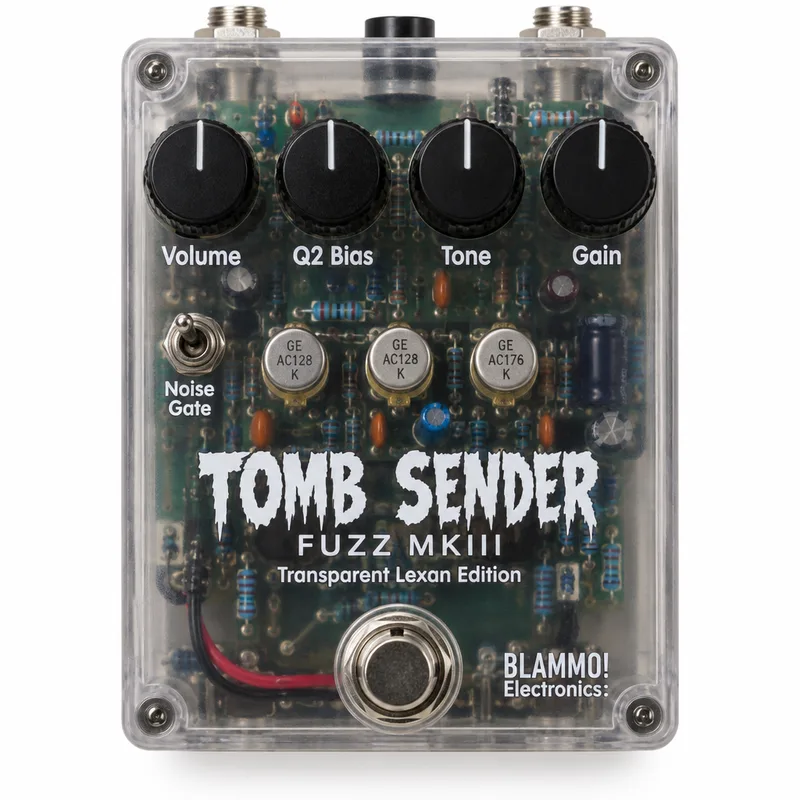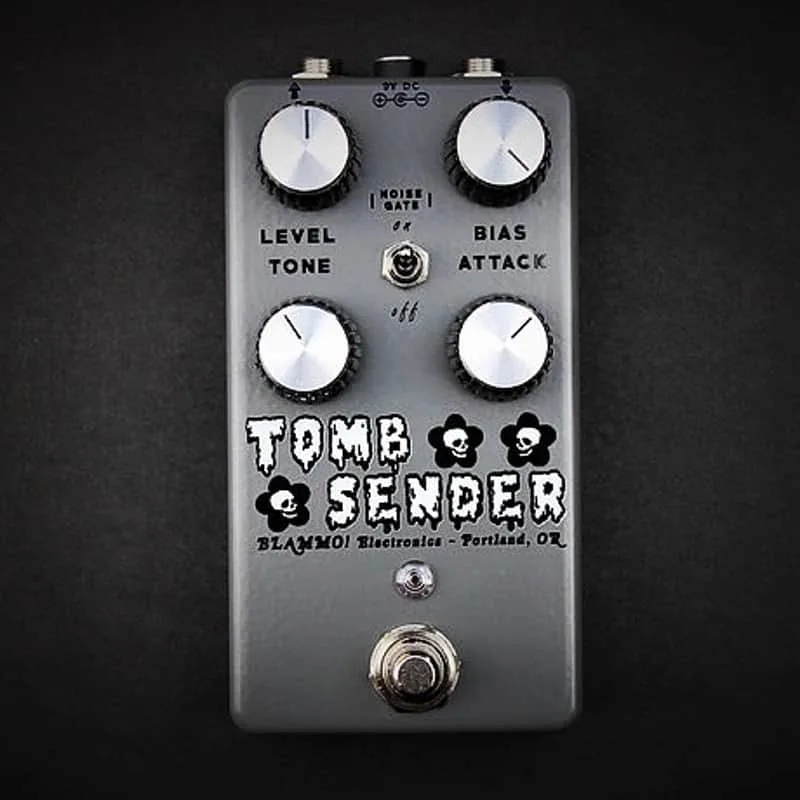



The BLAMMO! Electronics Tomb Sender is a germanium fuzz pedal built on the Sola Sound Tone Bender MkIII circuit. BLAMMO! calls it a "new-meets-old" take on the classic, using hand selected new-old-stock NPN germanium transistors, carbon composition resistors, and accurate component values to keep the heart of the circuit true to the original1. The specific transistors are NOS MP38a germaniums1.
What sets it apart from a straight reproduction is the extra control: a Bias knob that starves the second transistor for gated, splattery sounds, and a built-in noise gate toggle that keeps the background hiss of a germanium fuzz in check between notes1. It is handmade in Portland, Oregon1.
A germanium fuzz with a built-in noise gate
Germanium fuzzes are prized for their warm, vintage clipping character, but the old circuits also leak hiss and background noise between notes. The Tomb Sender addresses that directly: the toggle switch in the middle of the pedal operates a simple noise gate that cuts a good portion of the background noise between notes1. For a player who wants vintage Tone Bender tones on a modern pedalboard, that gate is the practical difference between this and a faithful clone.
The pedal sits in BLAMMO!'s wider line of vintage-circuit fuzzes, alongside the Tomb Sender Ge Fuzz, the earlier version Delicious Audio described as "a Germanium fuzz with an extra gain stage for more output and a beefed-up EQ section"2, and the Tomb Sender Fuzz MKIII Transparent Lexan Edition, which Guitar Pedal X listed among the best new fuzz pedals of 20203.
"Break your signal a little…..or send it six feet underground."
The controls
The Tomb Sender carries four knobs and a toggle, laid out for both classic and broken sounds3:
| Control | What it does |
|---|---|
| Attack | Sets the fuzz gain: more bite and compression when high, a more open and raw tone when dialed left1 |
| Bias | Controls the voltage level of the second germanium transistor: zippy, Velcro-like splattery and gated sounds at the lowest setting, familiar Tone Bender MkIII sounds turned all the way up1 |
| Tone | More bass frequencies without cutting the highs when turned left; more highs with some bass cut when turned right1 |
| Volume | Standard level control, with extra output so the signal will not dip below unity gain on the skronkier settings1 |
| Toggle switch | Operates the noise gate, cutting background noise between notes; works with the Bias knob to tune broken and dying battery sounds1 |
The Bias knob is the one that reaches beyond stock Tone Bender territory. Where the original MkIII had fixed transistor bias, here you can pull the second transistor's voltage down for the gated, Velcro-rip sounds players usually chase with a dying battery, then bring it back up for the standard MkIII voice1. The Volume control's extra headroom matters here: extreme Bias settings normally cost volume on vintage-style circuits, and BLAMMO! says the Tomb Sender's output keeps the signal from dipping below unity gain on those settings1.
Guitar Pedal X's review of the Transparent Lexan Edition listed the control set as "Volume, Q2 Bias, Tone, Gain, and a Noise Gate toggle-switch," the same arrangement under slightly different knob names3.
A Tone Bender MkIII circuit with NOS transistors
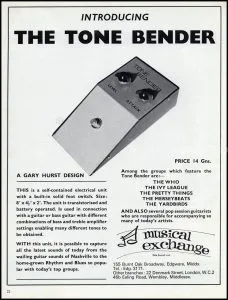
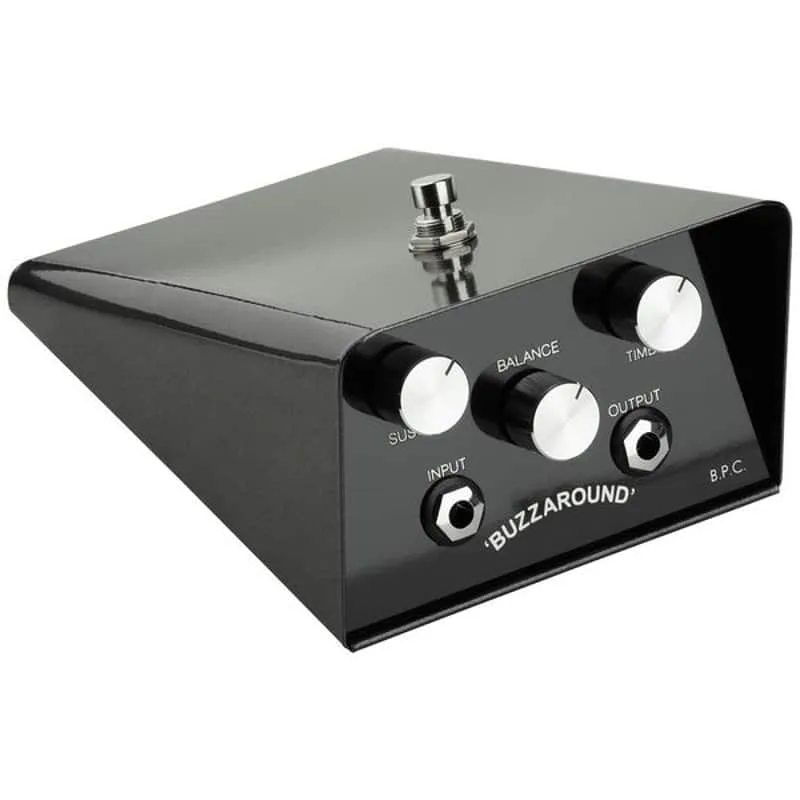
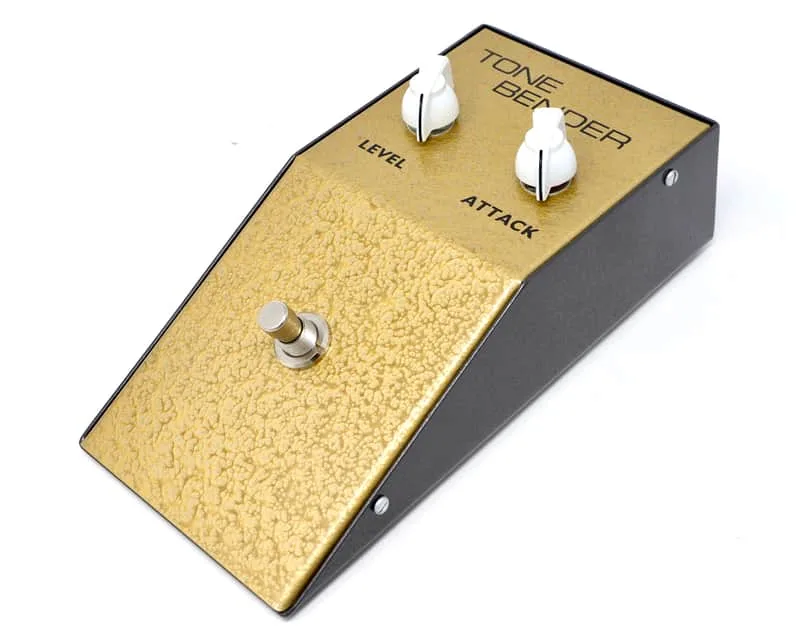
The Tomb Sender traces back to the Sola Sound Tone Bender MkIII, a three-transistor germanium fuzz from the late 1960s. Guitar World's Trevor Curwen describes the Mk III as "the three germanium transistor-equipped Mk III Tone Bender from the late '60s"4. Fuzzboxes.org notes that some of the earliest Tone Bender MKIIIs, with the same basic circuit, came with a variety of black glass Mullard, NKT and TI transistors, and that the germanium version of the Vox Tone Bender MKIII was loosely based on the earlier Baldwin-Burns Buzzaround5.
BLAMMO!'s version keeps that topology but sources its own transistors: hand selected NOS MP38a germaniums, an NPN type, paired with carbon composition resistors and accurate component values1. Delicious Audio's write-up of the Tomb Sender Ge Fuzz made the same point about that version's parts selection2.
The Tone Bender family history runs deeper than the MkIII. The earlier Sola Sound Tone Bender MKI used a three-transistor circuit with black glass Mullard germaniums, and BLAMMO! also builds a hand-wired point-to-point version of the Tone Bender MKII circuit. The Tomb Sender is the company's MkIII chapter of that lineage1.
The Tomb Sender runs on a standard 2.1mm center negative supply, Boss style, drawing 38mA1. That is the common pedalboard standard, so it fits typical isolated supplies without an adapter.
Videos
AndyDemos
Iga Massardi
Theo And His Pedals
Questions
Is the BLAMMO! Tomb Sender based on a Tone Bender?
Yes. BLAMMO! describes it as a new-meets-old take on the Sola Sound Tone Bender MkIII, and Delicious Audio calls it a modern take of the venerable Tone Bender MkIII. The circuit uses hand selected new-old-stock NPN germanium transistors, specifically NOS MP38a germaniums, with carbon composition resistors and accurate component values.
Is the Tomb Sender true bypass?
Yes. The pedal uses an updated relay based true bypass switching system, with a no-click footswitch. Delicious Audio's write-up of the earlier Tomb Sender Ge Fuzz likewise lists relay based true bypass.
What power does the Tomb Sender need?
It runs on a standard 2.1mm center negative power supply, Boss style, and draws 38mA. That is the same connector polarity as most modern pedals, so it fits typical pedalboard power supplies.
What does the Bias knob do on the Tomb Sender?
The Bias knob controls the voltage level of the second germanium transistor. Set lowest, it gives zippy, Velcro-like splattery and gated sounds; turned all the way up, it produces the familiar Tone Bender MkIII sounds. It also works with the noise gate toggle to fine tune broken and dying battery sounds.
What does the toggle switch do on the Tomb Sender?
The toggle switch operates a simple noise gate that cuts a good portion of the background noise between notes. It also works together with the Bias knob to finely tune broken and dying battery sounds.
Where is the BLAMMO! Tomb Sender made?
BLAMMO! says the Tomb Sender is carefully handmade in Portland, Oregon. Delicious Audio describes the earlier Tomb Sender Ge Fuzz as designed and soldered by hand in Portland, Oregon.
Sources (5)
- Tomb Sender, BLAMMO! Electronics
- BLAMMO! Electronics Tomb Sender Ge Fuzz, Delicious Audio, 2020-12-04
- Guitar Pedal X, Guitar Pedal X, 2020-12-18
- Electro-Harmonix Bender Royale review, Guitar World, 2026-01-13
- Vox Tone Bender MKIII • Fuzzboxes, Fuzzboxes.org, 2021-05-30