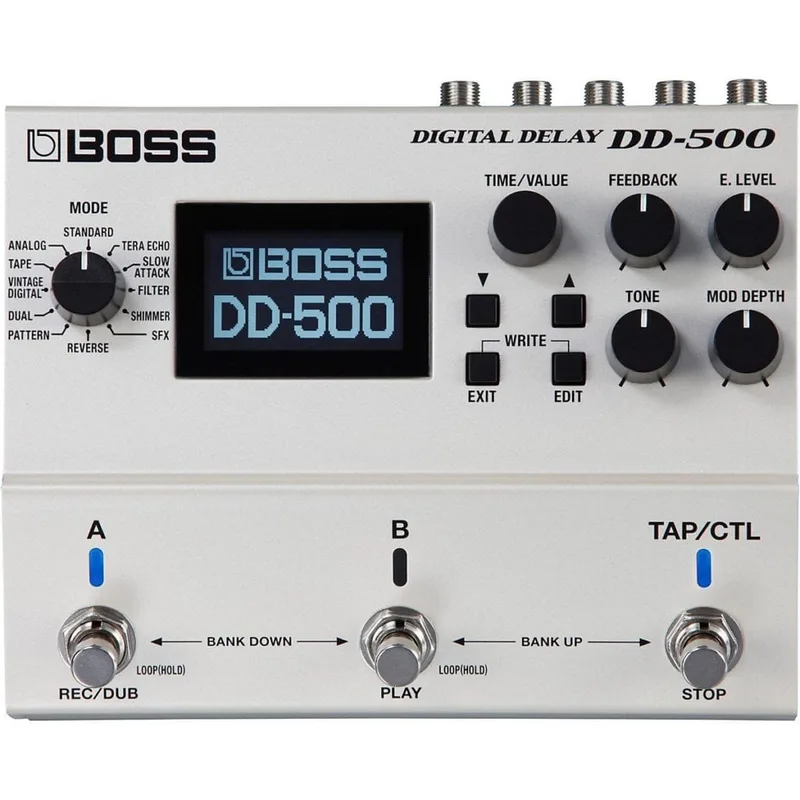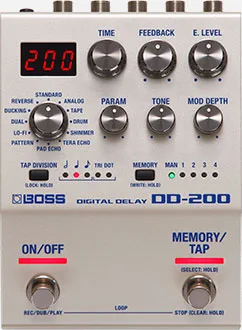


The Boss DD-200 is a compact digital delay pedal from Boss, released in 2019, that packs the sounds and features of the flagship DD-500 into a smaller, more pedalboard-friendly enclosure12. A rotary switch selects from 12 delay modes, from clean modern digital to classic analog emulations, and a built-in looper with up to 60 seconds of recording time is always ready to use34.
Under the hood it is a fully digital design: 32-bit AD/DA conversion, 32-bit floating-point processing and a 96 kHz sampling frequency4. Guitar World's reviewer called it "the full meal deal" for guitarists seeking a delay pedal for all occasions, praising its comprehensive variety of effects and sophisticated looper4.
What it does: 12 delay modes and a looper
The rotary mode switch provides 12 delay effects: Standard, Analog, Tape, Drum, Shimmer, Tera Echo, Pad Echo, Pattern, Lo-Fi, Dual, Reverse and Ducking4. Several modes are modeled on classic hardware:
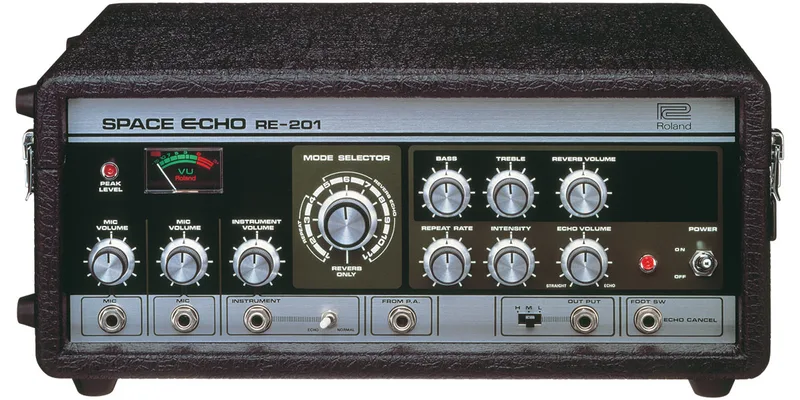
- Tape emulates the warm tape-based sound of the Roland RE-201 Space Echo, with selectable combinations of heads38
- Drum models the Binson Echorec 2 drum echo3
- Analog emulates Boss DM series BBD delays3
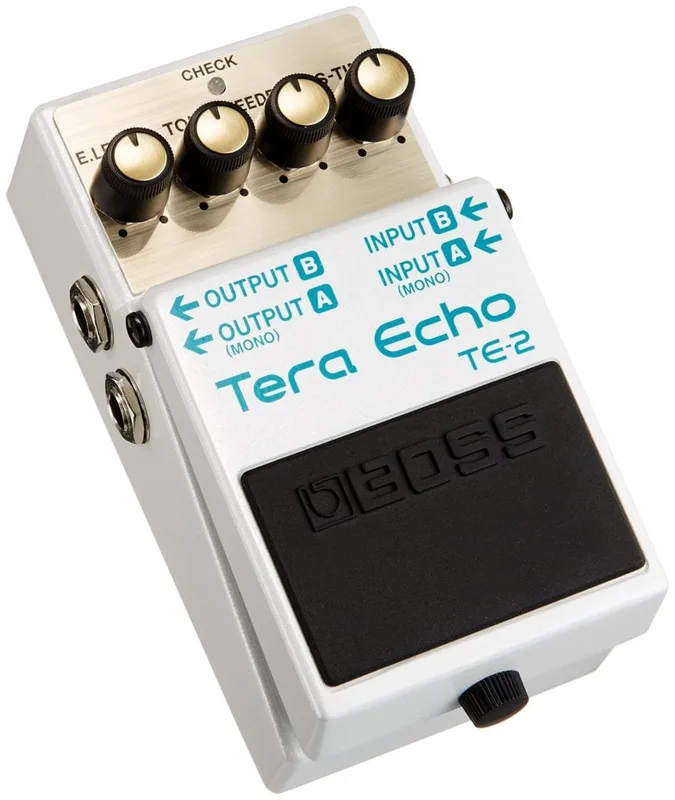
- Tera Echo derives from the Boss TE-2 Tera Echo pedal3
- Standard is a clear digital delay, with the PARAM knob adjusting the delay attack3
On That Pedal Show, Mick Taylor noted the Drum mode's lineage: "one setting that says drum and that refers of course to the binson eor"8. In the Tape mode, the parameter knob shows the heads on the display as you turn it8.
"this is based on an re 201 and you can again get different combinations of heads"
The PARAM knob's function changes in each mode to parameters tailored for the selected type, which Boss describes as delivering extended control without menu diving3. There is also a looper that is always ready to use, boasting up to 60 seconds of recording time4.
For bass players, a Boss article by Lee Glynn suggests Standard mode with a Time of 300-400 ms for short, rhythmic echoes, and Feedback kept low at 1-2 repeats so the delay will not muddy the low end10.
The controls and footswitches
The panel carries six knobs for on-the-fly control, a 12-position mode rotary selector, and a three-character LED display that replaces the DD-500's graphic LCD to save space7114. A pair of mini switches select Tap Division settings: half-, quarter- and eighth-note, triplet and dotted4.
| Control | What it does |
|---|---|
| Mode rotary selector | Chooses one of the 12 delay modes12 |
| PARAM knob | Changes function per mode for mode-specific parameters3 |
| TIME knob | Sets delay time10 |
| Feedback knob | Sets number of repeats10 |
| Mini switches | Select Tap Division (half, quarter, eighth, triplet, dotted)4 |
| Three-character LED | Shows delay time, memory number and more4 |
The two multi-function footswitches provide bypass, memory scrolling, tap tempo and looper control by default, and can be reassigned to hold, warp and other functions3. The On/Off footswitch consolidates the DD-500's A and B footswitch functions and controls record, overdub and play in Looper mode, while the Memory/Tap Tempo footswitch controls stop and clear functions4. The Tap Tempo footswitch has a press-and-hold function that makes presets fully footswitchable12.
External control is also possible via additional footswitches or an expression pedal, connected at the rear panel alongside the stereo input and output jacks34.
Power and connections
The DD-200 runs on a PSA-series AC adaptor or three AA-size batteries7, drawing 225 mA5. MusicRadar lists it as 9V DC or 3xAA batteries13.
At 225 mA, the DD-200 draws more current than a typical analog pedal, so a daisy chain shared with several other pedals may not keep up. An isolated or adequately rated 9V supply is the safer choice5.
MIDI I/O is provided on space-saving mini TRS jacks, with the BMIDI-5-35 adaptor cable available separately7. The 127 user memories can be recalled from the panel or via MIDI1.
Key audio specifications from Guitar World's review4:
| Specification | Value |
|---|---|
| Sampling frequency | 96 kHz |
| AD/DA conversion | 32 bits |
| Processing | 32-bit floating point |
| Nominal input/output level | -10 dBu |
| Maximum input/output level | +7 dBu |
| Input impedance | 2 M ohm |
| Output impedance | 1 k ohm |
DD-200 versus DD-500
The DD-200 brings together sounds and features inherited from the flagship DD-500 in a smaller footprint54. When Boss announced the 200 series in 2019, MusicRadar described the DD-200 as trimming down the triple-footswitched DD-500 into a smaller enclosure2. The DD-500, released in 2015, also offers 12 delay modes, 32-bit/96 kHz processing, a looper with up to 120 seconds of recording time, and an A/B Simul mode for running two delays at once14151.
The main trade-offs going smaller: the DD-200 replaces the DD-500's graphic LCD with a three-character LED, consolidates the A and B footswitches into one On/Off footswitch, and its looper records 60 seconds rather than the DD-500's 12041514. MusicRadar's review lists "there are compelling reasons to choose the DD-500 over this" among its reasons to avoid the DD-20013.
Firmware updates
Boss has issued several system program updates for the DD-200, downloadable from its support site11:
- Ver. 1.10 (January 2020): increased storable memories from 5 to 128, and added a function that always indicates the memory number on the display11
- Ver. 1.12 (December 2021): fixed an issue where MIDI control change messages immediately after a memory change to MEMORY 005-127 were ignored11
- Ver. 1.13 (November 2023): fixed an issue where, when switching memory during MIDI Sync, the delay time did not change according to the tap division set in the memory11
- Ver. 1.14 (July 2025): fixed a bug where, with tempo hold set to "on", the delay time did not change correctly11
To check your firmware version, hold down the MEMORY button and insert a plug into the INPUT A jack; the version appears on the display. If it shows version 1.14 or later, no update is needed11.
Updating requires the DD-200, a USB cable, and a Windows or Mac computer with a USB port compliant with USB 2.0 or USB 3.0 running an UpdSMF player. To enter update mode, hold down the TIME knob and insert a plug into the INPUT A jack; "UPd" appears on the display, and the update is then sent over MIDI11.
Boss warns that updating in normal mode against the correct procedure may destroy the system program, and that you must never power off the DD-200 while an update is in progress, or the unit will require servicing at a Roland service center11.
Videos
Pete Thorn
BOSSchannel
Brett Kingman
Questions
Can the Boss DD-200 run on batteries?
Yes. The DD-200 runs on a 9V DC power supply (Boss PSA-series adaptor) or on three AA-size batteries, which is unusual for a pedal with this much processing on board. It draws 225 mA, so an isolated or adequately rated supply is the practical choice for a permanent pedalboard.
How long is the DD-200 looper?
The built-in looper offers up to 60 seconds of recording time. It is always ready to use, with the On/Off footswitch handling record, overdub and play, and the Memory/Tap Tempo footswitch handling stop and clear functions.
How many presets does the DD-200 store?
The DD-200 has 127 user memories plus a real-time panel setting, for 128 total setups. A firmware update in January 2020 increased the storable memories from 5 to 128, and memories can be recalled from the panel or via MIDI.
What is the difference between the DD-200 and the DD-500?
The DD-200 inherits its sounds and features from the flagship DD-500 but puts them in a smaller enclosure, replacing the DD-500's graphic LCD with a three-character LED and consolidating the DD-500's A and B footswitches into a single On/Off footswitch. MusicRadar's review notes there are still compelling reasons to choose the DD-500.
How do I check the firmware version on a DD-200?
Hold down the MEMORY button and insert a plug into the INPUT A jack. The version number appears on the display. As of July 2025 the latest system program is version 1.14; if your unit shows 1.14 or later, no update is needed.
Does the DD-200 have MIDI?
Yes. The DD-200 provides full MIDI I/O on space-saving mini TRS jacks, with the BMIDI-5-35 adaptor cable available separately. The 127 user memories can be recalled via MIDI, and firmware updates are sent over MIDI using an UpdSMF player.
Sources (15)
- Echoes in Time: The History of BOSS Delay Pedals, BOSS (articles.boss.info), 2024-01-10
- Boss looks to the future with 4 premium 200 series effect pedals, MusicRadar, 2019-06-13
- BOSS - DD-200 | Digital Delay, boss.info
- Boss DD-3T and DD-200 Digital Delay review, Guitar World, 2020-05-28
- DD-200 Digital Delay by BOSS, RockBoard (rockboard.de PedalPedia), 2026
- Boss DD-200 Digital Delay Review, Premier Guitar, 2019-10-25
- BOSS DD-200 Digital Delay, Delicious Audio, 2020-07-08
- T-Rex Binson Echorec Vs Vintage Baby Rec, Volante, Boonar, Catalinbread Echorec & Boss DD-200, That Pedal Show (YouTube), 2023-11-10
- Boss DD-200, Revival Drive Compact, Fender Bubbler, Spaceman Gemini IV, That Pedal Show (YouTube), 2019-09-24
- Using a Delay Pedal with Other Instruments, BOSS (articles.boss.info), 2023-10-10
- BOSS - Support - DD-200 - Updates & Drivers, BOSS (boss.info), 2020
- Guitar Pedal X, Guitar Pedal X, 2020-07-26
- Boss DD-200 Digital Delay review, MusicRadar, 2019-11-21
- BOSS - DD-500 | Digital Delay, boss.info
- Strymon TimeLine MX review, MusicRadar, 2026-10-07