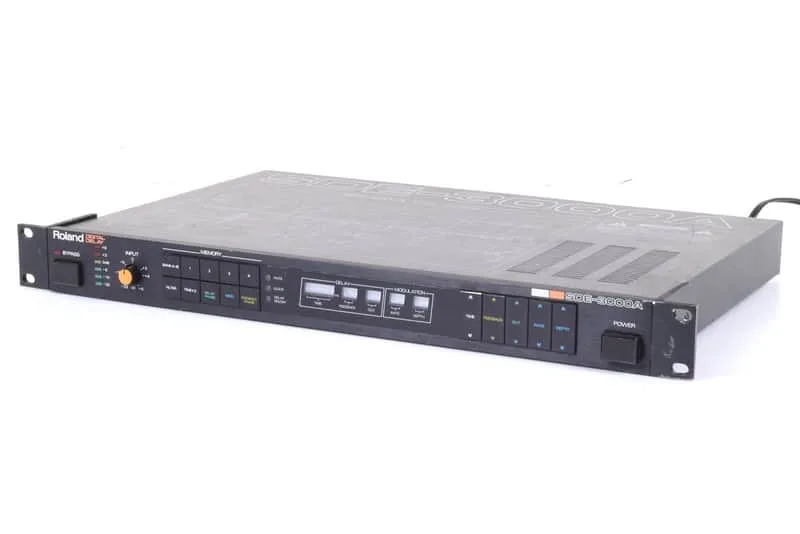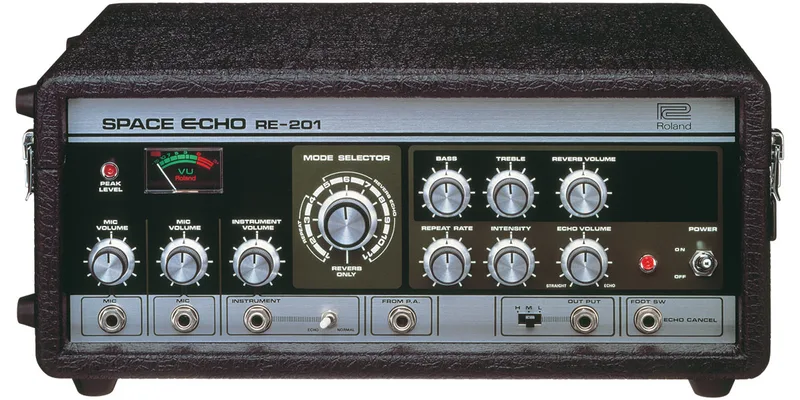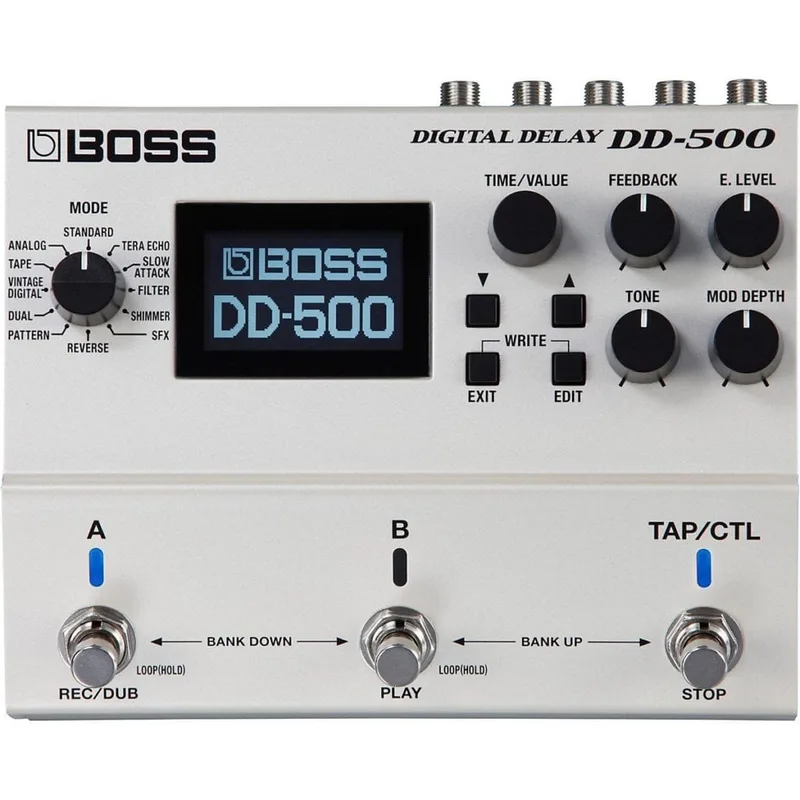


The Boss DD-500 Digital Delay is a large-format delay pedal from Boss, released in 2015 as what Boss claimed was "the most powerful and versatile digital delay pedal ever made"1. It carries 12 delay modes, up to 10 seconds of delay time, a 60-second looper, and 297 onboard patch memories, all edited through a large integrated LCD234. Boss positions it as able to "recreate the sounds of nearly all previous pedals in the BOSS delay lineup, plus classic units like the Roland SDE-3000 and Space Echo"4.
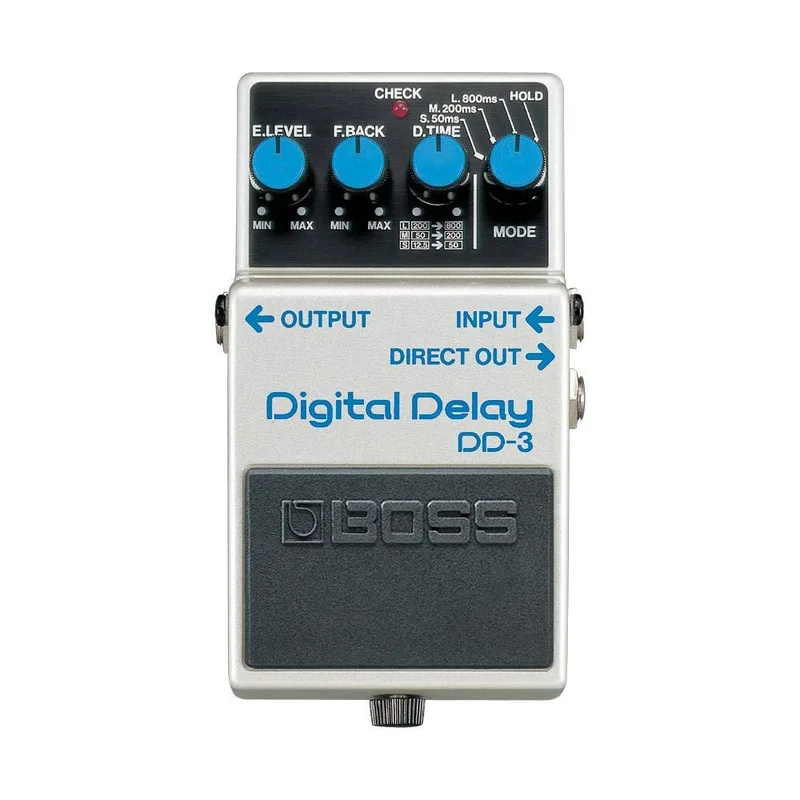
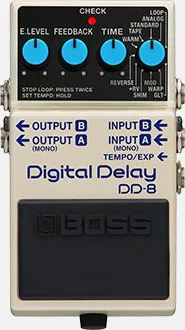
Where a compact Boss delay like the DD-3 or DD-8 gives you a handful of knobs, the DD-500 is a delay workstation: each of its delay types includes a semi-parametric four-band EQ, modulation, ducking, and many other parameters, with 32-bit AD/DA conversion and 32-bit/96 kHz processing throughout25.
What it does: the 12 delay modes
The DD-500's modes run from plain digital echo to emulations of classic delay designs213. Boss describes the range as covering "basic echo to dead-on emulations of classic delays to incredibly lush spatial textures"13.
| Mode | What it does |
|---|---|
| Standard | Clear digital delay2 |
| Analog | Emulates classic analog "BBD" delays like the Boss DM series2 |
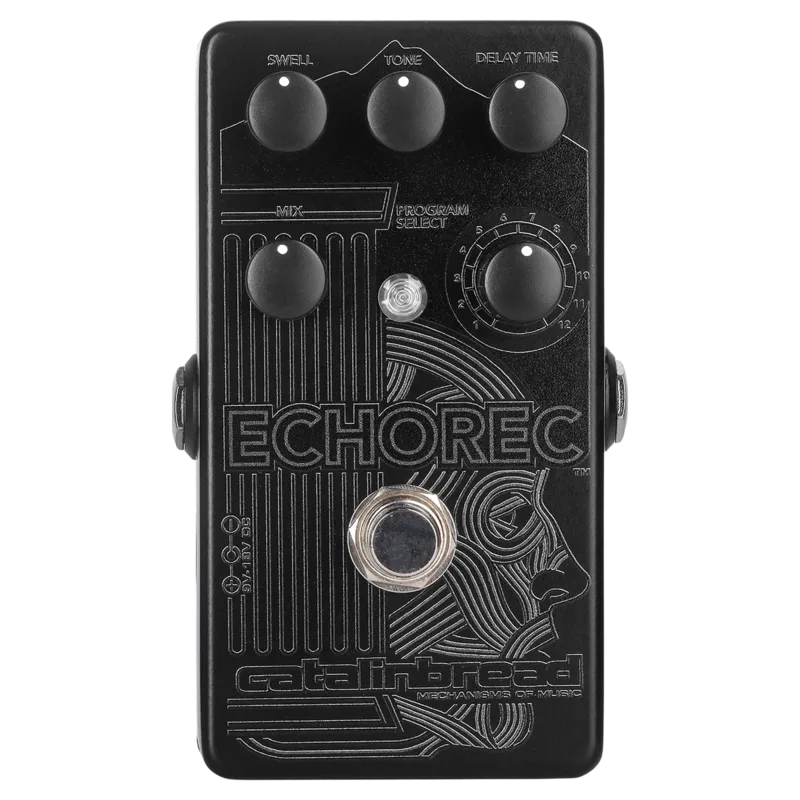
| Tape | Emulates tape delay units including the Maestro Echoplex, Binson Echorec 2, and Roland RE-201 Space Echo2 |
| Vintage Digital | Emulations of 1980s early digital delays, including Roland's SDE-2000 and SDE-3000 rack units and the Boss DD-22 |
| Dual | Two delay lines connectable in series, parallel, or three different A/B independent modes2 |
On That Pedal Show, the hosts noted the DD-500's 12 delay engines matched the Source Audio Nemesis ostensibly, and that its Tape mode includes an RE-201 simulation310. Every delay engine has an inbuilt four-band EQ with two bands of parametric mid, and the pedal can also produce other effects: with very short delay times, presets 46a and 52b give chorus and flanger sounds3. The Dual mode's parallel "world" delay lets you change the time of the second delay, infinitely adjustable, to shape the repeat pattern3.
Controls, display and footswitches
A large integrated LCD shows delay time, patch ID, and more on one screen, and handles navigation for parameter tweaks, patch naming, and system management2. There are 297 onboard memories with patch naming via the LCD45.
The three footswitches, A, B, and TAP/CTL, default to controlling two patches, bypass, bank selection, and tap tempo2. They can be customized: set up as A and B presets, or A and B added together for two delays at once, or with the tap switch reassigned as preset C for three presets from the floor23. The TAP/CTL switch can instead be assigned to real-time functions like Warp or Twist2.
- Tap: sets the delay in time with a song's tempo2
- Hold: the delay's feedback is held continuously while the switch is pressed2
- Warp: increases the delay's feedback and level simultaneously for expressive effects2
Bypass and carryover
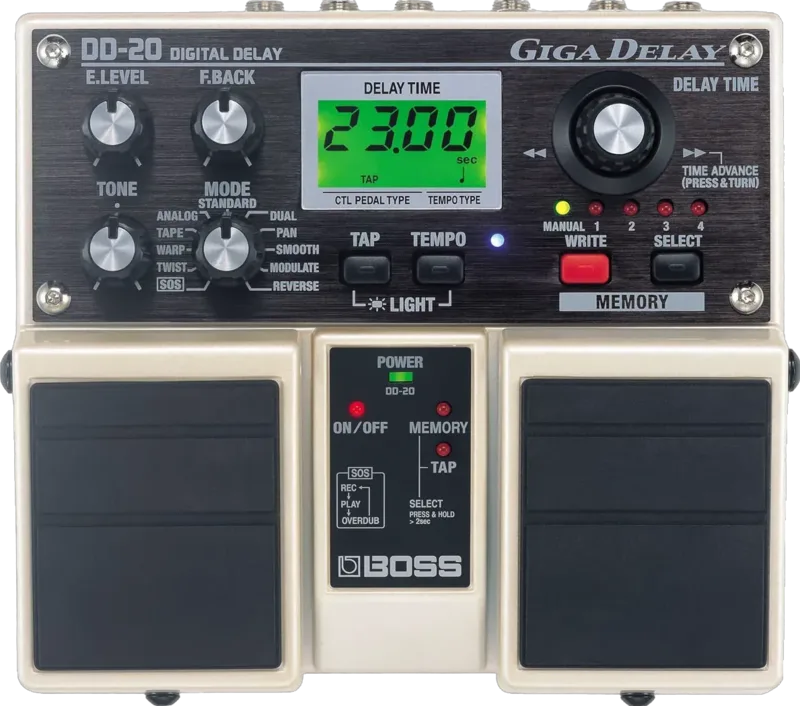
The DD-500 offers buffered- or true-bypass operation, the player's choice2. Buffered bypass has a practical advantage beyond buffering itself: it enables carryover, so delay trails are not cut off unnaturally when you turn the effect off or switch patches2. This differs from Boss's own earlier DD-20 Giga Delay, whose bypass the DIY Fever reviewer found not transparent, being a bit louder with more mids in bypass mode.
Power and connections: MIDI, USB and expression
The DD-500 runs on 9V at 200 mA12, or on four AA-size batteries or a PSA-series AC adapter511. On That Pedal Show, the hosts noted it and its siblings run 9V center negative off less than 500 milliamps10.
Connections are extensive for a pedal:
- Stereo inputs and outputs for studio-level stereo sound1213
- MIDI in/out for control with effects switching systems, other devices, and DAWs21
- USB for connecting to a computer12
- Expression pedal input for parameter manipulation; Disaster Area Designs lists CC16 for the DD-500's expression control214
An optional expression pedal or external switch opens up even more parameters, alongside MIDI commands2.
The macOS 10.15 driver requires the DD-500's USB MODE to be set to "VENDOR" to work, and Mac computers running Microsoft Windows are not supported by that driver15.
Software, editor and drivers
Boss's support site hosts the DD-500 Editor, which requires firmware Ver.2.00 or later16. Available drivers include Ver.1.0.0 for Windows17 and Ver.1.0.3 for macOS 10.15, for Apple Mac series computers with on-board USB15. The Ver.2.00 firmware added parameters documented in a supplement on the owner's manuals page, where the English owner's manual PDF also lives18. The downloaded driver file is an archive, with instructions in a Readme.htm file created after expanding it15.
Where it came from
Boss released the DD-500 in 2015, a date Premier Guitar's State of the Stomp columnist framed as "a response to technological progress and changing expectations"19. By 2017, MusicPlayers.com described it as "a best-seller that's been lauded for its great sound, powerful editing capabilities, intuitive interface, and expressive real-time control"20.
What reviewers said
Guitar World's reviewer called it "The current flagship in the Boss range" and said it "would make vintage gear blush with its sound quality, functionality and features"6. MusicRadar's review team took a comparative view: "While delay junkies may argue that Strymon and Eventide have the edge in the tone department, Boss has them and most others beat in terms of sheer flexibility and value for money"21. MusicRadar's DD-200 review summed the DD-500 up as "An almighty echo-heavy addition to the tenacious DD series"22, though the same outlet's buying guide flagged that "Shimmer mode isn't the strongest"12.
On That Pedal Show's big-box delay comparison, the hosts' quick answer for a really good allrounder among Boss's large delay pedals was the DD-500, though they noted its biggest competition was Boss's own DD-20010. The host was really impressed with what the DD-500 could do in analog mode, while feeling the DM-101 analog machine goes off nicer, and found the SDE-3000D stereo sounds wider10. The pedal's ducking drew a comparison to the TC 2290 rack's ducking delay10.
In the earlier Mega Delays comparison against the Source Audio Nemesis, That Pedal Show described the two as "incredibly capable, modern, multi-feature delay units that offer you an almost infinite amount of sonic and creative potential"23, noting the DD-500's 32-bit internal processing against the Timeline's 24-bit, with 24-bit AD/DA converters shared by all three pedals compared3.
Videos
ProGuitarShopDemos
Sweetwater
Andertons Music Co
Questions
Can the Boss DD-500 run on batteries?
Yes. It runs on four AA-size batteries or an optional AC adapter, including Boss's PSA-series adapter. Most players power it from a pedalboard supply instead, since it draws around 200 mA at 9V, which is more than a typical compact Boss pedal.
Is the Boss DD-500 true bypass or buffered?
Either, at your choice. Boss lets you switch between buffered and true-bypass operation. Buffered bypass has a benefit: it enables carryover, so delay trails keep ringing naturally when you turn the effect off or switch patches instead of being cut off abruptly.
How long is the looper on the Boss DD-500?
The built-in looper gives 60 seconds of recording at the maximum 96 kHz sample rate. Run it at half that rate in mono and you get two minutes of loop time.
Does the Boss DD-500 have tap tempo?
Yes. The TAP/CTL footswitch handles tap tempo by default, letting you set the delay in time with a song's tempo. If you would rather not use it for tapping, you can reassign it as a third preset switch or to real-time functions like Warp or Twist.
What is the maximum delay time on the DD-500?
The maximum delay time is 10 seconds. That is far beyond what analog or tape-style delays offer and gives room for ambient repeats, sound-on-sound layering, and the pedal's Hold and Warp functions.
Where do I get the Boss DD-500 editor and driver?
Both come from Boss's support site at boss.info, on the DD-500's updates and drivers page. The DD-500 Editor requires firmware Ver.2.00 or later. Drivers are available for Windows (Ver.1.0.0) and for Mac, including Ver.1.0.3 for macOS 10.15, which needs USB MODE set to VENDOR.
Sources (23)
- SUMMER NAMM 2015: Boss reveals DD-500 Digital Delay and RV-6 Reverb guitar pedals, MusicRadar, 2015-07-08
- BOSS - DD-500 | Digital Delay, boss.info
- That Pedal Show, That Pedal Show (YouTube), 2016-12-30
- Echoes in Time: The History of BOSS Delay Pedals, BOSS (articles.boss.info), 2024-01-10
- Boss Unveils New RV-6 Reverb & DD-500 Digital Delay, Premier Guitar, 2015-07-08
- Boss SDE-3 Dual Digital Delay pedal review, Guitar World, 2024-11-04
- Strymon's TimeLine MX might be the most advanced delay pedal on the planet, Guitar World, 2026-07-09
- "Units this inspirational are rare, and perhaps as a writing tool, that vibe alone makes the 2290 worth it”: TC Electronic 2290-P Dynamic Digital Delay review, MusicRadar, 2025-01-30
- Strymon TimeLine MX review, MusicRadar, 2026-10-07
- Why Does Boss Make All These Big-Box Delay Pedals? DD-500, DM-101, RE-202 & SDE-3000D, That Pedal Show (YouTube), 2024-09-20
- Boss DD-500 Digital Delay, Pedal of the Day, 2016-03-07
- Best delay pedals: add extra dimension to your tone, MusicRadar, 2022-05-17
- Summer NAMM 2015 news: Boss showcases new DD-500 Digital Delay and RV-6 Reverb, Guitar.com, 2015-07-14
- Supported Devices, Disaster Area Designs, 2021-10-11
- BOSS - Support - DD-500 - Updates & Drivers, BOSS (boss.info)
- BOSS - Support - Support News - Compatibility with macOS High Sierra (10.13), Boss (boss.info)
- BOSS - Support - DD-500 - Updates & Drivers, Boss (boss.info)
- BOSS - Support - DD-500 - Owner's Manuals, boss.info
- Why the Boss Digital Delay Is Still a Pedalboard Staple, Premier Guitar, 2026-07-04
- BOSS RV-500 Reverb And MD-500 Modulation Now Available, MusicPlayers.com, 2017-07-12
- Walrus Audio Mako D1 High-Fidelity Stereo Delay review, MusicRadar, 2020-06-04
- Boss DD-200 Digital Delay review, MusicRadar, 2019-11-21
- That Pedal Show, That Pedal Show, 2016-12-30