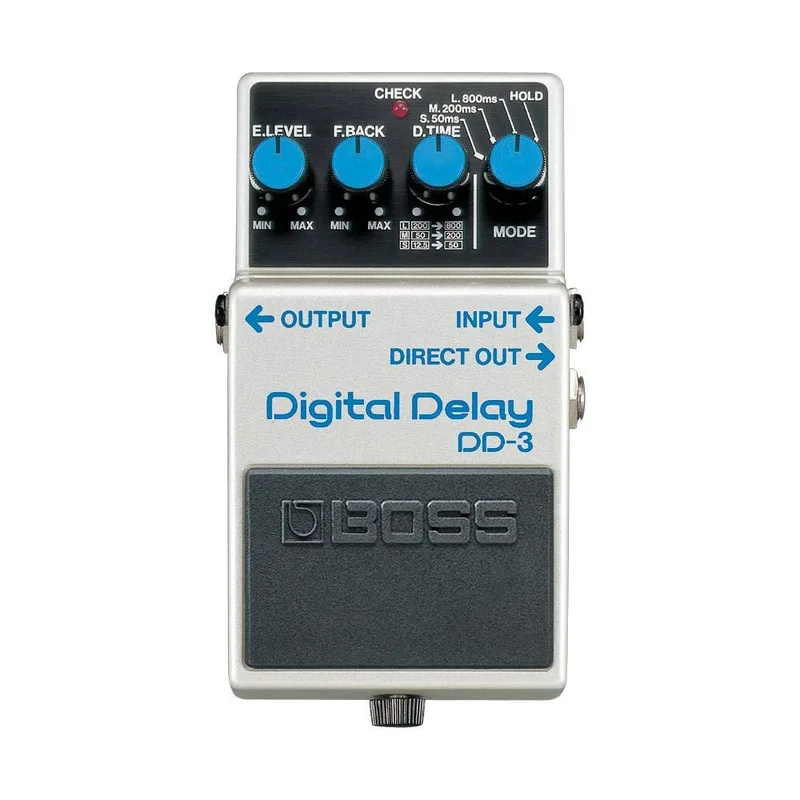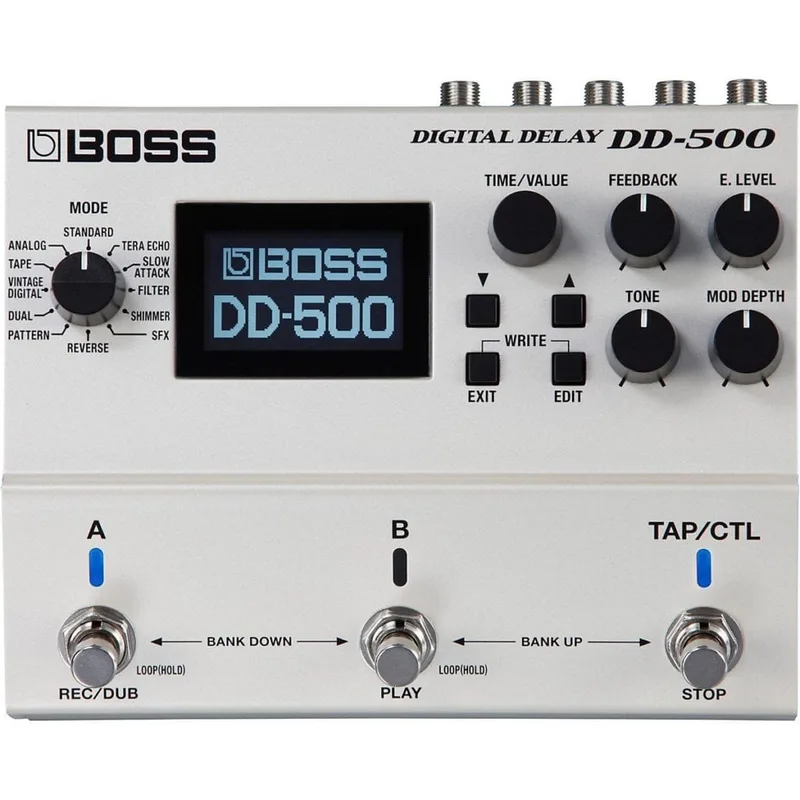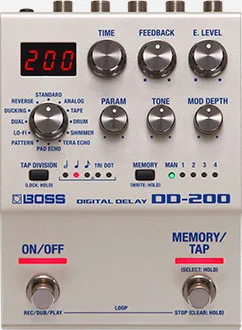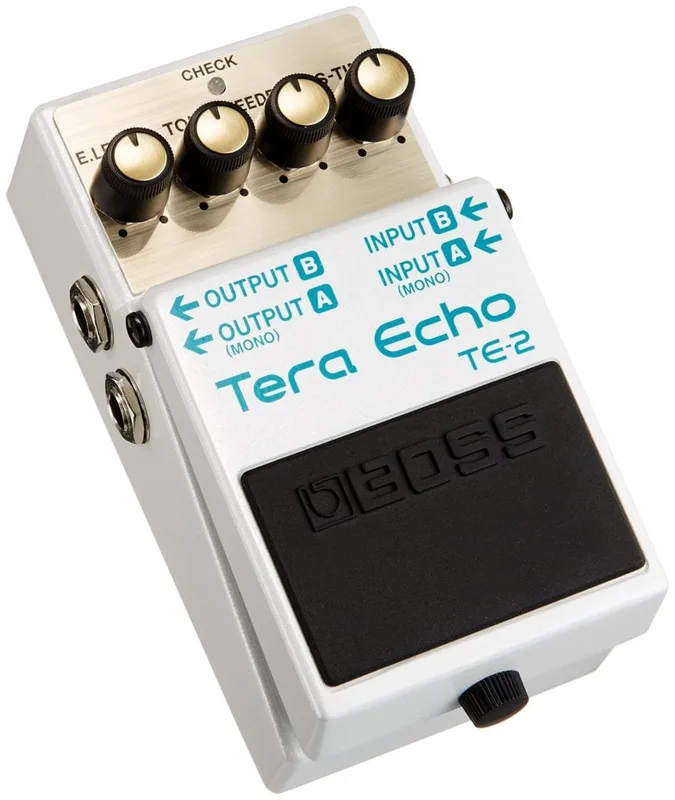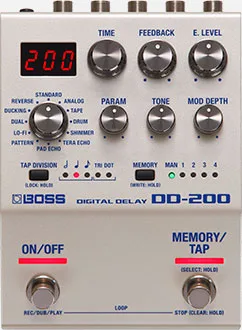


The Boss DD-200 Digital Delay Workstation is a compact delay pedal from Boss that packs a wide range of delay sounds into a single box. It offers 12 different delay modes and four onboard memories you can call up mid-gig12. Boss positions it as a middle ground in the 200-series: far more capable than a basic digital delay like the Boss DD-3, but smaller and simpler than the flagship Boss DD-500.
Under the hood it is a digital pedal, with Boss quoting 32-bit AD/DA conversion, 32-bit floating point processing, and a 96 kHz sampling rate3. The idea is that instead of buying separate pedals for tape echo, shimmer, or reverse delay, one box covers nearly any flavor of delay you want1.
What the DD-200 does
The DD-200 is a delay workstation: a single pedal that covers the territory most players would otherwise fill with several units. Twelve different modes offer delay colors ranging from modern digital to classic analog2, and a small LED display screen shows the delay time in milliseconds or BPM, which Guitar Pedal X's reviewer found incredibly useful for dialing in precise timings3.
Alongside the delay engine there is a looper that RockBoard's PedalPedia describes as always ready to use2, with up to 60 seconds of recording time. Guitar World's reviewer called it a sophisticated looper4. Four onboard memories let you save settings and recall them when you need them5, and Premier Guitar's review highlighted easy preset management as one of the pedal's strengths6.
The 12 delay modes
Mode selection is handled by a rotary selector on the front panel3. The 12 modes are13:
| Mode | What it does |
|---|---|
| Standard | Clean, modern digital delay3 |
| Analog | Analog-style repeats, emulating classic bucket-brigade delay3 |
| Tape | Tape echo character |
| Drum | Binson Echorec-style drum echo3 |
| Shimmer | Delay with pitch-shifting ambience |
| Tera Echo | Ambience processing related to the Boss TE-2 Tera Echo |
| Pad Echo | Sustaining, pad-like repeats |
| Pattern | Rhythmic patterned repeats |
| Lo-Fi | Degraded, lo-fi repeat character |
| Dual | Two delay lines at once |
| Reverse | Repeats that play backwards3 |
| Ducking | Delay level ducks under your playing, a classic ducking effect3 |
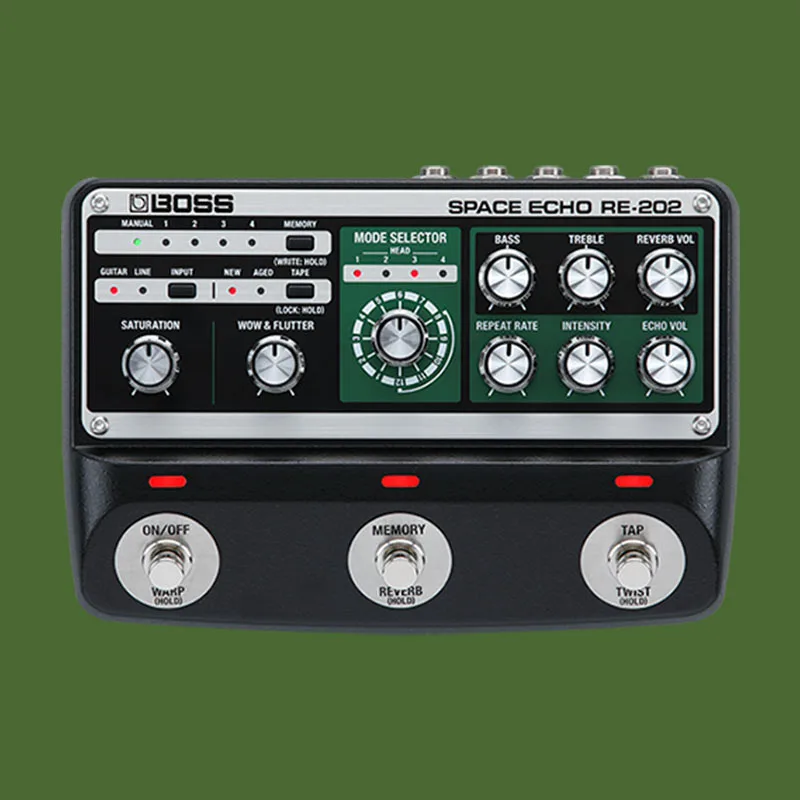
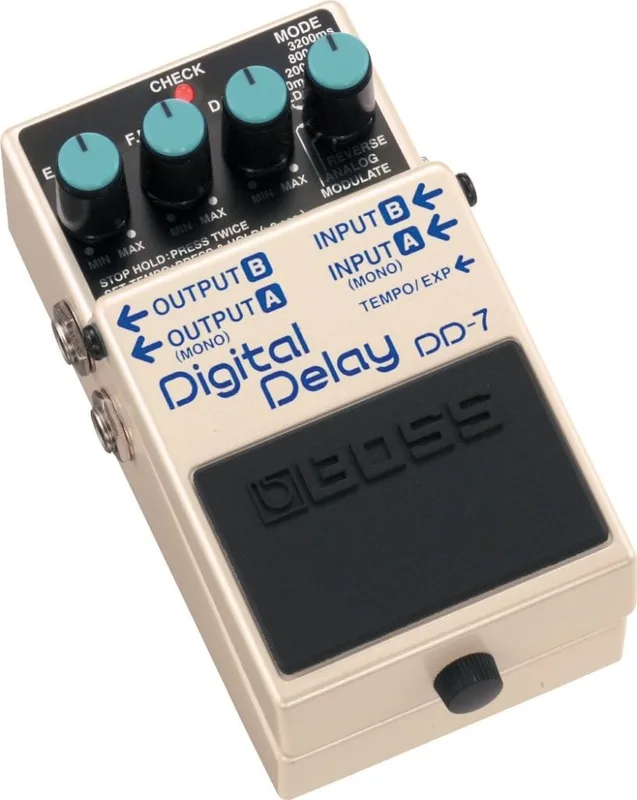
Several of these modes echo (sometimes literally) classic Boss and Roland hardware. The Drum mode is a Binson Echorec-style delay3, the same territory covered by dedicated units like the Boss RE-202 Space Echo, while Standard and Analog cover the ground of the Boss DD-7 in one mode dial.
The controls
Boss's design philosophy here is direct access: essential delay parameters are provided on dedicated controls rather than buried in menus1. The pedal carries six knobs for on-the-fly control7, plus Bypass and Tap footswitches, with room for expansion footswitches and an expression pedal on the rear5.
The main controls break down as follows3:
- Mode rotary selector: chooses one of the 12 delay modes3
- Feedback / Repeats: sets how many repeats you hear3
- Tone: makes the repeats darker or brighter; Guitar Pedal X noted this tone-shaping control is something the DD-200 has that its closest rival, the Source Audio Nemesis, lacks3
- Modulation Depth: adds modulation to the repeats3
- Memory / Preset controls: manage the four onboard memories3
- Tap Tempo footswitch: sets the delay time in time with the music; a press-and-hold function makes presets fully footswitchable3
The LED display showing delay time in milliseconds or BPM sits at the center of this, so knob tweaks translate directly into numbers you can read3.
Power: 225mA
The DD-200 runs on a PSA-series AC adaptor or three AA-size batteries67, at 9V DC5.
The DD-200 draws 225mA2, far more than a compact analog pedal. Three AA batteries will drain quickly at that draw, and the pedal is a poor candidate for a low-current daisy chain. Plan on a 9V DC output on your pedalboard supply that can deliver well over 225mA.
What reviewers said
Published reviews were positive. Premier Guitar's review listed easy preset management among its findings and gave the street price as $2496. MusicRadar noted the 60-second phrase looper and four onboard memories as headline features5.
The most detailed published comparison comes from Guitar Pedal X, where Stefan Karlsson ran the DD-200 head to head against the Source Audio Nemesis Digital Delay Workstation, a near-identical concept with its own 12-mode-style architecture. He found the DD-200's Tone control a genuine advantage, since only the DD-200 has that tone-shaping control for the repeats, and concluded3:
"on the basis of this analysis across all the key criteria that matter to me - the Boss DD-200 is my clear winner"3
Stefan Karlsson, Guitar Pedal X3
That same article noted the UK price as £190 for the DD-200 against £260 for the Nemesis as of 13 July 20263, so the DD-200 also undercut its closest rival on price in that market.
Firmware and the manual
The English manual is available as a PDF from Boss at static.roland.com/assets/media/pdf/DD-200_eng03_W.pdf2.
Videos
Premier Guitar
BOSSchannel
Brett Kingman
Questions
How many delay modes does the Boss DD-200 have?
The DD-200 offers 12 delay modes: Standard, Analog, Tape, Drum, Shimmer, Tera Echo, Pad Echo, Pattern, Lo-Fi, Dual, Reverse, and Ducking. They are selected with a rotary mode selector on the front panel, covering flavors from clean modern digital repeats to Binson Echorec-style drum echo.
How long is the DD-200 looper?
The built-in phrase looper records up to 60 seconds. Boss describes it as always ready to use, so you can capture a phrase without switching into a dedicated looper mode first, and it sits alongside the four onboard preset memories.
How much current does the DD-200 draw?
The DD-200 draws 225mA, which is well above what a typical compact analog pedal needs. That means it is a poor candidate for a small daisy-chain supply, and you should plan for an isolated or higher-current 9V DC output on your pedalboard power supply.
Is the Boss DD-200 analog or digital?
It is fully digital. Boss quotes 32-bit AD/DA conversion, 32-bit floating point processing, and a 96 kHz sampling rate. The Analog mode is a digital emulation of analog-style repeats rather than an actual bucket-brigade circuit.
Where can I find the DD-200 manual?
The English manual is published as a PDF by Boss at static.roland.com/assets/media/pdf/DD-200_eng03_W.pdf. Boss also released system program version 1.14 in July 2025, which fixed a tempo hold delay time bug, so it is worth updating the pedal's firmware.
Sources (7)
- BOSS - DD-200 | Digital Delay, boss.info
- DD-200 Digital Delay by BOSS, RockBoard (rockboard.de PedalPedia), 2026
- Guitar Pedal X, Guitar Pedal X, 2020-07-26
- Boss DD-3T and DD-200 Digital Delay review, Guitar World, 2020-05-28
- Boss DD-200 Digital Delay review, MusicRadar, 2019-11-21
- Boss DD-200 Digital Delay Review, Premier Guitar, 2019-10-25
- BOSS DD-200 Digital Delay, Delicious Audio, 2020-07-08