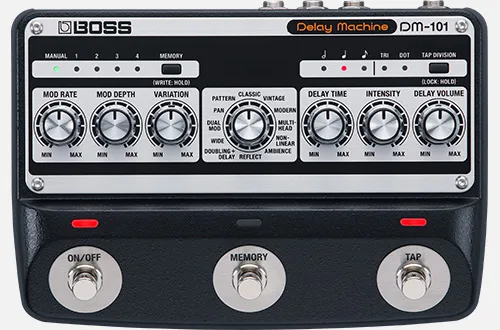


The BOSS DM-101 Delay Machine is an analog delay pedal from Boss, released in 20231. Where most modern delay pedals are digital, the DM-101 runs its audio through bucket-brigade device (BBD) chips, the classic analog delay technology, with eight BBDs under digital CPU control2. Boss describes the result as a "warm, saturated, and highly musical tone"2.
What makes it unusual is the combination: a fully analog BBD audio signal path shaped by precision digital CPU control, 12 delay modes, stereo outputs, tap tempo, memories and MIDI2. On That Pedal Show, Dan and Mick described it as "using eight BBD chips to create a true stereo, programmable, MIDI-enabled ANALOGUE delay"3.
An analog delay with eight BBDs and 12 modes
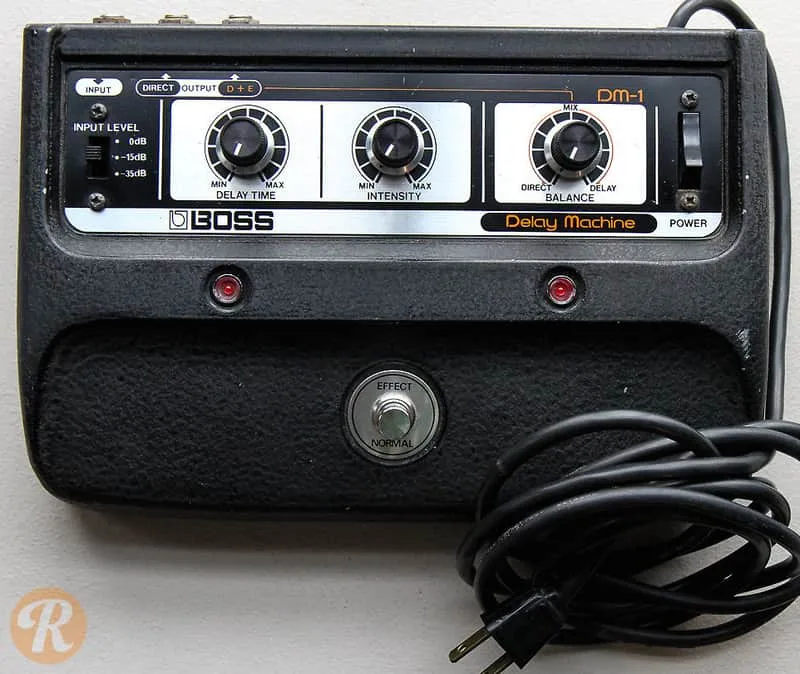
The core of the DM-101 is its bucket-brigade circuitry. Boss chose eight 2048-stage BBDs instead of the more common 4096-stage BBD, which is how the pedal reaches up to 1200 milliseconds of delay time in the Classic mode289. Overall delay times run from roughly 10ms to 1200ms, varying by mode8. For comparison, the original 1978 Boss DM-1 Delay Machine offered up to 500 milliseconds1.
The pedal offers 12 modes, split between mono and stereo8:
| Mono modes | Stereo modes |
|---|---|
| Classic | Reflect |
| Vintage | Doubling + Delay |
| Modern | Wide |
| Multi-Head | Dual Modulation |
| Non-Linear (Reverse) | Pan |
| Ambience | Pattern |
Several modes do things a plain delay does not. Multi-Head emulates a multi-head tape delay with an analog BBD character, with the Variation knob cycling through 10 different head combinations29. Non-Linear produces consecutive short delays (35 to 190 ms) that gradually increase in volume2. Wide offsets the left and right delay times for an expansive stereo sound, and Dual Mod runs different modulation phase settings on each output, with the phase fully inverted at the maximum setting2. Pattern offers stereo delay with different rhythmic patterns, with 10 pattern types on the Variation knob2.
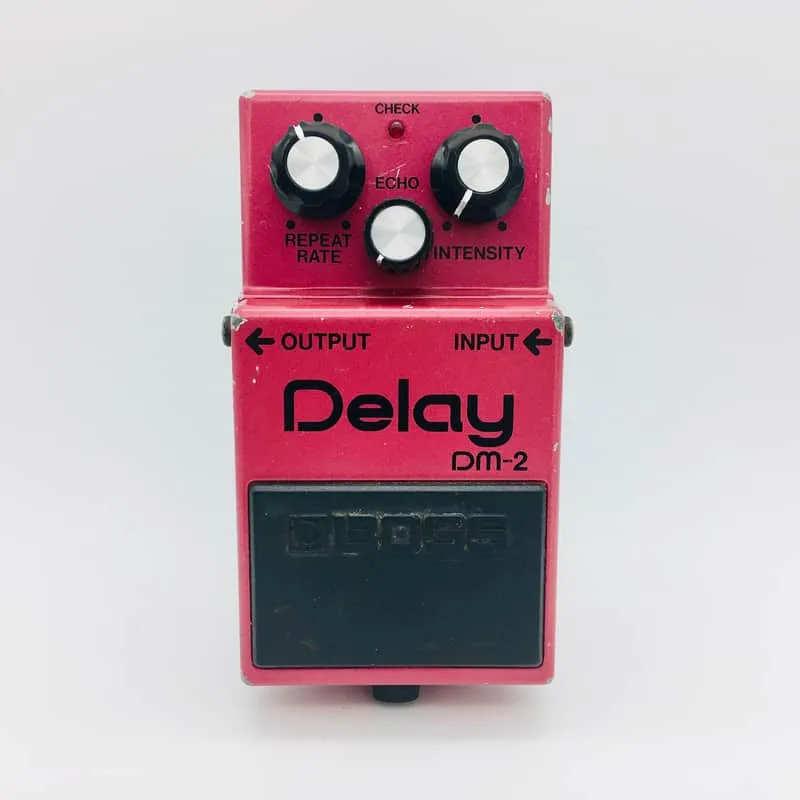
Vintage mode is a retro analog delay sound inspired by the Boss DM-2 Delay pedal introduced in 1981; in this mode the Variation control changes the waveform29.
Controls
The front panel carries six knobs plus mode and tap division selection5:
| Control | What it does |
|---|---|
| Delay Time | Sets the delay time |
| Intensity | Sets feedback; cranked, it drives delays into saturated self-oscillation2 |
| Delay Volume | Sets the effect level |
| Rate | Modulation rate2 |
| Depth | Modulation depth2 |
| Variation | Controls multiple parameters unique to each mode2 |
Three footswitches handle On/Off, Memory and Tap tempo functions7. Modulation rate and depth get their own dedicated knobs, so the warble that analog delays are known for is always on hand2. Boss's own article on using delay with other instruments suggests sample settings for a modular setup: Time at 200 to 300 ms for shorter delays, or 400 to 600 ms to accentuate chord changes, with Feedback set high to let textures evolve and enjoy the oscillation10.
Stereo outputs, MIDI and external control
The DM-101 runs in stereo with flexible signal routing options2. Six of the 12 modes are stereo9. The audio outputs ship set for blended operation but can be reconfigured for wet/dry rigs and wet-only parallel setups2.
Control expands well beyond the footswitches:
The pedal stores four onboard memories plus the current panel settings, and 127 user memories are accessible via MIDI program change2. Gearnews noted that this MIDI control "allows the DM-101 to have 127 user presets"11. Tap tempo and a tap division switch support rhythmic delays2.
At 260mA on 9V DC center negative6, the DM-101 draws far more current than a compact analog pedal. Plan on a dedicated, isolated power supply output rather than a battery or a shared daisy chain.
From the DM-1 and DM-2 to the DM-101
The DM-101's look is deliberate. MusicRadar's reviewer noted that it "nods back to the DM-1 design with a VHS- (sorry, I'm an '80s child) size dimensions and silver panel on black" chassis5. Guitar.com's reviewer went further, calling it "a homage to those hallowed black and silver dream machines of the seventies; Boss's very first pedal, the CE-1 Chorus Ensemble of 1976 and the DM-1, Boss's first delay"9.
The original DM-1 Delay Machine was a 1978 rack-style unit in the same heavy-duty metal chassis as the CE-1 Chorus Ensemble, with an AC power configuration, offering up to 500 milliseconds of delay1. Its circuit used a charge-coupled device (CCD), a component that went on to be widely used in digital gear1. The DM-1 was discontinued after 1978 to 198012. The compact analog DM-2 followed in 1981, and its sound is the inspiration for the DM-101's Vintage mode2.
The DM-101 arrived in 2023, priced at $499 when it hit stores in July4, and was available for preorder at Andertons, PMT and Sweetwater13.
What reviewers said
Reviews were strongly positive. MusicRadar's overall verdict called it "The best analogue delay pedal currently available anywhere and a future classic from Boss"5. Gearnews, reporting on Jan Rotring's review, wrote that "it sounds like a deeply expressive and unique pedal with its own signature sound. It's a rare thing to see wholly unique" pedal designs, especially among complex analog units14.
On That Pedal Show's comparison of analog and digital delays, when the question came up of which Boss delay to buy for the sound of analog, the answer was the DM-101, with Dan noting "the dm101 is actually analog," unlike the other digital delays in the comparison15.
Videos
JHS Pedals
Andertons Music Co
BOSSchannel
News
Questions
Is the BOSS DM-101 fully analog?
The audio signal path is fully analog BBD circuitry, driven by eight BBD chips, but it is shaped by a digital CPU that handles control functions like mode selection, memories and MIDI. So the sound path is analog while the control layer is digital.
How much current does the DM-101 draw?
The DM-101 draws 260mA at 9V DC, center negative. That is well beyond what a standard 9V battery or a small daisy-chain output can supply, so it needs a dedicated power supply output.
What is the longest delay time on the DM-101?
Up to 1200 milliseconds, reached in the Classic mode. Delay times run from roughly 10ms to 1200ms and vary depending on which of the 12 modes is selected.
Is the DM-101 true bypass or buffered?
It uses a buffered bypass, consistent with Boss's standard pedal design, rather than true bypass.
How many presets does the DM-101 store?
Four onboard memories plus the current panel settings are available at the pedal itself, and 127 user memories are accessible via MIDI program change.
Does the DM-101 have a DM-2 mode?
Yes. The Vintage mode is a retro analog delay sound inspired by the Boss DM-2 Delay pedal introduced in 1981, and in this mode the Variation control changes the waveform.
Sources (15)
- Echoes in Time: The History of BOSS Delay Pedals, BOSS (articles.boss.info), 2024-01-10
- BOSS - DM-101 | Delay Machine, boss.info
- Best Ever Analogue Delay? Boss DM-101, Carbon Copy, Suhr Discovery plus DD-200 & TimeLine, That Pedal Show, 2023-06-30
- The ultimate analog delay pedal? Boss unveils the all-powerful DM-101 Delay Machine, Guitar World, 2023-06-22
- Boss DM-101 Delay Machine pedal review, MusicRadar, 2023-07-10
- DM-101 Delay Machine by BOSS, RockBoard PedalPedia, 2026
- Boss DM-101 Delay Machine review, Guitar World, 2023-10-30
- Guitar Pedal X, Guitar Pedal X, 2023-12-20
- Is the Boss DM-101 a new benchmark for analogue delay?, guitar.com, 2023-07-28
- Using a Delay Pedal with Other Instruments, BOSS (articles.boss.info), 2023-10-10
- Best Effect Pedals 2023, gearnews.com, 2023-12-18
- If You Like Analog Delay You'll Love the New Boss DM-101 Delay Machine, GuitarPlayer (www.guitarplayer.com), 2023-06-22
- Has Boss just unveiled the must-have delay pedal for analogue fans with the DM-101?, MusicRadar, 2023-06-22
- The Best Effects Pedals of Summer 2023: WARM, UAFX, BOSS, EHX, gearnews.com, 2023-10-07
- Why Does Boss Make All These Big-Box Delay Pedals? DD-500, DM-101, RE-202 & SDE-3000D, That Pedal Show (YouTube), 2024-09-20