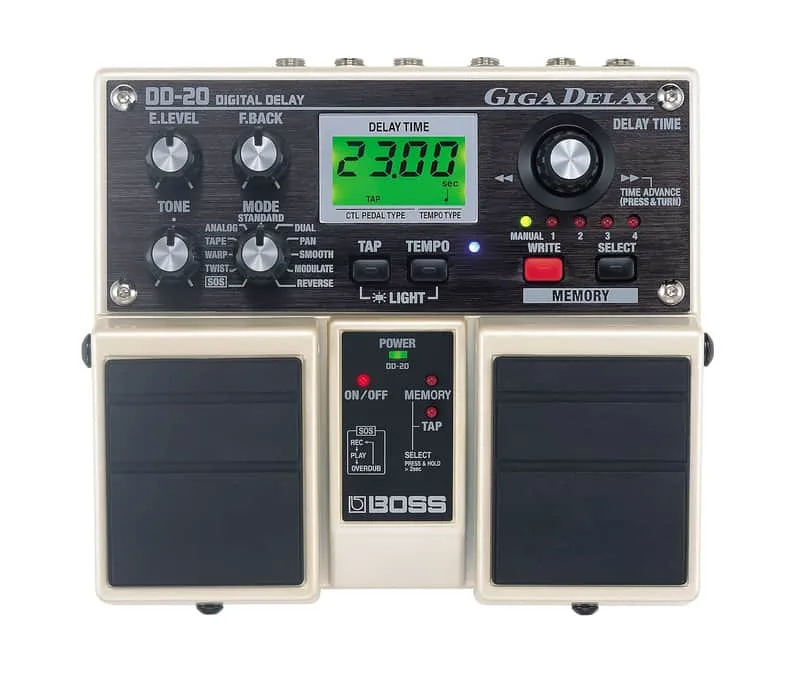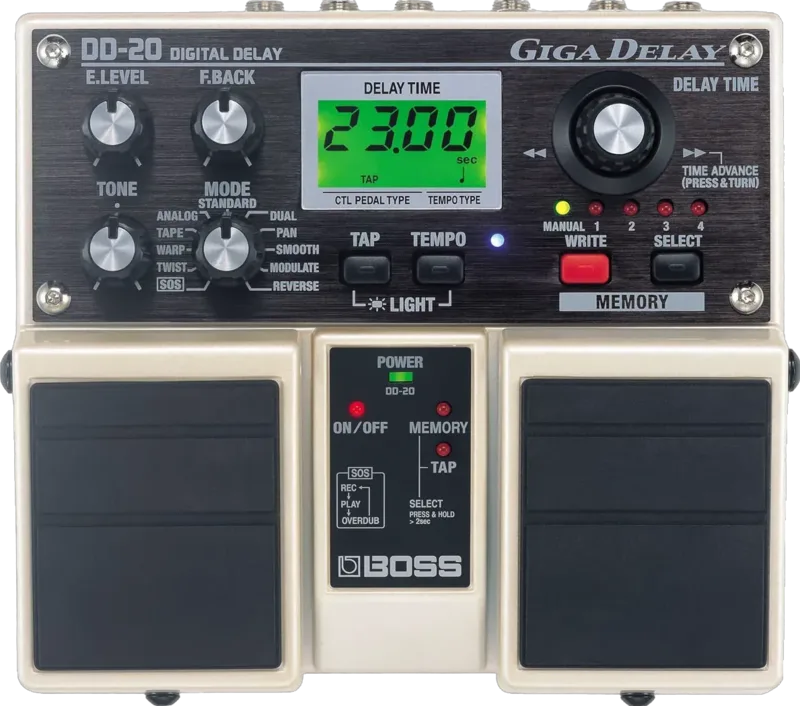


The Boss DD-20 Giga Delay is a digital delay pedal from Boss, released in 2003 in the company's Twin Pedal format: a wider, two-footswitch enclosure rather than the familiar compact Boss box1. Its headline feature is delay time of up to 23 seconds, along with a choice of 11 modes, including the "Smooth" and "Twist" delays and sound-on-sound recording2.
Boss built it as a do-everything delay workstation: a handy LED display, memories for storing four delay settings in addition to the current manual setting, and two onboard pedal switches giving easy access to tap tempo, memory selection, and other delay operations, plus an external footswitch input for additional control1.
What it does and how it sounds
The 11 modes cover the standard delay ground plus several creative options. The DIY Fever reviewer called the modulate mode interesting, since it adds modulation to the echoes and makes the sound bigger, and noted that pan mode alternates echoes between the two output jacks, which pays off with the stereo outputs3.
Not every mode is self-explanatory. The reviewer found that to make the best of some delay modes, specifically dual, twist, and wrap, you really need to read the manual, because setting them up is not intuitive3. Pedal of the Day's Mike B made a similar point about the documentation: the manual is about as thick as a phone book4.
On delay time, the reviewer's verdict was simple:
"23 seconds of delay is plenty"
DIY Fever reviewer3
They did add one wish: 23 seconds is enough for delay, but they would like to see more time for the sound-on-sound feature3.
Controls, presets, and tap tempo
Delay time can be set two ways: quickly with the push-button knob, or via tap tempo2. The Time knob itself has a two-speed behavior the reviewer appreciated: normally it moves in fine increments, but when pushed it switches to coarse increments, which makes it easy and fast to dial in a time3.
The four user memories sit alongside the current manual setting1. The DIY Fever reviewer found this genuinely useful:
"Being able to save presets and restore them quickly is a very useful thing"
DIY Fever reviewer3
They felt four presets seems enough for the way they use the pedal3.
If you want tap tempo on a separate switch, note the switch type. Vein-Tap.com lists the DD-20 among the pedals that require a normally closed tap tempo unit, so an external switch with the wrong polarity will not work5.
Power, batteries, and connections
The DD-20 runs on 9V DC, center negative, with a 200mA current draw2. It can also run on 6 AA 1.5V batteries3, though the DIY Fever reviewer reported that it goes through batteries very fast3.
With a 200mA draw and fast battery drain, the DD-20 is a pedal for a dedicated power supply output rather than a battery or a shared daisy chain.
Connections are stereo: stereo input and stereo output, plus a headphone output for silent practice or direct monitoring3. The metal enclosure is, in the reviewer's words, very well built3.
Bypass
The DD-20 is not true bypass. The DIY Fever reviewer found the bypass mode a bit louder with more mids, so it is not transparent. They later retracted the complaint, concluding the coloration was probably due to the difference in output impedance of the DD-20 compared with their other pedals, and not the bypass circuit itself3.
Where it came from
Boss introduced the DD-20 Giga Delay as part of its Twin Pedal line, bringing digital delay to the Twin Pedal format1. Pedal of the Day's Mike B noted the Twin Pedal Collection from Boss has produced some interesting and quite useful pedals, and the DD-20 fits that lineage4.
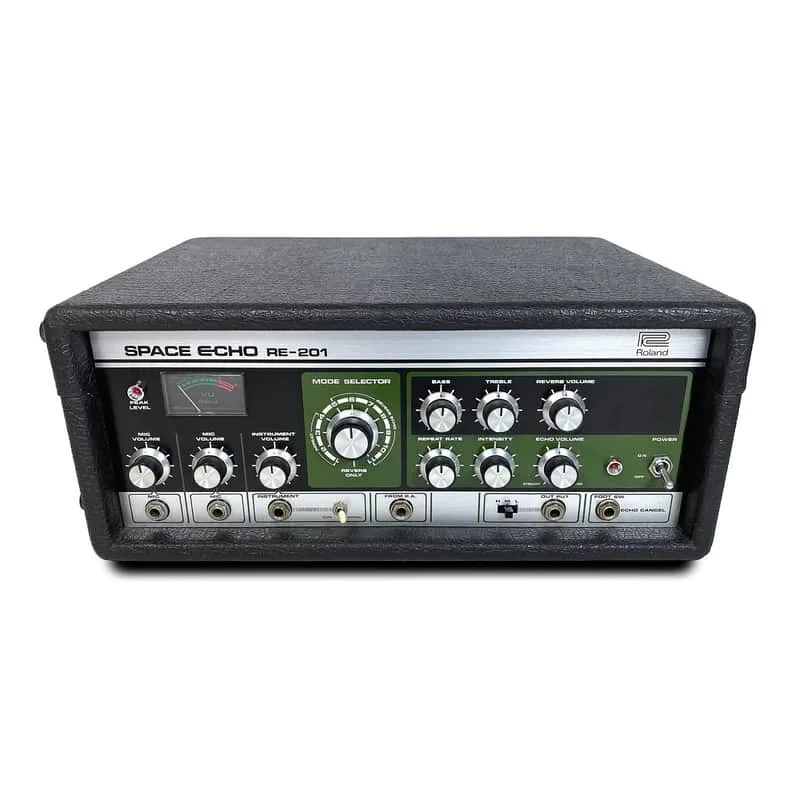
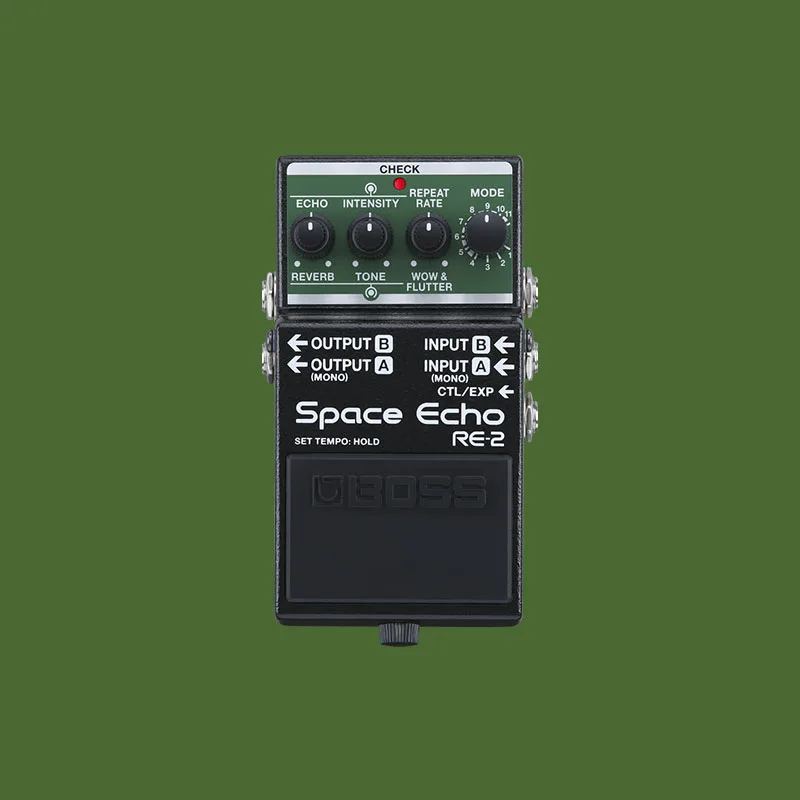
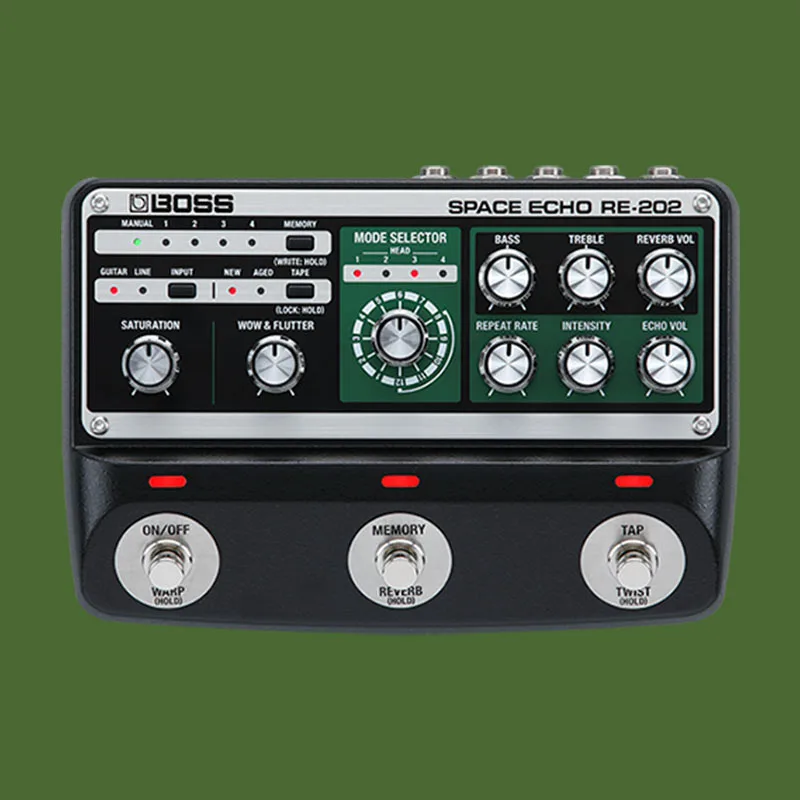
Among its modes is a Tape mode that recreates sounds produced by the classic Roland RE-201 Tape Echo4. Players who want that flavor in a current pedal can look at Boss's RE-series emulations, such as the Boss RE-2 Space Echo and the Boss RE-202 Space Echo.
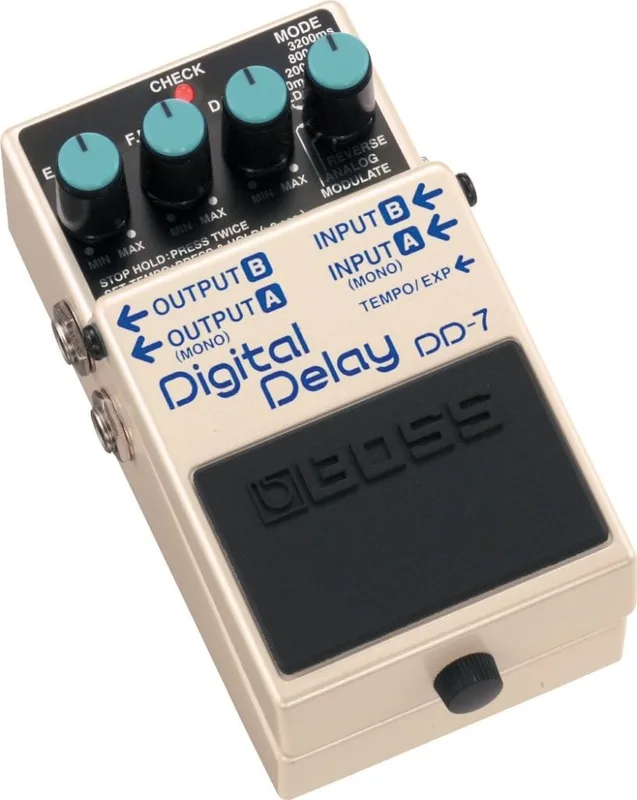
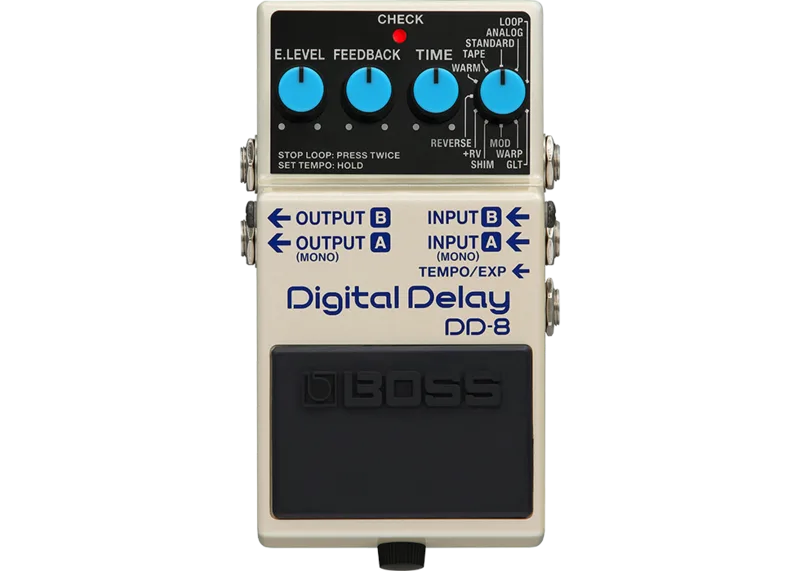
The DIY Fever reviewer observed that the DD-20 had been on the market for 7 years as of their review, which makes it easy to find good deals on used pedals3. For players comparing Boss delays, the compact Boss DD-7 Digital Delay and Boss DD-8 Digital Delay cover similar ground in a smaller box, while the Boss DD-200 Digital Delay is the later Twin Pedal successor.
Videos
ProGuitarShopDemos
BOSSchannel
BOSSchannel
Questions
Is the Boss DD-20 true bypass?
No. The DIY Fever reviewer found the bypass mode is a bit louder and, to their ears, has more mids, so it is not a transparent bypass. They later retracted the complaint, saying the coloration was probably due to the DD-20's output impedance compared with their other pedals rather than the bypass circuit itself.
How many batteries does the DD-20 take?
It takes 6 AA 1.5V batteries. The DIY Fever reviewer noted that it goes through batteries very fast, and with a 200mA current draw most players will prefer running it from a 9V DC center negative power supply.
Can the DD-20 work as a looper?
Yes. Sound-on-sound recording is one of its 11 modes, letting you layer parts on top of your playing. The DIY Fever reviewer wished it offered more than 23 seconds of recording time for that feature, since 23 seconds is enough for delay but tight for looping.
Which tap tempo switch works with the DD-20?
The DD-20 requires a normally closed tap tempo switch. Vein-Tap.com lists the DD-20 among the pedals that need a normally closed Vein Tap unit, so check the switch type before buying an external tap tempo pedal.
How many presets does the DD-20 store?
It stores four delay settings in memory, in addition to the current manual setting. The DIY Fever reviewer found being able to save presets and restore them quickly very useful, and felt four presets is enough.
Sources (5)
- Echoes in Time: The History of BOSS Delay Pedals, BOSS (articles.boss.info), 2024-01-10
- DD-20 Giga Delay by BOSS, RockBoard (rockboard.de PedalPedia), 2026
- Reviews > Effects > Boss DD-20 Giga Delay : DIY Fever, DIY Fever (diy-fever.com)
- Boss DD-20 Giga Delay, Pedal of the Day, 2014-08-05
- Which Pedals Can Use a Tap Tempo Pedal?, Vein-Tap.com, 2011-12-02
 Stuart Braithwaite