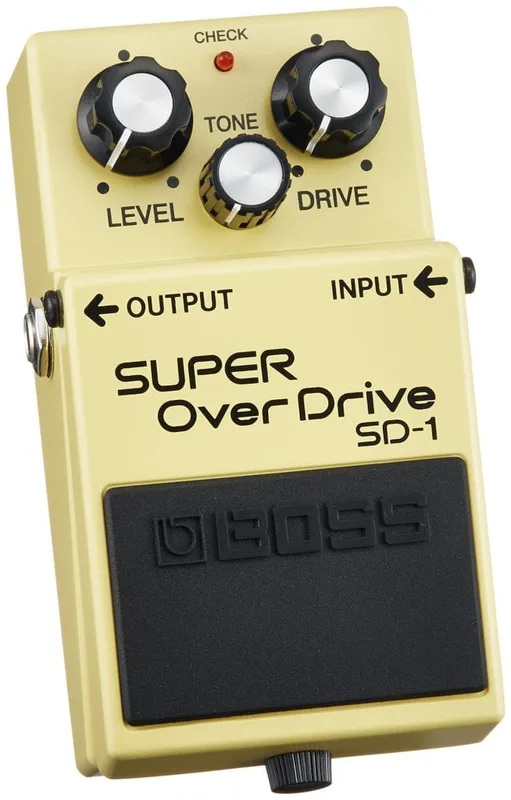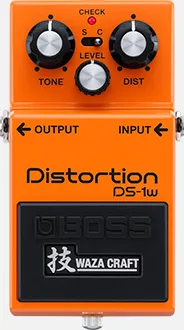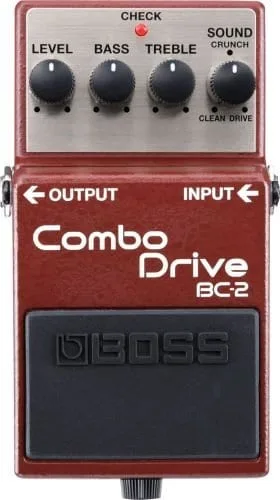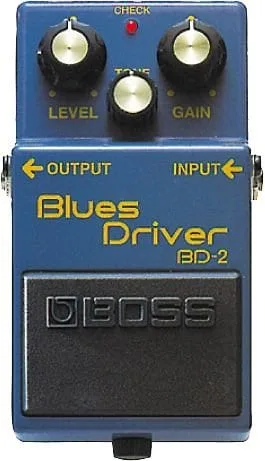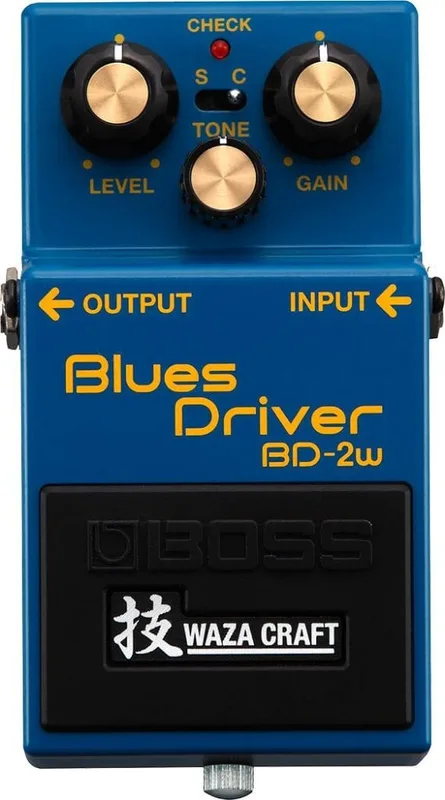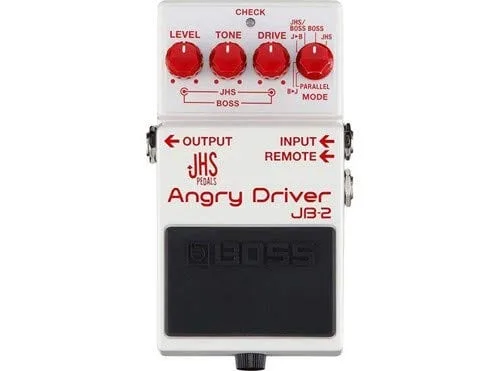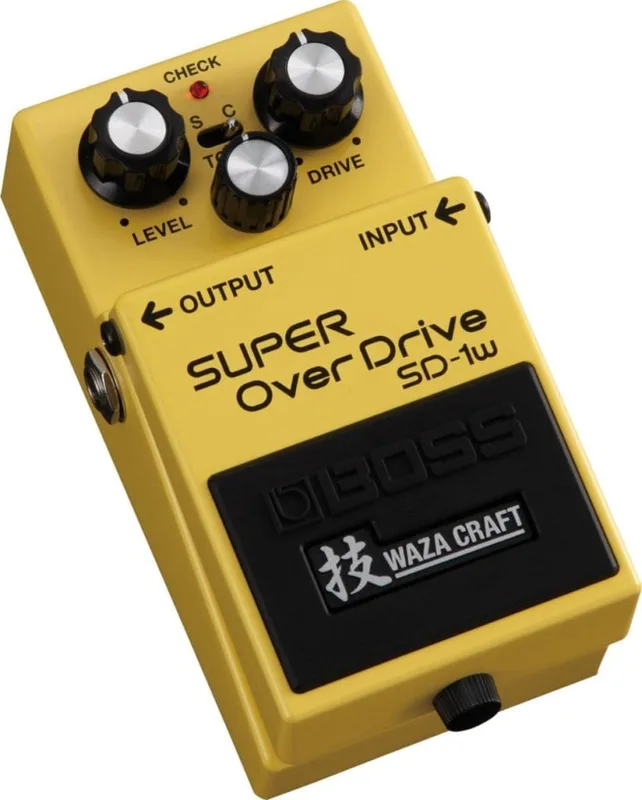


The Boss SD-1W Super Overdrive is the Waza Craft version of the Boss SD-1 Super Overdrive, an overdrive pedal Boss has built since 1981. Released in 2014, it hot rods the famous overdrive with all-discrete analog circuitry and adds a switchable Custom mode, while keeping the same three-knob layout and bright yellow compact enclosure players recognize from the original12.
Where the standard SD-1 uses an op-amp chip, the SD-1W's circuit consists entirely of discrete components, and its two modes give it a second voicing the original never had. Premier Guitar's 2014 announcement described it as hot rodding "this players' favorite with a revised circuit design" built from "all-discrete analog components, and switchable Standard and Custom sound modes"2.
The controls: Level, Tone, Drive and the mode switch
The SD-1W keeps the same triangular arrangement of level, tone and drive controls as the standard SD-1, with mono input and output jacks and a 9V adapter input34. The knobs do the familiar jobs: Drive sets the amount of overdrive, Tone sets the brightness, and Level sets the output volume. The footswitch doubles as the battery cover, held by a screw at the front that releases with a squeeze on the spring-loaded switch3.
| Control | What it does |
|---|---|
| Drive | Sets the amount of overdrive3 |
| Tone | Sets the brightness of the overdriven signal3 |
| Level | Sets the output volume3 |
| Standard/Custom switch | Selects between the two voicings3 |
The mode switch is the new control relative to the original. In Pete Thorn's demo video for the pedal, he explained what it adds: "what the custom switch does it allows you to switch into mode that gives you more base and more gain"5.
Standard and Custom modes
The two modes are the heart of what separates the SD-1W from the standard pedal126.
- Standard mode captures the classic SD-1 sound. Boss's own history of the pedal says Standard mode redesigns the original's pioneering amp-like asymmetric clipping with all-analog discrete circuitry, achieving enhanced clarity and a lower noise floor. Compared to an SD-1, Boss says the SD-1W's tone control is significantly sweeter and more balanced, diminishing much of the gritty high end of the original78.
- Custom mode produces more warmth and less snarl, with a bounty of low end added to the signal, a slight boost in volume level, more low-end creamy crunch and sustain, and more sedate boosted mids, according to Boss's history of the pedal8.
Boss's Waza Craft overview sums up the split: Standard mode captures the classic SD-1 sound, while Custom mode offers a different variation that tone sculptors love91.
Guitar.com's reviewer characterized the pedal's overall voice as "a mids-focused overdrive, designed to cut through a mix and leave the lower frequencies to the bassist," calling it "a pretty traditional rock sound, throaty but not too harsh"3.
History: from the SD-1 to the Waza Craft version
The SD-1 Super Overdrive was introduced in 1981 and has been in production from 1981 to the present1011. Boss describes it as beloved by guitarists across genres7, and Premier Guitar called it "one of the best-loved stomps ever created"2.
The SD-1W arrived in 2014 as a Waza Craft version of the SD-1, an upgraded take on the overdrive Boss has built since 198181213. Boss positions Waza Craft as its premium line, and the SD-1W fits that idea: a revised circuit design built on the legendary SD-1 Super Overdrive, with all-discrete analog components and switchable Standard and Custom sound modes2.
The SD-1W is a Waza Craft version of the SD-1 Super Overdrive, released in 2014 with a revised circuit design based on the original8122. Standard mode redesigns the amp-like asymmetric clipping of the original with all-analog discrete circuitry, for enhanced clarity and a lower noise floor7.
How it differs from the standard SD-1
The circuit is the main difference. The standard SD-1 uses a version of the JRC4558 op-amp chip at the heart of its circuit, but the Waza circuit removes it. Guitar.com's reviewer put it plainly: the SD-1W is "revised for 'premium sound' using 100 per cent discrete circuitry rather than op amps," that is, separate components instead of a chip3. Guitar World's review likewise noted that the SD-1W's circuitry consists entirely of discrete components, with no op amps4.
The second difference is the mode switch, which the original SD-1 does not have. Gearnews highlighted this when recommending the pedal, writing: "Our choice would be the recent Waza Craft version of the SD-1W which offers a new, switchable, 'custom' voicing"6.
What reviewers and players said
Guitar World's review of the Waza Craft trio found the SD-1W doubles as a boost: "Both pedals provide outstanding clean boost functions with the level control cranked up and the gain/drive control turned all the way down"4.
On That Pedal Show, the presenters reached for the SD-1W by mistake while expecting a Tube Screamer and found it "not at all" like one10. The pedal has also appeared in the gear list for That Pedal Show's overdrive episode, with Dan playing a Fender Custom Shop '63 Telecaster through a Victory Sheriff 44 and Victory V212VH cabinet14.
!That Pedal Show on guitar overdrive pedals14
Boss's own buying guide names a documented user: John 5 of Rob Zombie uses an SD-1 and an SD-1W for country and bluegrass and with Rob Zombie15. Pedal of the Day's reviewer also found the SD-1W pairs well with its sibling, noting of the SD-1W and DS-1W that "not surprisingly, they sound great together"1.
Videos
ProGuitarShopDemos
BOSSchannel
News
Questions
What is the difference between the SD-1 and the SD-1W?
The SD-1W is a Waza Craft version of the SD-1 released in 2014. It keeps the same three-knob layout and mono jacks but replaces the original's op-amp-based circuit with all-discrete analog components, and adds a Standard/Custom mode switch. Standard mode aims for the classic SD-1 sound with a sweeter, more balanced tone control, while Custom mode adds low end, warmth and gain.
Does the SD-1W use a JRC4558 chip?
No. The standard SD-1 uses a version of the JRC4558 op-amp chip at the heart of its circuit, but the SD-1W's Waza circuit removes it. Guitar.com's reviewer described the SD-1W as using 100 per cent discrete circuitry rather than op amps, meaning separate components instead of a chip.
Can the SD-1W be used as a clean boost?
Yes. Guitar World's reviewer found the SD-1W provides an outstanding clean boost function with the level control cranked up and the drive control turned all the way down. That makes it usable as a level boost in front of an amp or another gain pedal.
Is the SD-1W made in Japan or Taiwan?
Reports differ. Pedal of the Day's 2024 review describes the SD-1W as made in Japan and passionately designed by Boss's master engineers in Japan, while Guitar.com's 2015 review lists it as made in Taiwan.
Does the SD-1W sound like a Tube Screamer?
Not according to That Pedal Show. The presenters played it by mistake while expecting a Tube Screamer and found it not at all like one. Guitar.com describes it as a mids-focused overdrive designed to cut through a mix and leave the low frequencies to the bassist, a throaty but not too harsh traditional rock sound.
Sources (15)
- Boss SD-1W Waza Craft SUPER OverDrive, Pedal of the Day, 2024-08-25
- Boss Introduces Waza Craft Compact Pedals, Premier Guitar, 2014-07-15
- BOSS Waza Craft SD-1W and BD-2W Reviews, Guitar.com, 2015-02-16
- Review: Boss Waza Craft BD-2W, DM-2W, and SD-1W Pedals, Guitar World, 2015-11-23
- Boss SD1w Waza Craft Super Overdrive, demo by Pete Thorn, Pete Thorn (YouTube), 2014-11-14
- Best Overdrive Pedals: Top 5 classic stompboxes to heat up your tone, gearnews.com, 2021-05-28
- What is the Waza Craft Pedal Line?, BOSS (articles.boss.info), 2021-06-08
- 40 Years of the BOSS SD-1 Super Overdrive, BOSS (articles.boss.info), 2021-03-17
- BOSS Effects Pedals for Keyboardists, BOSS (articles.boss.info), 2025-07-17
- Tube Screamers: TS808, TS9 & TS10, JHS Bonsai, Walrus, RYRA & Hudson, That Pedal Show (YouTube), 2018-08-02
- TONEHOME, TONEHOME
- Stratus Deluxe Overdrive / BOSS® SD-1W Waza Craft, Aion FX, 2025-03-28
- Boss commemorates two milestones with all black Anniversary MT2 and SD1 pedals, gearnews.com, 2021-05-20
- TPS AB Comparisons, That Pedal Show, 2016-12-13
- Getting the Most Out of Your Overdrive Pedal, BOSS (articles.boss.info), 2023-01-31