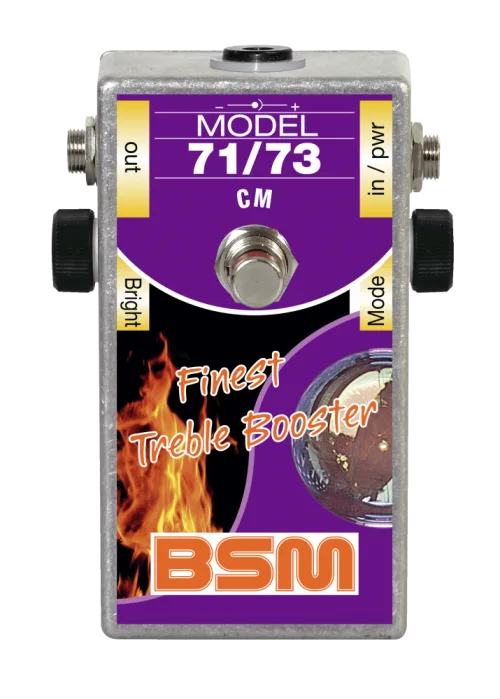
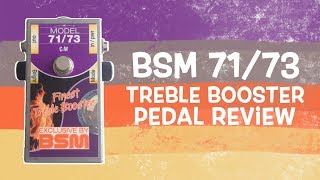

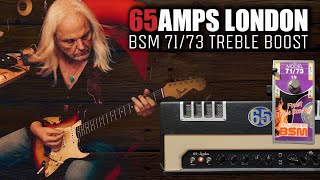
The BSM 71/73 CM Treble Booster is a treble booster stompbox from BSM, the German maker of Blackmore-focused boost pedals. It is a faithful recreation of the CM (custom made) booster that Bill Hough built and designed for Ritchie Blackmore, a circuit Blackmore used from 1971 until the end of 1973, plus what BSM calls the typical BSM add-ons12. BSM describes the pedal as producing a classical hard rock tone with a lot of nuances1.
Where it comes from
From 1971 forward, Ritchie Blackmore not only used the mid-rangy sounding Hornby-Skewes treble boosters, he also used the CM booster built and designed by Bill Hough2. BSM's standard setting for the 71/73 CM is based on that 1971 CM booster1. The maker describes the pedal as basically a recreation of Bill Hough's custom-made circuit, and notes that with its Bright and Mode controls the unit is very versatile for getting all the sounds of Ritchie's Deep Purple Mk2 period4.
The Bright and Mode controls
The two controls are what set this apart from a single-knob treble booster, and BSM gives fairly specific settings for each451.
| Control | What it does |
|---|---|
| Bright | Works similar to the bright volume of an amp, and works counter clockwise: full gain at 7:00, maximum treble at 17:00, neutral at 9:001 |
| Mode | Provides the specific frequency range of the basic CM booster model by Bill Hough, generating Ritchie's '71 Beat Club sound1 |
BSM also publishes settings for particular sounds:
- Power boost: Bright at full gain at 7:00 and Mode at 14:30 to 15:301
- '73 New York sound (Hofstra University show) with Marshall Majors: Bright turned to about 13:301
- HS-C emulation (germanium Hornby-Skewes): Mode at 11:00, Bright at 8:001
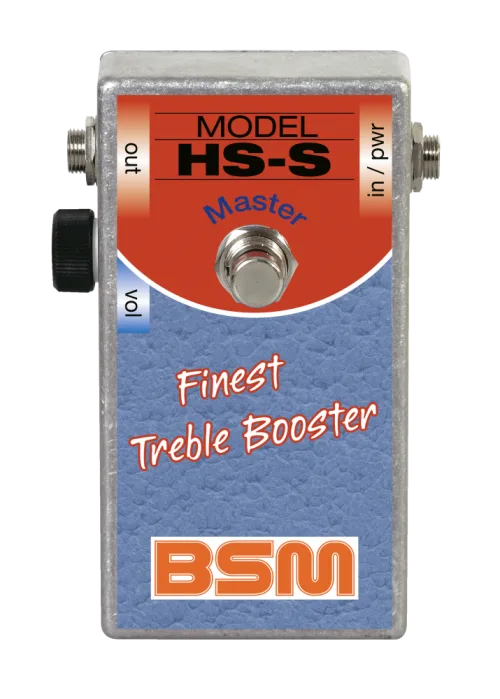
- HS-S emulation (silicon powered Hornby-Skewes): Mode turned fully back to 8:001
The Bright control works counter clockwise, the opposite of most knobs: full gain is at 7:00 and neutral is at 9:001. If the pedal seems to work backwards, that is by design.
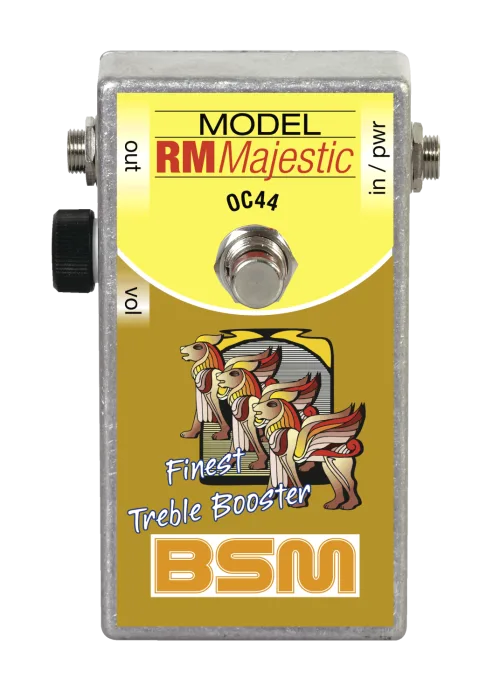
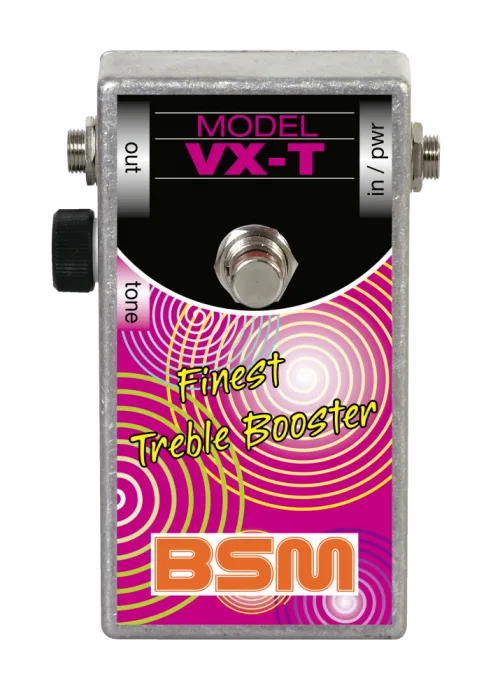
The Mode and Bright controls, in BSM's words, make this low-gain stompbox extremely versatile1. For players chasing the related Hornby-Skewes sounds in dedicated pedals, BSM also makes the BSM HS-S Treble Booster, and the wider boost pedal field includes the BSM RM Treble Booster and BSM VX-T Treble/Mid Boost.
Power and use with different pickups
The unit is powered by a 9V battery with a current consumption of approximately 250μA, and it can also be powered from the external 2.1mm maximum 9V DC power jack1. BSM notes that the negative pole of the battery is ground1. The average output level is 5dBm1.
According to BSM, this is a pedal that also works well with humbucking pickups, giving a crisp yet dirty crunch sound on an already overdriven tube amp1. That fits the pedal's origins, since Blackmore ran boosters into cranked valve amps in the early 1970s.
Videos
DogwithtwoBones
Haiko Heinz
Bibl Rocks - Guitars & Gear Show
Questions
Is the BSM 71/73 CM Treble Booster true bypass?
Yes. BSM states that the unit is true bypass, so when the pedal is off, the signal passes through without the booster circuit loading it. The pedal is powered by a 9V battery or an external 2.1mm 9V DC power jack, with a current consumption of approximately 250 microamps, and the negative pole of the battery is ground.
Can the BSM 71/73 CM run on a 9V battery?
Yes. BSM says the unit is powered by a 9V battery with a current consumption of approximately 250 microamps, and it can alternatively be powered from an external 2.1mm maximum 9V DC power jack. Note that the negative pole of the battery is ground, which matters when wiring power supplies.
Who was Bill Hough and what is the CM booster?
Bill Hough built and designed the CM, or custom made, booster for Ritchie Blackmore. From 1971 onward, Blackmore used the CM alongside the mid-rangy Hornby-Skewes treble boosters, and the BSM 71/73 CM is a faithful recreation of that circuit with typical BSM add-ons. BSM's standard setting for the pedal is based on the 1971 CM booster.
Does the BSM 71/73 CM work with humbucking pickups?
Yes. According to BSM, this is a pedal that also works well with humbucking pickups, giving a crisp yet dirty crunch sound on an already overdriven tube amp. The maker describes the overall result as a classical hard rock tone with a lot of nuances.
What is the difference between the HS-C and HS-S modes?
The Mode control can emulate the two Hornby-Skewes boosters Blackmore used. To emulate the germanium fitted HS-C booster, BSM says to turn Mode to 11:00 and Bright to 8:00. The silicon powered HS-S is achieved by turning the Mode control fully back to 8:00.
How do you contact BSM about the 71/73 CM?
BSM directs customers to send an email to info@treblebooster.net or to use the contact form on the treblebooster.net website to reach the maker with questions about the 71/73 CM.
Sources (5)
- 71/73 CM Treble Booster, BSM (treblebooster.net), 2025
- treblebooster-71-73.pdf, BSM, 2025
- BSM, gitarre & bass, 2011-03
- Custom made, BSM (treblebooster.net), 2025
- bsm-treble-boosters-2019.pdf, treblebooster.net
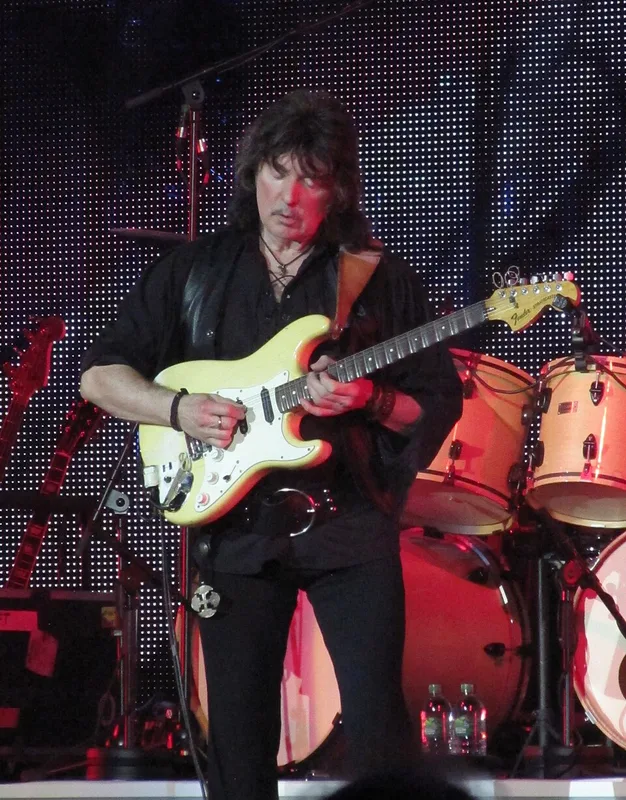 Ritchie Blackmore