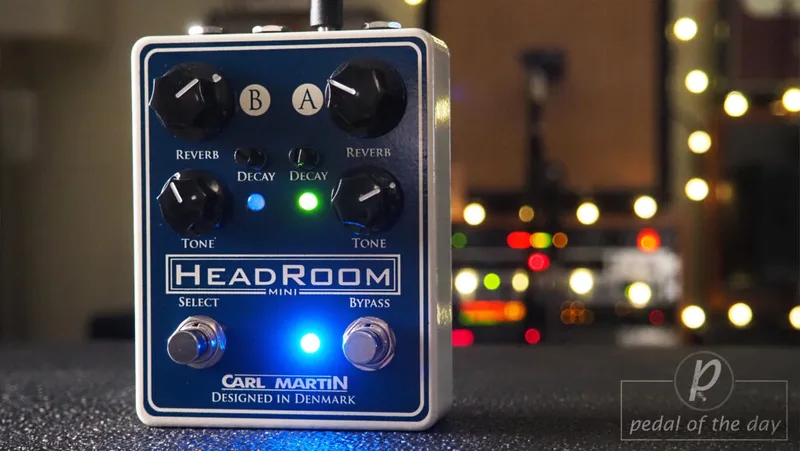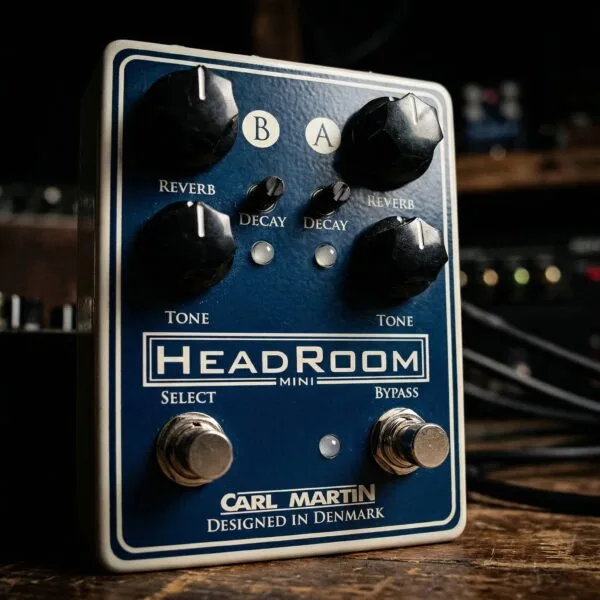


Where the original HeadRoom carries a genuine spring reverb tank, the Mini replaces the springs with a digital algorithm. As Carl Martin puts it123:
"Instead of real springs, we chose a digital reverb engine that allows us to recreate the depth, warmth, and movement of spring-style reverb while keeping size, weight, and power requirements practical."3
Delicious Audio described the result as covering "everything from tight room ambience to vast cathedral-like spaces"4.
Two reverb channels and the controls
The HeadRoom Mini offers two independent reverb channels, A and B, each with its own set of controls, and a Select footswitch that toggles between them32. That gives you two settable reverb sounds you can jump between on stage, in the same spirit as the original HeadRoom's two channels, which Carl Martin built instead of menus or presets1. Guitar Pedal X summed it up as "2 sets of Reverb, Tone and Decay controls, so you can switch between 2 different Reverb Settings"6.
Each channel carries three controls34:
| Control | What it does |
|---|---|
| Reverb (Level) | Sets the reverb amount for that channel |
| Tone | Adjustes the reverb tone for that channel |
| Decay | Sets how long the reverb tail lasts |
Delicious Audio's example of how to use the two channels: set a bright room sound on one and a darker, more dramatic reverb on the other, then switch between them with the Select footswitch4. The RockBoard PedalPedia entry for the original HeadRoom describes the same idea, with a soft small-room reverb on Channel A and a more dramatic, dark large-room reverb on Channel B8.
The pedal also has a Remote jack for external preset selection, built into its rugged metal casing, so the two channels can be switched from a remote switch rather than the onboard footswitch34.
Bypass, stereo and power
The HeadRoom Mini uses a buffered bypass with spillover trails, not true bypass: when you switch the pedal off, the reverb tail decays naturally instead of cutting dead32. Carl Martin says the buffered output preserves signal integrity, especially on pedalboards with longer cable runs3, and Delicious Audio notes the buffered bypass "ensures signal integrity even in long pedal chains"4.
The Mini supports both mono and stereo operation, with stereo inputs and outputs and a switch on the pedal to select between the two modes, which makes it work with traditional amps as well as two-amp stereo rigs32. It runs on 9V DC3.
The buffered bypass means the HeadRoom Mini is not true bypass. Players who want the reverb tail to cut instantly when bypassed, the way a true bypass pedal does, will notice the spillover behavior instead.
How it differs from the original HeadRoom
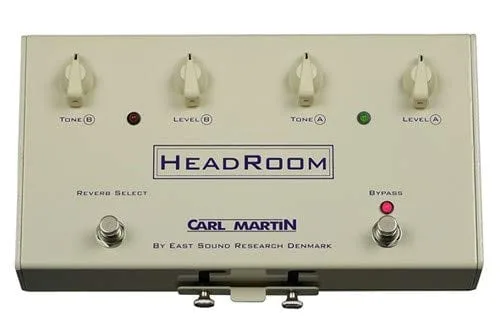
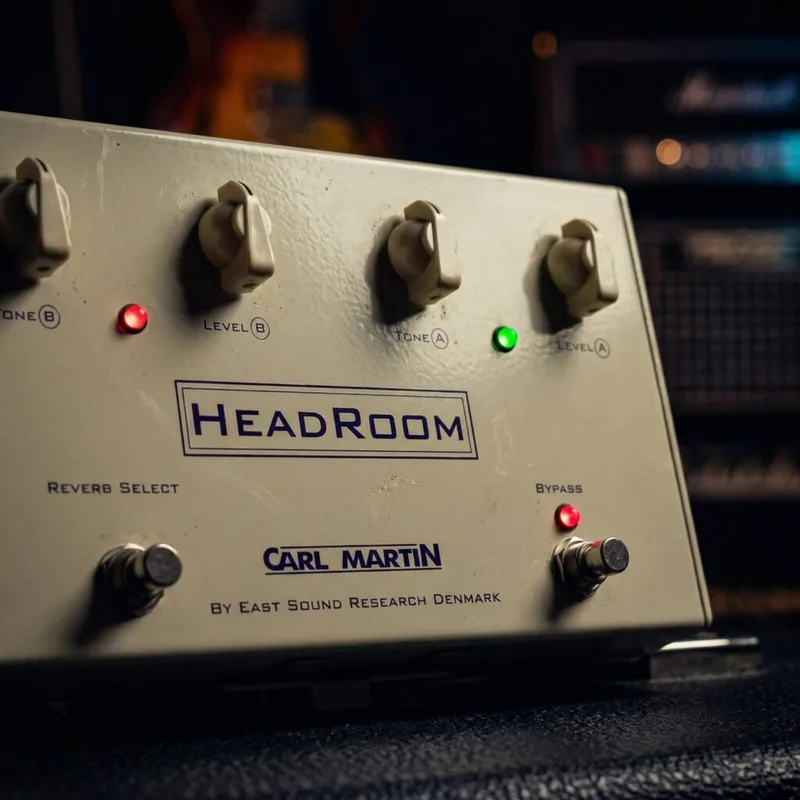
The original Carl Martin HeadRoom, released in 2011, is an analog pedal with a genuine spring reverb tank in a stompbox format15. RockBoard's PedalPedia entry calls it "this purely analogue 'real spring' reverb" with two identical channels, each with tone and level controls8. It was a mono-only pedal5, and its power arrangements varied by version: it runs internally around ±12V and can be powered by 9V DC, a 9V battery or a 12V AC adapter, with older versions actually carrying an AC mains plug1.
The Mini keeps the two-channel concept but changes nearly everything else2:
| Original HeadRoom | HeadRoom Mini | |
|---|---|---|
| Circuit | Analog, real spring tank18 | Digital emulation of the spring reverb3 |
| Channels | Two identical channels, tone and level8 | Two channels, each with Reverb, Tone and Decay3 |
| Stereo | Mono only5 | Mono and stereo, switchable32 |
| Bypass | True bypass switching9 | Buffered bypass with spillover3 |
| Power | 9V DC, 9V battery or 12V AC depending on version1 | 9V DC3 |
| Size | Full-sized unit5 | Compact, pedalboard-friendly3 |
Pedal of the Day reported that many players loved the original's spring reverb tone but found it difficult to fit the full-sized unit on their pedalboards, which is what drove demand for a smaller version5. Achieving a convincing digital recreation of the original's sound was, in that reviewer's words, "a major challenge," with the DSP integrated into an analog circuit5.
Guitar Pedal X's Stefan Karlsson called the Mini "an interesting move by Carl Martin" and "a smart enough device in a mid-size 1590BB style enclosure," while noting that customers for this kind of device might prefer a genuine spring tank pedal overall6.
The original Headroom pedal was released in 2011, a spring reverb pedal with two channels serving as two settable reverb sounds591:
Who uses it
On Carl Martin's artist pages, Amir John Haddad and James Massi are listed as HeadRoom Mini users10. The original HeadRoom has a longer roster: Kid Anderson, Paul Nelson, Carl Verheyen, Fred Turner and Derek Gripper10.
Videos
Carl Martin
Juliana Wilson
EytschPi42
Questions
Is the Carl Martin HeadRoom Mini true bypass?
No. The HeadRoom Mini uses a buffered bypass with spillover trails, so the reverb tail decays naturally when you switch the pedal off rather than cutting abruptly. Carl Martin says the buffered output also preserves signal integrity on pedalboards with longer cable runs.
Is the HeadRoom Mini analog or digital?
It is digital. Instead of the real spring tank used in the original HeadRoom, the Mini uses a digital reverb engine that Carl Martin says recreates the depth, warmth and movement of spring reverb. Pedal of the Day reported that the DSP was integrated into an analog circuit.
Does the HeadRoom Mini work in stereo?
Yes. The pedal has mono and stereo inputs and outputs, with a switch on the pedal to select mono or stereo operation. The original HeadRoom was a mono-only pedal, so stereo support is one of the Mini's additions.
What power does the HeadRoom Mini take?
The HeadRoom Mini runs on 9V DC. That is simpler than the original HeadRoom, which depending on version could be powered by 9V DC, a 9V battery or a 12V AC adapter, with older versions using an AC mains plug.
How is the HeadRoom Mini different from the original HeadRoom?
The original HeadRoom, released in 2011, is an analog pedal with a genuine spring reverb tank. The Mini is a digital emulation of that spring reverb in a smaller enclosure, and it adds stereo inputs and outputs plus a switchable buffered bypass with spillover.
Can you switch presets externally on the HeadRoom Mini?
Yes. The pedal has a Remote jack for external preset selection, so you can switch between the two reverb channels from a remote switch rather than the onboard Select footswitch. The rugged metal casing includes this remote switch jack.
Sources (10)
- HeadRoom, carlmartin.com, 2026
- Support - Carl Martin, Carl Martin (carlmartin.com), 2026
- HeadRoom Mini, Carl Martin, 2026
- Carl Martin Headroom Mini Stereo Reverb, Delicious Audio, 2025-08-19
- Carl Martin HeadRoom Mini Dual Channel Digital Spring Reverb, Pedal of the Day (www.pedal-of-the-day.com), 2025-03-25
- Guitar Pedal X, Guitar Pedal X, 2025-04-02
- DeLayla XL, Carl Martin, 2026-02
- Headroom by Carl Martin, RockBoard PedalPedia, 2026
- Carl Martin Headroom Reverb, demo by Pete Thorn, youtube.com, 2011-11-17
- Artists - Carl Martin, Carl Martin (carlmartin.com), 2026