
Inside, it runs on a triplet of OC71 germanium transistors and the now-obsolete cylindrical PP4 9-volt battery. GuitarPlayer's history of rare British fuzzboxes describes it as "a three-transistor fuzz pedal that runs off nine volts" with "a smoother, more balanced sound compared to a lot of the pedals from the era"12.
Inside the pedal
The circuit is built the old way: its electronic components were populated onto an eyelet board rather than a printed circuit board, the same construction method Fender used on its vintage amplifiers2.
The three OC71 transistors are the heart of it. These are PNP germanium types, which means the circuit requires a positive ground, the opposite of what most modern pedals use. That detail matters to anyone servicing an original or building a clone, because a positive-ground pedal cannot simply share a daisy-chained power supply with negative-ground pedals2.
The power source is a piece of history in itself. The pedal was designed around the cylindrical PP4 9-volt battery, a format that is now obsolete and hard to find. There is also a quirk in the paperwork: the engineer who drew up the circuit in 1966 mistakenly flipped the PP4 battery's polarity around in the schematic, so anyone working from the original factory drawing needs to know the error is there2.
The original factory schematic was acquired from Carlsbro by Bart Provoost before the original company was sold to its current owners, so the design is documented despite the pedal's rarity2.
Relation to the Maestro Fuzz-Tone
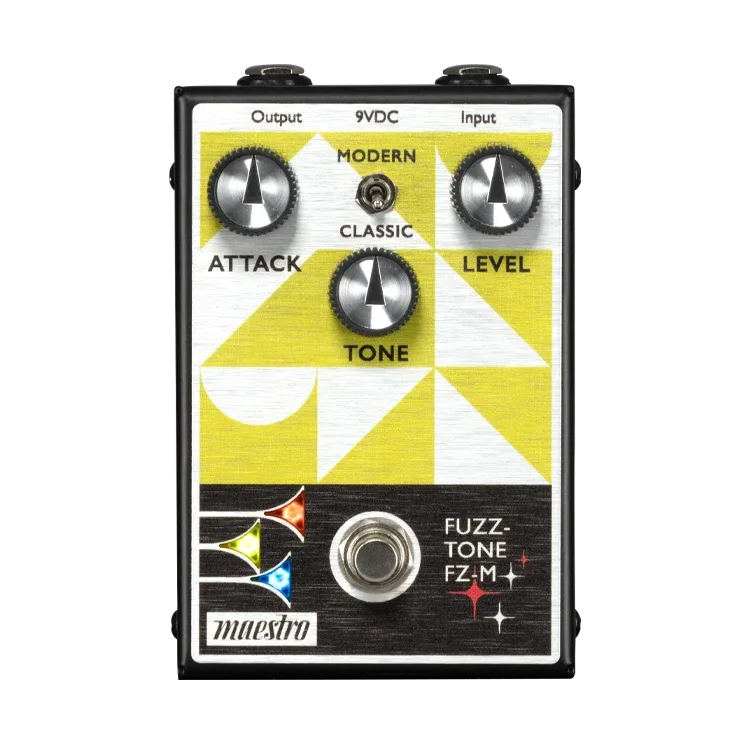
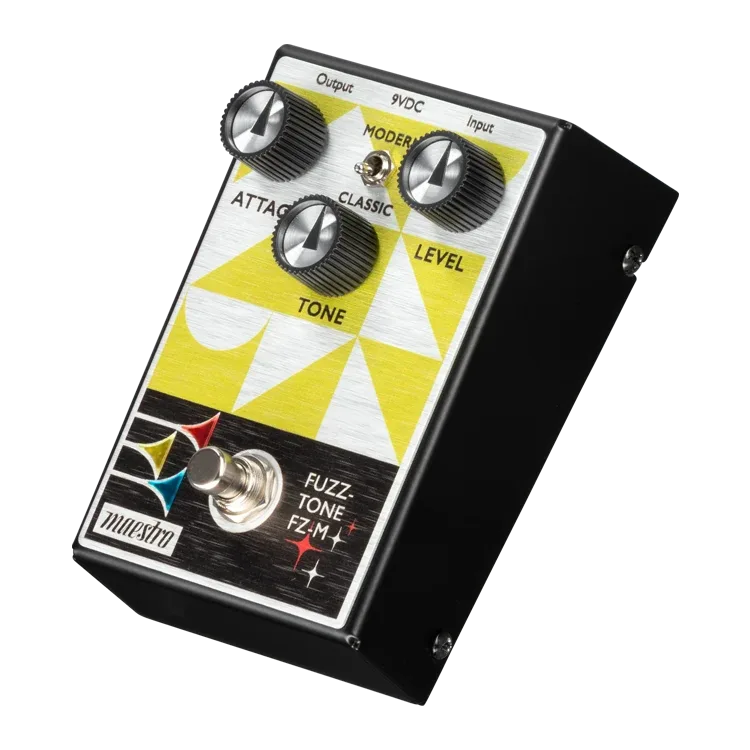
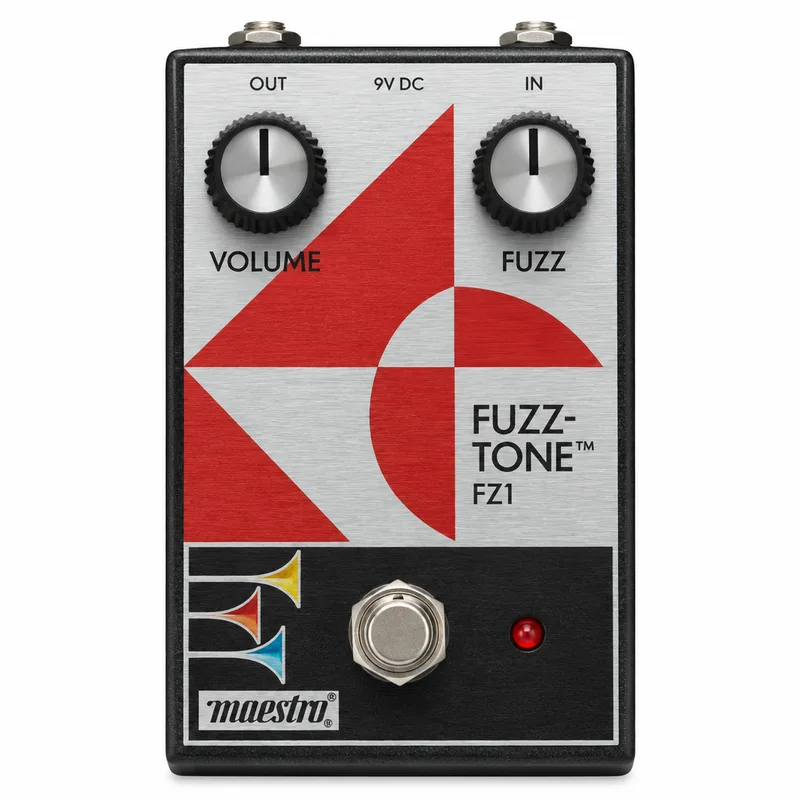
The name and the look both point at the Maestro Fuzz-Tone, the pedal that started it all. Gibson's subsidiary Maestro introduced the Fuzz-Tone in 19623, designed by recording engineer Glenn Snoddy and WSM-TV engineer Revis V, and manufactured by Gibson4. In the early 1960s, the fuzz sound moved from busted amps into the pedal platform with the Gibson Maestro Fuzz-Tone5. The original FZ-1 used three germanium transistors67, later revised with 2N2614 or 2N2613 transistors powered by a single 1.5-volt battery7.
Against that background, the Carlsbro Fuzz-Tone is unusual. Unlike the majority of early fuzz boxes built on either side of the Atlantic, it was not a direct copy of Gibson's Maestro Fuzz-Tone, even though the enclosure shape and the electronics construction are almost identical to it2. Carlsbro's engineer drew up his own circuit around different transistors and a different battery, while keeping the Maestro's wedge form.
| Carlsbro Fuzz-Tone | Maestro FZ-1 | |
|---|---|---|
| Year | By 19662 | 19623 |
| Transistors | Three OC71 germanium, PNP2 | Three germanium67 |
| Battery | PP4 9-volt cylindrical2 | 1.5-volt (revised circuit)7 |
| Circuit | Own design, not a direct copy2 | Snoddy and Revis V design4 |
Players and recordings
Two 1960s British recordings are documented as featuring the Carlsbro Fuzz-Tone:
- The Sorrows, a cult freakbeat band from the Midlands, whose guitar player used it on the track "Pink, Purple, Yellow & Red"1
- Skip Bifferty, on the track "On Love"2
Both fit the pedal's short window: the early Carlsbro fuzz pedals were available to purchase as early as by 1966, a date supported by an original owner and by potentiometer date codes inside surviving units2.
How rare is it?
Videos
blondegraemey
Questions
Is the Carlsbro Fuzz-Tone a copy of the Maestro Fuzz-Tone?
No. Although the enclosure shape and the way the electronics are constructed are almost identical to Gibson's Maestro Fuzz-Tone, the circuit itself is not a direct copy. The majority of early fuzz boxes on either side of the Atlantic were clones of existing designs, but the Carlsbro Fuzz-Tone drew up its own circuit, built around three OC71 germanium transistors.
What transistors are in the Carlsbro Fuzz-Tone?
A triplet of OC71 germanium transistors. These are PNP types, which means the circuit requires a positive ground rather than the negative ground most modern pedals use. Germanium transistors of this kind were standard in 1960s fuzz designs, including the early Maestro Fuzz-Tone, which also used three germanium devices.
Does the Carlsbro Fuzz-Tone use a positive ground?
Yes. Because its OC71 transistors are PNP types, the circuit requires a positive ground. This is common to many germanium fuzz pedals of the era and matters to anyone building or servicing one today, since a positive-ground pedal cannot share a power supply with negative-ground pedals without isolating it.
What battery does the Carlsbro Fuzz-Tone take?
The now-obsolete cylindrical PP4 9-volt battery. The engineer who drew up the circuit in 1966 mistakenly flipped the battery's polarity in the schematic, an error worth knowing about for anyone working from the original factory drawing. The pedal runs on nine volts in total.
Who used the Carlsbro Fuzz-Tone on record?
The guitar player in The Sorrows, a cult freakbeat band from the Midlands, used it on the track "Pink, Purple, Yellow & Red". Another notable recording featuring the pedal is Skip Bifferty's "On Love". Both are 1960s British tracks, which fits the pedal's short production window.
How many Carlsbro Fuzz-Tone pedals survive?
Only a very low number of examples are known to survive, and it is not known for how long production of the blue wedge-shaped 1966 pedal lasted. The original factory schematic was acquired from Carlsbro by Bart Provoost before the original company was sold to its current owners, which has helped document the design.
Sources (7)
- Five Rare British Vintage Fuzzboxes (That Aren't Tone Benders or Fuzz Faces!), GuitarPlayer, 2021-08-31
- Carlsbro Fuzz-Tone • Fuzzboxes, Fuzzboxes.org, 2021-05-12
- Gibson revives Maestro as a fully-fledged pedal brand with five new stompboxes, Guitar.com, 2022-01-18
- The legendary Maestro Fuzz-Tone appears poised to make a comeback in 2022, Guitar.com, 2022-01-06
- FUZZCYCLOPEDIA : A Side-by-Side Comparison of EQD Fuzz Boxes, EarthQuaker Devices, 2021-08-10
- Interview: "It's arguably the first guitar effects pedal ever", MusicRadar, 2022-02-21
- The history and origins of the iconic Maestro FZ-1 Fuzz-Tone, Guitar World, 2021-10-20