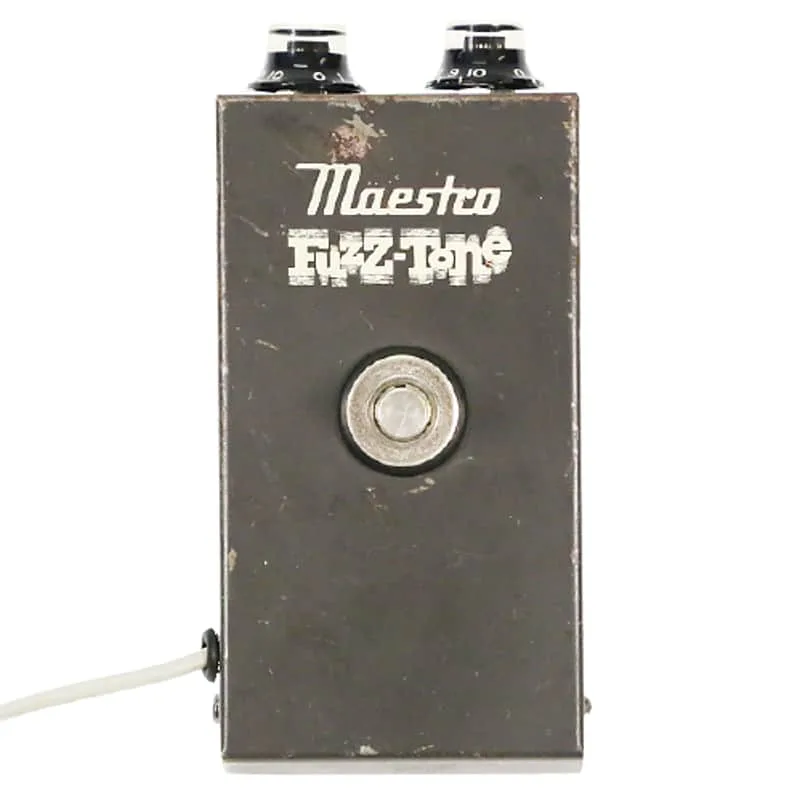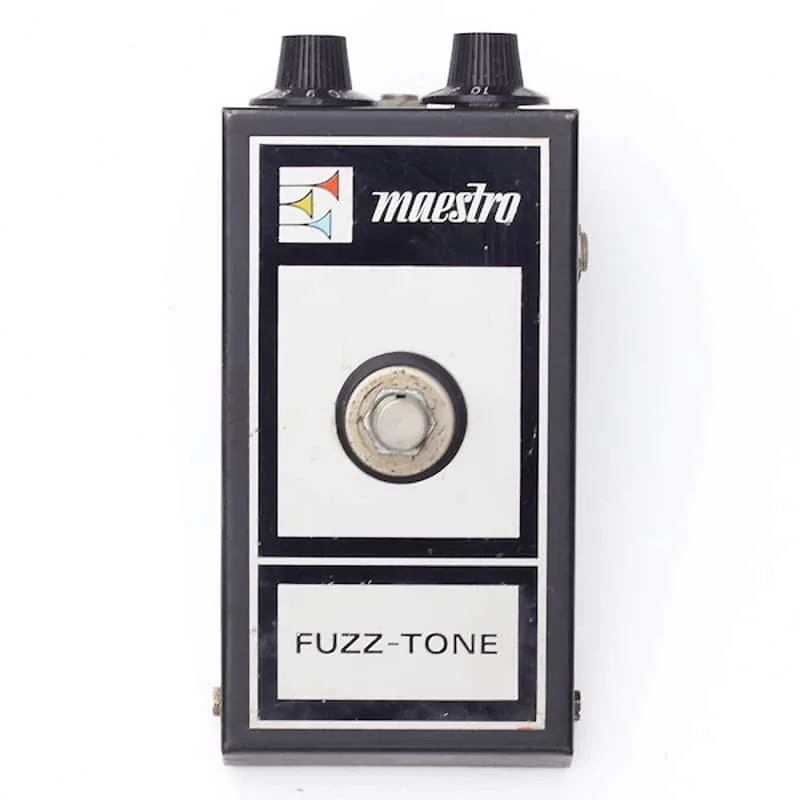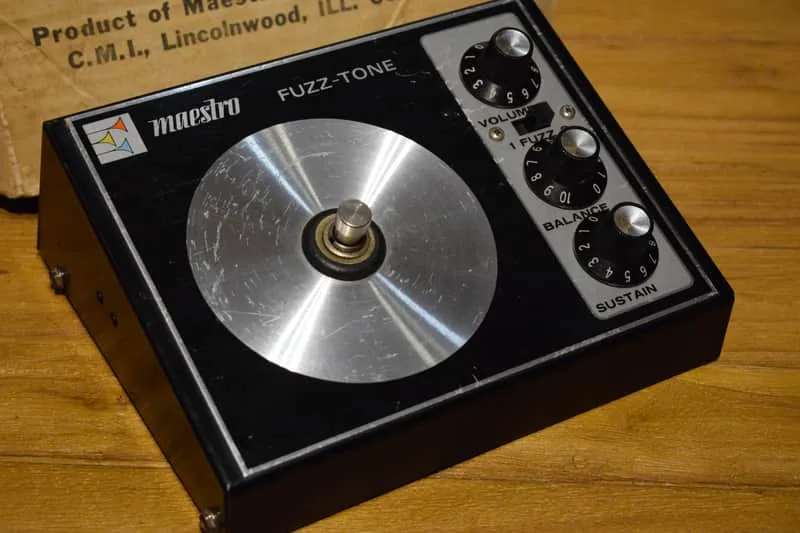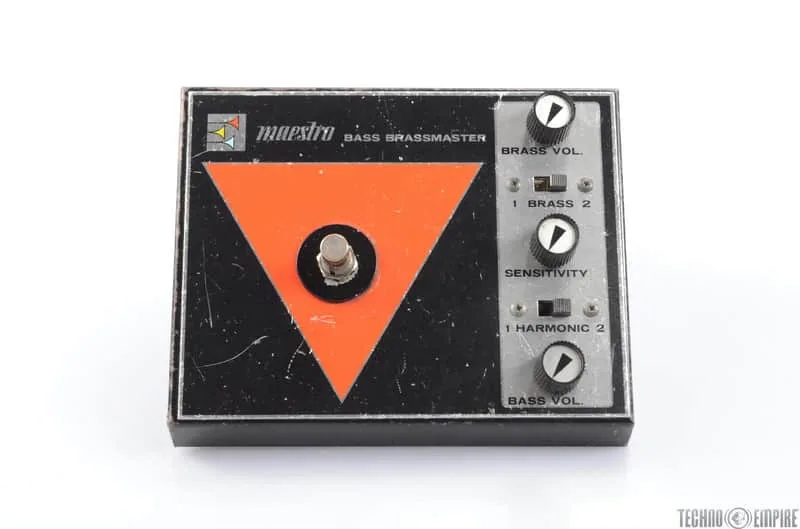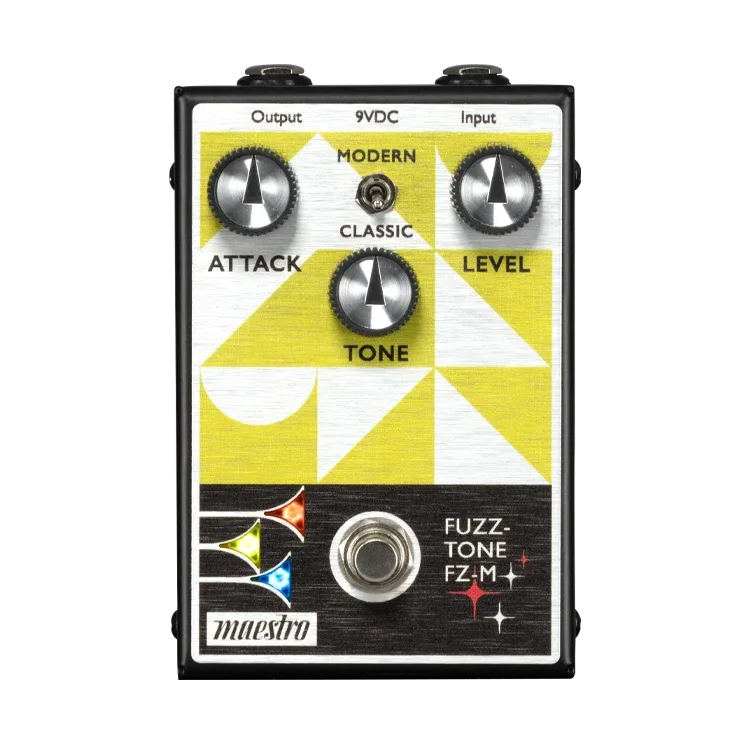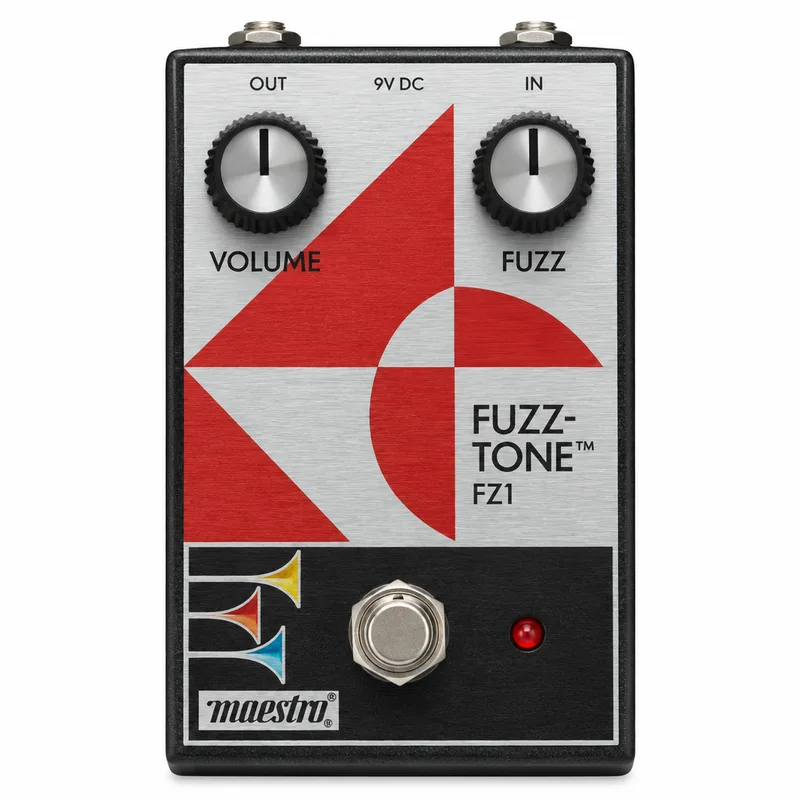

The Maestro Fuzz-Tone FZ-1 is a two-knob fuzz pedal that Gibson launched under its Maestro brand name in 1962, and it is widely credited as the world's first fuzz pedal and the first commercially successful stompbox123. Instead of the saturated, sustaining fuzz most players expect today, it was originally marketed to make your guitar achieve tones similar to those of a brass instrument, with the patent application describing a circuit designed to let stringed instruments simulate trumpets, trombones and tubas12.
That brass-instrument pitch made it a slow start. MusicRadar calls the FZ-1 "largely a commercial failure" in its early days, and Guitar World reports that after an initial production run of five thousand units, sales almost completely dried up45. What turned it around was rock and roll: the pedal became the legendary sound on the Rolling Stones' "(I Can't Get No) Satisfaction," after which Gibson was soon selling FZ-1s in their tens of thousands35.
A two-knob fuzz built to sound like a brass instrument
The FZ-1 is about as simple as a pedal gets: two knobs, labeled Volume and Attack, on a wedge-shaped box26. Volume sets the output level; Attack sets the intensity of the fuzz. The circuit inside the original FZ-1 used three germanium transistors powered by two 1.5-volt batteries1. Coda Effects identifies the original transistors as germanium 1N270s8.
The brass-instrument idea came straight from the design brief. The May 3, 1962 patent application describes the goal as providing "a tone modifying attachment and circuit for electrically produced signals which will permit stringed musical" instruments to imitate other instruments2. Gibson even made a demo for the pedal that was released on vinyl in 19624. Vintage Guitar notes that the marketing simply did not connect with guitarists at first, which is why the whole first production run sat with dealers until the Stones record changed the picture2.
The pedal's low operating voltage is part of its character. Premier Guitar groups the FZ-1 with "lower voltage vintage fuzzes," noting the original ran on 3 volts from AA batteries, a detail that matters to players chasing that sound today, since most modern pedals expect 9 volts7910.
Who invented it, and where it came from
The Fuzz-Tone was designed by recording engineer Glenn Snoddy and WSM-TV engineer Revis Hobbs, and manufactured by Gibson11. Snoddy and Hobbs filed their patent application on May 3, 1962, and Vintage Guitar quotes the pair saying "together we worked out the details of the Fuzz-Tone"2. Guitar.com calls it the first fuzz effect to gain widespread popularity11.
Its influence ran well beyond its own sales. In a MusicRadar interview, Craig Hockenberry traced the family tree: "Obviously, the Tone Bender and Fuzz Face, but there were so many others that followed suit"12. Guitar World likewise credits the FZ-1 with inspiring the Tone Bender, Fuzz Face and many other fuzz designs of the mid-'60s12.
Early production and price
Gibson built the first run in Kalamazoo, Michigan. The numbers from the press and from serial research852:
| Detail | Value | Source |
|---|---|---|
| 1962 production run | 5,000 units, all snapped up by dealers | 28 |
| 1962 shipment (serial research) | 5,461 units, serials 1 to 5461 | 8 |
| 1962 retail price | $40 | 2 |
| FZ-1A sales (from late 1965) | Some 40,000 pedals | 2 |
| Vintage unit price, 2023 | Over $600 | 13 |
Guitar World's Huw Price reports that after the initial five thousand units, sales almost completely dried up until "Satisfaction" revived demand, at which point Gibson was soon selling FZ-1s in their tens of thousands5. An original FZ-1 could still be found cheap decades later: Premier Guitar's Ted Drozdowski recalls picking one up "used for about $20 in the early '90s"14. Today the vintage unit sells for over $600, which is why a clone market exists, with builders like Mozztronics offering FZ-1-inspired pedals at $14513.
The FZ-1A, FZ-1B and later versions
Gibson revised the pedal several times over the following decade and a half1152:
| Version | Year | Circuit | Power | Notes |
|---|---|---|---|---|
| FZ-1 | 1962 | Three germanium transistors (1N270) | Two 1.5V batteries | Original18 |
| FZ-1A | Late 1965 | Three germanium transistors, 2N2614 or 2N2613 | Single 1.5V battery | Largely same circuitry as FZ-112 |
| FZ-1B | 1968 | Two or four silicon transistors (depending on date of manufacture) | 9-volt supply | Circuit by Robert Moog, revised graphics12 |
| FZ-1S Super-Fuzz | 1970s | Designed by Tom Oberheim | Different look and distinctly different sound116 |
The FZ-1A kept the Volume and Attack controls and largely the same three-germanium-transistor circuitry as the original, but moved to Motorola 2N2614 transistors and a single 1.5-volt battery128. The FZ-1B was a bigger departure: legendary synthesizer engineer Robert Moog crafted a circuit using a nine-volt power supply that powered two or four silicon transistors depending on the date of manufacture1. Vintage Guitar describes the FZ-1B as Lincolnwood-built, 9-volt and two-transistor, with revised graphics2.
DIY builders still work on the FZ-1A circuit. On the Guitar FX Layouts blog, Travis verified a build using SFT323 transistors (about 200 hfe with a lot of leakage) and noted that PNP transistors with some leakage work best, with two 1µ capacitors in the signal path where any capacitor type will do17.
Videos
ikisugita_DIY
Questions
How much did the original Maestro FZ-1 cost?
The FZ-1 carried a retail price of $40 when Gibson launched it in 1962. Original units were cheap on the used market for decades after, but by 2023 the vintage unit was selling for over $600.
How many Maestro FZ-1 pedals were made?
Gibson produced 5,000 units in 1962, and dealers snapped up the entire run. Coda Effects' serial research puts the 1962 shipment at 5,461 units from Kalamazoo, Michigan. Sales then almost completely dried up until the FZ-1A arrived in 1965 and sold some 40,000 pedals.
What transistors does the Maestro FZ-1 use?
The original FZ-1 used a three-germanium-transistor circuit. Coda Effects identifies the original transistors as germanium 1N270s, while the FZ-1A revision used Motorola 2N2614 or 2N2613 transistors. The FZ-1B switched to silicon.
What voltage does the Maestro FZ-1 run on?
The original FZ-1 ran on three volts from two 1.5-volt batteries. The FZ-1A dropped to a single 1.5-volt battery, and the 1968 FZ-1B moved to a nine-volt supply.
Who invented the Maestro Fuzz-Tone?
The Fuzz-Tone was designed by recording engineer Glenn Snoddy and WSM-TV engineer Revis Hobbs, who worked out the details together, and it was manufactured by Gibson. Snoddy and Hobbs filed a patent application on May 3, 1962.
What changed in the FZ-1A and FZ-1B?
The FZ-1A arrived in late 1965 with largely the same three-germanium-transistor circuit but 2N2614 or 2N2613 transistors and a single 1.5-volt battery. The 1968 FZ-1B was a redesign by Robert Moog using silicon transistors, a nine-volt supply and revised graphics.
Sources (17)
- The history and origins of the iconic Maestro FZ-1 Fuzz-Tone, Guitar World, 2021-10-20
- Maestro Fuzz-Tone, Vintage Guitar magazine, 2015-12-08
- The Big Review: Maestro Original Collection pedals, Guitar.com, 2022-02-10
- Jimmy Page talks about Roger Mayer bringing the distortion pedal into his life, MusicRadar, 2019-09-19
- Fuzz pedals: how the wildest drive of all conquered the radio, Guitar World, 2023-06-14
- Maestro FZ-M Fuzz-Tone Review, GuitarPlayer, 2022-04-06
- The history of the Sola Sound Tone Bender, Guitar World, 2021-03-26
- Coda Effects, Coda Effects (coda-effects.com), 2016-12
- Crazy Tube Limelight Review, Premier Guitar, 2019-09-30
- Electro-Harmonix Bender Royale Review, Premier Guitar, 2026-02-22
- The legendary Maestro Fuzz-Tone appears poised to make a comeback in 2022, Guitar.com, 2022-01-06
- Interview: "It's arguably the first guitar effects pedal ever", MusicRadar, 2022-02-21
- The Best Maestro FZ-1 Fuzz Tone Clones & Evolutions In 2023, Delicious Audio, 2023-05-15
- The Fuzz Boxes That Fuel PG Staff’s Meanest Musical Moments, Premier Guitar, 2025-05-12
- [BALTIC BLUE FUZZ (OC-BBFn)
- Maestro™ FZ-1S™ Super-Fuzz™ Clone: Schematic & Layout, General Guitar Gadgets, 2014-05-14
- Guitar FX Layouts: Maestro Fuzz Tone FZ-1A, Guitar FX Layouts (tagboardeffects.blogspot.com), 2015-08-29
 Keith Richards