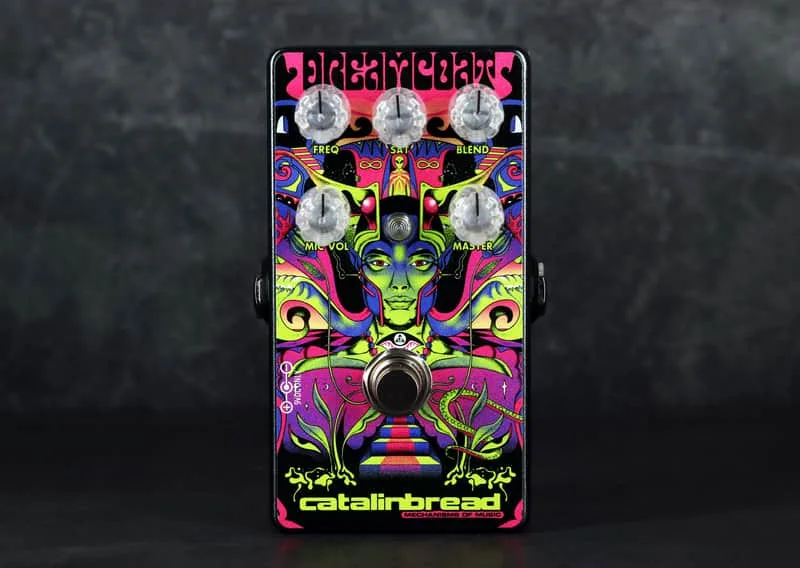


The Catalinbread Dreamcoat is a preamp pedal that recreates the preamp circuit of the Aiwa TP-1011, a reel-to-reel tape deck that can be found in '60s and '70s classic rock recordings1. Catalinbread describes the heart of the pedal as "a near-exact recreation of the preamp circuit from the Aiwa TP-1011 reel-to-reel," built to the exact specs of the original deck's preamp1.
The reason a tape deck preamp ended up on guitarists' radar is simple: the TP-1011 was originally designed to accept a microphone input, and a guitar signal naturally overloaded the front end, creating its signature distortion2. The deck also ran at 18V, which is part of why its preamp behaves the way it does1. The Dreamcoat captures that overloaded-tape character in a stompbox, and Catalinbread says it "can be an unruly, velcro-y, and sputtery beast, but one that can be tamed at low levels for a more classic rock approach"1.
Where the circuit comes from
The Aiwa TP-1011 was a reel-to-reel deck whose preamp was designed for microphone-level signals, not the hotter output of a guitar pickup. Push a guitar into it and the front end overloads, producing the distortion that made the deck's sound recognizable on classic rock recordings2. Catalinbread's approach was to copy that preamp exactly rather than approximate it: the company states the Dreamcoat "has the exact specs of the Aiwa TP-1011 reel-to-reel preamp"1.
One detail from the original carries over in a modified way. The TP-1011 ran at 18V internally1. The Dreamcoat runs from an ordinary 9V DC center-negative supply, but a shunt-regulated charge pump inside the pedal steps the circuit up to run at 20V1. For a player, that means standard pedalboard power works, with no special high-voltage supply needed.
The pedal also carries a piece of history in its control layout. The famous user of the Aiwa TP-1011 tape deck had a passive boost tailored to the resonant frequency of his setup, and Catalinbread carries that idea into the Dreamcoat's internal frequency trimmer1.
Controls and how to use them
The Dreamcoat has four external knobs and one internal trimmer. The trimmer is a set-it-and-forget-it control you dial in once to suit your guitar; the external FREQ knob then gives you the boost amount on the fly13.
| Control | What it does |
|---|---|
| MASTER | Master volume. Catalinbread notes the pedal "can get punishingly loud," and that you may need to raise it when adjusting the Blend control1 |
| MIC VOL | The original "distortion" control of the Aiwa deck; sets the total "distortion" of the circuit1 |
| FREQ | Controls the amount of boost at a frequency band from 2.4KHz to 5KHz, set by the internal trimmer. Fully counter-clockwise it is out of the circuit; fully up gives a full 10dB boost at the selected frequency1 |
| BLEND | Blends the signal coming out of the Freq control with the Aiwa deck circuit. All the way down you hear just the EQ'd dry signal1 |
| Frequency trimmer (internal) | Sets the boost frequency from 2.4KHz to 5KHz. A set-it/forget-it control dialed to suit your guitar1 |
MusicRadar's Jonathan Horsley described the interaction simply: "Once you have set the frequency via the trimmer, Freq adjusts the frequency boost, offering you 10dB to play with"3.
The BLEND control is worth understanding because of where the clean blend sits in the chain. Catalinbread included a clean blend circuit that begins after the frequency boost and ends after the tape preamp, which the company says preserves pick attack and presence1. In practice, that means your blended clean signal carries the treble boost but not the tape preamp's overload, so you can keep definition while adding the deck's character underneath.
Catalinbread publishes starter settings for two modes on its product page: Classic Rock and Splatty Fuzz2. The difference between them comes down largely to how hard the MIC VOL control is pushed, since that knob governs the total distortion of the circuit1.
Power and connections
The Dreamcoat requires a 9V DC center-negative power supply and draws 44mA1. There is no battery option; the pedal is power-supply only2. The internal charge pump runs the audio circuit at 20V, so a standard 9V pedalboard output is all you need.
Input impedance is greater than 1MΩ and output impedance is under 5KΩ1, which means the pedal preserves high-end detail from passive pickups and drives long cable runs or later pedals without loading issues. The enclosure measures 4.33" x 2.36" x 1.93" and weighs 0.4 lbs1, a compact footprint for a preamp with this much gain on tap.
The Skewer and the box set launch
The Dreamcoat launched in June 2021 alongside the Skewer, a treble booster, and the two were released as a pair. MusicRadar described the launch as Catalinbread "releasing both as a limited edition two-for-one box set"3, with the pedals carrying complementary artwork3. The set was inspired by the sound of a legend and by the signature graphics of his band's record covers4.
The release plan worked in two stages:
- For the first month of production, the Dreamcoat and Skewer were sold exclusively as a two-pedal box set at a discounted price5. Guitar.com's Daniel Seah reported that discounted price as $299.99, versus a usual $359.98 for the pair6.
- After the first month, the pedals became available as separate units, at no longer discounted prices7. Gearnews reported the individual versions were expected in August 20215.
Delicious Audio framed the intent behind the set: "This box set is not meant to nail Blackmore's tone, but rather be a toolkit to help you make your own sonic footprint"4.
For players running the two pedals together, Catalinbread notes that the Skewer sounds great going into the Dreamcoat, and that the Skewer's internal trimmer may need to be dialed back a bit when the two are used this way2.
Where it sits in Catalinbread's range
The Dreamcoat is one of several Catalinbread pedals built as a recreation of a specific vintage circuit rather than a generic overdrive, sitting alongside amp-in-a-box and console-style preamp designs in the company's lineup. It is a preamp first and a dirt pedal second: with MIC VOL low and BLEND favoring the clean path it works as an EQ'd boost, while pushing MIC VOL takes it into overdrive and fuzz territory. Players comparing it against more conventional drives can read about the broader category on the overdrive pedals and fuzz pedals pages1.
Videos
AndyDemos
Demos In The Dark
Chicago Music Exchange
News
Questions
Is the Catalinbread Dreamcoat true bypass?
Yes. Catalinbread lists the Dreamcoat as true bypass, so with the pedal disengaged your signal passes through without buffering or coloring. Input impedance is greater than 1MΩ and output impedance is under 5KΩ, so it plays well with other pedals on a board.
Can the Dreamcoat run on a battery?
No. The Dreamcoat requires a 9V DC center-negative power supply and draws 44mA. Catalinbread's product page specifies a power supply only, with no battery option. Internally, a shunt-regulated charge pump steps the circuit up to run at 20V, like the original Aiwa deck's higher operating voltage.
What does the Sat knob do on the Dreamcoat?
The Dreamcoat does not have a Sat knob. Its four external controls are MASTER (volume), MIC VOL (the original distortion control of the Aiwa deck, setting total circuit distortion), FREQ (amount of boost at a frequency set by an internal trimmer), and BLEND (mixing the EQ'd signal with the tape preamp circuit).
Is the Dreamcoat sold on its own or only in the box set?
At launch in June 2021 it was sold only as a two-pedal box set with the Skewer treble booster, at a discounted $299.99 versus the usual $359.98. After the first month of sales the pedals became available separately, though at no longer discounted prices.
What settings give the Dreamcoat a splatty fuzz sound?
Catalinbread publishes starter settings for two modes, Classic Rock and Splatty Fuzz, on its product page. The splatty character comes from pushing the MIC VOL control, which sets the total distortion of the circuit. At low levels the pedal is tamed for a classic rock approach; turned up it becomes what Catalinbread calls an unruly, velcro-y, sputtery beast.
Sources (7)
- Dreamcoat/Skewer Special Edition Box Set, Catalinbread Effects
- Dreamcoat/Skewer Bundle (B-Stock), Catalinbread Effects
- Catalinbread turns a shade of Deep Purple with a two-pedal box set for exploring Ritchie Blackmore's tone, MusicRadar, 2021-06-25
- Catalinbread Dreamcoat/Skewer Box Set, Delicious Audio, 2021-06-23
- New Ritchie Blackmore-inspired Catalinbread Dreamcoat and Skewer pedals, gearnews.com, 2021-06-23
- Catalinbread’s Dreamcoat and Skewer pedals were inspired by Ritchie Blackmore‘s iconic guitar tone, Guitar.com, 2021-06-23
- Catalinbread unleashes Ritchie Blackmore-inspired double-pedal boxset, Guitar World, 2021-06-24
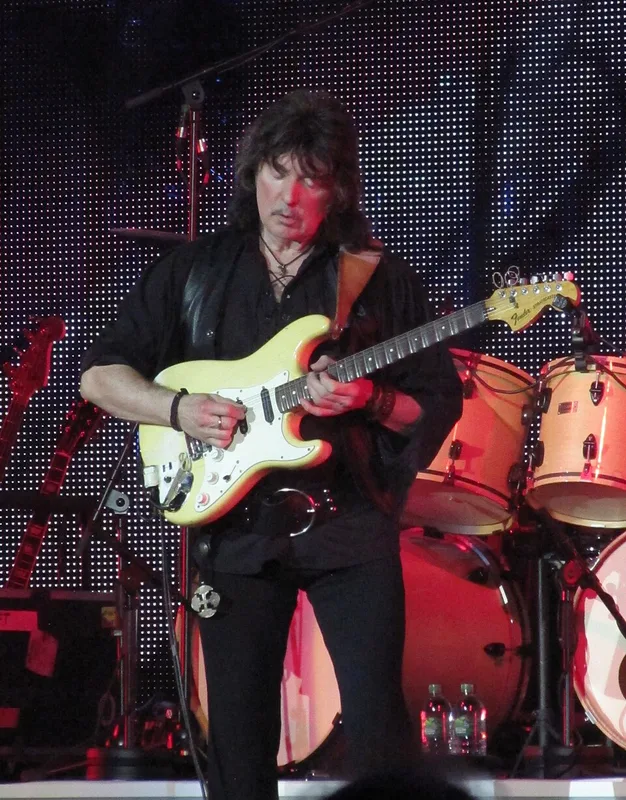 Ritchie Blackmore