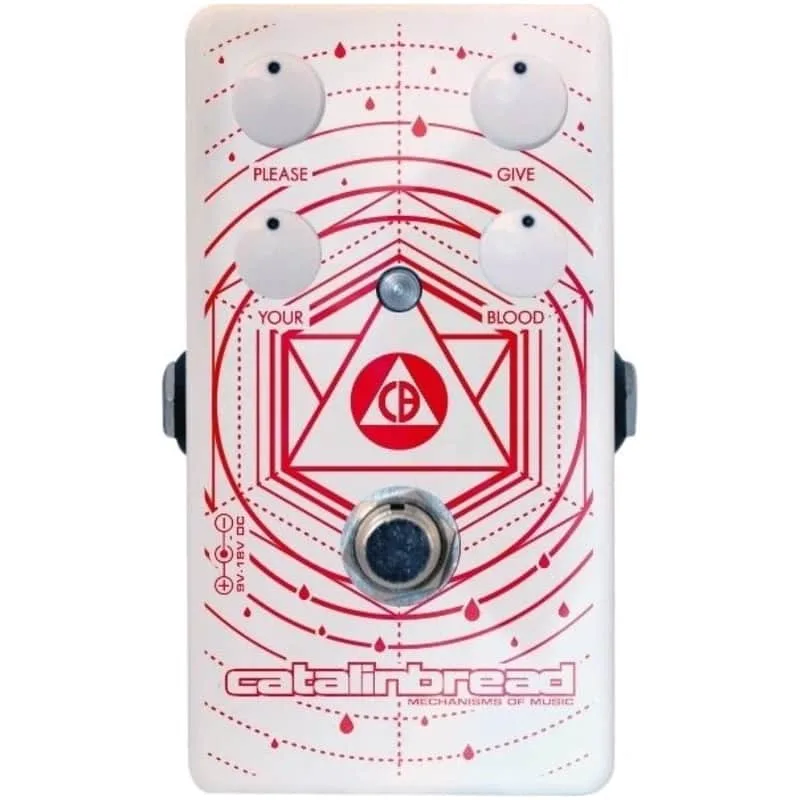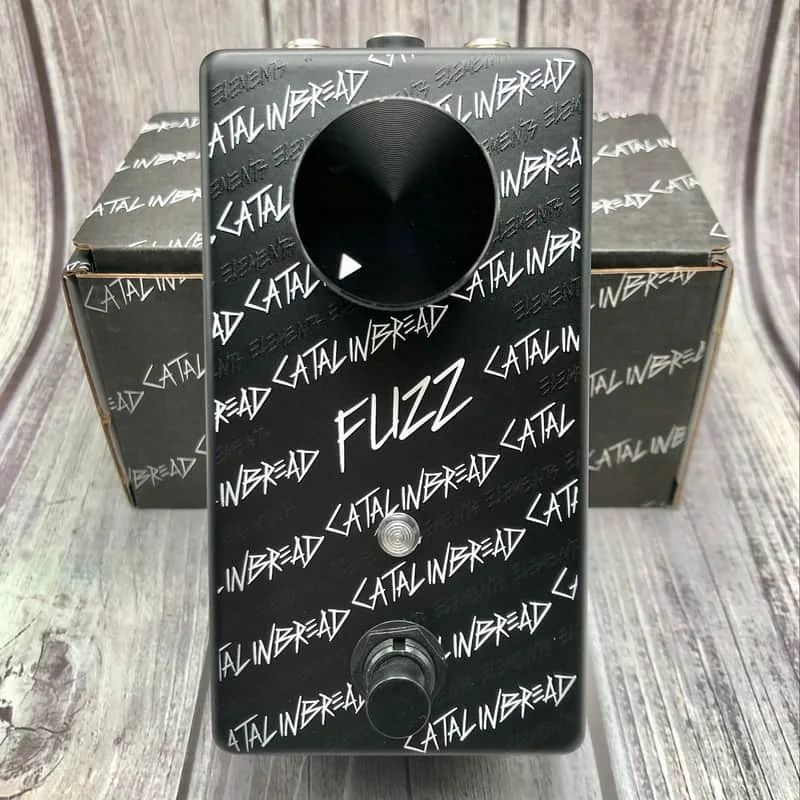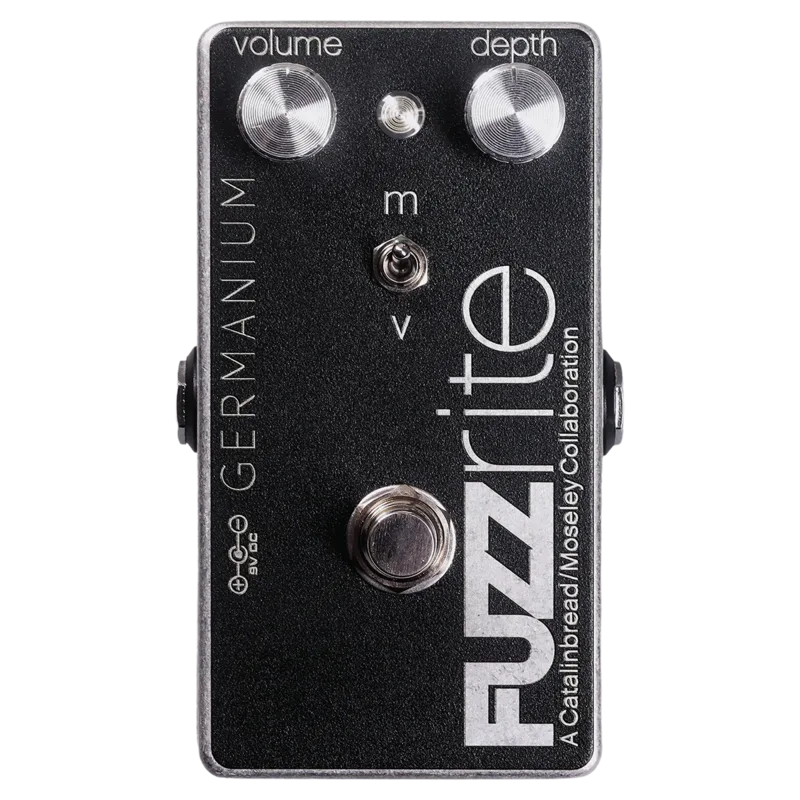



The Catalinbread Fuzzrite Germanium is a limited-run fuzz pedal from Catalinbread, a modern recreation of the rare germanium version of the 1960s Mosrite Fuzzrite. It follows the company's existing silicon-equipped Catalinbread Fuzzrite clone, but swaps the silicon transistors for two NOS PNP germanium semiconductors, which Gearnews says gives "a somewhat smoother fuzz tone"1.
Catalinbread built the pedal as a benchmark exercise: the company owns an original germanium Fuzzrite and used it as the reference for the recreation. Guitar World called the result "an extremely faithful version with a modern twist"2. Like the original, it is an old-school fuzz that responds to pick attack and the guitar's controls3.
The controls: Volume, Depth and the M/V toggle
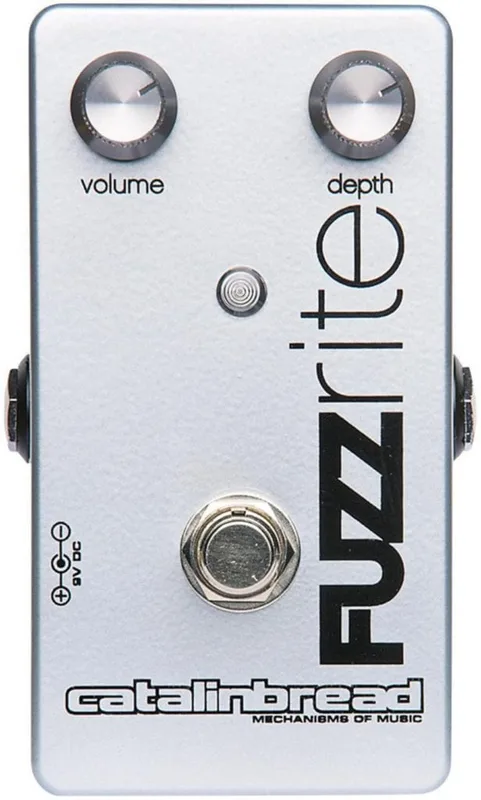
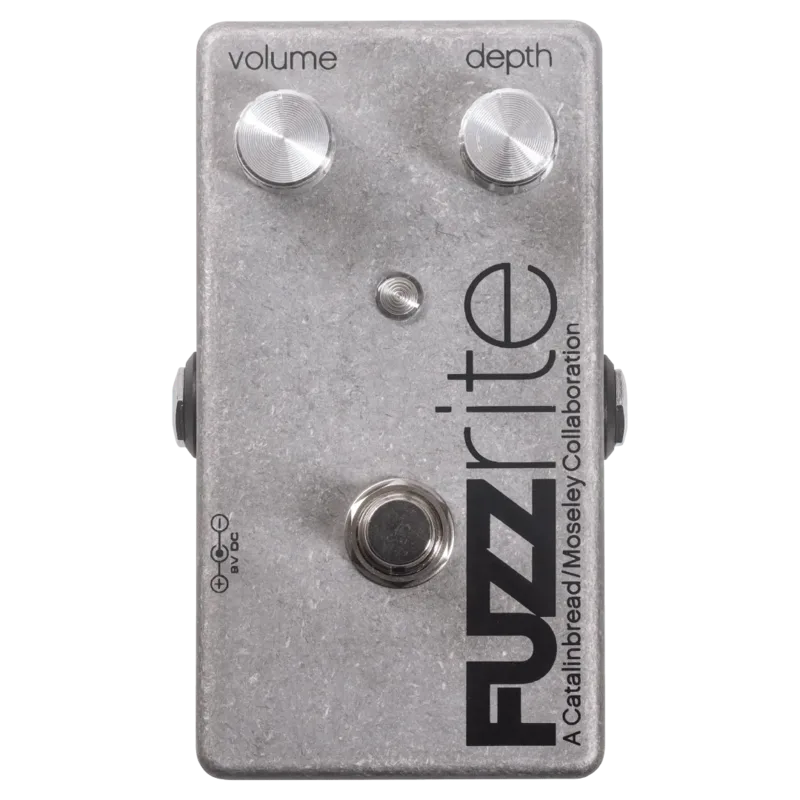
The pedal keeps the original's minimal control layout, with two knobs and one toggle26.
| Control | What it does |
|---|---|
| Volume | Controls the output volume of the circuit. Higher settings begin to overdrive your amplifier, which can add body and smoothness to the fuzzed-out sounds6 |
| Depth | The heart of the pedal. A blend control that mixes a second transistor gain stage in with the first6 |
| M/V toggle | Vintage/Modern switch. "Vintage" is the stock value, 2nF; "Modern" switches both output capacitors from 2nF to 10nF, increasing the low end passing through3 |
The Depth knob is where the character lives. Catalinbread describes the circuit as two simple, separate gain stages, with the Depth knob acting as a mix control between stage "1" and "1+2"; you never hear the second stage by itself6.
- Depth at minimum: you hear the first transistor on its own, for a cleanish, fat tone3
- Depth dialed right: the second stage comes in, producing voltage-starved, gated tones with what Catalinbread calls "pseudo ring mod-style upper octave harmonics"1
- Depth at maximum: a thinner, more aggressive saturated sound with a ripping top-end attack and huge bloom to the notes3
One thing to know about the circuit: no matter where the Depth control is set, the signal travels directly through a small capacitor that cuts the low end6. That is the character of the original design, and it is what the M/V toggle addresses. Aion FX notes the toggle "reduces the steep bass cut of the original and fills out the midrange" in its Modern position7. Gearnews sums up the two modes: the M setting has a beefed-up low-end character modern players should be more familiar with, while the V setting gives the classic late sixties tone1.
"DEPTH - the heart of the pedal. This knob is essentially a blend control that mixes in a second transistor gain stage with the first."
Where it goes in your chain
Catalinbread says the pedal is best placed first in your chain of effects to get the best dynamic response, and warns against putting any buffers in front of it, since they can severely limit the dynamic potential when using the guitar's controls6. This is standard practice for vintage-style fuzz circuits, and it is what makes the pedal clean up with your guitar's volume knob.
History: the rare germanium Mosrite Fuzzrite
From 1966 to 1968, instrument manufacturer Mosrite produced two distinct fuzz circuits, one outfitted with silicon transistors and the other with germanium21. The germanium model is by far the rarer of the two2. Former Mosrite employee Ed Sanner estimates that around 250 germanium models were produced between 1966 and 19681.
The originals were built with 2N2613 and 2N408 germanium transistors8, and the Fuzzboxes history site notes that the conventional phenolic-board version, with parts facing inwards, is statistically the most common version of the germanium Fuzzrite8. Mosrite apparently soon settled on fitting 50nF ceramic capacitors for the input, output and coupling positions for the remainder of the germanium run8.
The builder behind the Guitar FX Layouts blog traced the original germanium circuit from his own pedal and documented the sound9:
"it has a big, fat, musical sound at some of the lowest gain and lower volume settings. And of course it rips at full gain and volume"
Catalinbread released the Germanium Fuzzrite in 2022, inspired by the early Mosrite units but also featuring a "modern" voice with beefed up lows, as Delicious Audio's buying guide puts it5. The company had announced the pedal alongside news that it owned a germanium version and had used it as a benchmark10.
Germanium versus silicon
The Fuzzrite Germanium is a variation on what Delicious Audio calls the most popular Fuzzrite clone, Catalinbread's silicon version4. The differences that matter to a player:
- Transistors: two NOS PNP germanium semiconductors here, versus silicon in the standard Fuzzrite14
- Tone: Gearnews describes the germanium version as having a somewhat smoother fuzz tone than its silicon counterpart1
- Power handling: the polarity inverter IC means the germanium pedal "plays nice with all forms of power," a practical addition since raw PNP germanium circuits otherwise need special power arrangements4
The Fuzzrite Germanium was a limited edition of 50 units6. Catalinbread's silicon Fuzzrite and the compact Fuzzrite Mini remain part of the regular line.
Videos
Let's Play All
JayLeonardJ
Demos In The Dark
Questions
How many Catalinbread Fuzzrite Germanium pedals were made?
Catalinbread limited the run to 50 units, with the first batch shipping mid-July. The pedal recreates the rare germanium Mosrite Fuzzrite, of which former Mosrite employee Ed Sanner estimates only around 250 originals were produced between 1966 and 1968.
Does the Catalinbread Fuzzrite Germanium take a battery?
Yes. The pedal accepts a 9V battery or any good quality 9V DC adapter that is filtered and regulated, with a center-negative tipped plug. Catalinbread says the circuit has a very low mA draw, so batteries last a long time.
What is the difference between the germanium and silicon Catalinbread Fuzzrite?
The Germanium version follows Catalinbread's existing silicon-equipped Fuzzrite clone and is based on the rarer of the two original Mosrite circuits, using two NOS PNP germanium transistors instead of silicon. Gearnews describes the germanium version as producing a somewhat smoother fuzz tone.
Should the Fuzzrite Germanium go before a buffered pedal?
Catalinbread says it is best placed first in your chain of effects for the best dynamic response, and that no buffers should go in front of the pedal, since they can severely limit the dynamic potential when using the guitar's controls.
What transistors are in the Catalinbread Fuzzrite Germanium?
Two NOS PNP germanium semiconductors, paired with a polarity inverter IC so the pedal plays nice with all forms of power. The original Mosrite germanium Fuzzrites used 2N2613 and 2N408 germanium transistors.
Sources (10)
- Catalinbread Fuzzrite Germanium: Rare '60s fuzz recreated, gearnews.com, 2022-08-11
- Catalinbread's all-new Fuzzrite Germanium recreates a highly sought-after Mosrite classic, Guitar World, 2022-08-11
- Fuzzrite Germanium, Catalinbread Effects
- Catalinbread Germanium Fuzzrite, Delicious Audio, 2022-09-13
- Best Fuzzrite Clones And Evolutions In 2023, Delicious Audio, 2022-08-10
- Fuzzrite Germanium (White), Catalinbread Effects
- Orpheus Silicon Fuzz / Mosrite Fuzzrite, Aion FX, 2024-07-04
- Mosrite Fuzzrite: A detailed history • Fuzzboxes, Fuzzboxes (fuzzboxes.org), 2023-07-20
- Guitar FX Layouts: Mosrite Fuzzrite germanium, Guitar FX Layouts (tagboardeffects.blogspot.com), 2015-08-28
- Catalinbread Releases the Fuzzrite Germanium, Premier Guitar, 2022-08-11