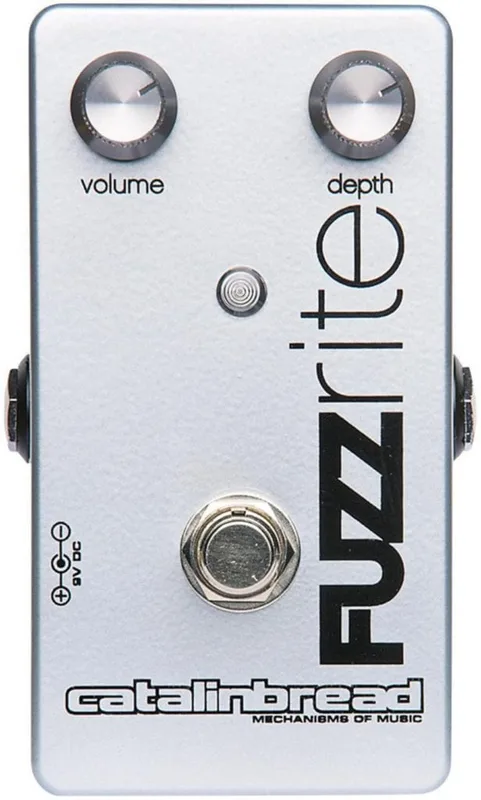


The Catalinbread Fuzzrite is a fuzz pedal from Catalinbread, hand-made in Portland, Oregon, that recreates the silicon version of the Mosrite Fuzzrite circuit that first appeared in the late '60s12. It is a faithful recreation of the original classic circuit with modern updates: true bypass, a 9V power supply and a compact enclosure34. Premier Guitar's reviewer described the result as "injecting power chords with throaty, muscle car mass topped with just the right amount of '60s rasp"2.
The original Mosrite Fuzzrite was designed by Ed Sanner and built between 1966 and 1968 in two distinct circuits, one fitted with silicon transistors and the other with germanium components56. Catalinbread's standard Fuzzrite follows the silicon version, which seems to have been much more widespread than the germanium original5.
What the original Mosrite Fuzzrite was
The Fuzzrite was a 1960s fuzz pedal built by Mosrite, first in an all-germanium version in the mid sixties, with silicon versions following8. Earlier Fuzzrites were built with a set of 2N2613 and 2N408 germanium transistors, while later versions used silicon transistors across a variety of construction methods9. The pedals went through several physical builds: early units on phenolic boards with red molded 100nF input, output and coupling capacitors, later perf-board versions with Cornell Dubilier 100nF capacitors, then around 1967 to 1968 a smaller eyelet board version, and a 1968 run with circuits encased in orange Sprague "modules"9. One surviving eyelet board Fuzzrite has the date "12/67" engraved on its battery cover9.
The silicon circuit was also whitelabeled or cloned as the Orpheum Fuzz, Guild Foxey Lady, and Electro-Harmonix Axis Fuzz5. Catalinbread teamed up with the Moseley estate and Ed Sanner to release an official reissue of the Fuzzrite, based on the silicon version5.
The controls: Volume and Depth
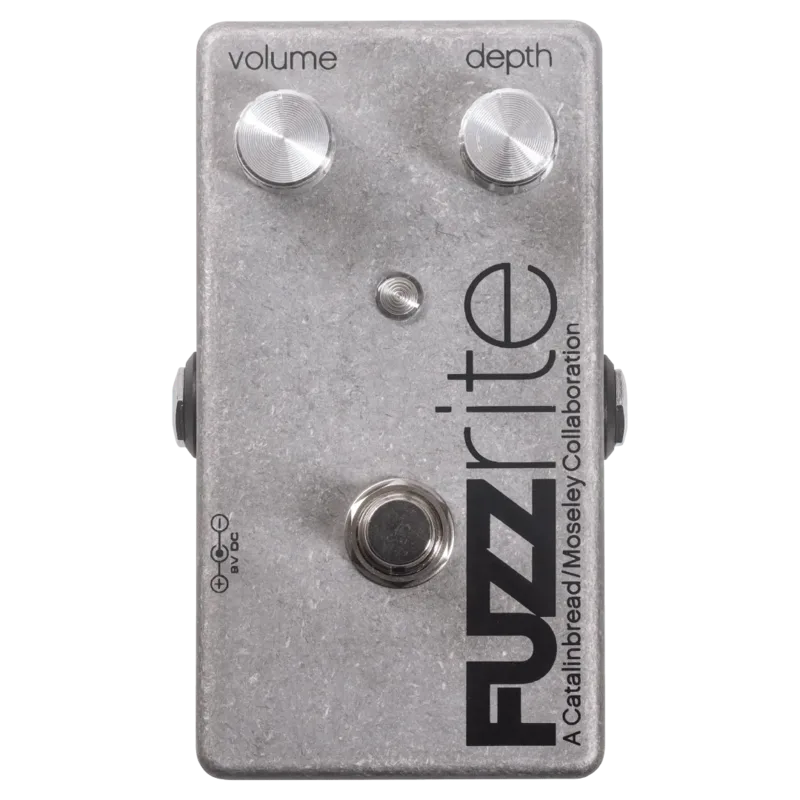
The Fuzzrite keeps the original's two-knob layout. The circuit is composed of two simple, separate gain stages, and the Depth knob is the heart of the pedal: a blend control that mixes the second transistor gain stage in with the first10.
| Control | What it does |
|---|---|
| Volume | Controls the output volume of the circuit. Higher settings will begin to overdrive your amplifier, which can add additional body and smoothness to the fuzzed-out sounds11 |
| Depth | A blend between the two gain stages. At minimum you hear the first transistor alone, cleanish and fat; blending in the second gives voltage-starved, gated sounds and pseudo ring mod-style upper octave harmonics; at max it is a thinner, more aggressive saturated sound with a ripping top-end attack and huge bloom to the notes10 |
You never hear the second gain stage by itself: Depth is a mix between "1" and "1+2"10. Premier Guitar's reviewer noted that, apart from the two transistors at the heart of the circuit, there probably aren't more than a dozen additional components on the board2.
Power, build and true bypass
The Fuzzrite runs on a 9V DC power supply (sold separately) or a 9V battery, drawing 5mA, and it is true bypass134. Catalinbread advises unplugging the input cable to preserve battery life when the pedal is not in use12.
The 5mA draw is light enough that the Fuzzrite is easy on a pedalboard power supply, but the 9V DC supply is sold separately from the pedal1.
The build drew praise from Premier Guitar's reviewer, who found it "a beautifully robust box" with the circuit board held in place by the sturdy footswitch and the volume and depth knobs, plus small steel braces affixed directly to the enclosure2.
Silicon and germanium versions
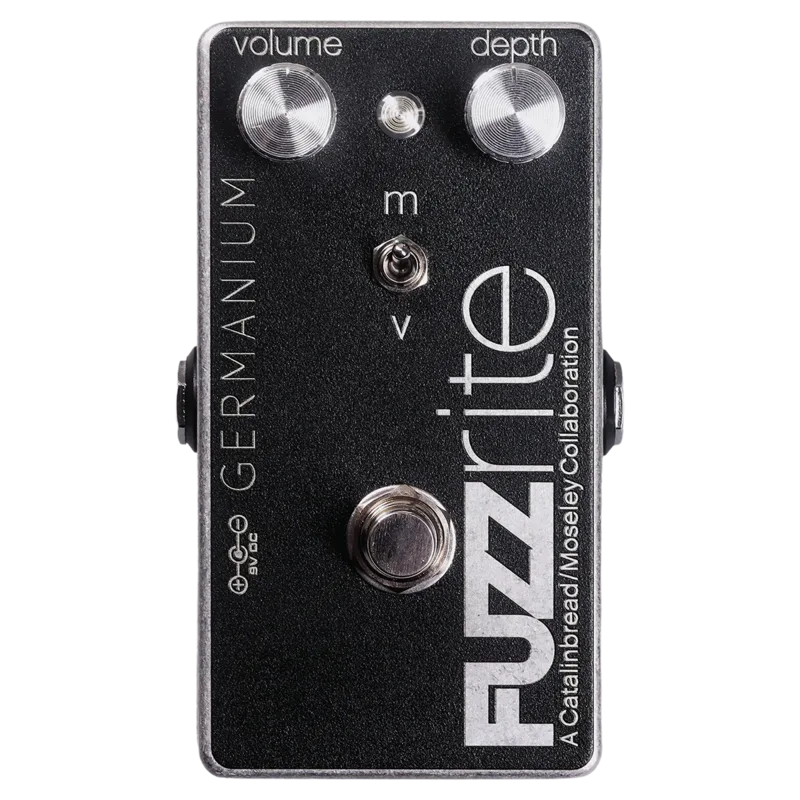
In 2022 Catalinbread released a second Fuzzrite, the Catalinbread Fuzzrite Germanium, a faithful recreation of the germanium Mosrite Fuzzrite with a modern twist1314. It uses two NOS PNP germanium semiconductors with a polarity inverter IC, and Catalinbread voiced it after an original germanium Fuzzrite unit the company owns, used as a benchmark158.
The Germanium version adds a third control the silicon pedal does not have: a Vintage/Modern toggle switch. In the Modern position it switches both output capacitors from 2nF to 10nF, increasing the amount of low end passing through, which reduces the steep bass cut of the original and fills out the midrange for more contemporary styles1015. Gearnews described the germanium version as producing a somewhat smoother fuzz tone than its silicon sibling6.
On Guitar Pedal X, Stefan Karlsson compared the two directly:
"the original Silicon one is proper raw and garage-punk-y, while the Germanium one is both more textured, in terms of its core harmonics, while at the same time somewhat more refined"7
Delicious Audio has called Catalinbread's silicon Fuzzrite remake "the most popular Fuzzrite clone," saying it "recaptures that classic raspy fuzz" of the late-1960s silicon original1615.
The Fuzzrite Mini
The Fuzzrite packs Catalinbread's take on the classic Fuzzrite circuit into a compact box, measuring 2.36" wide, 4.33" deep and 1.96" tall, and weighing .40 lbs.8. Catalinbread describes its sound as "injecting power chords with throaty, muscle car mass topped with just of the right amount of '60s rasp"2. It sells at a $149 street price2, with the Germanium and Silicon versions offered as a pair for $1797.
The Fuzzrite draws only 5mA of power1, so it places a light load on a pedalboard power supply.
Videos
ProGuitarShopDemos
ProGuitarShopDemos
Catalinbread Effects
News
Questions
Is the Catalinbread Fuzzrite true bypass?
Yes. The Catalinbread Fuzzrite uses true bypass switching, which was one of the modern updates Catalinbread added to the original simple two-transistor circuit. When the pedal is off, your guitar signal passes through without the circuit loading it down.
Does the Catalinbread Fuzzrite take a battery?
Yes. The standard Fuzzrite accepts a 9V battery, and it can also run on a 9V DC power supply, which is sold separately. Catalinbread advises unplugging the input cable when the pedal is not in use to preserve battery life.
What does the Voicing switch do on the Fuzzrite?
The Vintage/Modern toggle on the Fuzzrite Germanium switches both output capacitors from 2nF to 10nF, increasing the amount of low end passing through the circuit. Vintage keeps the steep bass cut of the original Mosrite; Modern fills out the midrange and low end for more contemporary styles.
How many transistors does the Fuzzrite use?
Two. Like any Fuzzrite circuit, it is a simple affair with two transistors at the heart of the circuit and probably no more than a dozen additional components on the board. The Depth knob is a blend control that mixes in the second gain stage.
Is there a mini version of the Catalinbread Fuzzrite?
Yes. In October 2025 Catalinbread introduced a Silicon Fuzzrite Mini, a two-knob Jr edition with the same Volume and Depth controls as the compact version, priced at $129, around $30 less than the compact edition.
Where is the Catalinbread Fuzzrite made?
The Catalinbread Fuzzrite is hand-made in Portland, Oregon, where Catalinbread builds its pedals. The company also used an original germanium Fuzzrite in its own collection as the benchmark for its Germanium version.
Sources (16)
- Fuzzrite, Catalinbread Effects
- Catalinbread Fuzzrite Review, Premier Guitar, 2015-10-08
- Catalinbread's Fuzzrite recreates '60s classic, MusicRadar, 2015-05-19
- Best Fuzzrite Clones And Evolutions In 2023, Delicious Audio, 2022-08-10
- Orpheus Silicon Fuzz / Mosrite Fuzzrite, Aion FX, 2024-07-04
- Catalinbread Fuzzrite Germanium: Rare '60s fuzz recreated, gearnews.com, 2022-08-11
- Guitar Pedal X, Guitar Pedal X, 2024-06-24
- Custom shop releases 60's Mosrite Fuzzrite recreation!, robertkeeley.com, 2012-01-25
- Mosrite Fuzzrite: A detailed history • Fuzzboxes, Fuzzboxes (fuzzboxes.org), 2023-07-20
- Fuzzrite Germanium, Catalinbread Effects
- Fuzzrite Mini, Catalinbread Effects
- Fuzzrite Germanium (White), Catalinbread Effects
- Catalinbread Releases the Fuzzrite Germanium, Premier Guitar, 2022-08-11
- Catalinbread's all-new Fuzzrite Germanium recreates a highly sought-after Mosrite classic, Guitar World, 2022-08-11
- Catalinbread Germanium Fuzzrite, Delicious Audio, 2022-09-13
- The 5 Most Pupular Fuzz Pedals Of All Time: Compare Five Classic Circuits, Delicious Audio, 2020-08-06