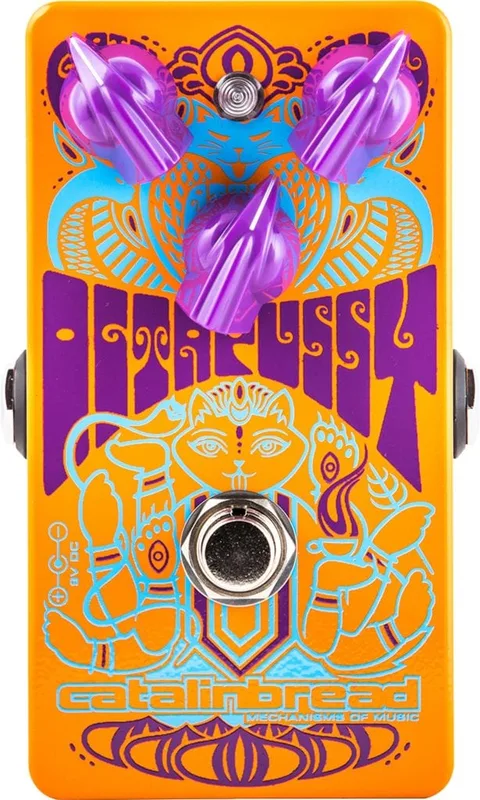


The Catalinbread Octapussy is a three-knob octave fuzz released in 2012 by Catalinbread12. It is an octave-up fuzz, meaning it generates a note one octave above what you play, layered with fuzz. Catalinbread's stated goal was to keep the singing quality of Octavia-type effects while cutting the heavy compression that makes many classic octave fuzzes squash your picking dynamics3. Premier Guitar's reviewer summed up the result as "Extremely responsive and dynamic octave-fuzz tones."3
The pedal was announced at NAMM 2012 as a "searing three knob octave fuzz," "capable of delicate octave harmonies, to ripping fuzz tones"2, and it shipped that March at $179.994. Premier Guitar's review lists a street price of $1793.
An octave fuzz built for picking dynamics
Octave fuzzes descend from the Octavia, the effect designed by Roger Mayer5. Classic circuits in that family tend to compress the signal hard, so the octave overtone rings out but the guitar stops responding to how hard or softly you pick. Premier Guitar notes that one of the design goals for the Octapussy was "to infuse the singing qualities of Octavia-type effects with less compression, which would kill picking dynamics in many classic octave fuzzes"3.
Part of how it gets there is in the input stage. The Fuzz Face input section uses a unique feedback arrangement that acts as a tone control, softening the fuzz and preparing the signal before it reaches the octave stage1. For a player, that means the octave effect tracks and responds more like the rest of your fuzz pedals and less like a fixed, squashed wall of harmonics.
The controls: Gain, Body and Attenuate
The three knobs cover gain level, low-end response, and volume attenuation3. Catalinbread's own descriptions, from the launch announcement, explain what each does4:
| Control | What it does |
|---|---|
| Gain | Increases gain for more fuzz, harmonics, and an upper-midrange boost. Voiced to be usable across its whole range, minimum to maximum4. |
| Body | Sets low-end response3. Technically, it fades a parallel 680n capacitor in the feedback loop in and out against a static 1n cap, reducing effective capacitance from 681n to 1n as you turn it up, which adds low end6. |
| Attenuate | A reverse-wired volume control at the tail end of the circuit6. Designed to sit full counter-clockwise (maximum volume); turn it up only when Gain and Body are really cranking and you need to trim the output4. |
The Attenuate knob is worth a note, because it works backwards from what most players expect: turning it up reduces volume. Aion FX suggests the name was "most likely a marketing decision"1.
Keep Attenuate full counter-clockwise for the best tone and response. It is a pure volume cut, so leaving it up all the time just means you are running the output below maximum for no benefit61.
Power: 9V or 18V
The Octapussy runs on a 9V battery or a power supply set to 9 or 18 volts3. The 18V option gives the transistors more headroom, which suits a pedal whose selling point is dynamics rather than pure squash.
Inside, there is an internal trimmer that biases the octave stage. Aion FX measured its range as 3.06V to 3.88V assuming a 9.6V supply, and found it set to 21.5k (21% rotation) on the traced unit, which works out to a 3.26V base voltage6. Unless you know what you are doing, this is a set-and-forget factory adjustment.
Inside the circuit: three silicon transistors and two diodes
The Octapussy is an all-analog circuit built around three silicon transistors and a pair of diodes37. Delicious Audio describes it as "an original circuit utilizing 3 silicon transistors, two diodes, and a custom-voiced preamp section"8.
Aion FX traced the circuit in 2023 and documented the build in detail16. The designer, Howard Gee, commented in the manual that the components were all carefully chosen for their sonic properties6, and the parts list backs that up: carbon film and carbon comp resistors, and polyester, polypropylene, orange drop, electrolytic, and MLCC ceramic capacitors6. The carbon comp resistors in particular measured well off their nominal values, with a 15k resistor reading 17.1k (14% high) and a 150k resistor reading 159.8k (+6.5%), both within their 5% tolerance markings6. That kind of drift is normal for carbon comp and is part of why two examples of an analog fuzz can sound slightly different.
Original design or Octavia relative?
Catalinbread says the Octapussy is an original design, not another Octavia clone. Premier Guitar reports that "avoiding the temptation to build another Octavia clone, Catalinbread designed an entirely new circuit from the ground up"3, and the company compared it to the Octavia while claiming originality6.
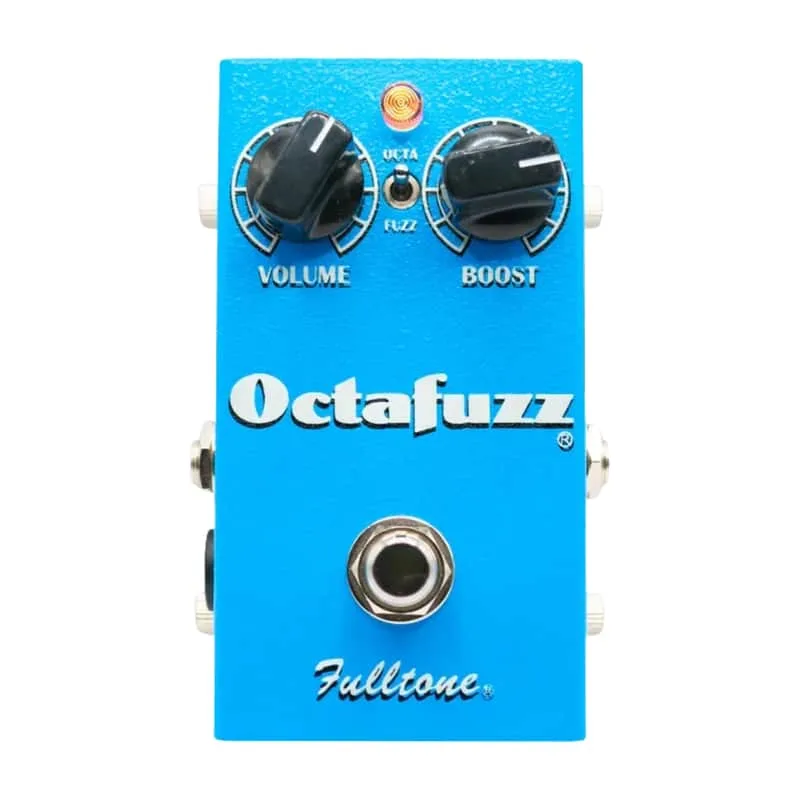
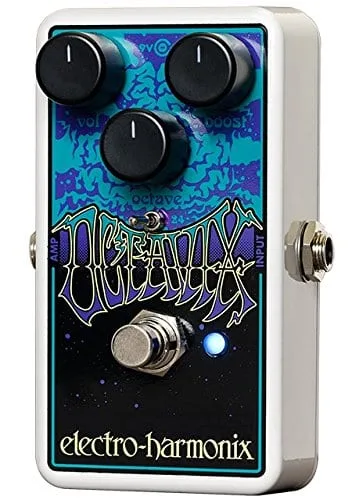
Aion FX's trace tells a more mixed story. The pedal "was called an original circuit, though they hinted that it was related to the Octavia"1, and after tracing it Aion FX was skeptical of the originality claim6. Their finding: the front half of the circuit is very similar to a silicon Fuzz Face, and the octave section is directly lifted from the Octavia1. Coda Effects lists the Octapussy among the Octavia's many clones and modifications, alongside the Fulltone Octafuzz and Electro-Harmonix Octavix9.
So the honest answer sits between the two accounts: the octave core is Octavia lineage, while the input stage and voicing are Catalinbread's own work, and that input stage is what gives the pedal its more dynamic, less compressed character1.
What reviewers said
Premier Guitar's review is the main published verdict, and it is positive on the pedal's core promise, calling out "extremely responsive and dynamic octave-fuzz tones" as a strength3. The review also credits Catalinbread with addressing the usability issues common to octave fuzzes3.
On the technical side, Aion FX's 2023 trace is the deepest published look at the circuit, and while it questions the "original circuit" framing, it documents the design as a thoughtful build with deliberately chosen parts6. Delicious Audio includes it in a roundup of Octavia-family pedals and repeats the original-circuit claim8.
Videos
Premier Guitar
Catalinbread Effects
Catalinbread Effects
Questions
Where should the Attenuate knob be set on the Octapussy?
Catalinbread designed the Attenuate control to sit full counter-clockwise, which is maximum volume. The maker recommends only turning it up when the Gain and Body knobs are really cranking and you need to trim the output level. It is a reverse-wired volume control at the end of the circuit, so it only cuts level, never boosts it.
Who designed the Catalinbread Octapussy?
The Octapussy was developed by Catalinbread, and the designer named in the manual is Howard Gee. Aion FX's technical analysis of the circuit quotes Gee commenting in the manual that the pedal's components were carefully chosen for their sonic properties.
Is the Octapussy an Octavia clone?
Catalinbread calls it an original circuit and compares it to the Octavia, but not a clone. Aion FX, which traced the circuit in 2023, found the front half similar to a silicon Fuzz Face and the octave section directly lifted from the Octavia, and was skeptical of the originality claim.
How much does the Catalinbread Octapussy cost?
At launch in March 2012 the Octapussy was priced at $179.99. Premier Guitar's review lists a street price of $179. It is one of Catalinbread's fuzz offerings alongside pedals like the Katzenkonig and the Antichthon.
Sources (9)
- Nereus Octave Fuzz / Catalinbread Octapussy, Aion FX, 2023-11-24
- NAMM 2012: Catalinbread unveils new pedals, MusicRadar, 2012-01-19
- Catalinbread Octapussy Pedal Review, Premier Guitar, 2012-09-05
- Catalinbread Releases the Octapussy Octave Fuzz Pedal, Premier Guitar, 2012-03-13
- Dusky Electronics Augustus Octave Fuzz review, Guitar World, 2021-08-25
- Tracing Journal: Catalinbread Octapussy, Aion FX, 2023-11-24
- Catalinbread Offers Octapussy Octave Fuzz, Vintage Guitar magazine, 2012-03-06
- The Best Octavia Fuzz Pedals In 2023: Clones And Evolutions, Delicious Audio, 2023-03-09
- Coda Effects, Coda Effects, 2015-08
 Howard Gee