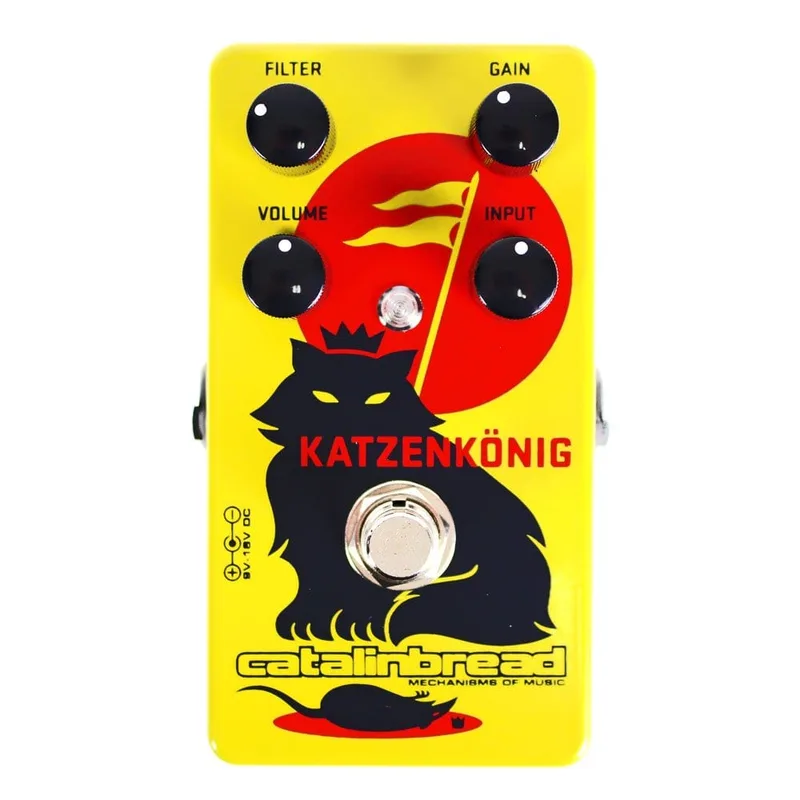


The Catalinbread Katzenkonig is a distortion/fuzz pedal that puts two classic circuits in one box: the front half of the circuit is a modified Tone Bender MKII built from three silicon transistors, and the second half is the output section of a Rat, including its clipping stage, filter and output buffer1. Catalinbread, the Portland, Oregon maker behind it, hand-builds the pedal in a standard B-sized enclosure23. It originally shipped in 2015 and is still in production, with the maker's current page listing it at 6mA current draw24.
For a player, that hybrid means fuzz character up front and Rat-style hard clipping at the back. Premier Guitar described the result as a pedal whose Gain knob works differently from a conventional gain control, and whose manual is unusually detailed, right down to a full circuit schematic3.
How the circuit works
The Katzenkonig is best understood as two pedals in series. The front half follows the Tone Bender MKII, a three-transistor germanium fuzz of the late 1960s, here rebuilt with silicon transistors13. The back half is lifted from the Rat: an op amp generates gain, after which the signal hits a pair of clipping diodes and the Rat's single-knob tone circuit3. An independent technical analysis of the layout confirms the family resemblance: the hard clipping diodes shunt to ground, as in an OD250, Dist+ and a Rat, and the Filter control is straight out of a Rat6.
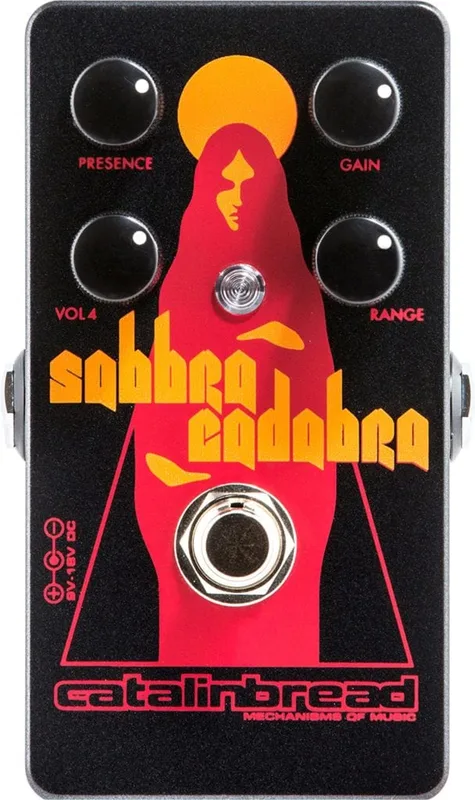
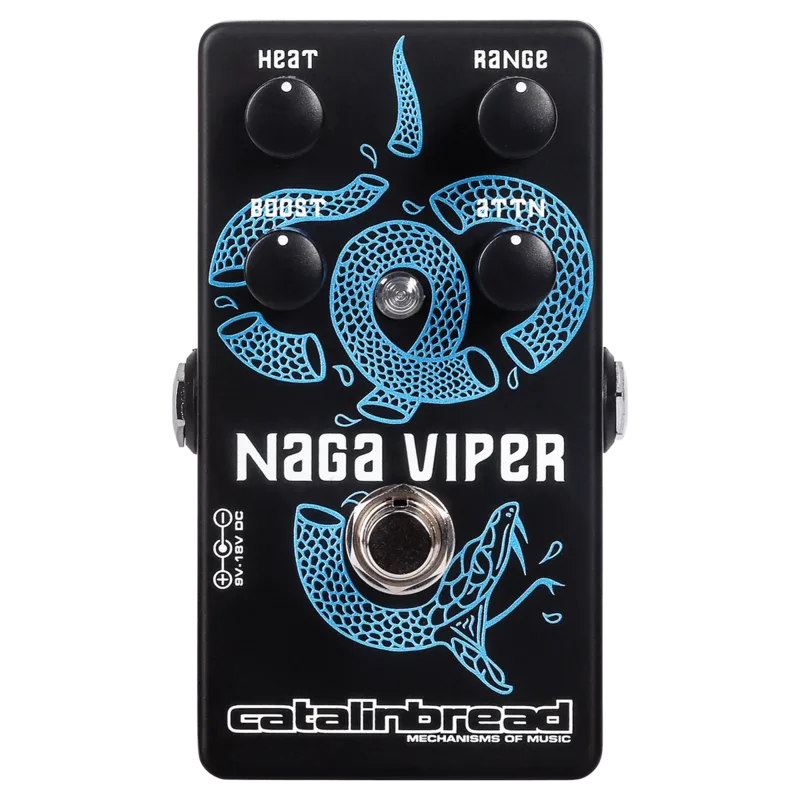
The Input knob is the pedal's most unusual feature. Catalinbread has used this input capacitor blend approach on several of its effects, including the Katzenkonig, Sabbra Cadabra and Naga Viper7. Premier Guitar's reviewer called it a useful addition: an input trim control that reduces gain, scaled to compensate for output variations between pickup types3.
The controls: Filter, Volume, Gain and Input
| Control | What it does |
|---|---|
| Filter | Dials in the final tone from smooth and creamy to bright and cutting; Catalinbread calls it an even better version of the Rat's Filter control58 |
| Volume | Standard volume control; the maker says it sounds great turned down quiet or cranked up loud9 |
| Gain | Controls the gain of the second gain stage by varying the amount of negative feedback in that stage, rather than as a conventional gain control9 |
| Input | Controls the input sensitivity, trimming gain to suit different pickups83 |
Because the Gain knob works through negative feedback rather than by simply adding gain, Catalinbread says it behaves well across its whole rotation9. The Filter control is the Rat's tone control reworked, so players who know a Rat will find familiar ground, with what the maker describes as a wider effective range5.
Power: 9V to 18V DC
The Katzenkonig runs anywhere from 9 to 18 volts DC, using a standard center negative power supply or a 9-volt battery5. Powering it above 9 volts gives a louder sound with a slightly different feel, according to Catalinbread10. Running it on a battery rather than a supply gives a softer response with a slightly different picking feel5.
The 6mA current draw2 is low enough that the pedal is easy on a shared supply, but the maker's battery recommendation is worth noting: a battery and a higher-voltage supply produce noticeably different feels, so the power source is part of the tone shaping on this pedal5.
Where it came from
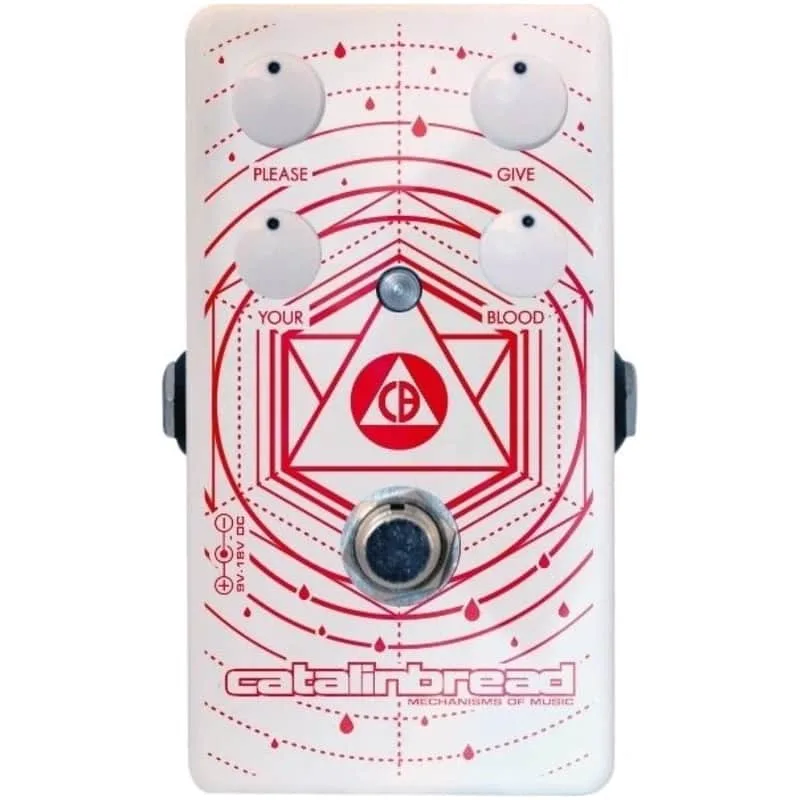
Guitar.com covered the Katzenkonig's launch in September 2015, reporting it as a true-bypass pedal that was then shipping and available to all Catalinbread dealers and distributors worldwide1. Aion FX's project documentation dates the original release to 20154. Since then, Catalinbread has issued numerous variations and colourways of the enclosure, including the Blood Donor variants11. Guitar World reported in 2020 that the Blood Donor, a Red Cross charity pedal, was a revamped and fine-tuned version of the Katzenkonig with increased saturation and gain12. In April 2024 the pedal was re-skinned in a green finish as part of Catalinbread's StarCrash '70s Collection, alongside the Adineko, SFT and Valcoder11.
The circuit has a life beyond the factory, too. Catalinbread shared the circuit diagram publicly, and Jed's Pedals sells a DIY kit that compares to the Katzenkonig13. A verified build on the Guitar FX Layouts blog reported that it "sounds just like the original" built with 2N5088 transistors6.
"Verified! Had a spare hour. Sounds just like the original. Used 5088s."
What reviewers said
Premier Guitar reviewed the Katzenkonig at a $169 street price and found much to like, but flagged one practical drawback: high-gain settings can be noisy, and a player may need to ride the guitar's volume knob or use a noise gate to keep the buzzing down3. The same review praised the pedal's manual as extraordinarily useful and detailed, noting that it includes a circuit schematic3.
Versions and pricing
Videos
ProGuitarShopDemos
Premier Guitar
Catalinbread Effects
News
Questions
Does the Katzenkonig run on a battery?
Yes. It runs on a 9-volt battery or a standard center negative 9V DC supply, and Catalinbread says a battery gives a softer response with a slightly different picking feel. It also accepts DC above 9 volts, up to 18V, which the maker says gives a louder sound with a slightly different feel.
Is the Catalinbread Katzenkonig noisy?
It can be. Premier Guitar's reviewer found that high-gain settings can be noisy, and suggested you may need to ride your guitar's volume knob or use a noise gate to keep the buzzing down. At lower gain settings it is not reported as a problem.
Is the Katzenkonig true bypass?
Yes. Guitar.com reported the Katzenkonig as true-bypass when it covered the pedal's release in 2015. Catalinbread does not list a battery-free buffered mode; the pedal passes signal unaltered when bypassed.
What transistors does the Katzenkonig use?
It is an all-discrete analog circuit using three silicon transistors in a modified Tone Bender MKII arrangement, followed by the output section of a Rat, including its clipping section, filter and output buffer. DIY builders have verified the circuit with 2N5088 silicon transistors.
What is the Katzenkonig Halloween edition?
A limited seasonal run of the same circuit in a Halloween finish. The 2026 Halloween edition is only available until October 31 and runs on the same 9 to 18V DC power or 9-volt battery as the standard pedal. Catalinbread has also issued other limited colourways, including a run of 25 units that shipped mid to late July.
Sources (13)
- News: Catalinbread reveal the new Katzenkönig distortion pedal, Guitar.com, 2015-09-29
- Katzenkönig, Catalinbread Effects
- Catalinbread Katzenkönig Review, Premier Guitar, 2015-12-24
- Poseidon Silicon Fuzz / Catalinbread® Katzenkönig, Aion FX, 2021-02-19
- Katzenkönig (Traditional Ink Collection) B-Stock, Catalinbread Effects
- Guitar FX Layouts: Catalinbread Katzenkönig, Guitar FX Layouts (tagboardeffects.blogspot.com), 2017-05-19
- Tracing Journal: Catalinbread Karma Suture (Germanium & Silicon), Aion FX, 2021-02-21
- Katzenkönig (Fireworks Collection), Catalinbread Effects
- Katzenkönig (2026 Halloween), Catalinbread Effects
- Katzenkönig ('70s Collection) B-Stock, Catalinbread Effects
- Guitar Pedal X, Guitar Pedal X, 2024-04-19
- Catalinbread's Blood Donor is a distortion pedal that aids the Red Cross, Guitar World, 2020-04-02
- Katzenkonig, Jed's Pedals