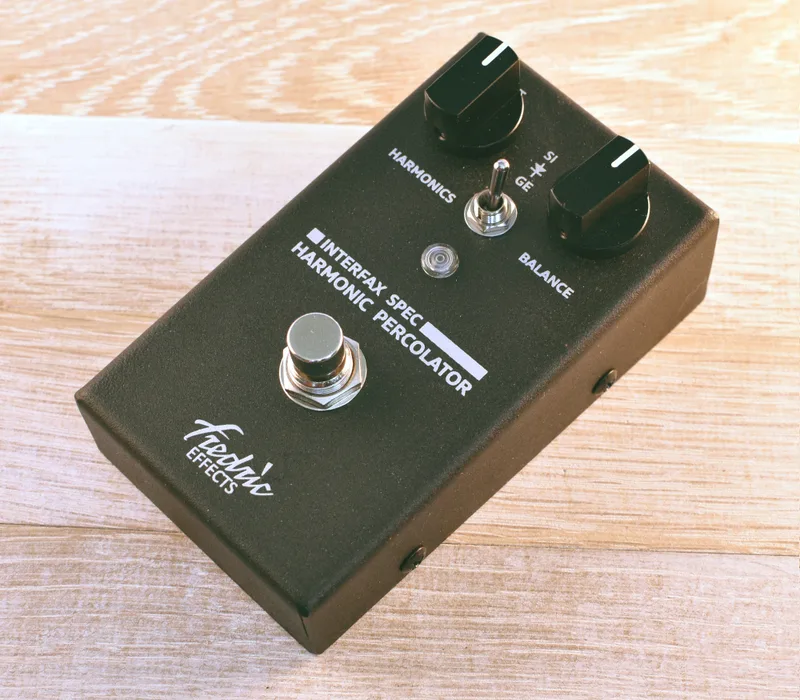


The Catalinbread Karma Suture is a fuzz/drive pedal from Catalinbread, first released on March 17th, 2014 and priced at $169.991. It is Catalinbread's take on the Interfax Harmonic Percolator, a rare fuzz/drive circuit from the early 1970s, but with several circuit changes that make it its own effect rather than a straight clone2. Catalinbread describes it as a drive pedal that generates predominantly even-order harmonic distortion that sustains while harmonics bubble up, with what the company calls incredible note clarity at even the most extreme settings1.
The pedal comes in two versions, one germanium and one silicon, and both were active products sold at the same retail price as of Aion FX's 2021 tracing of the circuits2. In practice it covers ground from clean-ish boost to fuzz: MusicRadar's launch coverage said players would use it for applications ranging from harmonically sparkling boost, through tight overdrive, to thick fuzz1.
Where the circuit comes from
The Karma Suture is based on the Interfax Harmonic Percolator, a circuit Aion FX calls "a unique and extremely rare fuzz/drive from the early 1970s"2. Catalinbread kept the basic topology but changed most of the component values from the original and added two new controls, Density and Diodes3. Aion FX's verdict on the result: "They ended up with a smash hit, well worth your time even if you've already built a Percolator."2
The Harmonic Percolator has its own place in fuzz history. Guitar Pedal X, writing in a tribute to Steve Albini, listed the Interfax HP-1 among the fuzzes the recording engineer helped popularize, and included the Catalinbread Germanium Karma Suture among the representatives of that format5.
The controls: Density and Diodes
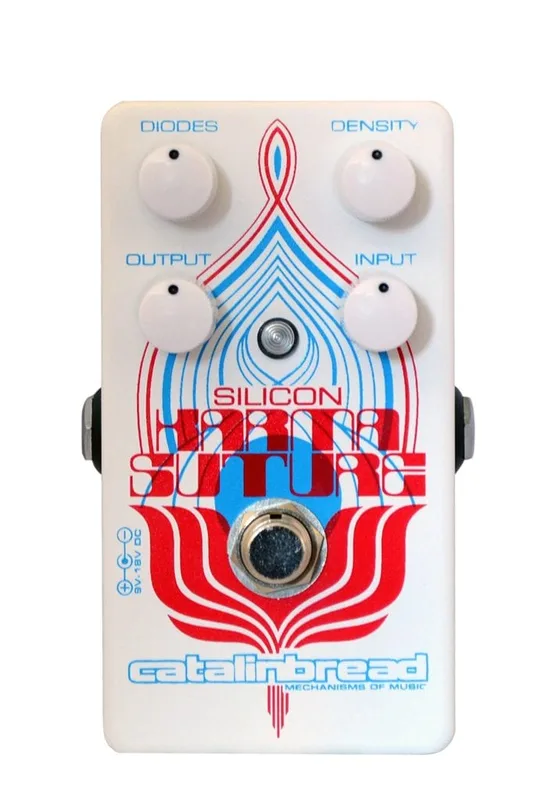
The Germanium Karma Suture carries four controls: Diodes (a bias control), Density (a saturation control), Output, and Input5. The two controls Catalinbread added over the original Percolator are the heart of the pedal's flexibility3.
| Control | What it does |
|---|---|
| Density | An input capacitor blend control, added by Catalinbread, shaping saturation25 |
| Diodes | A bias control, added by Catalinbread35 |
| Input | Sets the input level into the circuit5 |
| Output | Sets the output volume5 |
On the silicon version's layout, the Density pot and the Output (volume) pot are the controls called out, with the wiring notes referring to the output pot as "volume"6.
Germanium or silicon?
The two versions are genuinely different pedals, not one replacing the other. Aion FX states plainly that "the silicon version sounds completely different and they really are two different pedals," and that the silicon is not an update or a replacement for the germanium version3. The original Karma Suture was released in 2014, and the silicon version followed in 2016, again with several part changes from the germanium version3.
| Germanium | Silicon | |
|---|---|---|
| Transistors | NOS Russian PNP germanium paired with an NPN silicon transistor1 | All-silicon transistors2 |
| Character | Warmer and grittier, closer to the original HP-17 | More searing and strident, ups gain and brightness to cut through a live mix57 |
| Status | Active product2 | Active product, its own pedal2 |
Guitar Pedal X's take on the split: "Silicon tends to be more searing and strident, while Germanium is warmer and grittier!"5. Delicious Audio's buying guide on Harmonic Percolator clones put it similarly, the germanium version sounding warmer and closer to the original HP-1, while the silicon version ups the gain and brightness to definitively cut through a live mix7.
Aion FX, having traced and built both, came down on the silicon side: "I was surprised that I actually preferred the silicon version. It's a bit easier to build since you don't have to hunt for" old-stock germanium transistors, and the author found it by no means a compromise despite the lack of obsolete parts2.
Fuzz, overdrive, or something in between
Neither version is a high-gain monster. Aion FX found that "Neither version is terribly high gain, only approaching fuzz territory due to the rough-around-the-edges transistor clipping," describing a smooth, harmonically-rich drive with a vintage flavor2. That places it between the fuzz and overdrive camps, closer in spirit to the vintage circuit it comes from than to a modern distortion.
Build details and DIY
Inside, the germanium version carries a polarity-protection diode on the power input and no other power filtering2. The silicon version moved to 9mm PCB-mounted pots with a sub-board connected by ribbon cable2.
For DIY builders, Guitar FX Layouts published vero, or stripboard, layouts for both versions, with the schematic hosted on the freestompboxes.org forum6.
The Karma Suture runs on a 9V negative ground DC power supply or a 9V battery1, so it works with a standard pedalboard supply and does not need a dedicated or reversed-polarity adapter.
Videos
ProGuitarShopDemos
Catalinbread Effects
Catalinbread Effects
Questions
What is the difference between the germanium and silicon Karma Suture?
The germanium version uses an old-stock germanium transistor and sounds warmer and grittier, closer to the original Interfax HP-1. The silicon version uses silicon transistors, ups the gain and brightness, and sounds completely different, so Catalinbread sells them as two separate pedals rather than one replacing the other. Both were sold at the same retail price.
Is the Catalinbread Karma Suture a fuzz or an overdrive?
It sits between the two. Catalinbread describes it as a drive pedal that covers harmonically sparkling boost, tight overdrive, and thick fuzz. Aion FX found neither version is terribly high gain, only approaching fuzz territory through rough-around-the-edges transistor clipping, with a smooth, harmonically rich vintage flavor.
Is the Karma Suture true bypass?
Yes. The 2014 launch announcement for the pedal states that it is true bypass. It runs on a 9V negative ground DC power supply or a 9V battery.
Is there a DIY layout for the Karma Suture?
Yes. Guitar FX Layouts published vero, or stripboard, layouts for both the germanium and silicon versions, and points to a schematic hosted on the freestompboxes.org forum for home builders who want to build one from scratch.
What transistors does the Karma Suture use?
The germanium version uses a NOS Russian PNP germanium transistor paired with an NPN silicon transistor. The silicon version is an all-silicon build, which Aion FX noted makes it easier to build since you do not have to hunt for old-stock germanium parts.
Sources (7)
- Catalinbread announces two new pedals, MusicRadar, 2014-03-20
- Tracing Journal: Catalinbread Karma Suture (Germanium & Silicon), Aion FX, 2021-02-21
- Calliope Vintage Fuzz / Catalinbread Karma Suture, Aion FX, 2021-02-19
- Catalinbread Launches Karma Suture & Topanga Reverb, Premier Guitar, 2014-03-19
- Guitar Pedal X, Guitar Pedal X, 2024-05-13
- Guitar FX Layouts: Catalinbread Karma Suture, Guitar FX Layouts (tagboardeffects.blogspot.com), 2022-03-04
- 9 Best Harmonic Percolator Fuzz Clones & Evolutions In 2023, Delicious Audio, 2023-05-03