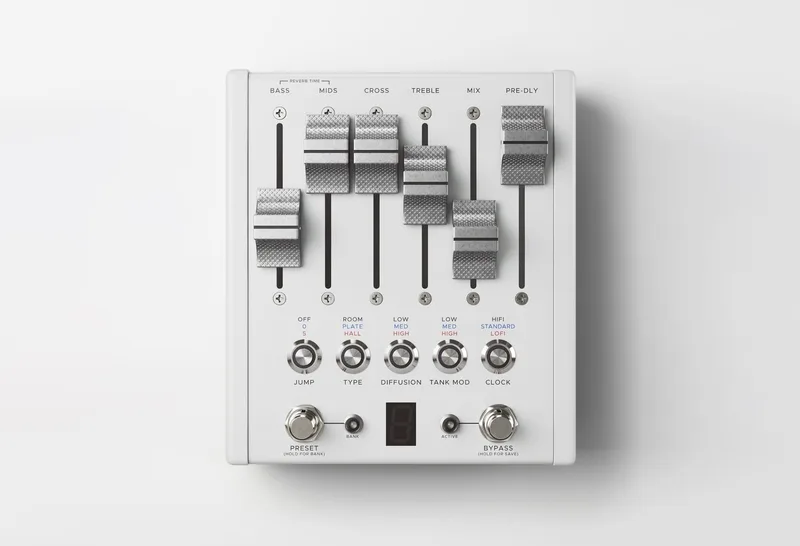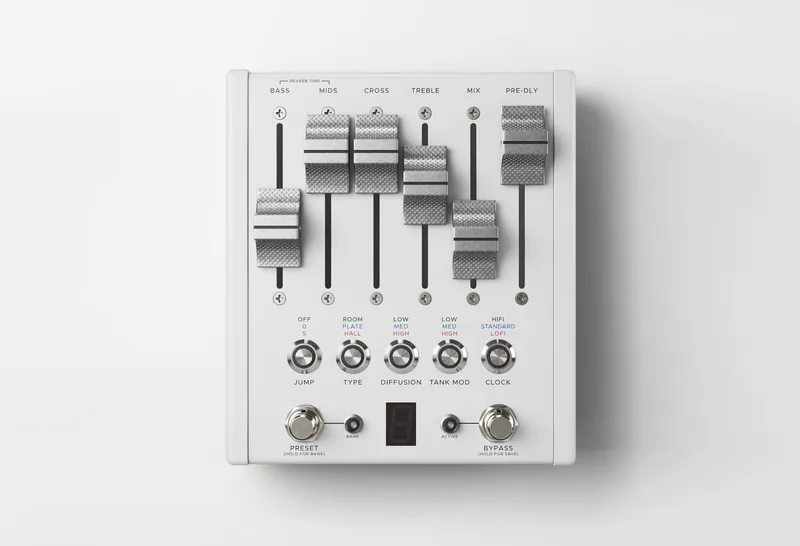


The Chase Bliss Audio CXM 1978 Automatone Reverb is a digital reverb pedal built in collaboration with Meris, and it is a tribute to one specific machine: the Lexicon 224 Digital Reverb of 1978. Pedal of the Day describes it as "designed in tribute to the coveted Lexicon 224 Digital Reverb"1, and Delicious Audio calls it "a pedal adaption of the venerable Lexicon 224 studio reverb"2. What makes it an Automatone is its row of motorized "flying faders": switch presets and the faders physically glide to the saved positions3.
It is a fully stereo unit with 32-bit AD/DA conversion, three reverb types, MIDI and expression control, and an adjustable decay crossover for shaping the reverb tail145.
A tribute to the Lexicon 224
The Lexicon 224 was the studio digital reverb of the late 1970s and early 1980s, and the CXM 1978 takes its name from the year it appeared. Every press account of the pedal frames it the same way: gearnews calls it "based on the classic Lexicon 224 Digital Reverb"5, and Delicious Audio describes it as "a reinterpretation of the vintage Lexicon 224 Digital Reverb"8. Guitar.com calls the result "a modern take on vintage studio reverb"9.
The reverb algorithms themselves come from Meris, honed from the Meris Mercury 7 and largely matched to the Lexicon 2247. The housing and the flying-fader automation come from Chase Bliss's Automatone platform6, so the pedal combines what Delicious Audio describes as "Chase Bliss Automatone's robust industrial housing and Meris pro-audio level sound design"2.
The buttons: Type, Clock, Tank Mod and Diffusion
Alongside the faders, four buttons shape the character of the reverb. Each offers three settings, and the combinations are where the vintage character lives1016.
| Button | Settings | What it does |
|---|---|---|
| Type | Room, Plate, Hall | Selects one of three distinct reverb characters16 |
| Clock | HiFi, Standard, LoFi | Sets the fidelity and length of the Pre-Dly control: HiFi is clean and modern, Standard is retro and "pleasantly flawed," LoFi is textured, filtered and degrading1 |
| Tank Mod | Low, Med, High | Sets the amount of modulation in the virtual reverb tank, from chorus-like to rotary speaker emulation13 |
| Diffusion | Low, Med, High | Low is uncolored and clear, Med is a softer, gentler attack, High introduces Regeneration and depends on the pre-delay time1 |
The Clock button is the one that reaches back to 1978 most directly. Delicious Audio notes that at its lowest settings the tails "can sound as grainy multi-delays," emulating early digital reverbs10. The LoFi mode delivers those vintage digital sounds, which Delicious Audio flags as a feature that might intrigue synth players10.
The faders handle the rest of the shaping. The Treble fader darkens the reverb reflections, and the Cross fader sets the crossover point of the Bass and Mids faders, acting as a frequency splitter1. That crossover point is 362Hz1, and the decay crossover is adjustable, giving what gearnews calls "a fully shape-able reverb tail"5.
Presets, MIDI and expression
The CXM 1978 stores presets in banks, and you reach them through the Preset button or by adding a MIDI controller for extended flexibility1. A Jump button lets you move instantly between two chosen presets, either jumping from the current preset to Preset 0 or Preset 5, or toggling between those two1.
When you recall a preset, the motorized faders move to the saved position of each parameter, and they also respond to MIDI3. Two multi-function footswitches handle switching duties3.
Expression control runs deep. You can assign an external expression pedal to control the sliders, and the same jack also accepts 0-5V control voltage over a TRS cable1. Guitar.com's reviewer found it supports global expression over the reverb mix level and morphing between fader positions from toe to heel3. The unit is also AUX switch compatible4. Guitar Pedal X notes that all the flying-fader behavior, presets, MIDI and expression control work exactly as they do on the Automatone Preamp MKII6.
History: the second Automatone, built with Meris
The CXM 1978 is the second Automatone pedal, following the Preamp MKII, which was a collaboration with Benson Amps13. Meris announced the partnership on October 1, 2020, describing it as "our very 1st collaboration; CXM 1978, a new Automatone reverb with Chase Bliss"11. Guitar World covered it as "the newest Automatone addition"12, and its reverb algorithms were honed from the Meris Mercury 7 and largely matched to the Lexicon 224 Digital Reverb127.
The pedal also features optional ultra-low-noise, fully balanced I/O and internally boosted +/-15V rails for line level use, which is part of why it suits studio and synth duty as well as guitar1.
What reviewers said
Reception was strong across the press:
- Pedal of the Day concluded the pedal "has the potential to be the reverb to end all reverbs"1.
- Guitar.com's review found it "succeeds in elevating the humble reverb pedal concept to a whole new level of tonal excellence and creative potential"9.
- Guitar Pedal X called it "one of the truly great Studio Reverb Workstation Units" that "will easily and consistently generate killer reverb sounds"6.
- gearnews suggested it "could be an amazing studio tool, too"5.
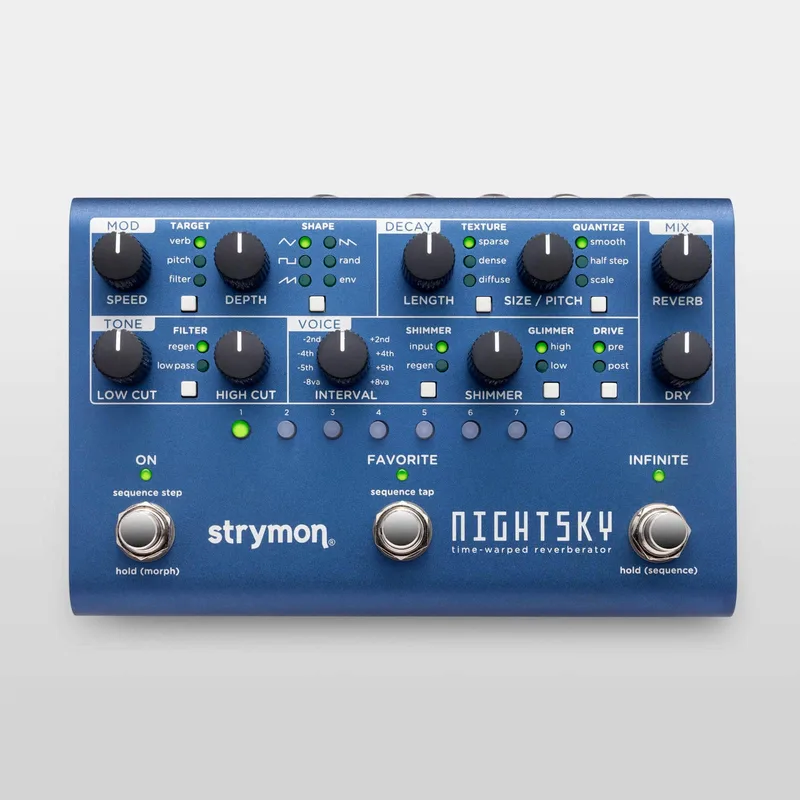
- That Pedal Show grouped it with the Strymon NightSky and Eventide Blackhole as one of the three big reverb releases of 202013.
"it succeeds in elevating the humble reverb pedal concept to a whole new level of tonal excellence and creative potential"
Guitar.com's reviewer also strongly recommended experiencing the unit in stereo with a pair of amps3, and Delicious Audio lists it among the best stereo reverb pedals for synths, noting its fully stereo design and the LoFi mode aimed at vintage digital sounds10.
Videos
Pete Thorn
Ricky Tinez
Vintage King
News
Questions
Is the CXM 1978 stereo?
Yes. The CXM 1978 has stereo input and output, with 32-bit AD/DA conversion. Guitar.com's reviewer strongly recommended experiencing it in stereo with a pair of amps rather than running it mono.
How many presets does the CXM 1978 hold?
It holds 30 presets, organized as three banks of 10 preset slots each. You can reach them from the Preset button or a MIDI controller, and a Jump button lets you skip instantly between two favorite presets.
What reverb types does the CXM 1978 have?
The Type button selects Room, Plate or Hall, giving three distinct reverb characters. The algorithms were honed from the Meris Mercury 7 and largely matched to the Lexicon 224 Digital Reverb.
Can you control the CXM 1978 faders with an expression pedal?
Yes. An expression pedal can be assigned to control the sliders, and the same jack also accepts 0-5V control voltage over a TRS cable. Guitar.com notes it supports global expression over the reverb mix level and morphing between fader positions.
What is the crossover frequency on the CXM 1978?
The crossover point is 362Hz, set by the Cross fader, which acts as a frequency splitter between the Bass and Mids faders. The decay crossover is adjustable, giving a fully shapeable reverb tail.
Sources (13)
- Chase Bliss Audio CXM 1978 Automatone Reverb, Pedal of the Day, 2020-12-06
- Chase Bliss & Meris CXM 1978 Reverb, Delicious Audio, 2025-02-19
- Review: Chase Bliss Audio Automatone CXM 1978, Guitar.com, 2021-01-27
- CXM 1978, Chase Bliss
- Chase Bliss Audio CXM 1978 opens for pre-orders: The reverb pedal of the decade?, gearnews.com, 2020-10-02
- Guitar Pedal X, Guitar Pedal X, 2020-10-02
- Guitar Pedal X, Guitar Pedal X, 2021-08-16
- A Q&A With Chase Bliss Audio And Meris About The CMX 1978 Automatone, Delicious Audio, 2020-11-03
- Gear Of The Year: Best Premium Effects Pedal of 2021, Guitar.com, 2021-12-09
- Best Stereo Reverb Pedals For Synths For Texture, Ambiance, And Automation, Delicious Audio, 2024-02-23
- CXM 1978, Meris, 2022-10-10
- Chase Bliss Audio teams up with Meris for the automated slider-equipped CXM 1978 Studio Reverb, Guitar World, 2020-10-02
- Spectacular Reverbs! Strymon NightSky, Chase Bliss CXM 1978, Eventide Blackhole, That Pedal Show (thatpedalshow.com), 2020-11-27