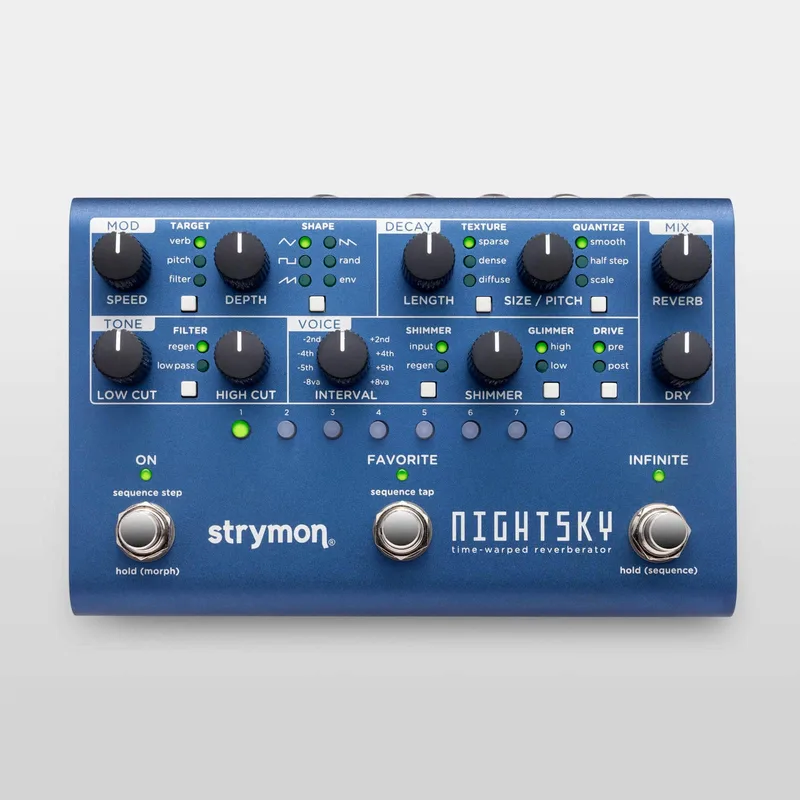


The Strymon NightSky is a stereo reverb pedal from Strymon that the maker calls a "time-warped reverberator": a reverb whose pitch, size and harmonic content can be bent and shaped while it plays, rather than a simulation of a room. Strymon describes it as applying "mind-bending pitch and harmonic manipulation to your reverb tails, with synth-like filter sweeps"1. It runs 32-bit floating point processing on a SHARC DSP, keeps the dry signal on an analog path, and is aimed squarely at ambient players and sound designers1.
Strymon's sound designer and DSP engineer Pete Celi presents the pedal in the maker's own in-depth tour, and Strymon positions it as a reverb that "turned reverb into an instrument"12.
An experimental reverb with pitch and filter shaping
Most reverb pedals give you a fixed algorithm and let you adjust decay and tone. The NightSky instead builds its reverb around a variable rate core: the SIZE/PITCH knob increases the size of the reverb core to create a larger "space" for reflections, and as it does so it also shifts the pitch of the reverb, with a pitch range of 2.5 octaves when QUANTIZE is set to smooth and two octaves in half step or scale mode4. A QUANTIZE function snaps that pitch movement to intervals: at noon it sits in the middle of the range, at minimum it is one octave up, and at maximum one octave down4. You can also select one of eight scales that determine the quantization intervals of the SIZE/PITCH knob by pressing and holding the QUANTIZE button and pressing the corresponding preset button4.
Beyond pitch, the pedal adds Shimmer, Glimmer, Drive and a resonant filter to the reverb tail2, and a MOD section lets you modulate the reverb itself. TARGET selects what the modulation is applied to: "verb" modulates the delay lines within the regenerating reverb core, and "pitch" modulates the size, or process rate, of the reverb core4. SHAPE selects the modulating waveform from six options, including triangle (a wave that rises and falls evenly, becoming a sine wave when TARGET is set to filter), square (jumps between two fixed values) and ramp (rises gradually, falls abruptly)4. SPEED adjusts the modulation rate from 0.06Hz, a 16 second sweep, to 12Hz, a 0.08 second sweep1.
The DECAY section's TEXTURE button selects one of three reverb types, Sparse, Dense and Diffuse, and MusicRadar's Jonathan Horsley described how they differ at launch5:
| Texture | What it does |
|---|---|
| Sparse | A "granular-sounding reverb" that can be clean with a sustaining input and more unusual with staccato inputs5 |
| Dense | Based around a plate-style reverb that "can go potty when you increase the decay time"5 |
| Diffuse | For "slow-building ambient textures, strange swells and so on"5 |
A Pre-Delay live edit function, reached by pressing and holding the TEXTURE button and turning the REVERB knob, adjusts the time between the dry signal and the onset of the reverb, left for shorter and right for longer4.
Presets, MIDI and expression
The pedal holds 16 presets accessible from the front panel and 300 via MIDI1. Its three footswitches are On, Favorite and Infinite1. The Favorite footswitch saves your current knob settings, and if the pedal is in Sequence mode and responding to MIDI Clock, the sequence runs as soon as you tap Favorite6.
MIDI is fully featured, transmitting and receiving over 5-pin DIN, USB and even the expression jack, supporting MIDI CCs, program changes and MIDI clock sync1. MIDI inputs include the 5-pin DIN port, a 1/4" TRS MIDI input at the EXP jack when set to MIDI mode, and USB6. The manual's MIDI specification is at page 15 of the user manual7. Extra INTERVAL options are available by sending MIDI CC# 26 with values 0 to 25, a two octave range in half step increments: value 0 is one octave down, value 8 is down a major 3rd, value 19 is up a tritone and value 25 is one octave up84.
The EXP jack can be set to several modes1:
- Expression Pedal
- MIDI, giving three presets via the MultiSwitch Plus or 300 presets via MIDI
- Preset Up/Down
- MOD, TONE or VOICE bypass
Strymon recommends an expression pedal with a 25k Ohm minimum potentiometer9. The USB jack also handles firmware updates1.
The NightSky needs its own 9V DC center negative supply delivering at least 300mA, and the supply is not included1. Strymon warns that subjecting the pedal to any voltage above 9V will damage it and void the warranty10.
Specifications
| Specification | Value |
|---|---|
| Converters | 24-bit 96kHz A/D and D/A3 |
| DSP performance | 1585 MegaFLOPS3 |
| Max input level | +8dBu3 |
| Frequency response | 20Hz to 20kHz3 |
| Signal to noise | 115dB typical3 |
| Dimensions | 4.5" deep x 7" wide x 2.4" tall (11.43 x 17.78 x 6.1 cm)1 |
| Enclosure | Anodized dark blue aluminum chassis1 |
The third pedal in Strymon's Sky series
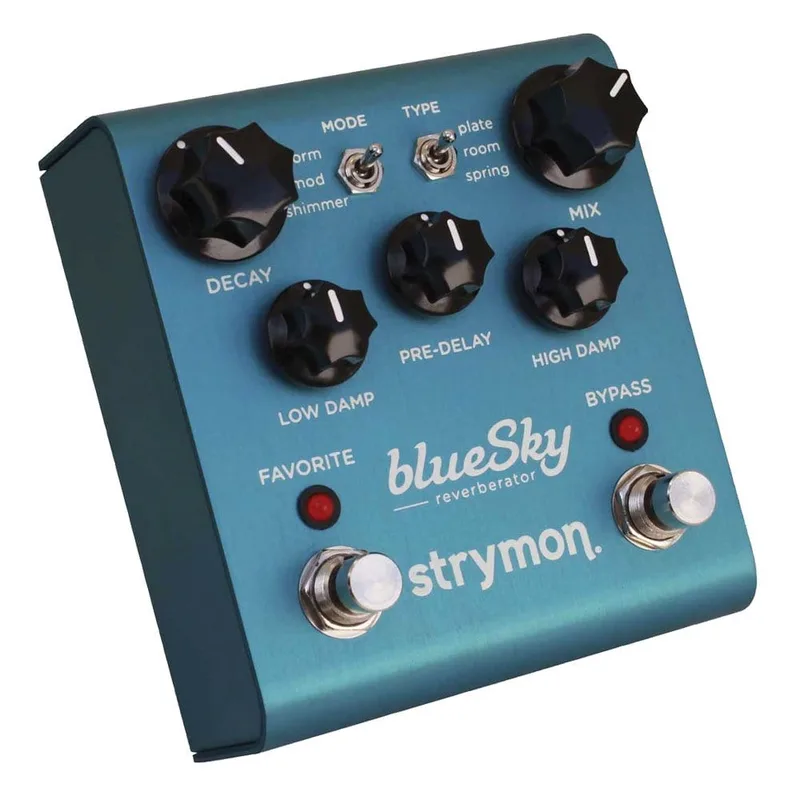
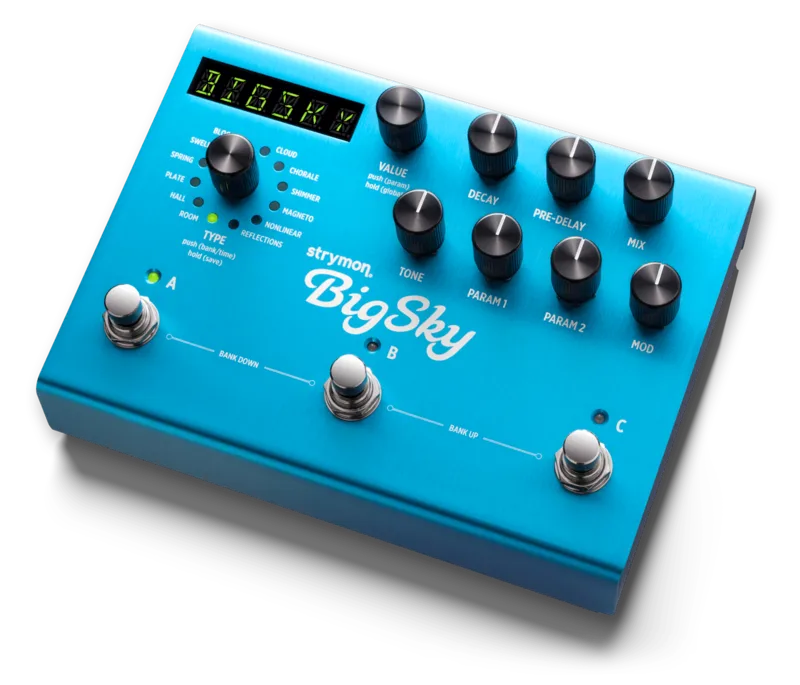
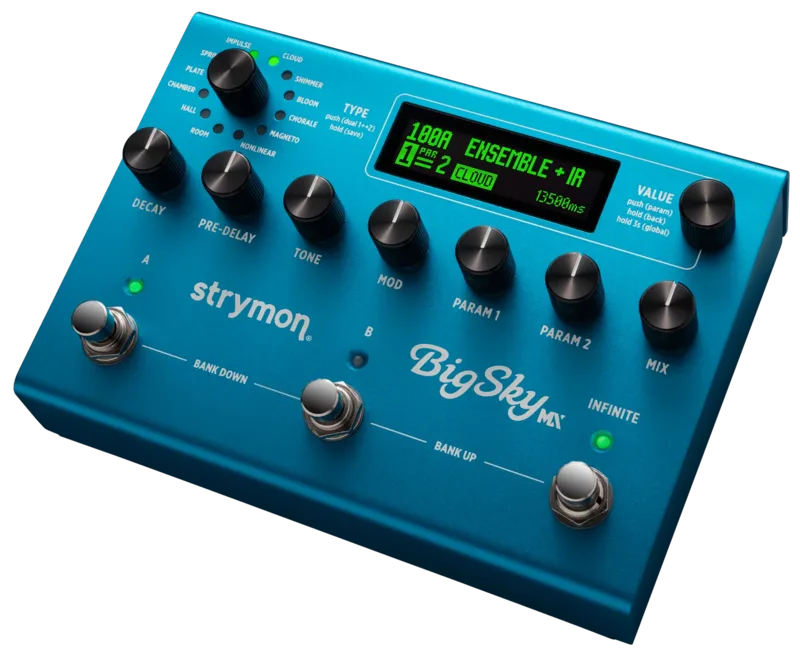
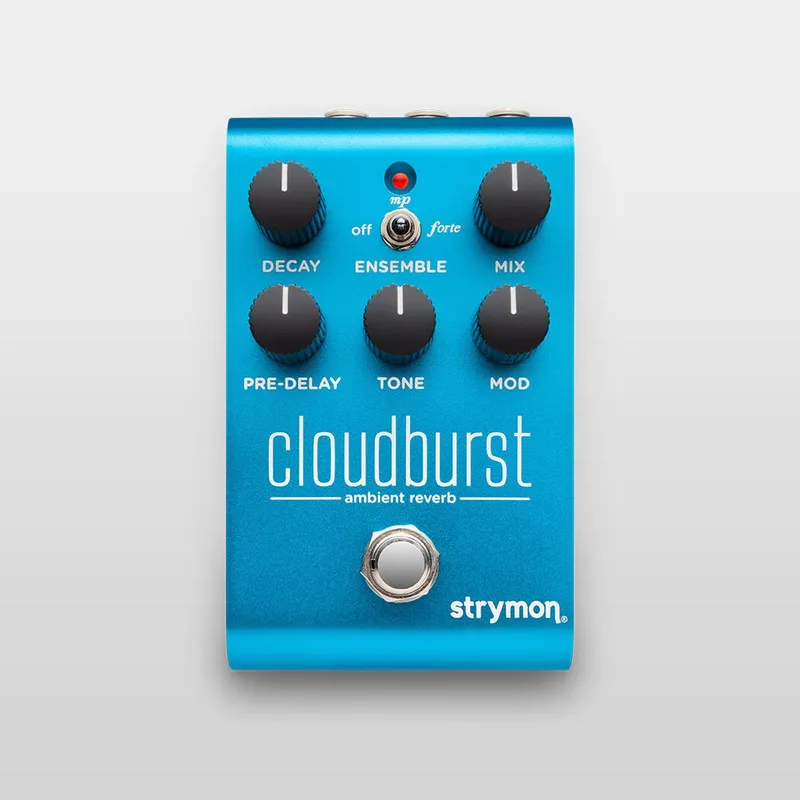
The NightSky is the latest and most experimental member of Strymon's Sky line of reverb pedals, following the BlueSky and BigSky1112. Guitar World's Trevor Curwen notes that where the earlier Sky pedals went some way into altered reverb, the NightSky "ventures far deeper into that rabbit hole of altered reverbs and otherworldly ambience"11. It was announced in September 2020, available for pre-order at $4291314, and by October 2022 it had been out for a little over two years14. Strymon has since extended the family with the BigSky MX and Cloudburst, and the NightSky itself now exists as a plugin, "NightSky's time-warped reverb, now inside your DAW"2.
What reviewers said
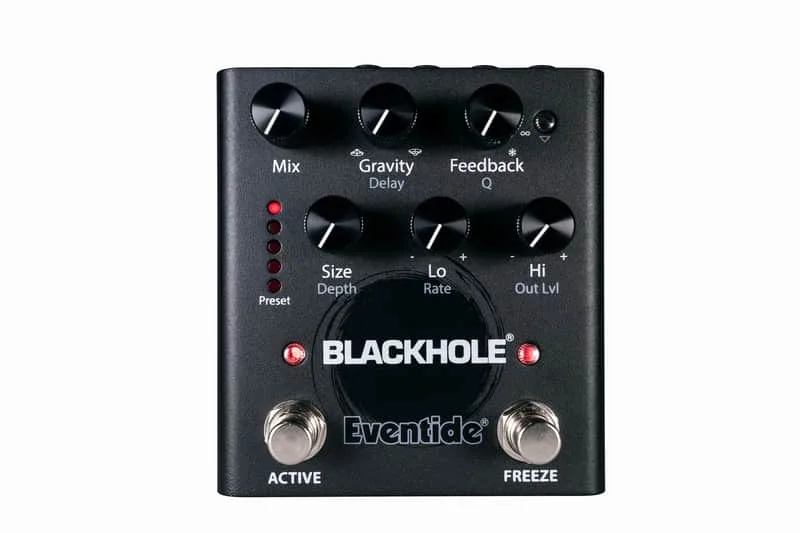
Guitar.com's Richard Purvis reviewed it at launch and highlighted the practical side of the design: "An analogue dry path means your original signal runs through without any digital tampering"12. His review compared it against the Eventide BlackHole, Empress Reverb and Meris Mercury7 as alternatives in the same experimental reverb space12. MusicRadar's review team listed its origin as the USA15, and in a later round-up MusicRadar's Matt called it the benchmark of its kind:
"If you like experimental reverb tones, the Strymon NightSky is the gold standard."16
Factory reset and firmware
A factory reset returns all custom presets, power up functions and secondary parameters to their factory settings17. The procedure, from Strymon's support article17:
- Before powering up, press and hold the ON footswitch, then plug in the power.
- After a few seconds, preset buttons 1 to 4 light amber and preset buttons 5 to 8 light green, and the ON footswitch blinks red; release the footswitch.
- Sweep the DECAY knob from 0% to 100% twice, with status shown on the Favorite LED, amber at 0% and red at 100%.
- All three footswitch LEDs blink red while the reset runs; when they stop, the pedal power cycles and starts up normally.
The current firmware release is REV v1.07, released March 2021, which added the ability to store expression pedal control over the Shimmer Interval in a preset18. Updates are done by connecting the powered pedal to your computer with the included USB-mini cable via the USB-mini jack on the back19.
Videos
Rhett Shull
strymon
strymon
Questions
Is the Strymon NightSky true bypass?
Yes. The NightSky uses true bypass with electromechanical relay switching, with an optional buffered bypass, and buffered bypass is used when you run the stereo output. The dry signal also has an analog path, so it is never converted to digital.
How do you factory reset a Strymon NightSky?
Before powering up, press and hold the ON footswitch and plug in the power. After a few seconds, preset buttons 1 to 4 light amber and 5 to 8 light green, and the ON footswitch blinks red; release the footswitch, then sweep the DECAY knob from 0% to 100% twice. The reset clears all custom presets, power up functions and secondary parameters.
How many presets does the NightSky hold?
You can access 16 presets from the front panel and 300 presets via MIDI. The Favorite footswitch saves your current settings, and the three footswitches are On, Favorite and Infinite.
What is the difference between Sparse, Dense and Diffuse on the NightSky?
Sparse is a granular-sounding reverb that stays clean with sustaining input and gets more unusual with staccato playing. Dense is based on a plate-style reverb that gets wilder as you increase the decay time. Diffuse is aimed at slow-building ambient textures and strange swells.
Does the NightSky have an analog dry path?
Yes. Strymon specifies an analog dry path, so the dry signal passes through with zero latency and is never converted to digital. Only the wet reverb signal goes through the 24-bit 96kHz converters.
How do you update the NightSky firmware?
Connect the powered pedal to your computer with the included USB-mini cable via the USB-mini jack on the back, then follow Strymon's update process. The current release is firmware REV v1.07, which among other changes lets expression pedal control over the Shimmer Interval be stored in a preset.
Sources (19)
- NightSky Experimental Reverb, Strymon, 2026-08-12
- NightSky Family Page, Strymon, 2026-10-08
- What are the hardware specifications on NightSky?, Strymon, 2021-07-16
- NightSky Support, Strymon (www.strymon.net), 2025-10-17
- Strymon reveals the NightSky, a "Time-Warped Reverberator" for all your extra-dimensional reverb needs, MusicRadar, 2020-09-18
- How to Sync the NightSky Sequencer to MIDI Clock, Strymon, 2021-07-16
- How can I control my Strymon Pedal with MIDI?, Strymon, 2023-10-19
- How does each section of NightSky work?, Strymon, 2021-07-16
- How to use an expression pedal to control the knobs on NightSky?, Strymon, 2021-07-16
- What are the power supply requirements for NightSky?, Strymon, 2021-07-16
- Strymon NightSky review, Guitar World, 2021-02-17
- The Big Review: Strymon NightSky, Guitar.com, 2020-11-13
- Strymon unveils the NightSky, Guitar World, 2020-09-18
- Strymon teases an addition to its Sky reverb range, Guitar.com, 2022-10-18
- Strymon NightSky review, MusicRadar, 2021-02-14
- “At times it can really feel like more of a multi-effects pedal rather than just a straight reverb pedal”: Electro-Harmonix Oceans Abyss review, MusicRadar, 2025-06-20
- How do I perform a factory reset on NightSky?, Strymon, 2021-07-16
- NightSky Firmware Revision Release Notes, Strymon, 2023-02-02
- How to connect to Strymon Update, Strymon, 2023-02-01