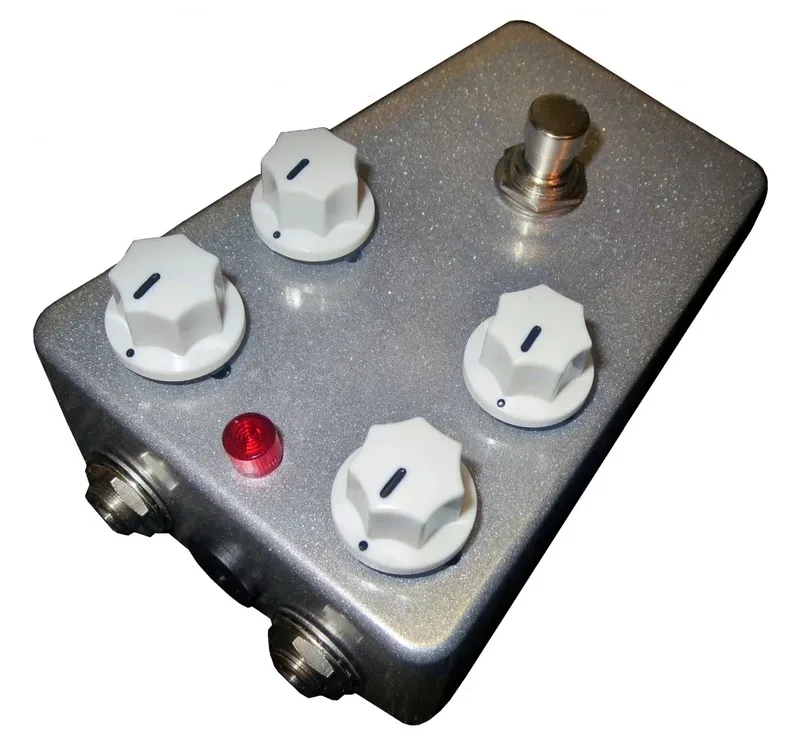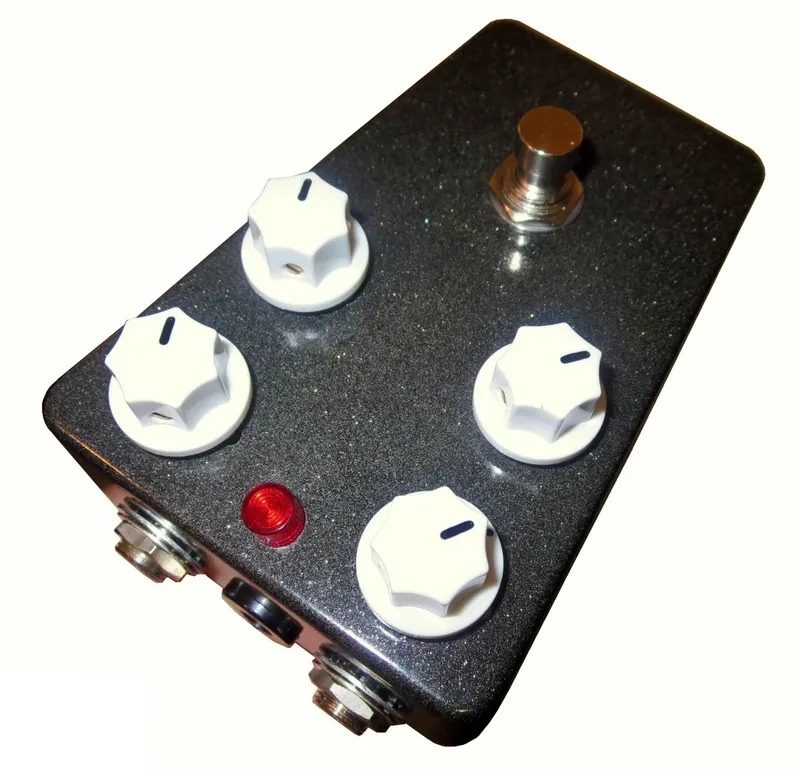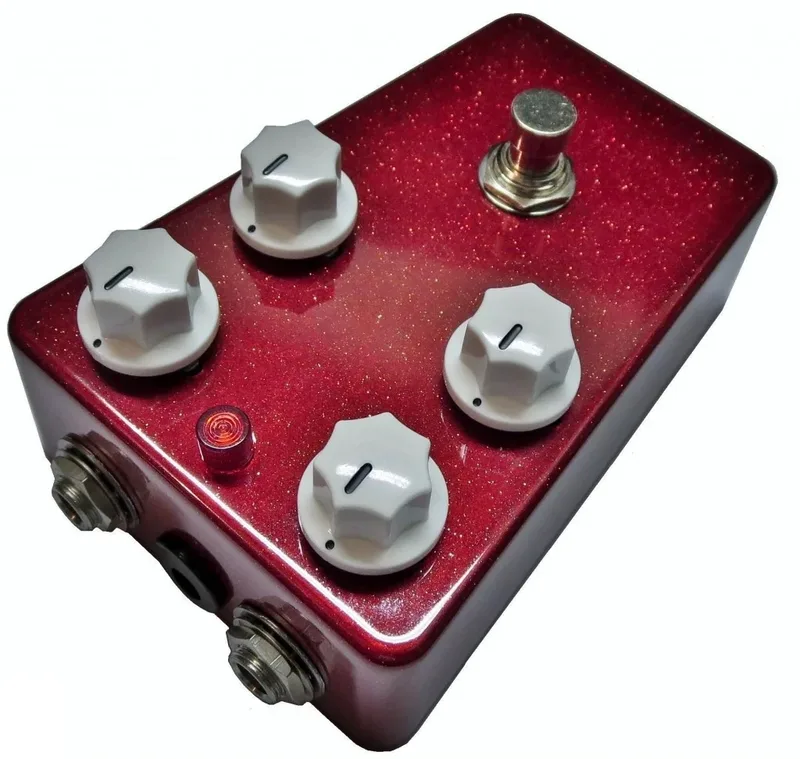

The Chase Tone Red Stardust Germanium Fuzz is a germanium fuzz pedal built with NOS cherry picked gold lead plated germanium transistors. Chase Tone describes it as having "more gain, thick fuzz, sustain and feedback than a stock vintage germanium fuzz face," while staying present in a mix. It is part of the maker's Stardust Effects Pedal series, with translucent Star Dust powder coat finishes inspired by a love for astronomy, and it is made in the USA.1
The Red Stardust uses a positive ground, non-standard DC jack, a common trait of germanium fuzz circuits. It will not sit on a standard center-negative daisy chain with most modern pedals without an isolated or polarity-converting supply. The pedal is also listed as sold out, and Chase Tone describes it as a limited production run.1
The controls: Output, Fuzz, Temper and Headroom
The Red Stardust has four controls, each aimed at a different part of the fuzz response1:
| Control | What it does |
|---|---|
| Output | Maximizing it increases sustain, punch and treble bite; the sweet spot is usually between three quarters and maximum clockwise, set against your amp and guitar1 |
| Fuzz | Maximizing it increases the total amount of fuzz; a customized circuit offers an improved range, allowing less fuzz and more overdriven fluid tone for the majority of the control's travel1 |
| Temper | Optimal adjustment is around half-way (noon) at 72 degrees Fahrenheit; fine tuning in either direction compensates for temperature fluctuations, and extreme settings produce a gated effect1 |
| Headroom | Fully clockwise removes it from the circuit; counter-clockwise it adjusts headroom clipping of the input circuit, reduces bass frequencies for dark or humbucker guitars, and helps eliminate oscillations after a wah pedal1 |
The Temper control reflects a practical reality of germanium circuits: their behavior shifts with temperature. Chase Tone's guidance is to set it near noon at 72 degrees Fahrenheit and adjust from there as conditions change.1
How it sounds
Chase Tone's own description centers on gain and sustain beyond a stock vintage germanium Fuzz Face, with the pedal never getting lost in the mix. The maker's sound clip shows what it calls a smooth spread of rich harmonic textures of clean, overdrive and "rubber band quality" fuzz tones, produced by manipulating the guitar's volume between 3 and 10, standing out in the mix while never being too bright. As with most germanium fuzz designs, cleaning up with the guitar volume knob is part of the intended playing approach.1
Part of the Stardust series
The Red Stardust sits in Chase Tone's Stardust Effects Pedal series, whose finishes are inspired by a love for astronomy. The series includes silicon-based siblings alongside this germanium model1:
- Chase Tone Silver Stardust BC183/2L Silicon Fuzz
- Chase Tone Blue Stardust BC108 Silicon Fuzz
- Chase Tone Black Stardust BC109 Silicon Fuzz
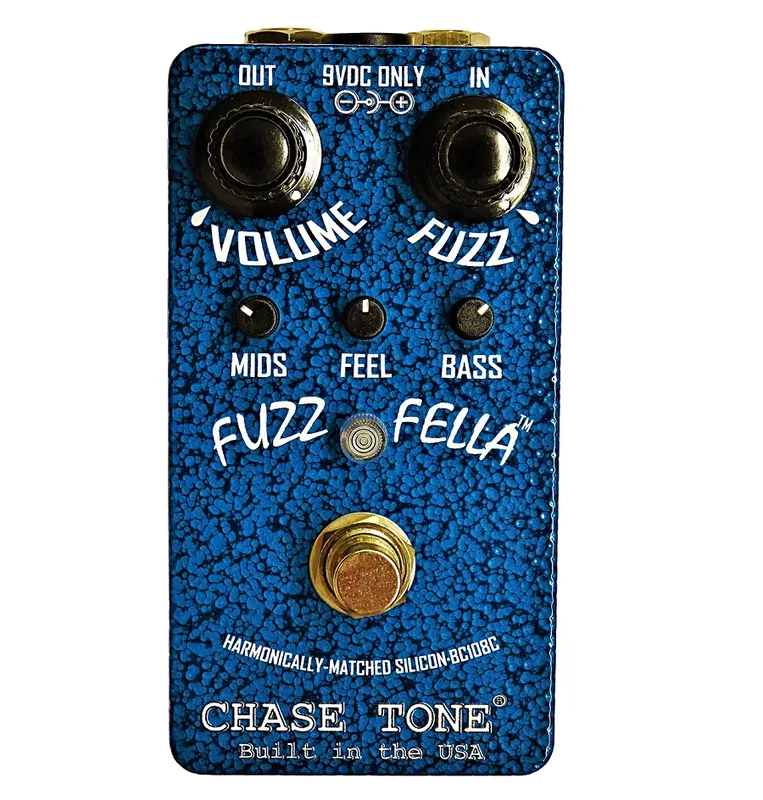
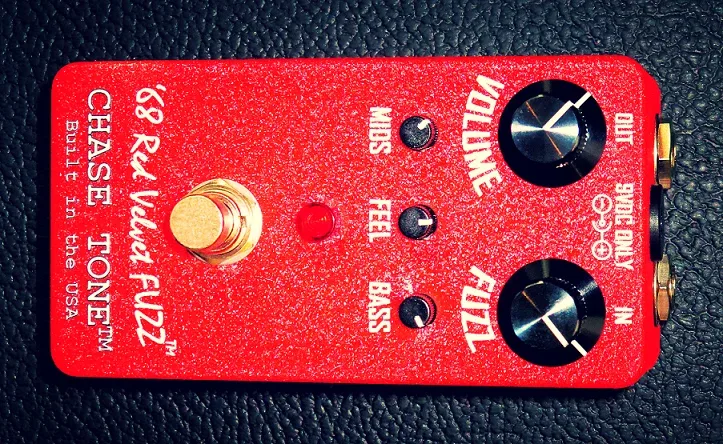
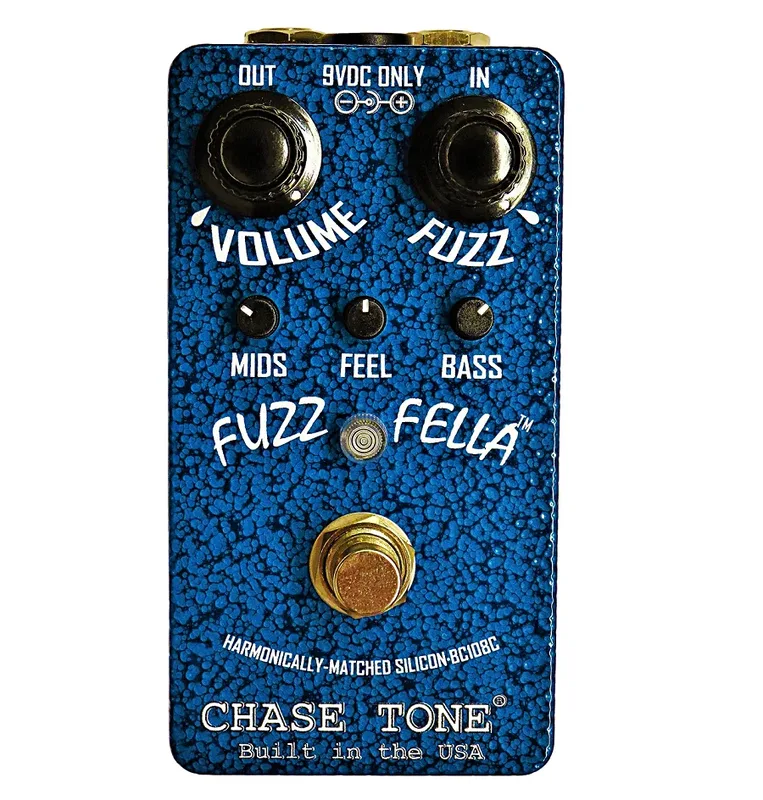
Chase Tone also builds other germanium and Fuzz Face style pedals, including the Chase Tone '68 Red Velvet Fuzz, the Chase Tone Fuzz Fella and the Chase Tone Dallas Arbiter Germanium Fuzz Face Replica.1
Buying details
The Red Stardust carried a list price of $249.99 USD, with sale pricing of $234.98 USD reflecting $15.01 in instant savings, as of 26 October 2026. Chase Tone offered flat $10 worldwide shipping, with USA orders sent by USPS Priority Mail for delivery in 3 to 5 days, and a 30 day money back guarantee for USA buyers. United States Veterans receive a 5% discount. The pedal is currently listed as sold out.1
Videos
Patrick Hoss
Patrick Hoss
Questions
Does the Chase Tone Red Stardust use positive ground power?
Yes. Chase Tone specifies a positive ground, non-standard DC jack, which is typical of germanium fuzz circuits. That means it will not share a standard center-negative daisy chain with most modern pedals without an isolated or polarity-converting supply. The maker also describes the pedal as temperature stable, and the Temper control allows fine tuning for temperature changes.
What does the Temper control do on a germanium fuzz?
The Temper control compensates for temperature. Chase Tone says the optimal setting is around half-way, or noon, at 72 degrees Fahrenheit, and that fine tuning in either direction may be needed as the temperature changes. At extreme settings the control produces a gated effect.
Where is the Chase Tone Red Stardust made?
Chase Tone states the Red Stardust is made in the USA. The input and output jacks are rear facing and American made, and the pedal uses NOS cherry-picked gold lead plated germanium transistors.
Is the Red Stardust Germanium Fuzz still available?
No. The pedal is listed as sold out on the Chase Tone product page as of 26 October 2026. It was a limited production run, so it may not return.
What is the difference between the Headroom and Fuzz controls?
The Fuzz control sets the total amount of fuzz, with a customized circuit that allows less fuzz and more overdriven fluid tone for most of its travel. The Headroom control, turned fully clockwise, is removed from the circuit; turned counter-clockwise it adjusts headroom clipping of the input circuit, reduces bass frequencies for dark or humbucker guitars, and helps eliminate oscillations after a wah pedal.
Sources (1)
- Chase Tone™ Red Stardust™ Germanium Fuzz, Chase Tone (chasetone.com)