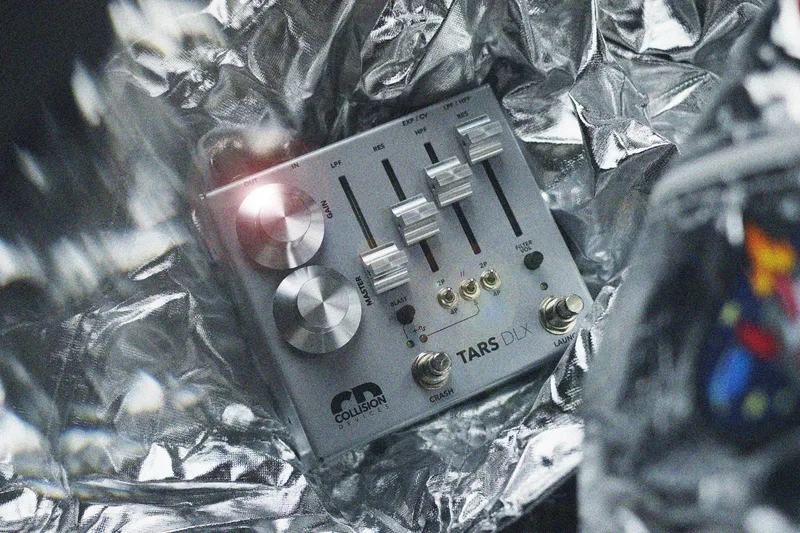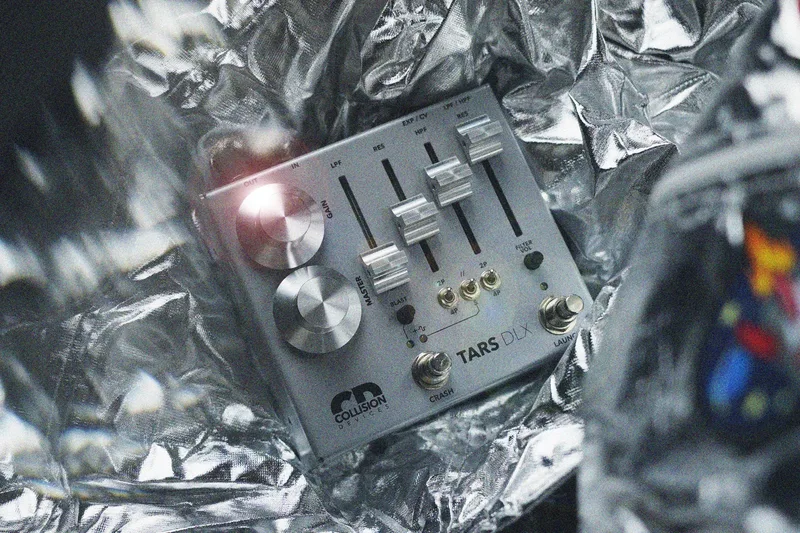


The Collision Devices TARS DLX is a dual fuzz pedal with two analog resonant filters, a low-pass and a high-pass, inspired by the filters of the Korg MS-20 synthesizer1. Released on 31 December 2024 as a limited edition, with the first 100 units selling out immediately2, it is a reworked and expanded version of the company's earlier TARS fuzz and filter pedal. Collision Devices describes it as "probably the only pedal with 4 poles - resonant - Low Pass and High Pass Filters"1.
For a player, that means one box holding two fuzz voices and a pair of sweepable, resonant filters that can shape the fuzz, run alongside it, or be used on their own. Pedal of the Day called it "a beast of a dirt and filtering pedal" aimed at the experimenter3.
A dual fuzz with analog resonant filters
The two filters are the heart of the pedal. Both are analog, and both are resonant, meaning they emphasize a peak at their cutoff point rather than simply rolling off frequencies. The design follows the filter section of the Korg MS-20, a synthesizer known for its aggressive, self-oscillating filters, and Collision Devices originally built the TARS filter to "create fuzzy-noisy textures and cut through the mix"5. On the DLX, the frequency response of both filters has been improved to better work on very low end sources with subby bass sounds, which makes the pedal a candidate for bass as well as guitar1.
The fuzz and filter sections are not locked together. Collision Devices states that "Fuzz and filters can be used separately in parallel or in serial"1, so a player can run a clean signal through the filters alone, use the fuzz on its own, or route the fuzz into the filters in series.
Fuzz, filters and the ADD FUZZ configuration
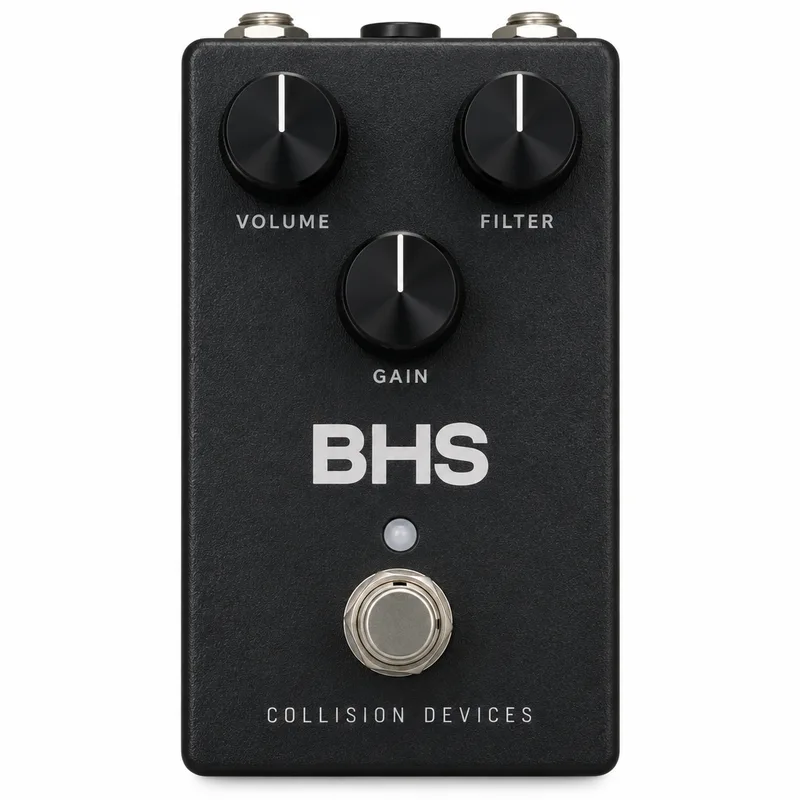
The DLX carries two fuzz circuits. The main one is an evolution of the fuzz found in Collision Devices' Black Hole Symmetry pedal, reworked to open up in the high end so it works as a low gain fuzz or distortion, and becoming more aggressive with the Gain control maxed out2. The second circuit, called BLAST, feeds part of the circuit back into itself to produce what the maker describes as huge and abrasive "burning" sounds1. A Blast button on the pedal adds this feedback fuzz to the first fuzz when engaged2.
The ADD FUZZ mode is the configuration Collision Devices describes as found nowhere else. Triggered by the Crash footswitch, it layers a filtered fuzz on top of the main fuzz signal, and on the DLX it has been upgraded with a high-pass filter placed after the low-pass filter2. Because the added fuzz is filtered, the filters can be used as EQ shaping or phasing effects within this configuration1.
| Section | What it does | How it is engaged |
|---|---|---|
| Main fuzz | Low gain fuzz/distortion to aggressive fuzz, evolved from the Black Hole Symmetry circuit | Gain control |
| BLAST | Feedback fuzz layered onto the main fuzz for huge, abrasive sounds | Blast button |
| Filters | Analog resonant 4-pole low-pass and high-pass, MS-20 inspired | Used with fuzz or alone, parallel or serial |
| ADD FUZZ | Filtered fuzz layered on top of the main fuzz, high-pass after the low-pass | Crash footswitch |
TARS versus TARS DLX
The original TARS is a single fuzz with one analog resonant filter, also MS-20 inspired5. The DLX, as Collision Devices puts it, took the TARS and "pushed it forward"1: a second fuzz circuit, a high-pass filter alongside the low-pass, the improved low end response, and the upgraded ADD FUZZ mode. A "Mirror Polished" version of the TARS DLX appears in the maker's discontinued index6.
The TARS DLX launched as a limited edition and the first 100 units sold out immediately, with more said to be on the way at the time2. Check the maker's shop for current availability rather than assuming a listing price reflects stock.
What reviewers said
Pedal of the Day reviewed the pedal on 13 July 2025 and described it as an evolved version of the original TARS, noting the reworked fuzz circuitry, the BLAST fuzz mode, and the Korg MS-20 inspired resonant filters3.
"This truly is a beast of a dirt and filtering pedal."
The reviewer highlighted the sheer number of knobs, sliders, switches and hidden features as something that draws in the experimenter3. Delicious Audio, covering the launch, noted the first 100 units selling out instantly and pointed readers to the Collision Devices website for full details2.
Videos
Collision Devices
Collision Devices
Collision Devices
Questions
What is the difference between the TARS and the TARS DLX?
The TARS DLX is a reworked and expanded version of the original TARS. It adds a second fuzz circuit called BLAST, a high-pass filter alongside the low-pass filter, an improved frequency response for very low end sources, and the ADD FUZZ mode triggered by the Crash footswitch. The original TARS is a single fuzz with one analog resonant filter.
Can the fuzz and filters be used separately?
Yes. Collision Devices states that the fuzz and filters can be used separately, in parallel or in serial. The filters can also serve as EQ shaping or phasing effects when the ADD FUZZ configuration layers a filtered fuzz on top of the main fuzz signal.
What does the Crash footswitch do?
The Crash footswitch triggers the ADD FUZZ mode, which layers a filtered fuzz on top of the main fuzz signal. On the TARS DLX this mode has been upgraded with a high-pass filter that follows the low-pass filter, a configuration Collision Devices describes as found nowhere else.
Are the filters on the TARS DLX analog or digital?
They are analog. The TARS DLX carries two analog resonant filters, a low-pass and a high-pass, each with 4 poles, inspired by the filters of the Korg MS-20 synthesizer.
Does the TARS DLX work with bass?
Yes. Collision Devices says the frequency response of both filters has been improved to better work on very low end sources, with subby bass sounds. The company describes it as suited to very low end sources generally.
Sources (6)
- TARS DLX, Collision Devices
- New Pedal: Collision Devices TARS DLX Dual Fuzz + Filter, Delicious Audio, 2024-12-31
- Collision Devices TARS DLX Dual Distortion/Fuzz w/Analog Filters, Pedal of the Day, 2025-07-13
- TARS by Collision Devices, RockBoard PedalPedia, 2026
- TARS - filter fuzz - COLLISION DEVICES, Collision Devices
- Discontinued pedals, Collision Devices