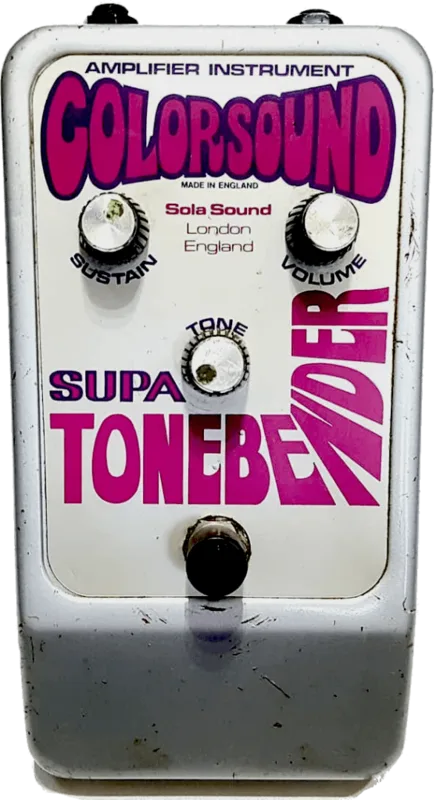


The Colorsound Supa Tonebender is a fuzz pedal made in England by Sola Sound and released in 197412. Despite the name, it is not a continuation of the classic germanium Tone Bender line. It is a four-transistor silicon fuzz that, in circuit terms, is a modified Big Muff, and it is known for a big low end and long sustain345.
Premier Guitar's history of the Tone Bender puts it plainly: the Supa Tone Bender "didn't use germanium transistors like previous Tone Benders, and was essentially a mildly modified Big Muff" based on the "ram's head" Muff of the same period, with four silicon transistors and diode clipping3. In another Premier Guitar piece it is described as "a Colorsound-branded Big Muff design that was, in many ways, a louder, nastier version of the legendary 'ram's head' Big Muff"6.
A Big Muff relative, not a classic Tone Bender
The Tone Bender family goes back to the 1960s, when Colorsound originated the design, and by 1969 several versions and variations existed from Vox, Jennings, Coloursound and JMI1011. The classic Tone Benders, like the Sola Sound Tone Bender MKIV, were germanium-transistor fuzzes in a slim enclosure112.
The Supa Tonebender broke from that lineage. TONEHOME's page for the pedal notes it is "different to the classic germanium transistor Tone Bender in the slim enclosure"1. Independent technical analysis at Guitar FX Layouts identifies the specific differences: "the supa tonebender is essentially a modified big muff. it's got a few changes to components values, and the removal of the first set of clipping diodes," which also removes the coupling caps in the first clipping stage13. Coda Effects' Big Muff mods article makes the same point from the other direction: "Remove the first pair of diodes, and you have got a Colorsound Supa Tonebender! The unit will be louder, with more bass," which is why the mod is recommended for bass players9.
General Guitar Gadgets, whose DIY project reproduces the circuit, describes the result as "an excellent classic distortion box and is probably a bit more 'in your face' than a standard Big Muff," with "a circuit similar to a Big Muff, not like the older ToneBenders"8.
The controls: Volume, Sustain and Tone
The original pedal has three knobs: volume, sustain and tone4. The General Guitar Gadgets bill of materials gives the pot values behind each control8:
| Control | Potentiometer | Taper |
|---|---|---|
| Volume (R25) | 10k | Log (audio) |
| Sustain (R6) | 10k | Log (audio) |
| Tone (R20) | 100k | Linear |
Sustain sets the amount of fuzz and compression, Volume sets the output level, and Tone tilts the frequency balance. On the GuitarPCB ColorTone reproduction, the tone control is a blend control: it balances the frequency response at 50% rotation, increasing high frequencies clockwise and low frequencies counterclockwise from the middle position14.
Builders using the Guitar FX Layouts stripboard layout should know the tone pot is wired reversed in that layout. Swapping the wires on lugs 1 and 3 makes it work in the usual way13.
Circuit and components
The circuit is a Big Muff topology with four silicon NPN bipolar junction transistors (Q1 to Q4) and diode clipping89. Coda Effects' teardown of an original unit notes "4 transistors, 470pF capacitors, everything that is included in a classical Big Muff circuit," with pots marked "made in UK"4. The original is wired with a 2PDT footswitch and no LED, since LEDs were not yet commercially common in pedals4.
The General Guitar Gadgets project specifies four 1N914 diodes and one LED for the clipping section, a heavy duty 3PDT footswitch, a stereo quarter-inch input jack, a mono quarter-inch output jack, a DC jack and a 9 volt battery snap, with the battery not included in the kit8.
The GuitarPCB ColorTone Supa Tonebender v4 (2022) uses BC546 transistors for Q1 to Q4 and 1N34A germanium diodes for the clipping pairs, with 2N5088 and 2N5089 listed as excellent alternates that must be installed in reversed orientation as shown on the board silkscreen14. The 2022 version adds a 1N5817 circuit protection diode and onboard potentiometers, plus an advanced tone section providing both bass and treble emphasis14. No rare or expensive germanium transistors are required12.
History and versions
Colorsound also made a 3-knob reissue in the 1990s that used an IC with clipping diodes in the feedback path, described by Guitar FX Layouts as "sort of a stripped down Tube Screamer"13.
The circuit lives on in DIY form. General Guitar Gadgets offers it as a Ready to S solder Circuit Board project, with its bill of materials at Version 2014May21 and copyright 2009 JD Sleep8. GuitarPCB's ColorTone Supa Tonebender PCB "has recreated the famous Supa Tonebender and added some versatile features to bring this into the modern era,"12.
Who uses it
Analog Man's page credits Steve Hackett with the pedal on Genesis's The Lamb Lies Down on Broadway, and notes a special "limited edition Steve Hackett" insignia on some units5. GuitarPCB cites Jimmy Page and Jeff Beck as great performers associated with the classic fuzz sounds the circuit recreates12.
On That Pedal Show, the vintage Colorsound Supa Tonebender was compared against Pigdog fuzzes and a vintage Shin-Ei in a demo of fuzz pedals7.
Videos
Benoit M
Marcus Serck
Macari's SolaSound
Questions
Is the Supa Tonebender a Big Muff?
In circuit terms, essentially yes. Independent technical analyses describe it as a modified Big Muff with a few component value changes and the first set of clipping diodes removed, and Premier Guitar calls it a mildly modified Big Muff based on the ram's head version of the same period. It is not a continuation of the germanium Tone Bender line.
Did Steve Hackett use a Colorsound Supa Tonebender?
Yes. Analog Man's page for the pedal lists Steve Hackett as a user, crediting it on Genesis's The Lamb Lies Down on Broadway, and notes a special limited edition Steve Hackett insignia on some units.
Does the Supa Tonebender run on a battery?
The original ran on a 9 volt battery, and the General Guitar Gadgets project bill of materials includes a 9 volt battery snap, with the battery itself not included in the kit. The project also lists a DC jack for external power.
Why does the tone knob work backwards on a Supa Tonebender build?
On the Guitar FX Layouts stripboard layout the tone pot is wired reversed. The fix is simple: swap the wires on lugs 1 and 3 of the pot and it works in the usual way.
Sources (14)
- TONEHOME, TONEHOME - the World of Vintage Guitar Effects Pedals
- ToneBender variants, Skreddy Pedals
- The Mighty Tone Bender Fuzz: A 50-Year Legacy, Premier Guitar, 2018-12-13
- Coda Effects, Coda Effects, 2015-10
- Colorsound vintage reissue effects pedals, Analog Man Vintage guitar effects (analogman.com), 2015
- Death by Audio Thee Ffuzz Warr Overload Review, Premier Guitar, 2013-09-05
- Pigdog Fuzzes plus Vintage Shin-ei and Colorsound Supa Tonebender compared, That Pedal Show, 2015-04-24
- ColorSound™ Supa Tone Bender™ Clone: PCB & Schematic, General Guitar Gadgets, 2014-05-15
- Coda Effects, Coda Effects, 2015-11
- PULL FOCUS, Rainger FX
- FIREFLY - JHS Pedals, JHS Pedals, 1969
- ColorTone Supa Tonebender, GuitarPCB
- Guitar FX Layouts: Colorsound Supa ToneBender, Guitar FX Layouts (tagboardeffects.blogspot.com), 2016-01-03
- CT-Supa-Fuzz-v4-2022.pdf, GuitarPCB, 2022-09