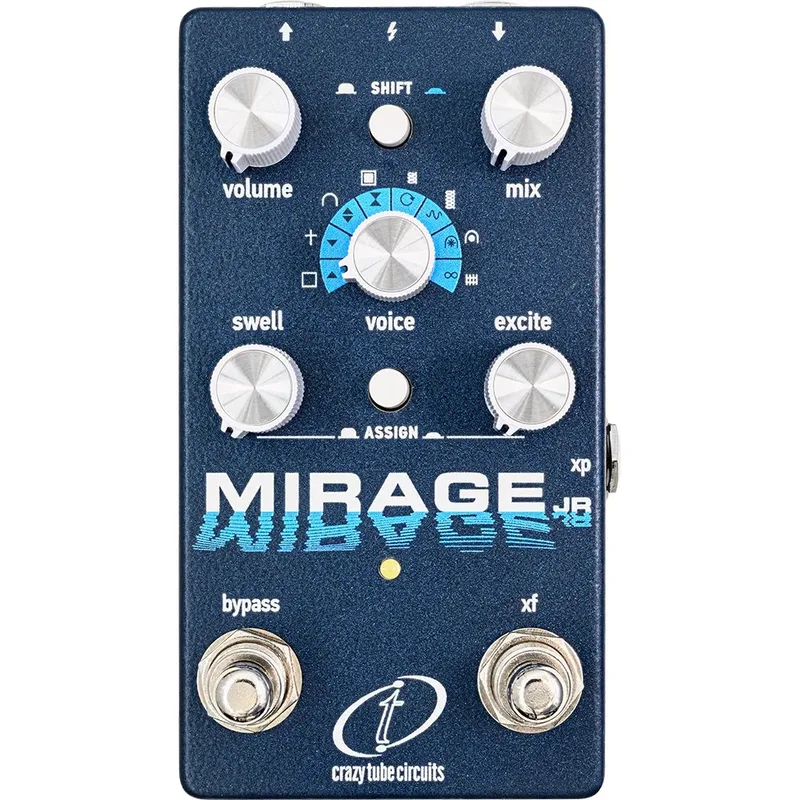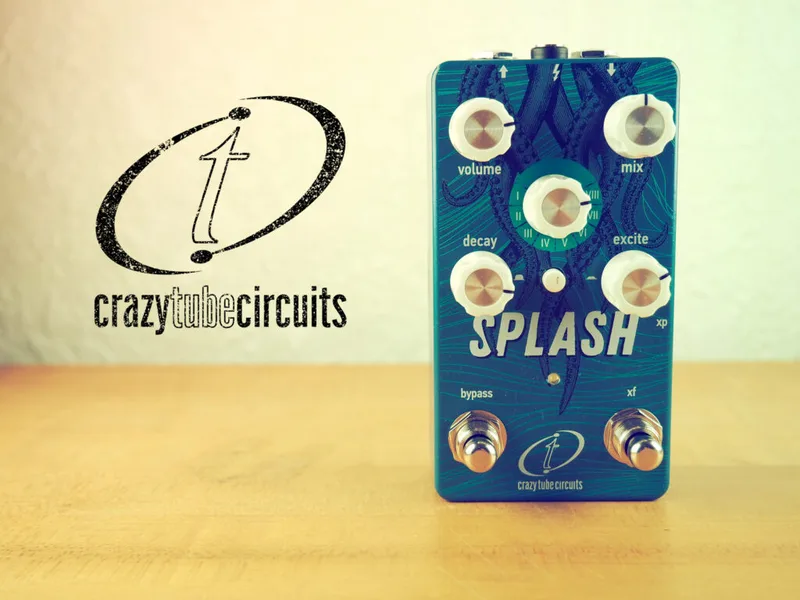


The Crazy Tube Circuits Splash Mk4 is a reverb pedal from Crazy Tube Circuits in a blue enclosure. Pedal of the Day described it as "a ton packed into this little blue beast"1. Its algorithms draw on the earlier Splash Mk3 and the Sidekick, with new additions of its own, and its on-board XF footswitch controls the Decay and Excite parameters on all algorithms1.
A key thing for any player weighing a reverb pedal is what happens to the dry signal. On the Splash Mk4, the dry path is fully analog: "The Dry signal on the Splash Mk4 is still 100% all analog, and all the mixing and filtering of the wet signal is also in" the analog domain, as Pedal of the Day put it1. In practical terms, your underlying guitar tone does not get converted and processed; only the reverb effect itself is generated and then blended back in.
Eight algorithms in an analog-dry reverb
The eight algorithms cover a wide range of reverb territory, from subtle room ambience to infinite-sustain ambient textures. The ones Pedal of the Day itemised in its review1:
- Algorithm I, "The Exciter": from a touch of ambience to a spacious pad effect, especially on extreme settings
- Algorithm III, Large reverb: from hall to ambience, taken from the Splash Mk3 with a small twist for extra decay
- Algorithm IV, Plate-style reverb: taken from the Sidekick, with medium decay
- Algorithm V, Shimmer: high-pitched harmonics ambience, taken from the Sidekick with a small twist for extra decay
- Algorithm VIII, Flanged Freeze reverb: short to infinite decay
Two parameters, Decay and Excite, run through every algorithm, and both can be worked from the on-board XF footswitch or from an external expression pedal plugged into the expression input. Pedal of the Day noted that this gives "extra flexibility for controlling the Decay (length of the reverb tail) and Excite (differing functionality for" each algorithm, letting you sweep the effect while playing and, in the reviewer's words, create "the ultimate ambient tones"1.
There are also internal switches on the board that set Kill Dry, expression pedal assignment and bypass functionality1. Kill Dry is the setting ambient players use to run the pedal fully wet, with no dry signal passing through.
From Splash Mk3 and Sidekick to Mk4
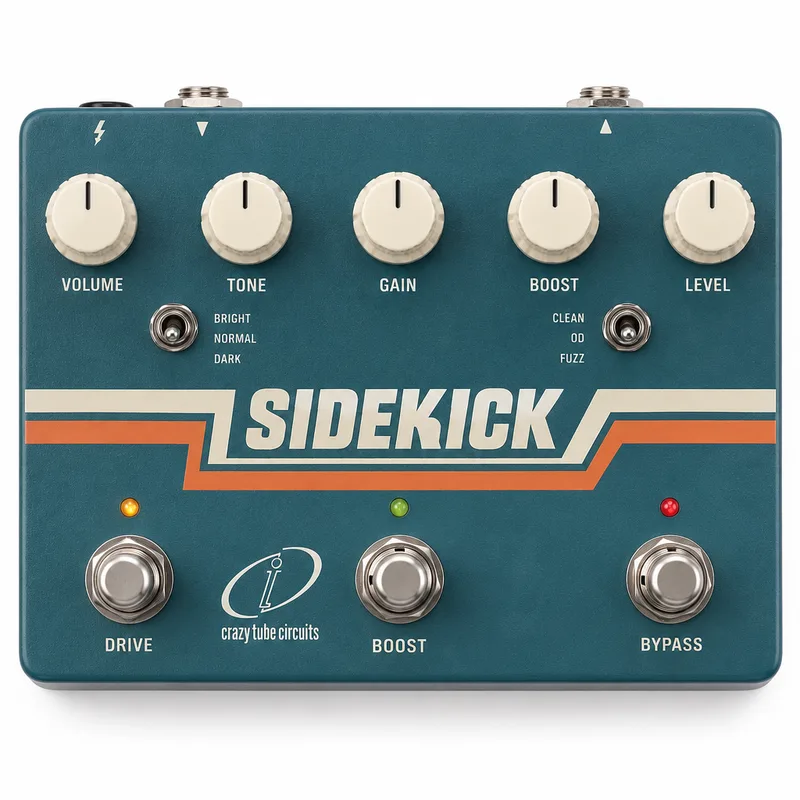
The Mk4 is not a clean-sheet design. Pedal of the Day explained that it "takes elements from said Sidekick, as well as the last version, the Splash mk3, plus adds in a couple of new algorithms of its own"1. The Sidekick's contribution shows up in two of the Mk4's modes: Algorithm IV is a plate-style reverb with medium decay, taken from the Sidekick, and Algorithm V is a shimmer, a high-pitched harmonics ambience also taken from the Sidekick, there with a small twist for extra decay1. Algorithm III, a large reverb running from hall to ambience, comes from the Splash Mk3, again with a small twist for extra decay1.
The earlier Splash Mk3, reviewed by Pedal of the Day in 2016, was a simpler pedal: three main algorithm modes chosen with a toggle switch, covering a touch of ambience up to a spacious pad, moderately sized spring-to-hall sounds, and large reverb from hall to big ambience2. Its controls included a Mix/Kill Dry knob, a push/pull switch that when pulled out and maxed turned the pedal into a 100 percent wet effect, an Excite knob that added presence and harmonics while controlling pre-delay from 0 to 100 ms in Mode I, and a Decay knob that took the reverb tail to almost infinite levels when maxed out in Mode I2.
The Mk4 carries that Decay and Excite control scheme forward but expands the algorithm count from three modes to eight and adds the expression input, which the Mk3 did not have12.
The lineage runs in both directions: the Mk4's plate and shimmer algorithms were taken from the Sidekick, and its large hall-to-ambience algorithm came from the Splash Mk3, each carried over with what Pedal of the Day called "a small twist for extra decay"1.
What the reviewer said
Pedal of the Day's verdict on the Mk4 was warm. The reviewer wrote, "There's a ton packed into this little blue beast," and closed with, "So much fun in such a small box, we'll never know how these guys keep doing it…"1. The same site had earlier called the Mk3 "a brilliant venture into the world of the ambient"2.
Videos
R.J. Ronquillo
Mike Hermans
EytschPi42
Questions
Is the Crazy Tube Circuits Splash Mk4 analog or digital?
The dry signal on the Splash Mk4 is 100 percent all analog, and all the mixing and filtering of the wet signal is also done in the analog domain, according to Pedal of the Day. The reverb algorithms themselves are digital processing applied to that wet path, which is the usual arrangement for a pedal of this kind: your underlying tone stays analog while the effect is generated digitally.
Can I use an expression pedal with the Splash Mk4?
Yes. An external expression pedal can control the Decay and Excite parameters across all eight algorithms, and the on-board XF footswitch can control those same parameters. Which parameter the expression pedal handles is set with internal switches, so you can assign it to suit how you play.
What does the Excite knob do on the Splash?
On the earlier Splash Mk3, the Excite knob adds presence and harmonics to the effect and also controls the pre-delay, from 0 to 100 ms, when in Mode I. On the Mk4, Excite is one of the two parameters, alongside Decay, that can be controlled from the XF footswitch or an external expression pedal on every algorithm.
What does Kill Dry do on the Splash?
Kill Dry removes the dry signal entirely and leaves only the reverb, which is useful for ambient playing and for running the pedal in an effects loop. On the Mk4, Kill Dry is set with internal switches, alongside expression pedal assignment and bypass functionality.
How does the Splash Mk4 differ from the Mk3?
The Mk3 offered three main algorithm modes chosen with a toggle switch, from a touch of ambience up to large hall sounds. The Mk4 expands that to eight algorithms, drawing on both the Mk3 and the Sidekick unit and adding new ones such as Shimmer and a Flanged Freeze reverb with short to infinite decay, plus expression pedal input control.
Sources (2)
- Crazy Tube Circuits Splash mk4 Reverb, Pedal of the Day (www.pedal-of-the-day.com), 2021-03-09
- Crazy Tube Circuits Splash Mk3 Reverb, Pedal of the Day (www.pedal-of-the-day.com), 2016-08-31