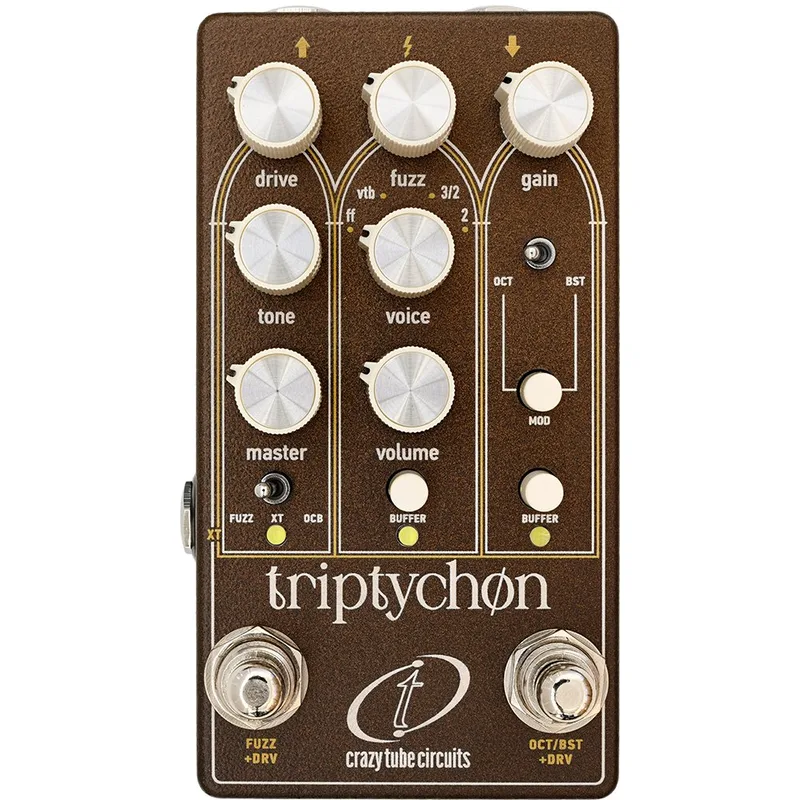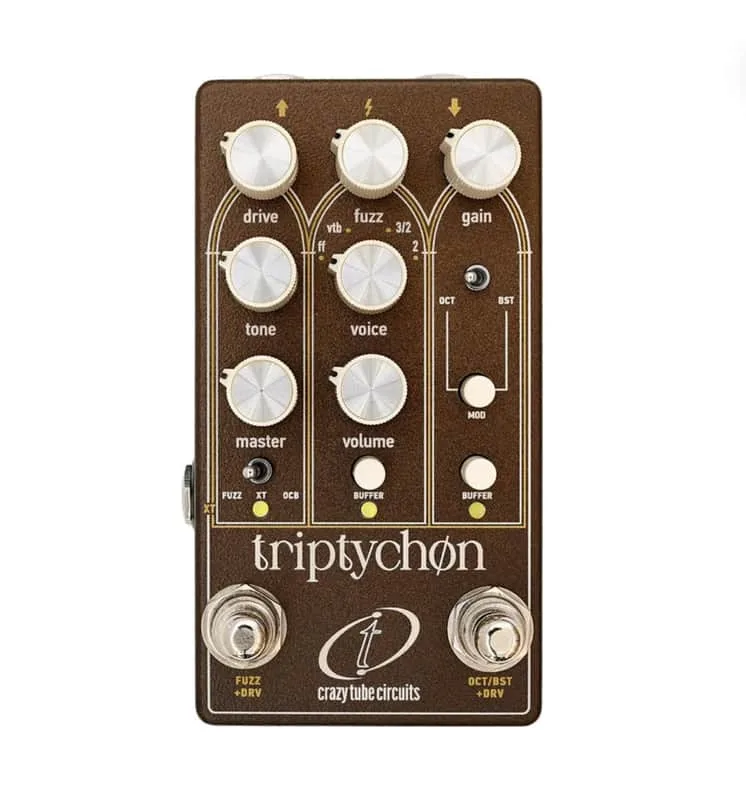


The Crazy Tube Circuits Triptychøn is a gain pedal that puts three stages in one box: an overdrive, a fuzz and a boost. On That Pedal Show, Dan and Mick looked at it in May 2026 as one of four gain pedals, introducing it as part of a lineup of "four really interesting overdrive pedals"1. The pedal's three sections can each be heard on their own: the show demonstrated the amp section, the fuzz section and the boost section separately2.
The three sections at a glance
| Section | What it does | What the show found |
|---|---|---|
| Overdrive (amp section) | Recreates the sound and feel of a driven tube amp, including the way a cranked amp limits and compresses1 | Built in what Dan called "loads and loads of output"1 |
| Fuzz | Two Fuzz Face types and two Tone Bender types1 | Tone Bender 2, 1.5 and Fuzz Face modes have tons of bottom end; the Vox Tone Bender carves that low end out1 |
| Boost | Two types of treble booster or two types of octave1 | Mick found the second octave option "too much"1 |
The overdrive section
The overdrive section, on the left of the pedal as you look down from pedal cam, is designed to recreate the sound and feel of a driven tube amp, including the way a cranked amp limits and compresses1. Crazy Tube Circuits built in what Dan called "loads and loads of output"1.
The fuzz section
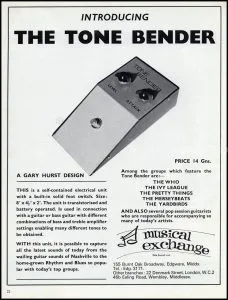
The fuzz section is the heart of the pedal. It offers "really two fuzz faces and two tone benders"1, covering:
- Fuzz Face types, two of them
- Tone Bender 1.5
- MK2 Tone Bender
- Vox Tone Bender
On the show, the reviewers found that the Tone Bender 2, the 1.5 and the Fuzz Face modes all have tons of bottom end, while the Vox Tone Bender carves that low end out1. In Fuzz Face mode, the guitar volume knob behaves as fuzz players expect: Dan turned the guitar volume down and it cleaned up beautifully1.
The boost section
The boost section can be set to two types of treble booster or two types of octave1. The switch on the right of the pedal switches the octave on and off or the treble booster1. Mick's verdict on the second octave option was critical:
"for me the second octa option was too much. it was started to gate or something on the on the bass"
Switching and the anti-buffer
An optional extra switch lets you turn the amp section on and off. Without it, the master overdrive section is always active1.
If you plan to place a buffered bypass pedal or a guitar with active pickups before the Triptychøn, the anti-buffer switch is made for that situation. It simulates the impedance and response of a passive guitar pickup1.
What reviewers said
That Pedal Show's overall verdict was positive:
"It's a very very cool pedal"
The Triptychøn was introduced at 7:41 in the episode, with each of its three sections demoed separately afterwards2. In the video, Dan and Mick run through the amp section, the fuzz voicings and the boost and octave options in turn, and close with the verdict quoted above.
Videos
TheGuitarGeek
Questions
What fuzz types are in the Crazy Tube Circuits Triptychøn?
The fuzz section carries two Fuzz Face types and two Tone Bender types. On That Pedal Show, Dan and Mick identified the Tone Bender options as the Tone Bender 1.5, the MK2 Tone Bender and the Vox Tone Bender. They noted that the Tone Bender 2, the 1.5 and the Fuzz Face modes all have tons of bottom end, while the Vox Tone Bender carves that low end out.
Does the Triptychøn have an octave?
Yes. The boost section can be set to two types of treble booster or two types of octave, and the switch on the right of the pedal switches the octave on and off or the treble booster. On That Pedal Show, Mick found the second octave option was too much for him, saying it started to gate on the bass.
What is the anti-buffer switch for?
The anti-buffer is a switch that simulates the impedance and response of a passive guitar pickup. Crazy Tube Circuits designed it for situations where a buffered bypass pedal or a guitar with active pickups sits before the Triptychøn, since either can change how the pedal's fuzz and gain stages respond.
Can the amp section be switched on and off?
Only with the optional extra switch. Without that switch fitted, the master overdrive section is always active. With it, you can switch the amp section on and off independently, which the show demonstrated alongside the fuzz and boost sections.
Does the Triptychøn include a Tone Bender?
Yes. The fuzz section includes Tone Bender types alongside the Fuzz Face types, specifically the Tone Bender 1.5, the MK2 Tone Bender and the Vox Tone Bender, giving four fuzz voicings in total.
Does the guitar volume knob clean up the fuzz?
On That Pedal Show, Dan turned the guitar volume down in Fuzz Face mode and it cleaned up beautifully, which he described as expected from a Fuzz Face. Players who rely on volume-knob cleanup with fuzz should find that behavior preserved here.
Sources (2)
- Four Fantastic Gain Pedals Empress Drive, CTC Triptychøn, Mad Prof Simble 2, EAE Citadel, That Pedal Show (YouTube), 2026-05-08
- Four Fantastic Gain Pedals Empress Drive, CTC Triptychøn, Mad Prof Simble 2, EAE Citadel, That Pedal Show, 2026-05-08