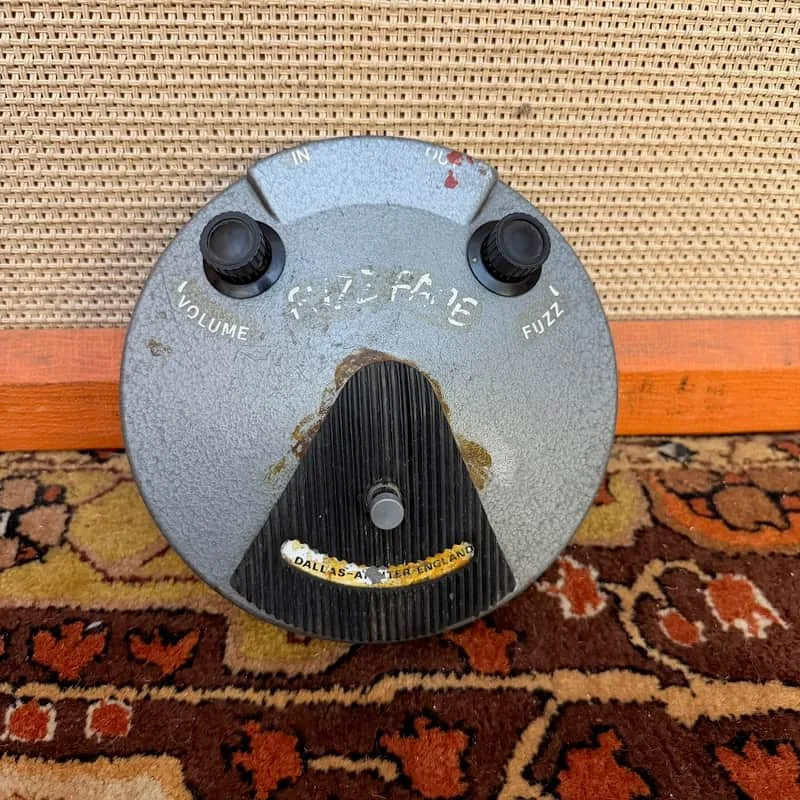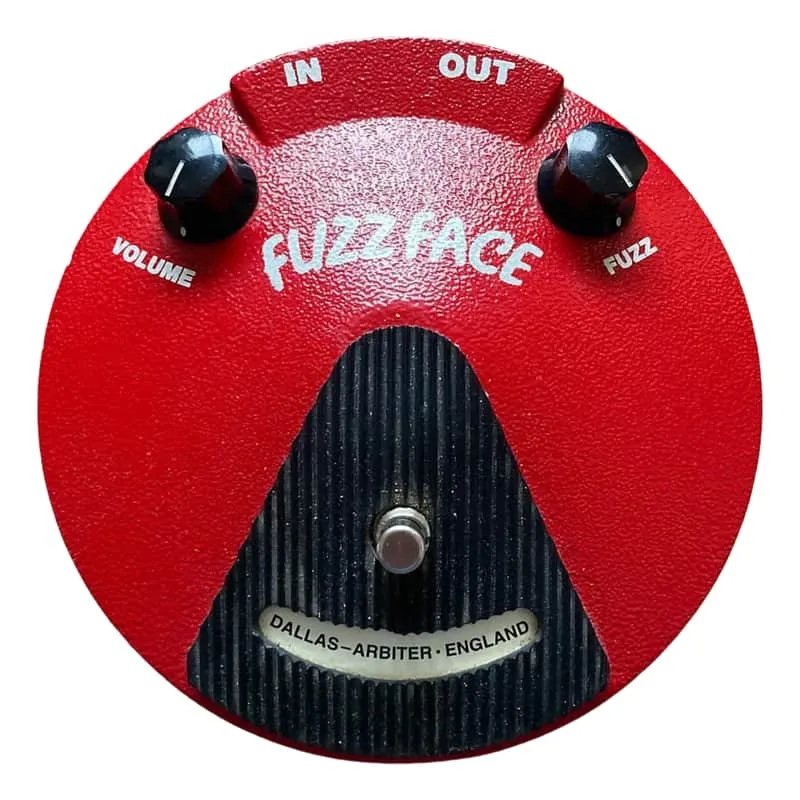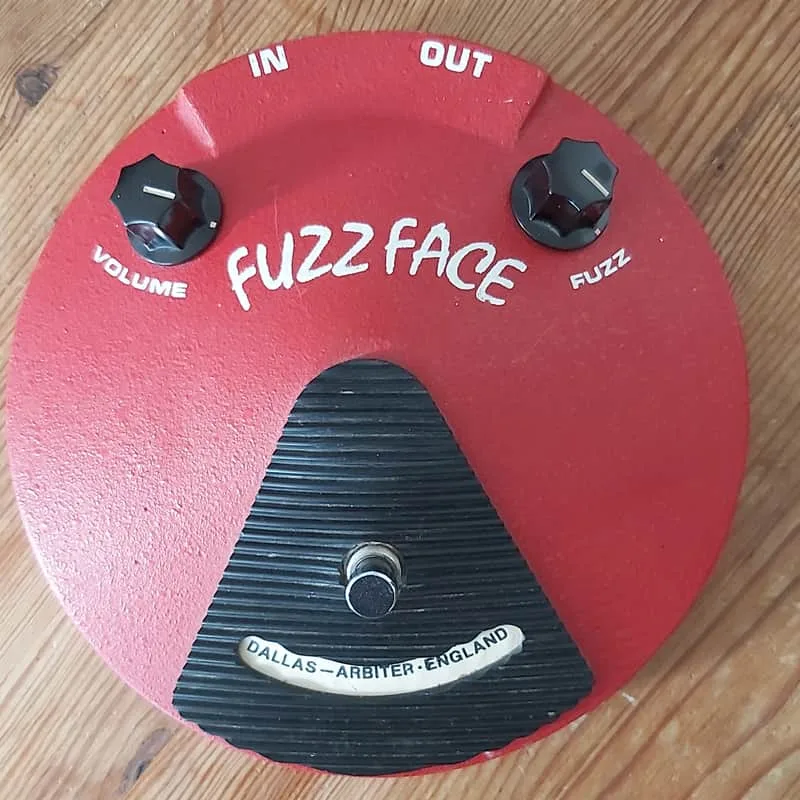


The Crest Audio Fuzz Face reissue is a fuzz pedal produced from mid-1986, reviving the round, face-shaped Dallas Arbiter Fuzz Face of the 1960s in an aluminum casting. It was designed by Dave Fox, who was working for the company that had manufactured Fuzz Faces in the mid-to-late 1960s, and it put the classic circuit back into production for the first time in a decade1.
Unlike the earliest germanium Fuzz Faces, the Crest Audio reissue is a silicon pedal. Fox built both PNP germanium and NPN silicon prototypes before committing to a design, and the silicon version won. The production units use BC109C transistors, bought in quantity, graded by gain and matched in pairs12.
A silicon Fuzz Face with BC109C transistors
The circuit follows the NPN silicon version of the Fuzz Face rather than the PNP germanium original. Fox's account of the development explains why. He built PNP germanium prototypes first and could not get them to sound good: in his words, "They sounded dull and lacked sustain"2. The NPN silicon prototypes were a different story, as he described on Foxrox Electronics' history of the reissue:
"I built up some NPN silicon prototypes and found that they were kind of noisy and very bright. But they had stustain and fire to their sound."1
He also reasoned that customers would probably be disappointed with the weaker tone of the PNP germanium approach, so the NPN version became the design2. The production run used BC109C transistors, the same type found in the 1976 Dallas Arbiter reissue that Fox had examined at Crest Audio, a blue unit about a half inch taller than the original 1960s Fuzz Faces1.
One practical detail came from the circuit's high gain: the units oscillated until shielded wires were fitted inside to prevent it12.
History and versions
The story begins with Fox working at Crest Audio, the company that had manufactured Fuzz Faces in the mid-to-late 1960s. While there he checked out a blue Fuzz Face that turned out to be a 1976 reissue, the NPN silicon version with BC109C transistors, and that discovery set the reissue project in motion1.
In mid-1986 word spread that Fuzz Faces would be made again. Fox initially figured they would make 100 of them and see how it went21. Production ran longer than that: during Crest's Fuzz Face production period, they made probably around 2000 of them, a figure Fox himself calls only a guess12. Ivor Arbiter took large numbers of them and sold them in the UK1.
Production ended when an agreement was reached that Dunlop would manufacture Fuzz Faces with permission from John Lee1. Dunlop bought the Arbiter Fuzz Face name in 1993 and has offered several versions since, with modern reliability3, releasing both germanium and silicon transistor versions to cater to different preferences4. That later history is covered on the Arbiter Fuzz Face Reissue page.
Colors and rare editions
The reissue went through several color runs during its production life, and the colors are the main way collectors tell the batches apart21.
| Run | Color |
|---|---|
| Entire first run | Gray12 |
| Later batches | A couple of batches each of blue, red and gray12 |
| Color trials | Two yellow units and one green unit12 |
The yellow and green units are the rare ones. As Fox puts it21:
"There were only two yellow ones and one green one. They are now part of my personal collection."2
There were also some slight variations in the style of the aluminum casting across the production period, so enclosures are not all identical12.
Videos
jrsrareguitars
average.punter
Kevin Bryant
Questions
How many Crest Audio Fuzz Faces were made?
Dave Fox, who designed the reissue, estimates probably around 2000 units were made during Crest's production period, though he calls it only a guess. The initial plan was much smaller: he figured they would make 100 of them and see how it went. Ivor Arbiter took large numbers and sold them in the UK.
Is the Crest Audio Fuzz Face germanium or silicon?
It is silicon. Fox built both PNP germanium and NPN silicon prototypes, found the germanium versions sounded dull and lacked sustain, and chose the NPN silicon circuit with BC109C transistors, which he described as noisy and very bright but with sustain and fire to their sound.
Why did Crest Audio stop making the Fuzz Face?
Production ended when an agreement was reached that Dunlop would manufacture Fuzz Faces with permission from John Lee. Dunlop bought the Arbiter Fuzz Face name in 1993 and has offered several versions since, in both germanium and silicon transistor forms.
How can you tell a Crest Audio Fuzz Face from a Dunlop one?
The Crest Audio units are the 1980s reissues in the round aluminum casting, made from mid-1986 in gray, blue and red, with BC109C silicon transistors and shielded internal wiring. Dunlop's versions date from 1993 onward, after it bought the name, and carry Dunlop branding.
Sources (4)
- Fuzz Face Reissue Story, Foxrox Electronics, 2014-09-12
- Analog Man Fuzz Face Story, analogman.com, 2015
- Arbiter Fuzz Face, Vintage Guitar magazine, 2016-01-14
- The guitar pedal that changed the world the Fuzz Face, Tru-Fi (tru-fi.com)