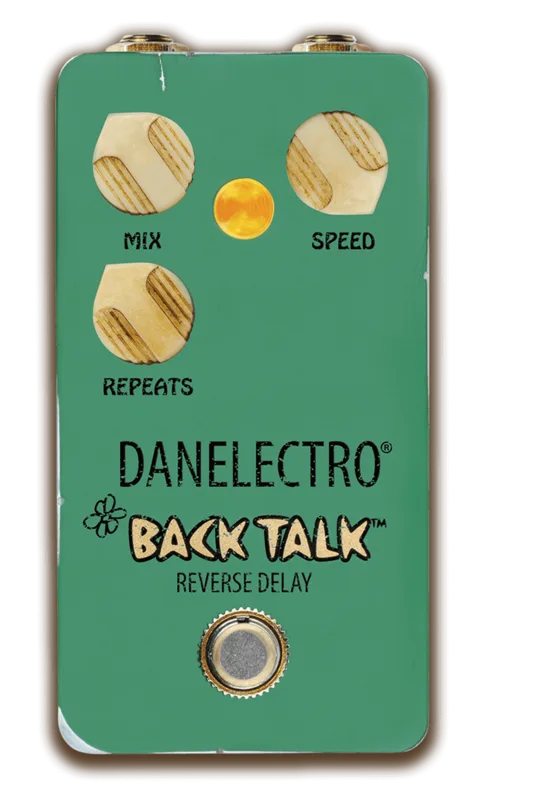


The Danelectro Back Talk is a reverse delay pedal: instead of echoing your notes forward, it records the phrase you just played and plays it back backwards. As Danelectro puts it, "It literally flips the phrase you just played and plays it backwards"1. The effect is a pure digital backward delay, capable of everything from a subtle delay to what circuit analysts at GuitarPCB describe as "psychedelic oscillating noisy sounds"2.
Danelectro invented the Back Talk in 19991, and the original run was brief. The pedal went on to cult status, with original units fetching high prices on the used market, and in 2020 Danelectro reissued it in its Vintage Pedals lineup using the same internal circuit and chip as the original, built with all NOS (new old stock) parts34. The reissue retails for $1995.
What a reverse delay does
A conventional delay pedal repeats your notes after you play them, in the order you played them. The Back Talk samples what you play and reverses it, so bends fall instead of rise, picked phrases un-pick themselves, and the decay of each note comes before its attack. Danelectro credits the pedal's character to its "warm violin-like, organ-like tone"1.
GuitarPCB's technical analysis calls it "a cost-effective pure digital backward delay, suitable for creative possibilities, going from subtle delay to psychedelic oscillating noisy sounds"2. The circuit is built around an 8-bit Atmel AT1200S microcontroller that manages few peripherals, housed in a sturdy die-cast enclosure and running on 9V2.
The controls
The Back Talk keeps the original's three-knob layout. Gearnews noted at the 2020 announcement that "The controls are labelled Mix, Speed and Repeats, just like the original"84.
| Control | What it does |
|---|---|
| Mix | Blends the dry signal with the reversed wet signal, from your clean input to the full effect2 |
| Speed | Sets the sample delay window, in other words how long the signal is delayed and how long each reversed sample lasts2 |
| Repeats | Sets how many times the sampled delayed signal repeats over the original, from one repeat to infinite27 |
Pedal of the Day found that "The Mix, Speed and Repeats controls are easy to use, but hold a TON of options and eons of exploration inside"6. Connections are a standard input and standard output, with top-mounted jacks on the reissue74.
The reissue runs on mains power only: there is no battery option, so it needs a 9V power supply from the start3.
History and versions
Danelectro states it invented the Back Talk reverse delay in 19991. Guitar.com describes it as "Introduced in 1999 for what seemed like only a moment," part of a trio of 1960s-inspired effects3. GuitarPCB's analysis places the pedal in Danelectro's Miscellaneous Series Effects released in 20012. The original run was short, and the pedal was discontinued, but it never lost its following. Guitar.com noted in 2018 that "the long discontinued Back Talk reverse delay being a case in point) have become classics, commanding high prices on the second-hand market"9.
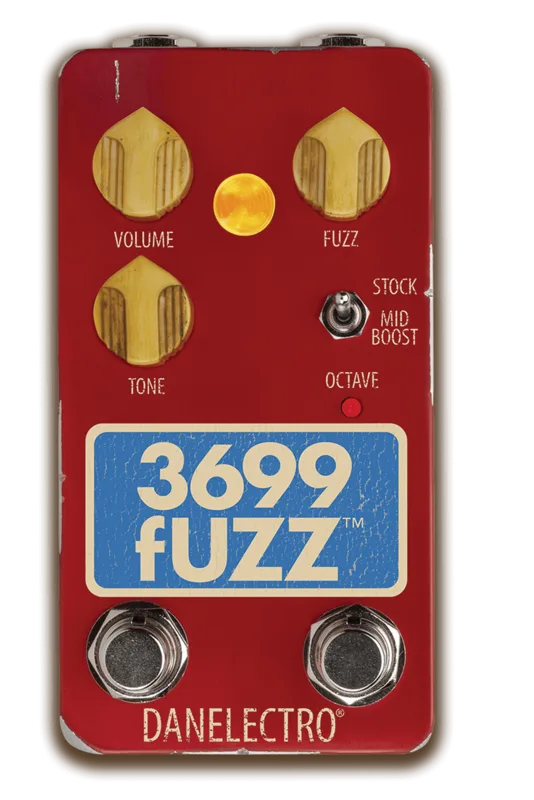
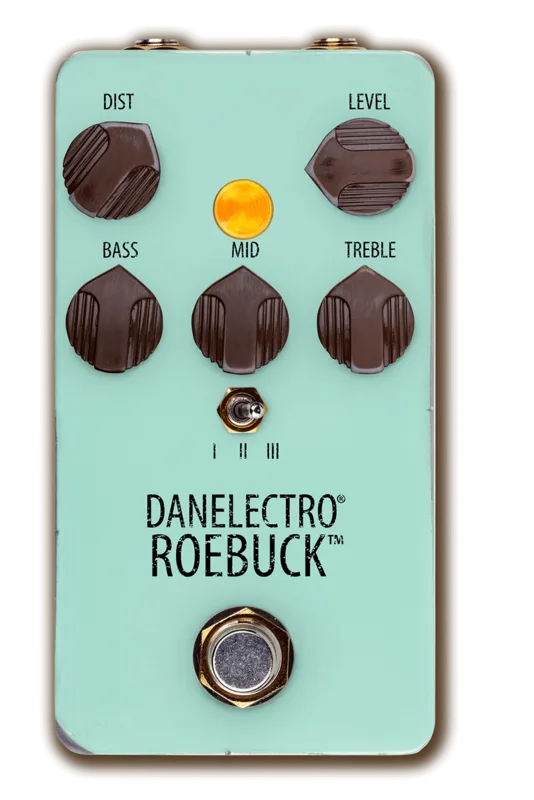
At NAMM 2020, Danelectro announced the Back Talk reverse delay pedal alongside the 3699 Fuzz and the Roebuck distortion5. The Back Talk was first invented by Danelectro in 19991, and the new version keeps the standard input and standard output connections of the original17.
Guitar World's Trevor Curwen reviewed the reissue and summed it up as "Fun, old-school setup and tones"7. In Delicious Audio's Best Guitar Pedals of 2020 roundup, the Back Talk placed 11th with 2 points.
Original versus reissue
For a player weighing the two versions, the differences are mostly practical:
- Circuit: The reissue uses the same internal circuit and chip as the original, with all NOS parts34.
- Enclosure: The reissue moves to a conventional rectangular die-cast enclosure with top-mounted jacks; the original used the 1990s housing52.
- Price: Original 1999 pedals fetch upwards of $500 used36; the reissue retails for $1995.
- Availability: The original is long discontinued and commands high second-hand prices9; the reissue is a current production pedal.
Guitar.com's Michael Watts called the original "a flawed classic which, despite its glorious reverse delay sound, remains a less than practical choice for most players' boards," a practicality gap the reissue's standard enclosure and jacks address3.
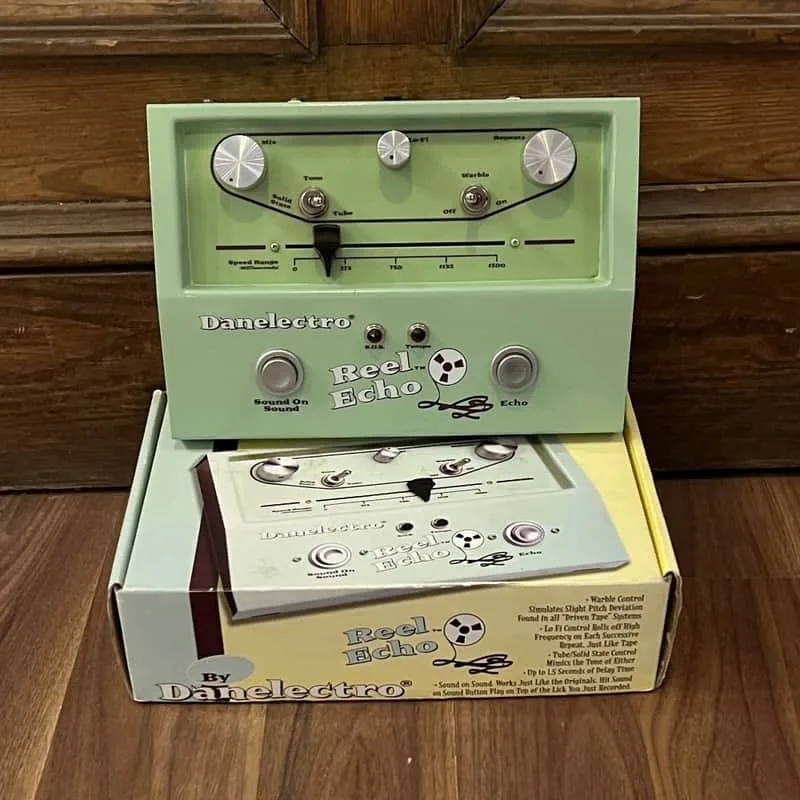
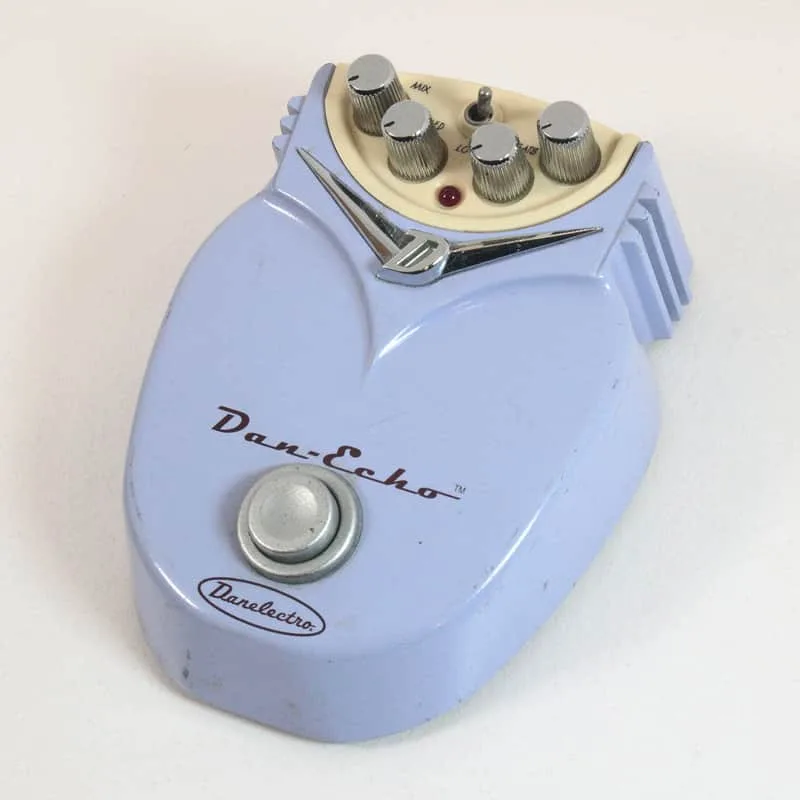
Players interested in Danelectro's other takes on delay can compare the Danelectro Wasabi Forward-Reverse Delay, which offered both forward and reverse modes, or the Danelectro Reel Echo Tape Delay and the Danelectro DE-1 Dan-Echo for conventional echoes.
Videos
AndyDemos
R.J. Ronquillo
Brett Kingman
Questions
Is the Danelectro Back Talk true bypass?
Yes. The reissue uses true bypass switching, and inside the pedal an HC4066 analog switch, commanded by the microcontroller, lets the input signal skip all digital signal processing and pass straight to the output when the pedal is off. Guitar World and Guitar.com both list true bypass among its features.
Why are original Danelectro Back Talk pedals so expensive?
The original 1999 pedal was only made for a short time, and Danelectro itself says it has achieved cult status and that originals cost a small fortune. Pedal of the Day reported in 2020 that original 1999 units fetch upwards of $500 on the used market, well above the reissue's $199 price.
What is the difference between the original and reissue Back Talk?
The 2020 reissue uses the same internal circuit and chip as the 1990s original, built with all NOS (new old stock) parts, but it comes in a more conventionally shaped rectangular enclosure with top-mounted jacks instead of the original's housing. The controls, Mix, Speed and Repeats, are the same as the original's.
Where is the Danelectro Back Talk reissue made?
Guitar World lists China as the origin of the Back Talk Reverse Delay reissue. The same review covers the pedal's build and features, and Guitar.com's 2020 review of the reissue pair also notes both pedals are made in China.
How much does the Danelectro Back Talk reissue cost?
The reissue retails for $199, a price Guitar.com reported at the January 2020 announcement and that Guitar World's review also lists, alongside £189 in the UK. That is notably higher than Danelectro's previous budget pedal lines.
Sources (9)
- Back Talk™ & Roebuck™, Danelectro
- Back Talk Reverse Delay Analysis, GuitarPCB
- Review: Danelectro Back Talk Reverse Delay & 3699 Fuzz, Guitar.com, 2020-07-07
- NAMM 2020: Danelectro 3699 fUZZ, a fOXX Tone Machine clone and more, gearnews.com, 2020-01-05
- NAMM 2020: Danelectro unveils a trio of boutique-y, throwback pedals, Guitar.com, 2020-01-07
- Danelectro Back Talk™ Reverse Delay, Pedal of the Day, 2020-08-20
- Danelectro Back Talk Reverse Delay review, Guitar World, 2020-09-21
- NAMM 2020: Danelectro unveils boutique-styled 3699 Fuzz, Back Talk Reverse Delay and Roebuck Distortion, Guitar World, 2020-01-06
- Danelectro Billionaire Pedals, Guitar.com, 2018-03-21