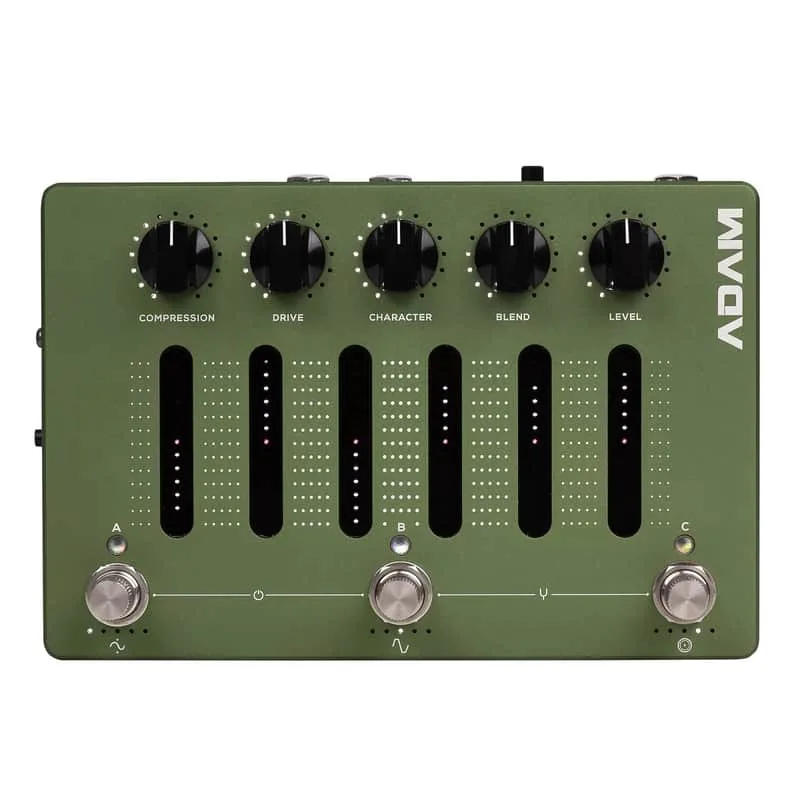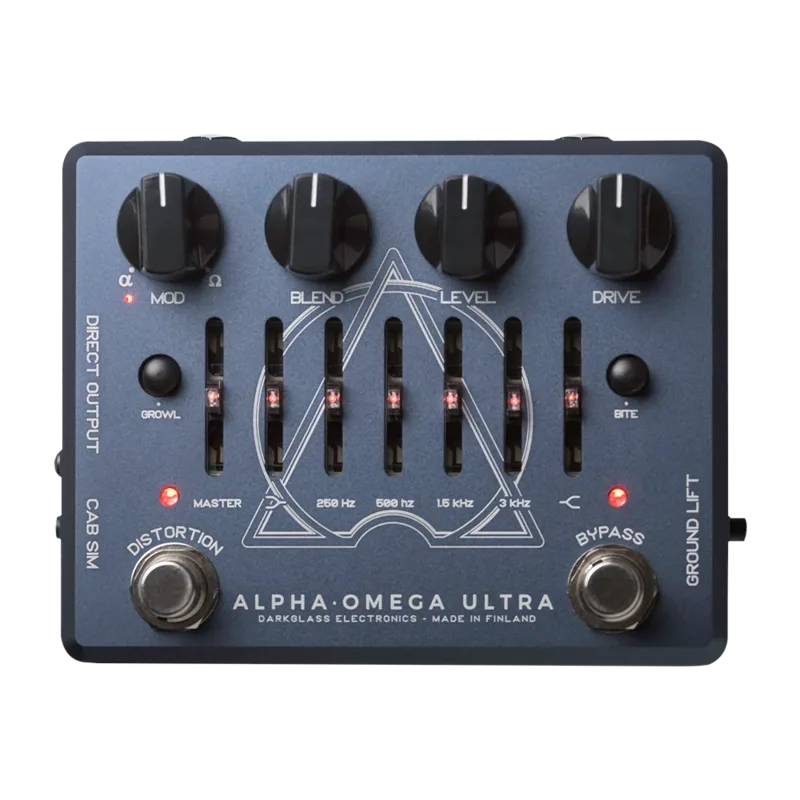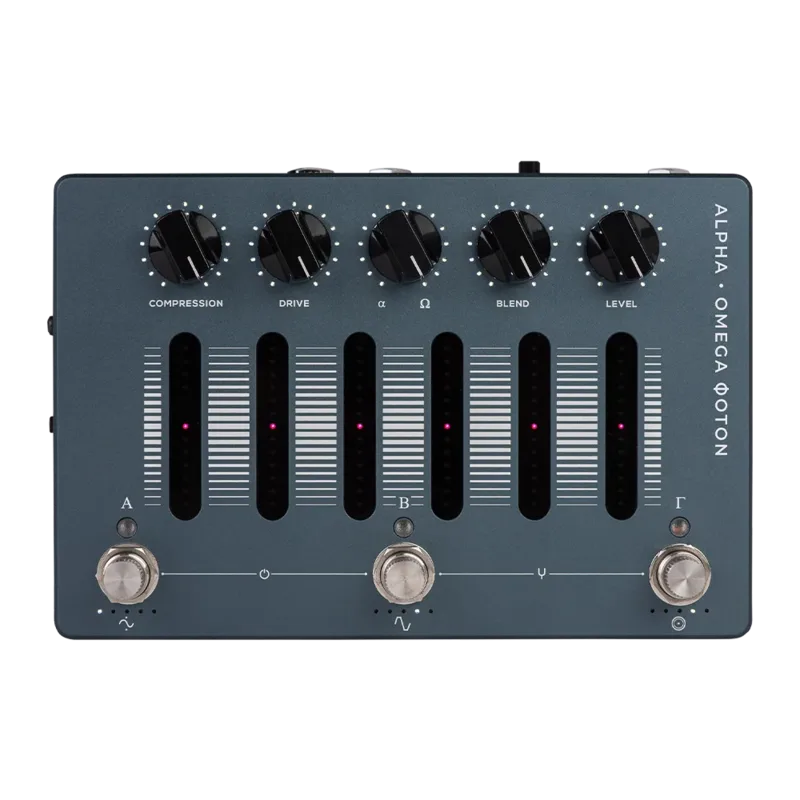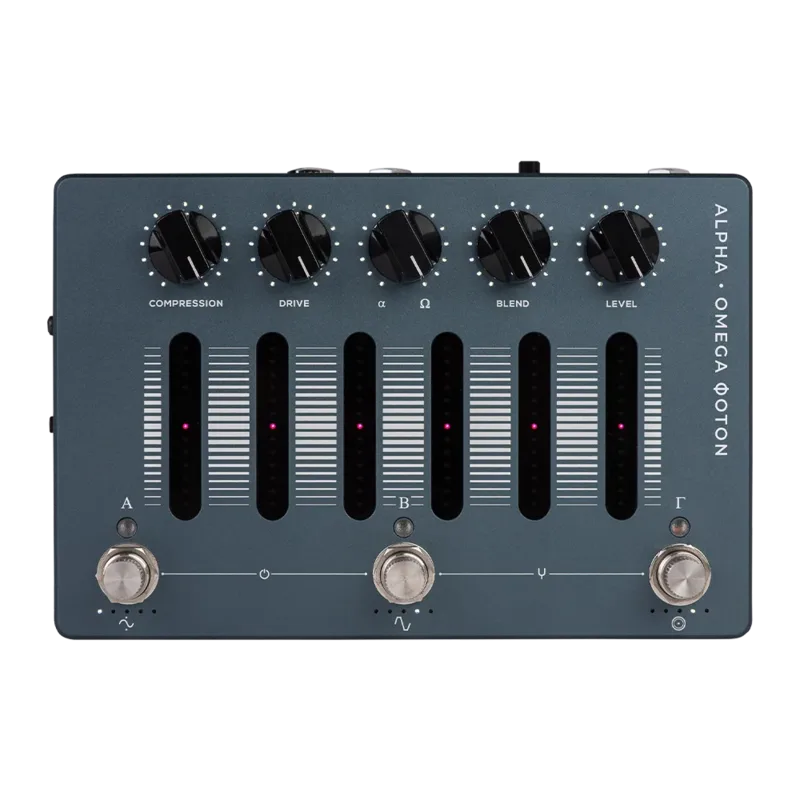


The Darkglass Alpha·Omega Photon is a bass preamp and multi-effects pedal with a built-in USB audio interface, made by Darkglass. At its core is a digital model of the company's Alpha·Omega parallel distortion circuit, developed in collaboration with bassist Jon Stockman, wrapped together with a compressor, a 6-band graphic EQ, IR cabinet simulation, Bluetooth and a headphone output. Darkglass describes it as combining the Alpha·Omega parallel distortion with the versatile format of its Aggressively Distorting Advanced Machine1.
As of late October 2026 the Photon is listed as sold out on Darkglass's own product page1, as are the earlier Alpha·Omega and Alpha·Omega Ultra pedals in the range.
The distortion: Alpha, Omega, Growl and Bite
The Photon's distortion section is an accurate model of the Alpha·Omega distortion, developed in collaboration with Jon Stockman, offering two distinct distortions that can be blended2. In Darkglass's own description of the two circuits, "Alpha is punchy, tight with a lot of definition, whereas Omega is simply brutal and raw"3.
The familiar Growl and Bite boost functions carry over from the original pedal for adding more low end and/or high end sparkle2. On the original Alpha·Omega, the Bite control boosts high mids at 2.8 kHz for additional presence and definition4. The Photon selects its character through encoder B, which offers five distortion modes21:
| Mode | Character |
|---|---|
| Alpha·Omega | The base parallel distortion |
| Alpha·Omega with GROWL | Adds the low-end boost |
| Alpha·Omega with BITE | Adds the high-mid boost |
| Alpha·Omega with GROWL and BITE | Both boosts engaged |
| Alpha·Omega Studio Rig with GROWL and BITE | The full Studio Rig voicing with both boosts |
The original Alpha·Omega pedal, co-designed with Stockman, put the two circuits on a Mod knob that could select or blend them5. Guitar.com reported at the time that the pedal was co-developed with Jon Stockman from Australian rock band Karnivool6.
Compressor and 6-band graphic EQ
Before the distortion, the Photon has a compressor with a single Compression potentiometer. Darkglass says it controls the amount of input gain to the compressor and intelligently applies the correct amount of make-up gain, keeping the output at usable levels3. Five ratios are available: 4:1, 8:1, 12:1, 20:1 and ALL IN2.
The EQ is a 6-band graphic equalizer controlled by touch-sensitive sliders, each with a -12 dB to 12 dB range32. The default band frequencies are2:
- Low shelf
- 250 Hz
- 500 Hz
- 1.5 kHz
- 3 kHz
- High shelf
Those bands can be changed to 100 Hz, 200 Hz, 400 Hz, 800 Hz, 1.6 kHz and 3.2 kHz in the Darkglass Suite2.
Presets, footswitches, tuner and bypass
Below the touch sliders are three rotary footswitch encoders, A, B and C, which can be pressed or rotated. Pressing one switches to the preset stored in that footswitch2. The pedal comes pre-programmed with three presets, A, B and C, selectable via the dedicated footswitches, and three additional presets are available via MIDI or the Darkglass Suite2.
The built-in tuner is a five-octave chromatic tuner that can tune any note between A0 and A#5, derived from A4 = 440 Hz, one note at a time. You enter and exit tuner mode by pressing footswitches B and C simultaneously, and the pedal outputs no audio while tuning, returning to the last active preset when you exit3.
Bypass mode is also a footswitch combination: pressing A and B simultaneously passes the unprocessed input signal through to the outputs with no processing, with all LEDs off3.
Power and connections
The Photon runs on a regulated 9V DC adapter with a center-negative plug only. Darkglass warns that unregulated supplies or higher voltages may damage the unit and void the warranty1. The manual specifies a 9V center negative supply with a minimum 500 mA rating, and lists current consumption at ~500mA2.
At ~500mA2, the Photon draws far more current than the original Alpha·Omega (~30mA4) and cannot share a typical low-current daisy chain. It needs its own 500 mA output on a power supply, and there is no battery option.
The full connection set2:
| Connection | Details |
|---|---|
| Instrument input | 1/4" mono, 1 MΩ input impedance |
| Aux In | 1/8" stereo jack for backing tracks from a phone or laptop |
| MIDI In | 1/8" TRS (Type B) for an external MIDI controller; USB MIDI also supported |
| Balanced outputs | Two 1/4" TRS, 220 Ω output impedance; use a mono plug for unbalanced inputs |
| Direct Output | XLR with ground lift switch, for a mixing desk or external interface |
| Headphones | 1/8" stereo jack with dedicated level pot, handles 16 to 600 ohms |
| USB-C | Audio interface, Darkglass Suite, software updates, IR library |
When not bypassed, the Level potentiometer controls the instrument volume at all four analog outputs and has no effect on USB, Aux or Bluetooth audio. The XLR DI carries only the instrument output, along with USB output 53.
USB audio interface and recording
The USB-C port turns the Photon into a USB audio interface, and also handles Darkglass Suite interaction, software updates and access to the Darkglass IR library. It supports 48 kHz and 44.1 kHz sampling rates2. On a Mac, no additional drivers are required; Windows users need to download the latest USB audio drivers from the Darkglass Suite page32.
You can record your processed signal to one track and simultaneously record an unprocessed copy to another track, and a stereo track from the Aux input is also possible2. The USB routing is fixed2:
| USB channel | Signal |
|---|---|
| Input 1 | Processed signal |
| Input 2 | Unprocessed raw signal |
| Input 3 | Aux left + Bluetooth left |
| Input 4 | Aux right + Bluetooth right |
| Output 1 | Balanced left + Headphone left |
| Output 2 | Balanced right + Headphone right |
| Output 3 | Balanced left |
| Output 4 | Balanced right |
| Output 5 | XLR DI (mono) |
The pedal also has Bluetooth: you pair by pressing and holding an encoder while rotating it, the device appears as "Alpha·Omega Photon", and Bluetooth audio is routed to the headphone and balanced outputs2.
For cabinet simulation, the Photon supports IR cabinet simulations with 5 cabinet slots on board. The default IRs were selected by the Darkglass Team, and new IRs can be assigned via the Darkglass Suite on desktop or mobile3.
The Alpha·Omega circuit and Jon Stockman
The Alpha·Omega distortion traces back to the original Alpha·Omega pedal, which Darkglass says it developed with Jon Stockman over 18 months of tweaking and tens of prototypes in its then Helsinki headquarters5. Aion FX, which traced the circuit, found it distinct from Darkglass's B3K and not adapted from anything else, with no clipping diodes: the distortion comes entirely from overdriving standard op-amps7. Aion FX also notes that the Alpha Omega was likely designed first, with the Alpha Omicron as a simplified version, and dates the Alpha Omega's first release to 20178.
The Photon is the latest step in the line. The Alpha·Omega Ultra was demoed at NAMM 2018, and Guitar World lists the Alpha Omega Ultra V2 with a 6-band graphic EQ, dual distortion circuits and USB-editable cab sims. The Photon goes further, folding the preamp, compressor, EQ, cab sims, Bluetooth and the USB interface into one unit9102.
Videos
Andertons Music Co
Darkglass Electronics
Nate Navarro
Questions
Does the Alpha·Omega Photon have Bluetooth?
Yes. You pair a device by pressing and holding an encoder while rotating it, and the pedal appears in your device's Bluetooth list as "Alpha·Omega Photon". Bluetooth audio is routed to the headphone and balanced outputs, and it also feeds the USB recording inputs alongside the Aux input.
Can I use the Alpha·Omega Photon with headphones?
Yes. There is a dedicated 1/8" stereo headphone output with its own level potentiometer, and it handles headphones with an impedance of 16 to 600 ohms. You can practice along with backing tracks from the Aux input or from a paired Bluetooth device.
Do I need drivers for the Photon USB interface on Windows?
On a Mac, no additional drivers are required to use the pedal as an audio interface. On Windows, you need to download the latest USB audio drivers from the Darkglass Suite page on the Darkglass website before using it as an interface.
Can I load my own cab IRs into the Photon?
Yes. The pedal has 5 cabinet slots on board, with default IRs selected by the Darkglass Team. New IRs can be assigned to those slots using the Darkglass Suite, which is available as a desktop or mobile app.
How do I control the Alpha·Omega Photon with MIDI?
There is a MIDI In jack on a standard 1/8" TRS (Type B) connector for attaching an external MIDI controller, and USB MIDI is also supported over the USB-C port. MIDI gives access to three additional presets beyond the three on the footswitches.
Is the Darkglass Alpha·Omega Photon discontinued?
No, but as of late October 2026 the Photon is listed as sold out on Darkglass's own product page. The same is true of the earlier Alpha·Omega and Alpha·Omega Ultra pedals in the range, so availability depends on stock at retailers.
Sources (10)
- Alpha·Omega Φoton, Darkglass
- Alpha Omega Photon Manual, Darkglass
- Alpha Omega Photon Manual, Darkglass
- Alpha Omega Manual, Darkglass
- Alpha Omega, Darkglass
- Darkglass Electronics Reveal Alpha Omicron Dual-Voiced Distortion, Guitar.com, 2017-09-04
- Tracing Journal: Darkglass® Alpha Omega & Alpha Omicron, Aion FX, 2025-03-28
- Empyrean Deluxe Distortion / Darkglass® Alpha Omega, Aion FX, 2025-03-28
- Darkglass Alpha Omega Ultra Demo at NAMM 2018 - Premier Guitar, Premier Guitar, 2018-01-30
- Best bass preamp pedals: consistently great tone, anywhere | Guitar World, Guitar World, 2023-05-23