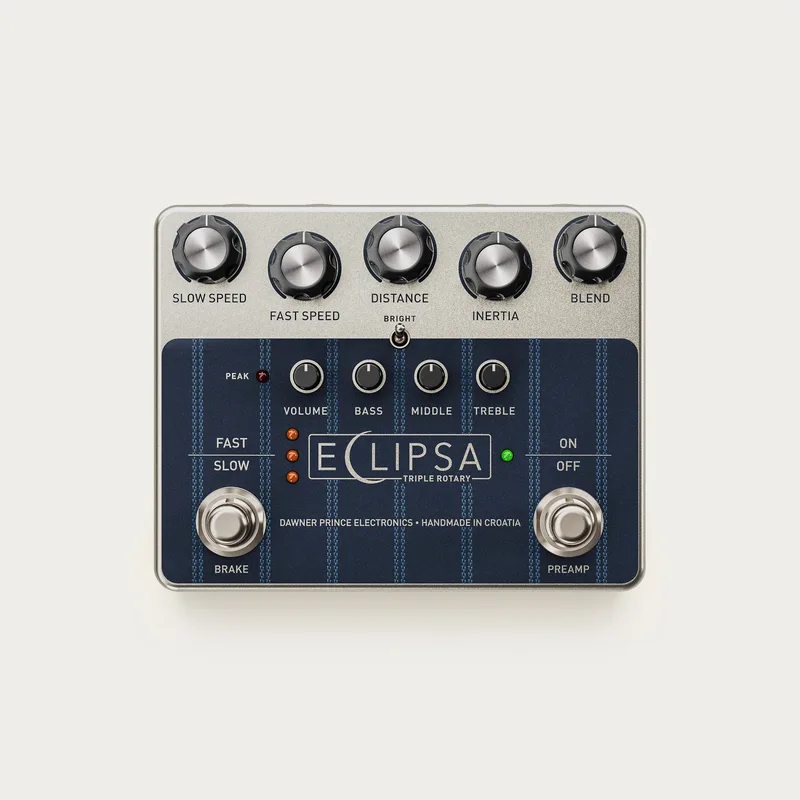


The Dawner Prince Eclipsa, sold as the Eclipsa Triple Rotary, is a rotary cabinet emulator and preamp pedal that recreates the Yamaha RA-200 rotary speaker cabinet, a cabinet known from the late 1970s, and pairs it with an Alembic F-2B-style preamp built with FET technology12. Where most rotary pedals chase the Leslie sound, Dawner Prince went after a different cabinet altogether: Guitar.com's reviewer called it "a tribute to the near-forgotten Yamaha RA-200"2. Premier Guitar describes it as a rotary cabinet emulator inspired by the famous Yamaha RA-200 system, recreated through detailed DSP modeling that captures both the tonal response and the complex movement of the original3.
It is a digital pedal with a lot of performance control: 127 onboard presets plus a Live Mode, full MIDI, stereo outputs derived from three virtual microphones, and an expression input for continuous speed control1. It lists at $589.95 USD1, and as of late October 2026 the maker's product page shows it as Sold Out1.
What it models: the Yamaha RA-200 and Alembic F-2B
Dawner Prince describes the rotary section as "a full rotary cabinet recreation of the iconic Yamaha RA-200"1. Guitar.com's Richard Purvis frames it the same way, noting the pedal recreates the sound of the Yamaha cabs used at the end of the 1970s as well as the Alembic F-2B valve preamp2. The preamp side is an Alembic F-2B-style circuit implemented with FET technology rather than tubes, which is what lets it fit in a pedal and run on 9V1.
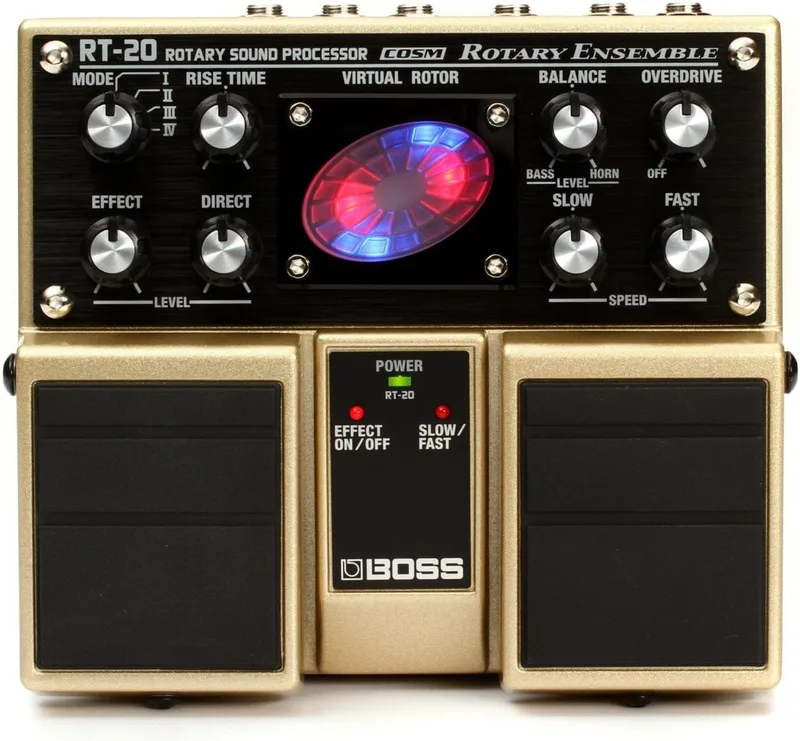
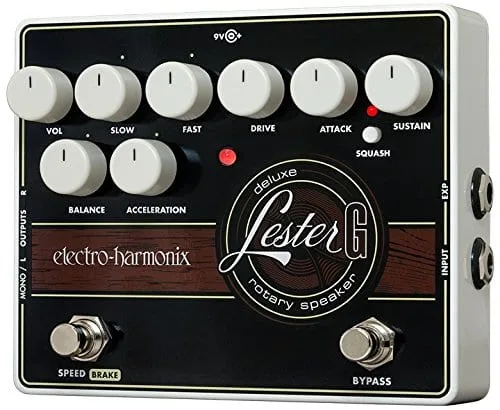
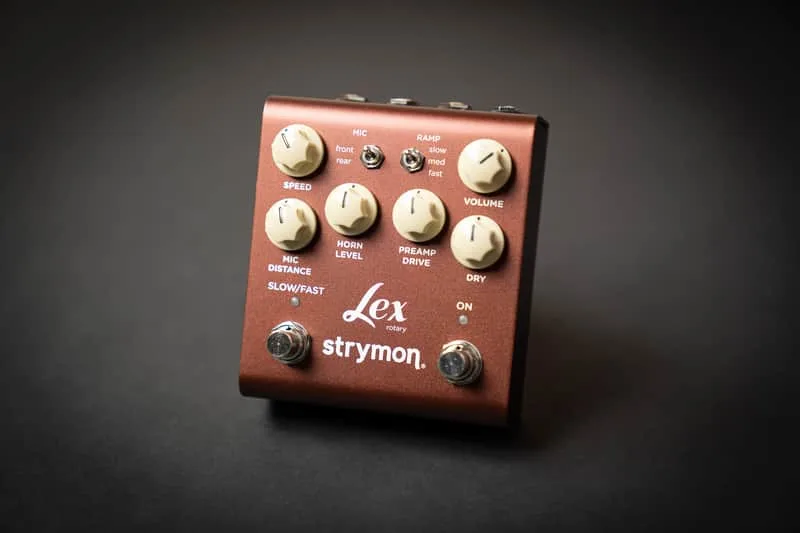
The RA-200 basis matters for players comparing rotary pedals. Guitar.com's reviewer found the Eclipsa delivers "rich rotary tones but with a distinctly non-Leslie voice"2, which is the practical difference between this and Leslie-style emulators like the Boss RT-20 Rotary Ensemble, the Electro-Harmonix Lester G Deluxe or the Strymon Lex. It belongs to the wider family of speaker simulation pedals, but its job is the moving speaker, not a static cab.
The controls and footswitches
The Eclipsa carries two soft-touch footswitches and a set of knobs Dawner Prince lays out around the preamp and the virtual cabinet2.
| Control or switch | What it does |
|---|---|
| Bass | Adjusts low-frequency response with a warm, musical character1 |
| Volume | Sets preamp output level and influences saturation; a Peak LED shows when clipping is approached1 |
| Bright | Adds subtle high-frequency emphasis at lower Volume settings1 |
| Distance | Adjusts the virtual microphone position relative to the rotary cabinet1 |
| Inertia | Sets acceleration and deceleration time between speed transitions1 |
| Instrument / Line switch | Configures the input stage for guitars, high-output pickups, synthesizers and line-level equipment1 |
| True / Buffered Bypass footswitch | ON/OFF with a bi-color LED; hold to switch between True Bypass and buffered Preamp-On modes1 |
| Fast / Slow / Brake footswitch | Tap to switch speeds; hold to engage Brake mode; three LEDs indicate rotor speed and Distance settings1 |
The Inertia control is the ramp-time control: it sets how quickly the virtual rotor accelerates and decelerates between fast and slow, the behavior a real rotary cabinet exhibits when you change speeds1. The Distance control works with the three virtual microphones, changing where they sit relative to the cabinet and therefore how wide and close the effect feels1.
Guitar.com's reviewer found the controls "cleverly laid-out" and praised the preamp as "easily set always-on", meaning the buffered Preamp-On mode lets the F-2B-style front end stay in your chain permanently while the rotary effect comes and goes21.
MIDI, presets and expression control
The Eclipsa has full MIDI implementation: Control Change messages adjust parameters, Program Change recalls presets, and the MIDI channel assignment is configurable1. With 127 onboard presets plus Live Mode, complete performance setups can be stored and recalled1. The rear panel carries MIDI In and MIDI Thru alongside the audio jacks4.
The EXT IN jack takes an expression pedal for continuous rotary speed control1, so instead of toggling between fast and slow you can sweep the speed smoothly with your foot, the way a volume pedal or expression pedal works elsewhere on a board.
Stereo outputs and bypass
Outputs are mono and stereo: Left/Mono and Right, both derived from the three virtual microphone signals1. Premier Guitar likewise describes stereo outputs via three virtual microphones3. Run in mono the pedal sums to a single output; in stereo the virtual mic placement gives the rotary movement its width.
For bypass, holding the footswitch toggles between True Bypass and buffered Preamp-On modes1. Premier Guitar also notes a magnetic, contactless true bypass switching system3.
How it differs from the Dawner Prince Pulse
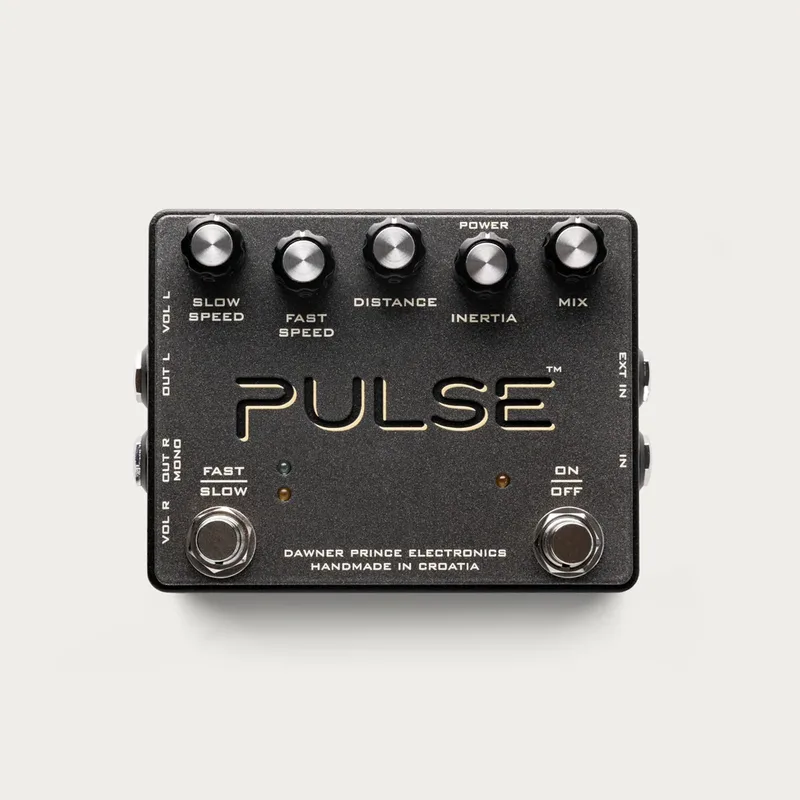
The Eclipsa is the successor to the Dawner Prince Pulse, but it models a different cabinet. The Pulse was based on the Maestro Rover RO-1, an open cabinet revolving speaker inspired by Pink Floyd's Doppola and the Maestro Rover RO-145. The Eclipsa instead emulates the Yamaha RA-200 and adds the F-2B-style preamp, which the Pulse did not have41.
The feature set also grew: the Pulse has stereo input and stereo outputs with an external input for an expression pedal or remote speed switch5, while the Eclipsa adds MIDI, 127 presets and the three-virtual-microphone output architecture1. On Guitar Pedal X, Stefan Karlsson wrote that "there's no question the new unit is more capable and refined" than the Pulse4.
Build, maker and availability
The Eclipsa is made in Croatia, which Guitar.com's reviewer found was "to a reliably sky-high standard of workmanship"2. It sits in a custom CNC-machined, anodized aluminum enclosure that Dawner Prince says provides long-term durability and mechanical stability1. The design comes from Zoran at Dawner Prince, credited by Guitar Pedal X as "another fantastic creation"4.
Premier Guitar reported that the first batch was available exclusively through the Dawner Prince Electronics web store, with broader dealer availability worldwide from late May 20263. As of late October 2026 the maker's page lists the pedal as Sold Out1.
What reviewers said
Guitar.com's Richard Purvis reviewed it at £499/$589.85 and summed it up as rich rotary tones with a distinctly non-Leslie voice, cleverly laid-out controls, an easily set always-on preamp and a beautifully solid build overall2. On practical playing, he found the slow mode sounds better on the bridge pickup with some overdrive, while the fast mode sounds better on the neck pickup for what he called sweet and shimmery wibblage2.
Videos
MustyGuitar
gilmourish
Brett Kingman
Questions
Is the Dawner Prince Eclipsa stereo?
Yes. It offers mono and stereo output configurations, with Left/Mono and Right outputs derived from three virtual microphone signals placed around the modeled rotary cabinet. You can run it mono into a single amp or in stereo for the widest rotary image.
Does the Eclipsa have MIDI?
Yes. It has full MIDI implementation with Control Change for parameter control and Program Change for preset recall, covering 127 onboard presets plus a Live Mode. The MIDI channel assignment is configurable, and the pedal carries MIDI In and MIDI Thru ports.
How is the Eclipsa different from the Dawner Prince Pulse?
The Pulse emulated the Maestro Rover RO-1 revolving speaker, while the Eclipsa is based on the Yamaha RA-200 rotary cabinet and adds an Alembic F-2B-style preamp. The Eclipsa also brings MIDI, 127 presets and stereo outputs from three virtual microphones, and reviewers describe it as more capable and refined than the Pulse.
Can you use an expression pedal with the Eclipsa?
Yes. The EXT IN jack takes an expression pedal for continuous rotary speed control, so you can sweep between fast and slow rotor speeds smoothly instead of switching between them. The same jack is listed as an EXT/EXP TRS input.
Is the Eclipsa true bypass?
It can be. Holding the bypass footswitch toggles between True Bypass mode and a buffered Preamp-On mode, so you can leave the preamp always in the signal path or take the pedal fully out when disengaged.
Where is the Dawner Prince Eclipsa made?
It is made in Croatia. Guitar.com's reviewer found it built to a reliably high standard of workmanship, and it sits in a custom CNC-machined, anodized aluminum enclosure.
Sources (5)
- ECLIPSA Rotary Cabinet Emulator and Preamp, Dawner Prince Electronics
- Dawner Prince Eclipsa review, Guitar.com
- Dawner Prince Electronics Introduces Eclipsa Triple Rotary, Premier Guitar, 2026-05-04
- Guitar Pedal X, Guitar Pedal X, 2026-04-30
- PULSE Revolving Speaker Emulator, Dawner Prince Electronics