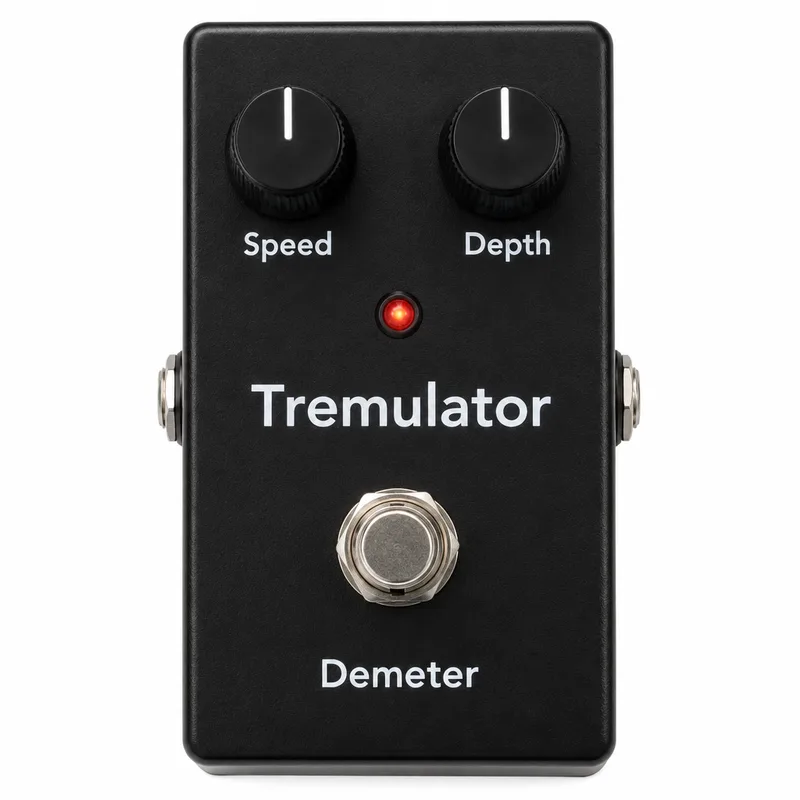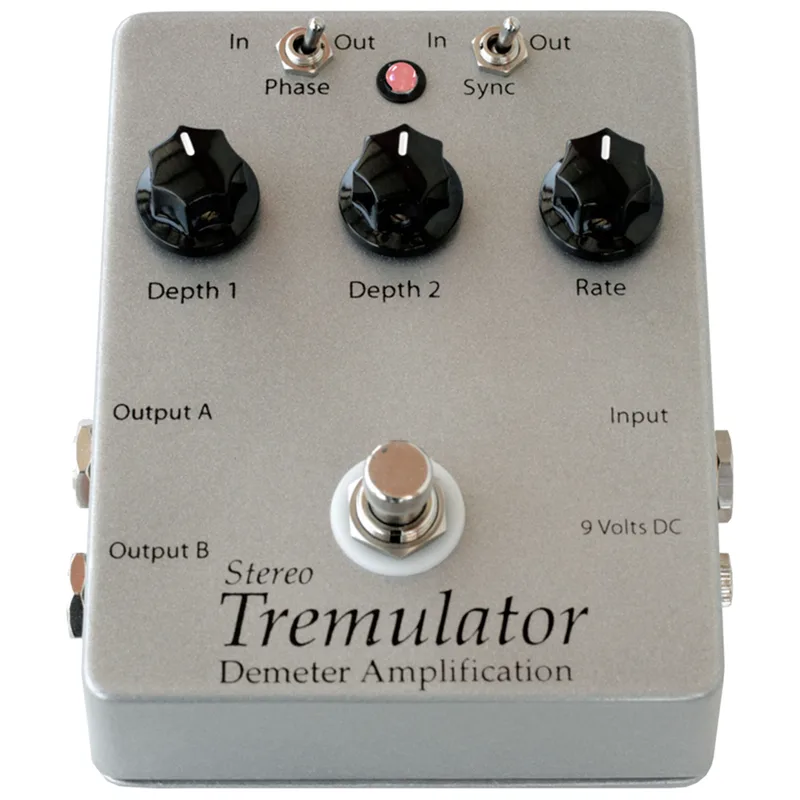
The Demeter STRM-1 Stereo Tremulator is an analog tremolo pedal from Demeter Amplification, designed to emulate the classic Fender tremolo effect, the kind Fender panels labeled "vibrato." It is the same analog tremolo circuit Demeter uses in its Classic mono Tremulator pedal, with added stereo circuitry: one input feeds two outputs, A and B, so a single guitar can drive two amplifiers with the tremolo running in sync or out of sync between them1.
Demeter describes the sound as "lopsided" amplitude modulation with a rounded off triangular modulated waveform, and says that in stereo mode it reproduces the tone of a Magnatone amplifier's tremolo1. Guitar Player's Darrin Fox, reviewing it in March 2008, noted it is preset with a classic triangle wave shape, the same as Ry Cooder's Fender Twin Reverb2.
A Fender-style optical tremolo split across two amps
The STRM-1 exists because of a request made decades before it. James Demeter's first Tremulator pedal was built at the request of Ry Cooder 25 years before Guitar Player's 2008 review of the STRM-1, and that mono pedal was designed to deliver "soft, amp-style tremolo with no volume losses or unwanted coloration"234. The STRM-1 carries that design forward into a stereo pedal, preset with a classic triangle wave shape, the same as Cooder's Fender Twin Reverb2.
The STRM-1 carries that circuit to two amplifiers. Demeter's product page puts it plainly: "Or hook up two amplifiers for the sweeping, pulsing sound of stereo"1. On the left side of the pedal are two 1/4" outputs, A and B, one for each amplifier, with a single 1/4" input and a 1/8" 9V power input on the right side1.
What the stereo circuitry adds is control over how the two outputs relate:
- In sync: both outputs pulse together, the tremolo arriving at both amps at the same time.
- Out of sync: one output's volume goes up as the other goes down, the panning-style effect Demeter associates with a Magnatone amplifier's tremolo1.
The controls: Depth 1, Depth 2, Rate, Phase, Sync and the bias trim
The STRM-1's control panel splits the effect between the two outputs. Rate is shared; each output gets its own Depth. Two switches, Sync and Phase, change how the outputs interact, and a trim pot on the side sets the bias of the optical tremolo units1.
| Control | What it does |
|---|---|
| Rate | Controls the speed of the tremolo for both outputs, raising and lowering the frequency of the low-frequency oscillator1 |
| Depth 1 | Sets the amount of amplitude modulation on output A1 |
| Depth 2 | Sets the amount of amplitude modulation on output B1 |
| Sync | Sets the tremolo in sync or out of sync between outputs A and B; out of sync, one output's volume rises as the other falls1 |
| Phase | Changes the audio phase of output A to in or out of phase1 |
| Trim pot | Sets the bias of the optical tremolo units, affecting the signal's on and off time ratio; high squeezes the signal, low loosens it1 |
The pedal also carries one footswitch to bypass the effect and an LED to indicate effect operation1.
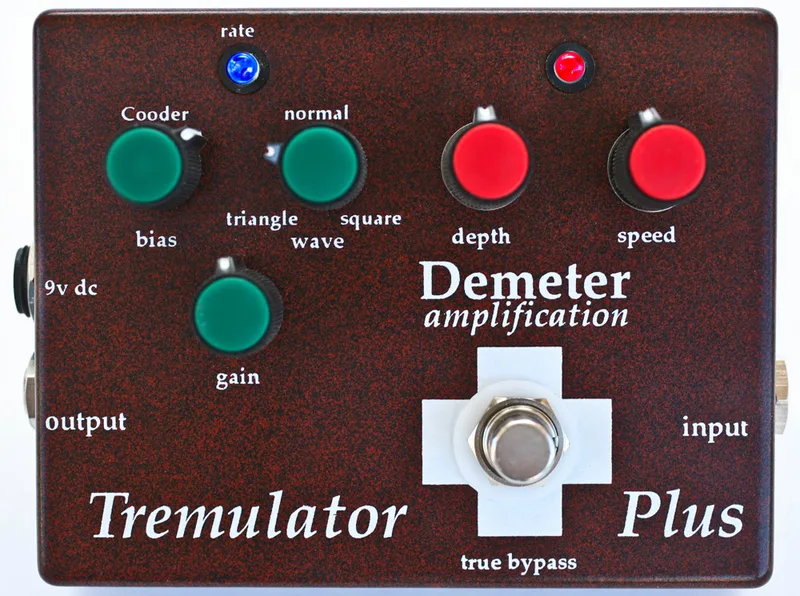
The trim pot on the side of the STRM-1 sets the bias of the optical tremolo units, affecting the signal's on and off time ratio; set high it squeezes the signal, set low it loosens it1. Demeter later moved this adjustment to the top of the pedal as a bias knob on the Tremulator Plus, replacing the trim pot on the original units, where the knob straight up gives what Demeter calls the famous Cooder setting5.
Power and connections
The STRM-1 runs on 9 volts DC, either external or internal1.
- External power: a standard Boss type adapter, 9 volt DC regulated, rated at 100 milliamps or more, through the 1/8" 9V input on the right side1.
- Internal power: a 9-volt battery, accessed by removing the four screws on the bottom of the unit and pulling it apart. Demeter notes the battery must have at least 7 volts for the unit to work1.
The 100 milliamp draw means the STRM-1 is best fed from its own regulated supply rather than a low-current daisy chain, and a battery below 7 volts will stop the pedal from working.
What reviewers said
Published details on the STRM-1 itself trace back through Demeter's own history with the effect. James Demeter's first Tremulator pedal was built at the request of Ry Cooder 25 years before Guitar Player's 2008 review of the STRM-1, and the stereo pedal is preset with a classic triangle wave shape, the same as Cooder's Fender Twin Reverb2. The mono Tremulator that preceded it was designed to deliver "soft, amp-style tremolo with no volume losses or unwanted coloration"4.
Availability
Demeter lists the STRM-1 at $349.00 USD, down from an original price of $369.00 USD13.
Questions
Does the Demeter STRM-1 take a battery?
Yes. It runs on an internal 9-volt battery, which you reach by removing the four screws on the bottom of the unit and pulling it apart. Demeter notes the battery must have at least 7 volts for the pedal to work. It also takes external 9V DC power through a standard Boss type adapter rated at 100 milliamps or more.
Can I use the Demeter STRM-1 with one amp?
Yes. The pedal has one input and two outputs, A and B, but nothing requires you to use both. Run it into a single amplifier and it works as the same analog tremolo circuit as the mono Demeter Tremulator, with Rate, Depth and the bias trim available as usual.
What does the trim pot on the Demeter Tremulator do?
The trim pot sets the bias of the optical tremolo unit, which affects the ratio of the signal's on and off time. Set high, it squeezes the signal; set low, it loosens it. On the original mono Tremulator it is reached through a hole on the side, and the Tremulator Plus replaces it with a bias knob on top.
Is the STRM-1 the same circuit as the mono Demeter Tremulator?
Yes. Demeter describes the STRM-1 as the same analog tremolo circuit found in its Classic mono Tremulator pedal, with added stereo circuitry. Guitar Player's Darrin Fox called it basically the same proven unit, except in stereo, preset with a classic triangle wave shape like Ry Cooder's Fender Twin Reverb.
Is the Demeter STRM-1 analog?
Yes. Demeter states the pedal uses the same analog tremolo circuit as its Classic mono Tremulator pedal, with added stereo circuitry. The effect is an optical tremolo, the style of amplitude modulation associated with classic Fender amplifiers.
Sources (5)
- STRM-1 Stereo Tremulator, Demeter Amplification
- STRM-1 | Guitar Player (March 2008) | Demeter Amplification, Guitar Player, 2008-03
- BEQ-PB Bass EQ Preamp Pedal, Demeter Amplification
- The Best Guitar Effects Pedals of All Time, GuitarPlayer (www.guitarplayer.com), 2021-06-25
- Tremulator Plus, Demeter Amplification