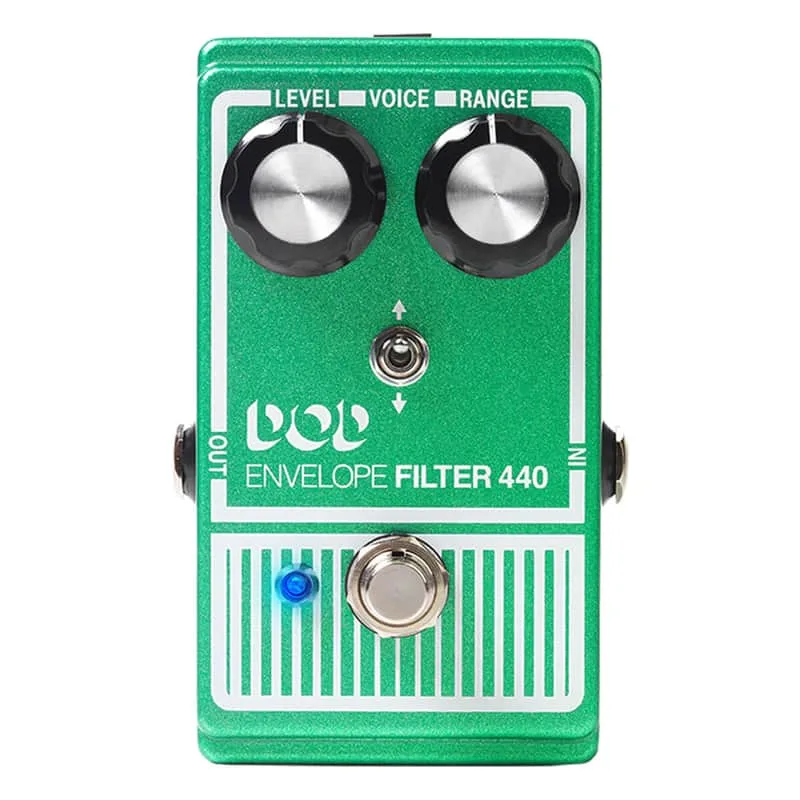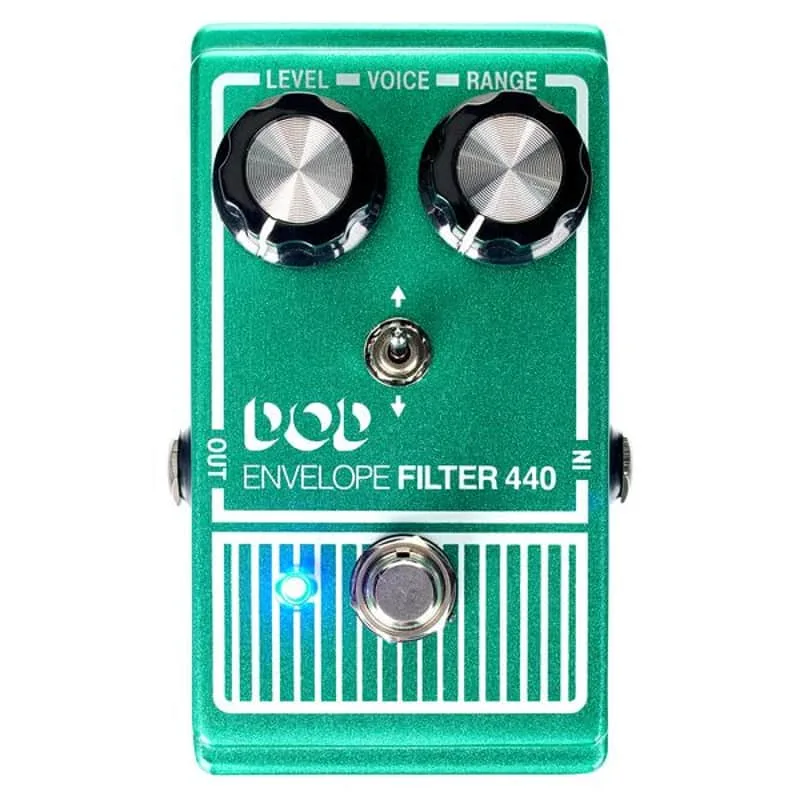


The DigiTech Envelope Filter 440 is a reissue of the sought-after original DOD Envelope Filter 440, the classic "auto-wah" effect, announced by DigiTech in June 2014 at a suggested retail price of $149.951. An envelope filter listens to how hard you play and sweeps a filter cutoff in response, so instead of rocking a wah treadle with your foot, your pick attack drives the sweep. Guitar World described the reissue as retaining "the unmistakable voice and touch sensitivity of the sought-after original" while adding true bypass, a 9-volt power adapter jack and a choice of Up or Down effect settings1. DigiTech itself says the pedal "delivers all the 'quack' and swept filter tones of the original and then some," making the guitar "speak" with vowel-like sounds1.
For more on the effect type generally, see filter pedals.
An auto-wah with Up and Down modes
The pedal's defining feature over the vintage 440 is its Up/Down voice switch, which lets you emphasize either the rise or the fall of the sweep. DigiTech describes it simply: "Choose which part of the sweep you want to emphasize"2.
- Up: delivers the classic quacking envelope filter "wah" effect1. Premier Guitar notes the up setting "provides the classic 440 wah-style effects"4.
- Down: emphasizes the lower frequency range, which Guitar World called "great for bassists wanting huge, thundering dub bass"1. Delicious Audio adds that the down setting "adds body to bass tones or gives the guitar synth-like attack"5.
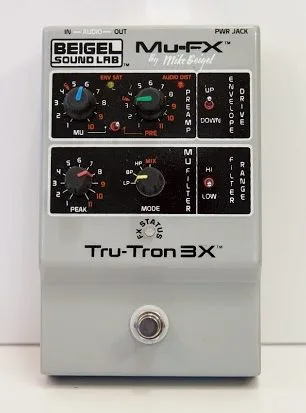
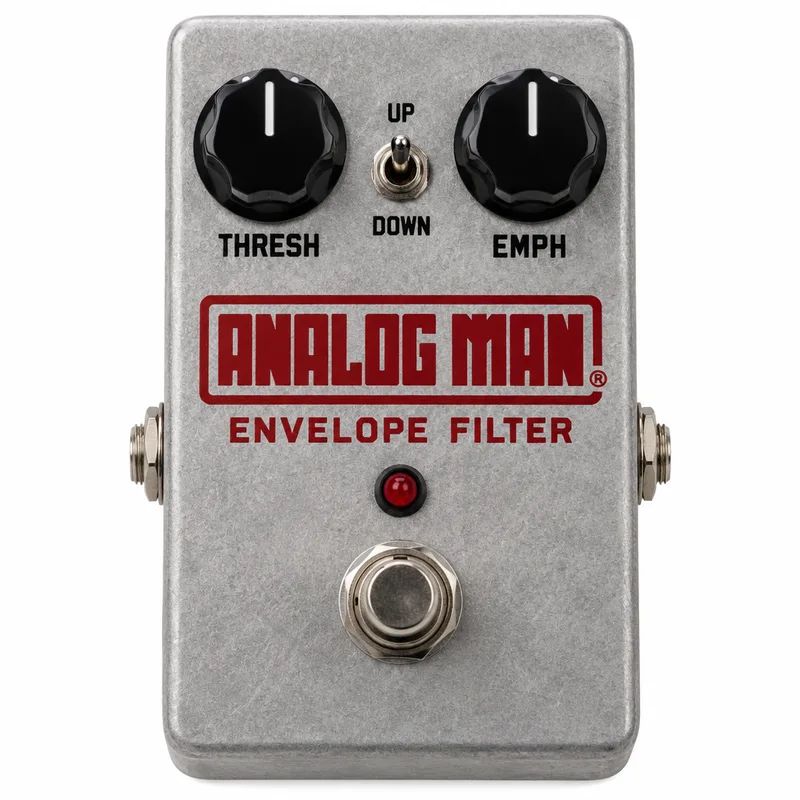
Guitar World's reviewer Alex Lynham observed that "Envelope filter and auto-wah on guitar is an effect that is niche by design," and pointed to "the more synth-like, locked-in sweep of an envelope filter" as what separates it from a hand-operated wah6. If you are comparing options, the same Up/Down idea appears on pedals like the Mu-FX Tru-Tron 3X and the Analog Man Block Logo Envelope Filter.
The controls
The 440 keeps the original's simple three-control layout. DigiTech's own descriptions of each control2:
| Control | What it does |
|---|---|
| Level | Controls the sensitivity of the envelope based on your pick attack2 |
| Range | Controls the frequency range of movement of the envelope's sweep2 |
| Up / Down switch | Chooses which part of the sweep you want to emphasize2 |
MusicRadar's reviewer Michael Astley-Brown put the Range control in plainer terms: "Range controls the frequencies affected by the filter's movement; the further clockwise you go, the higher the frequencies swept"7. The Level knob is the one to spend time with: Guitar World explained that it "adjusts the sensitivity of the envelope to tailor the response of the pedal based on pick or finger attack; higher sensitivity means less hard picking needed to trigger the effect"1. Set it high and a light touch sets the filter off; set it low and you have to dig in.
Power: 9V DC
The reissue runs on a 9V alkaline dry battery or the PS0913DC power supply through its 9-volt DC input21. Guitar World's review lists the power options as "9VDC Centre-negative or battery"6. The adapter jack was one of the improvements DigiTech made over the original, and Guitar World noted that "the 9-volt DC power supply input makes the Envelope Filter 440 far more pedalboard-friendly"8.
The original vintage DOD 440 had no DC input. If you are comparing the two on the used market, the reissue's adapter jack and true bypass are the practical differences that matter on a modern board18.
From the original DOD 440 to the DigiTech reissue
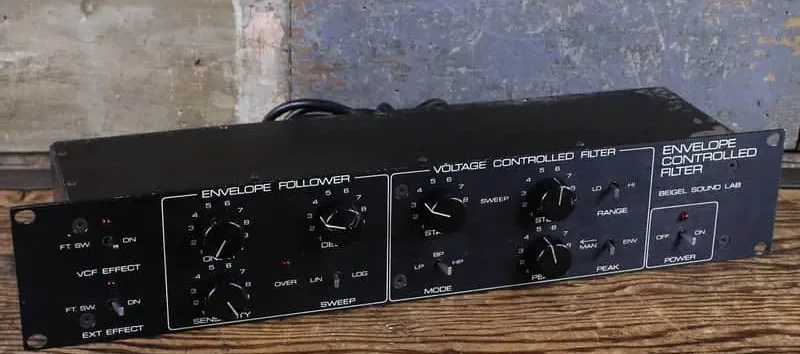
The original DOD 440 dates from the 1970s era of envelope filters, alongside designs like the Beigel Sound Lab Envelope Controlled Filter and the MXR Envelope Filter. DigiTech announced the reissue in June 2014, with the pedal available that June at $149.95 suggested retail1. MusicRadar carried the same announcement, describing the new Envelope Filter as retaining "the unmistakable voice and touch sensitivity of the sought-after original while adding improvements like true bypass, a 9-volt power adapter jack and a choice of Up or Down effect settings"8.
Vintage Guitar's news item on the reissue listed its other features: "true-bypass, 9-volt DC power supply and a lighter aluminum housing," along with Level and Range controls3. Pedal of the Day likewise highlighted the "lighter aluminum chassis" and the "New Up/Down switch allows you to choose which part of the sweep to emphasize"9.
DigiTech says the reissue is "a faithful recreation of the vintage 440," based on the original circuit design with updated components, and that "the addition of the up/down toggle gives it a modern sonic twist"2. The circuit has proven durable enough that other builders still work from it: PedalPCB's CDXL Classic Envelope Filter board is an open comparison to the DOD Envelope Filter 440.
In 2023, DigiTech and DOD relaunched the pedal again, with Delicious Audio calling the reissue "the first sign of life in this regard" for the DOD line5. The 2023 version keeps the up/down toggle, true bypass, an aluminum chassis and a blue LED5.
Videos
DigiTech
Rhythm Shaw
Get Offset
Questions
Is the DigiTech Envelope Filter 440 true bypass?
Yes. The reissue features true bypass operation, an improvement over the original vintage DOD 440. When the pedal is off, your dry signal passes through without buffering, so it will not load down the rest of your pedalboard the way the original could.
Does the DigiTech Envelope Filter 440 take a battery or a power adapter?
Both. It runs on a 9V alkaline dry battery or the PS0913DC power supply through its 9-volt DC input. The adapter jack was one of the additions DigiTech made over the original, and it makes the pedal far more pedalboard-friendly.
What does the Up/Down switch do on the Envelope Filter 440?
It chooses which part of the sweep you want to emphasize. Up delivers the classic quacking envelope filter wah effect, while Down emphasizes the lower frequency range, which suits bassists looking for a huge, thundering dub sound or guitarists after a synth-like attack.
How is the DigiTech Envelope Filter 440 different from the original DOD 440?
It is based on the original DOD Envelope Filter 440 circuit design with updated components, and it keeps the unmistakable voice and touch sensitivity of the sought-after original. The differences are practical: true bypass, a 9-volt power adapter jack, a choice of Up or Down effect settings, and a lighter aluminum housing.
What does the sensitivity knob do on an envelope filter?
On the 440 it is the Level knob, and it controls the sensitivity of the envelope based on your pick attack. Higher sensitivity means less hard picking is needed to trigger the effect, so you can set it to respond to a light touch or only to hard digs.
Sources (9)
- DigiTech Reissues DOD Envelope Filter 440, Guitar World, 2014-06-11
- DOD Envelope Filter 440, DigiTech, 2026-02-26
- DOD Offers 440 Envelope Filter, Vintage Guitar magazine, 2014-06-23
- DigiTech/DOD Relaunch DOD Envelope Filter 440 Effects Pedal, Premier Guitar, 2023-03-14
- Pedal Reissue: DOD Envelope Filter 440, Delicious Audio, 2023-03-14
- DOD Envelope Filter 440 review, Guitar World, 2023-06-21
- DOD Envelope Filter 440 review, MusicRadar, 2014-12-23
- Digitech reissues DOD Envelope Filter 440, MusicRadar, 2014-06-17
- DOD Envelope Filter 440 (2014), Pedal of the Day, 2016-11-08