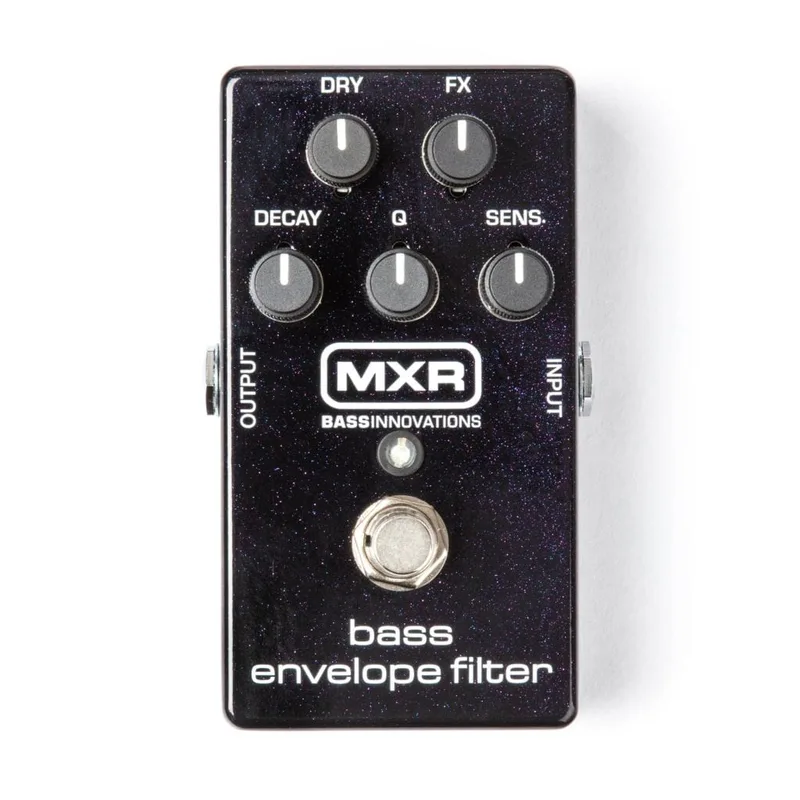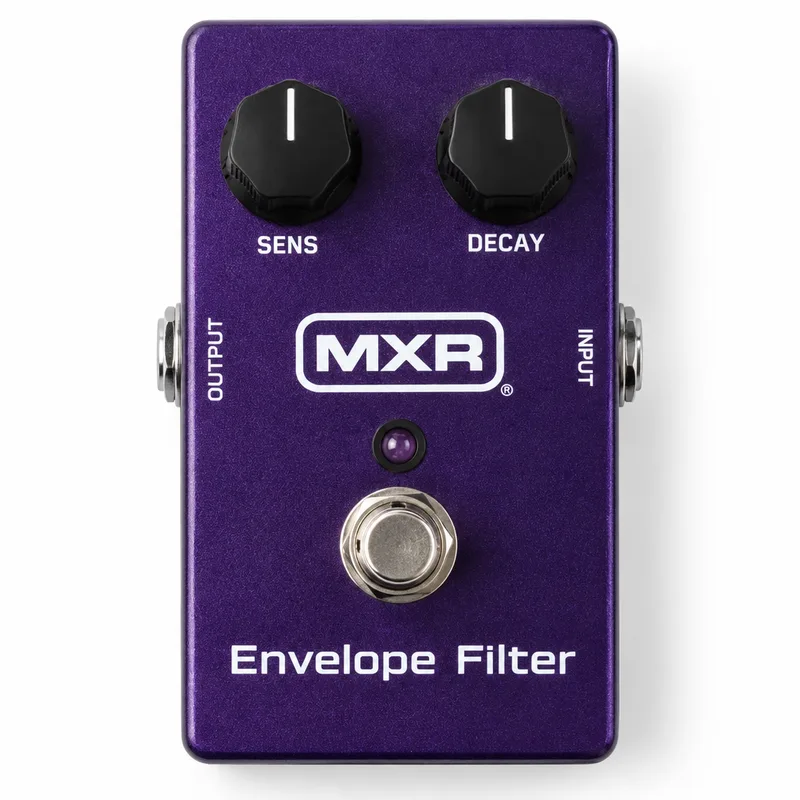


The MXR Envelope Filter, model number MX-120, is an analog filter pedal that MXR built in Rochester, New York, in 19791. An envelope filter listens to the volume of your picking and uses it to sweep a bandpass filter up or down, so each note opens and closes a wah-like sweep on its own, with no footwork. The MXR circuit uses op amps to do this, a design point that still gets discussed in reviews of modern clones2.
The original pedal is long out of production, and this page covers what is documented about it: where it came from, how the circuit is built, and how it survives today, both as a DIY clone project and in the modern MXR Bass Envelope Filter that Dunlop introduced in 20103.
The controls
The controls of the MX-120's DIY clone and of MXR's modern Bass Envelope Filter show how the circuit family works413.
The General Guitar Gadgets clone of the MXR Envelope Filter is built with three 500k linear pots4. Analog Man's Block Logo Envelope Filter, a clone that keeps what its makers call "a classic MXR look"5, adds a toggle switch with two sweep directions: in the UP position the filter sweeps up as a normal wah, which the Analog Man manual calls "the normal MXR setting"6.
"In the UP position, the filter sweeps up as normal "wah". This is the normal MXR setting."
The modern MXR Bass Envelope Filter carries the idea forward with five controls7:
| Control | What it does |
|---|---|
| Sensitivity | Tailors the pedal to your attack3 |
| Decay | Controls the decay of the envelope sweep7 |
| Q | Controls the peak resonance or intensity of the effect7 |
| Dry | Sets the level of the dry signal3 |
| FX | Controls the volume of the envelope filter signal8 |
Guitar World's buying guide called the separate Dry and FX controls "absolutely key to shaping the sound you're looking for," since blending dry and wet signal is what keeps a bass or guitar articulate under a heavy sweep7.
Power and connections
For the DIY clone, General Guitar Gadgets specifies the build down to the jack and switch4:
- Input: 1 mono quarter inch jack
- Output: 1 stereo quarter inch jack
- Power: 9V, via battery snaps and holder and/or a DC jack
- Footswitch: 1 heavy duty 3PDT or DPDT footswitch for bypass
- Toggle switches: 1 DPDT on-on and 1 SPST on-on
- ICs: 2 x 4069 and 1 x 4066
- Pots: 3 x 500k linear
- Board size: 5.7cm x 5.6cm
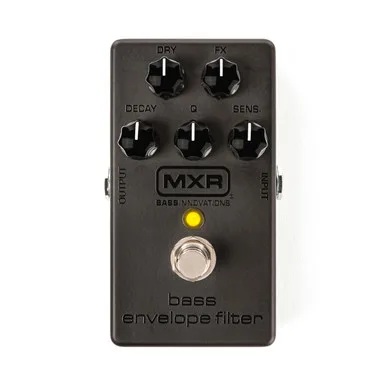
The modern MXR Bass Envelope Filter (M82) runs on a 9-volt AC adapter such as the Dunlop ECB003/ECB003E, or a DC Brick power supply, and also operates on a battery87. Its power supply circuitry is designed to withstand over-voltage or polarity mishaps, a useful safeguard if you run it from an unregulated supply9. The output jack feeds your amplifier8. The Blackout Series special edition, released to celebrate 15 years of MXR Bass Innovations, shares the same power protection and the same Dry and Effect control layout10.
Origins and the DIY clone
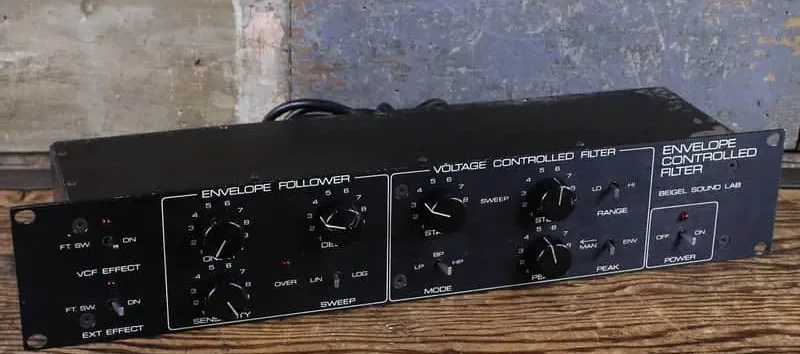
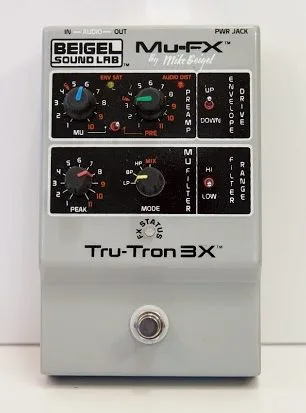
The MXR Envelope Filter was made in Rochester, New York, in 1979, during MXR's original independent era1. It appeared in German retail channels soon after, carrying a list price of 230 DM in 19821. MXR was not first with the concept: Mike Beigel, designer of the Beigel Sound Lab Envelope Controlled Filter, is credited by Mu-Tron as the inventor of the envelope controlled filter effect11, and his later Mu-FX Tru-Tron 3X continues that line12.
The MX-120's circuit has had a long afterlife as a DIY project. General Guitar Gadgets publishes a full clone project under its Filters (Envelope) category, with modification instructions copyright 2005 by JD Sleep and a build version dated January 200641. PedalPCB sells a Duck Box Envelope Filter PCB project in the same tradition13. Analog Man built its reputation partly on this circuit; in a Stompbox Book interview, Mike Piera pointed to the envelope filter as an example of their classic MXR-styled designs5, and a Premier Guitar review of the Analog Man filter noted that "the MXR circuit, which uses op amps," differs from the Mu-Tron approach it was compared against2.
Videos
Reverb
Marty Music
E'Lon JD
Questions
Is the MXR Envelope Filter true bypass?
The original 1979 MXR Envelope Filter predates modern true bypass switching, and no source in this page's material states its bypass type. The modern MXR Bass Envelope Filter (M82) uses what Dunlop's manual calls True Hardwire bypass, and MXR says its true-bypass switching preserves your tone in bypass mode.
Who designed the MXR Envelope Filter?
No source names the designer of the original 1979 MXR Envelope Filter. The best documented name connected to it is JD Sleep, who wrote the modification instructions for the popular General Guitar Gadgets DIY clone of the circuit, first published in 2005. Mike Beigel designed the earlier Mu-Tron envelope controlled filter, not the MXR.
Where was the MXR Envelope Filter made?
The original MXR Envelope Filter (MX-120) was made in Rochester, New York, in 1979, when MXR was still an independent Rochester company. Today the MXR brand is owned and run by Dunlop Manufacturing, and the modern Bass Envelope Filter is sold under the Jim Dunlop name.
Is there a DIY kit of the MXR Envelope Filter?
Yes. General Guitar Gadgets publishes a DIY effects project that clones the MXR Envelope Filter, with instructions by JD Sleep dated 2005 and a build version dated January 2006. PedalPCB also sells a Duck Box Envelope Filter PCB project based on the same type of circuit.
Sources (13)
- TONEHOME, TONEHOME - the World of Vintage Guitar Effects Pedals, 1982
- Analog Man Envelope Filter Review, Premier Guitar, 2015-11-09
- Gear Watch: MXR Bass Envelope Filter, No Treble, 2010-02-19
- MXR™ Envelope Filter™ Clone: Schematic & Layout, General Guitar Gadgets, 2014-05-14
- Analog Man, Stompbox Book, 2019-10-20
- EnvelopeFilterManual.pdf, Analog Man Guitar Effects, 2021-01
- Best bass effects pedals: best pedals for every style, Guitar World, 2021-12-20
- M82.pdf, Dunlop Manufacturing, Inc., 2019
- MXR® BASS ENVELOPE FILTER, Jim Dunlop (jimdunlop.com)
- MXR® BLACKOUT™ SERIES BASS ENVELOPE FILTER, Jim Dunlop (jimdunlop.com)
- Beigel Sound Lab, Musitronics Mu-Tron (mu-tron.com)
- Mu-FX Tru-Tron 3X™ Envelope Filter, Pedal of the Day, 2016-04-19
- Duck Box Envelope Filter, PedalPCB.com