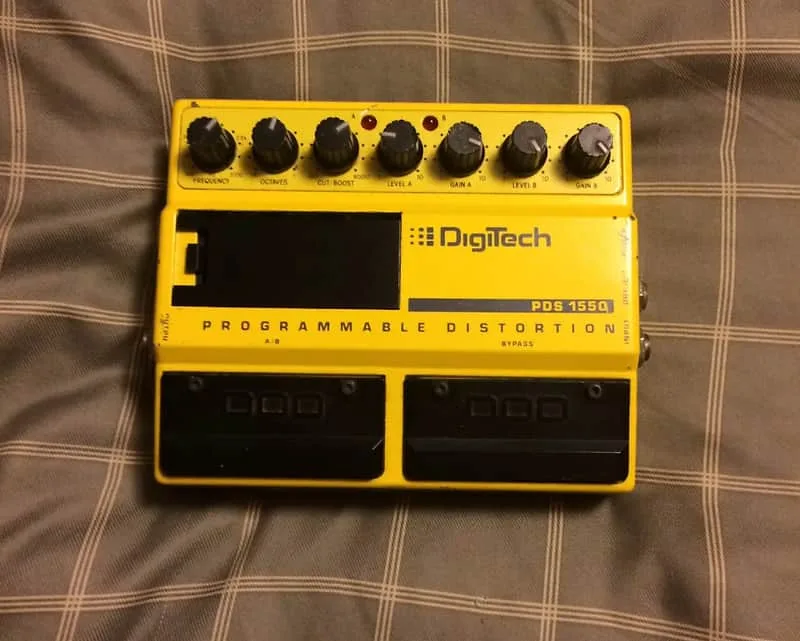


The Digitech PDS-1550 is a 1980s Digitech "Dual pedal" that puts two drive circuits in one box: a Metal Distortion channel and an Overdrive channel, plus a double-tracking delay and a parametric EQ. One footswitch selects between the two channels, and a second switches between the effect and the bypassed signal1. It is a long-discontinued vintage pedal, and the main published documentation of it is a detailed circuit analysis by Electric Druid, on which this page is based.
The Metal Distortion channel is practically the Boss HM-2 circuit, and the Overdrive channel is similar in structure to a Tube Screamer, so the pedal is effectively two well-known designs in one enclosure, with Digitech's own additions around them1.
Two drive channels: HM-2 metal and Tube Screamer overdrive
After a unity gain op-amp input buffer (a 1458 dual op-amp, similar to a pair of uA741s, giving 470K input impedance), the signal splits into channels A and B1.
Channel A, Metal Distortion. This channel is pretty much identical to the Boss HM-2, the pedal fans affectionately know as the chainsaw. It starts with a 2N5088 transistor gain stage exactly like the input of a Big Muff Pi or Boss DS-1, providing 24dB of boost (a gain of x15.8) regardless of the pot setting. A second stage, a PNP 2N3906, adds another 21dB, for 45dB of gain (x178) after two stages. As Electric Druid's Tom puts it1:
"So our original signal gets sliced and diced!"
He adds: "It's no wonder it's a chainsaw"1.
A pair of 1N34 germanium diodes (D18/D19) in series act as a simple noise gate at the distortion stage, clamping the signal below a threshold1.
Channel B, Overdrive. This channel is the unit's overdrive side, built in the general structure of a Tube Screamer, with clipping diodes in the feedback loop of a non-inverting op-amp, though the values are not exactly Tube Screamer values. It sits alongside Channel A's high-gain metal voicing as the lower-gain option, giving the PDS-1550 two distinct drive characters in one box1.
The controls, footswitches and internal trimmers
The front panel carries seven controls, but the pedal actually has more than that: open the back and you find trimmers and DIP switches that add further adjustments1.
| Control or switch | What it does |
|---|---|
| Footswitch 1 | Selects channel A or B |
| Footswitch 2 | Effect or bypassed signal |
| Seven front panel controls | Main user adjustments |
| Internal trimmers and DIP switches | Extra controls, including delay settings |
| Parametric EQ Cut/Boost | Extreme +/-20dB range |
The parametric EQ is shared by both channels, which Electric Druid judges a slight shame: settings that suit one drive sound are unlikely to suit the other. The Metal Distortion channel's tone shaping is basically identical to the HM-2's three-gyrator "Colour mix" arrangement, with different component values giving an extremely similar frequency response. The low gyrator peaks at 87Hz with a Q of 3.7, described in the user manual as a "lo boost", and can only be switched on or off. The HM-2, by contrast, has a cut/boost control for its low peak (958Hz, Q of 3.4), so it can produce a "double notch" response the PDS-1550 cannot1.
All the channel switching is done with FETs, and the logic for the various options is involved enough to generate quite a lot of the circuit1.
The double-tracking delay
Channel A carries a short delay that mixes the straight and delayed distortion signals at equal weight, an original Digitech addition the HM-2 has nothing like. The delay uses an MN3007 BBD delay line with an MN3101 clock circuit, PMOS devices wired with their supply pins back to front for a negative supply. A 3-pole anti-aliasing filter (-18dB/Oct) ahead of the delay has a cutoff around 3.4KHz; the user manual's claimed 4KHz bandwidth is the -6dB point1.
The delay time itself is the catch:
Delay Time is a trimmer (P3/1M) that you can only reach by taking the back off the pedal. It is not a front panel control1.
Internal DIP switches set the delay range: both open gives up to 40 milliseconds, one shut gives up to 20 milliseconds, and both shut gives up to 10 milliseconds. Another DIP switch turns the delay on or off, followed by a pair of germanium diodes acting as a noise gate for the delay output, with R44/1M attenuating BBD noise when they are not conducting1.
Power: a tip-positive 1/8" jack
The PDS-1550 takes power through a non-standard 3.5mm (1/8") TS jack, and the polarity is the reverse of what most players expect: on the original DOD 1/8" jack, the tip is positive and the sleeve is ground, whereas the Boss center-negative convention puts ground on the sleeve and negative on the tip. Electric Druid suggests a possible mod of replacing the jack with a standard plastic-bodied 2.1mm DC socket, noting that because the Digitech jack is tip positive and the Boss standard is tip negative, the replacement socket has to be wired accordingly1.
Circuit board versions
A commenter on the Electric Druid analysis reports two versions of the pedal with pretty different circuit boards, one clearly a machine created PCB and one looking more hand drawn. Tom has seen no sign of documented differences between them, so the variation appears to be in board production rather than circuit design1.
What reviewers and players said
Electric Druid's overall verdict:
"All in all, it's a quirky pedal with some interesting technical elements and several odd design decisions. While I don't [think it was ever going to become a classic]..1."
He judges the two channels sufficiently different in character that nobody is likely to like both, but expects that pretty much everyone could get one usable sound out of it1.
Players' reports are positive. One bought one off a friend in high school, loved it, and gigged and recorded with it. Two bass players report good results: one used it in a late 80s to early 90s bass rig as a favorite bass distortion, largely because of the parametric EQ, and another played bass in a 90s grunge band using Channel A as massive fuzz mayhem and Channel B as a clean boost1.
Videos
Demo
Mauro Vital
Fuzzed Drones
Questions
Is the Digitech PDS-1550 the same as a Boss HM-2?
Very close, but not identical. The Metal Distortion channel is practically the Boss HM-2 circuit, including the same three-gyrator tone shaping arrangement, though with different component values that give an extremely similar frequency response. The HM-2 adds a cut/boost control for its low peak that lets it produce a double notch response the PDS-1550 cannot, and the PDS-1550 adds a double-tracking delay the HM-2 never had.
How do you change the delay time on the PDS-1550?
You have to take the back off the pedal. Delay Time is a trimmer (P3/1M) inside the box, not a front panel control. Internal DIP switches set the delay range: both open gives up to 40 milliseconds, one shut gives up to 20 milliseconds, and both shut gives up to 10 milliseconds. A further DIP switch turns the delay on or off.
What power supply does the Digitech PDS-1550 need?
It uses a non-standard 3.5mm (1/8 inch) TS jack, and the original DOD jack is tip positive with the sleeve at ground, the reverse of the Boss center-negative convention. Plugging in a standard Boss-style supply with the wrong polarity could damage the pedal. Some owners replace the jack with a standard 2.1mm socket, which requires wiring it with the opposite polarity to match.
Does the PDS-1550 work on bass?
Players have used it on bass and liked it. One owner used it in a late 80s to early 90s bass rig and called it a favorite bass distortion, largely because of the parametric EQ. Another played bass in a 90s grunge band using Channel A as a heavy fuzz and Channel B as a clean boost.
Are there different versions of the PDS-1550 circuit board?
Yes, apparently. A commenter reports two versions with pretty different circuit boards, one clearly machine created and one looking more hand drawn. The analyst who documented the circuit has seen no sign of any documented differences between the versions, so the variation appears to be in the board layout rather than the design.
Sources (1)
- Digitech PDS-1550 Programmable Distortion pedal analysis, Electric Druid (electricdruid.net), 2018-11-22