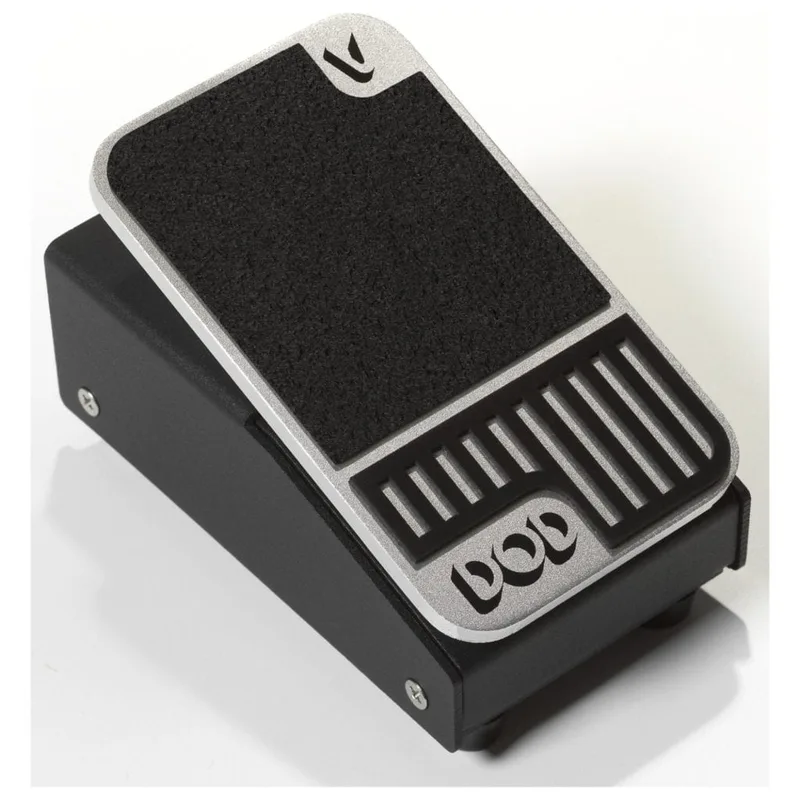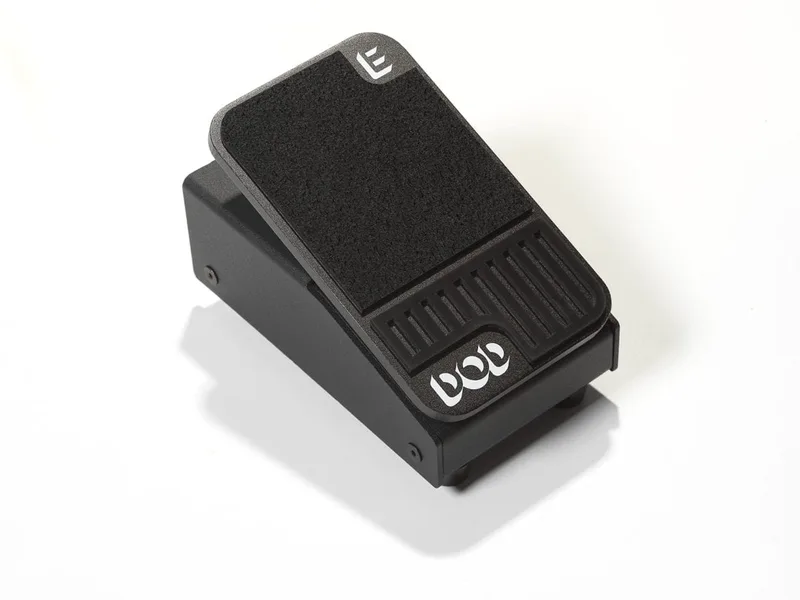



The DOD Mini Expression is a compact expression pedal from DOD: a treadle you rock with your foot to control a parameter on another piece of gear, such as delay repeats, modulation depth, or volume on a modeler. Unlike a wah or volume pedal in your signal chain, an expression pedal sits off to the side, connected by a single cable to an expression input, and leaves your tone untouched while it works1.
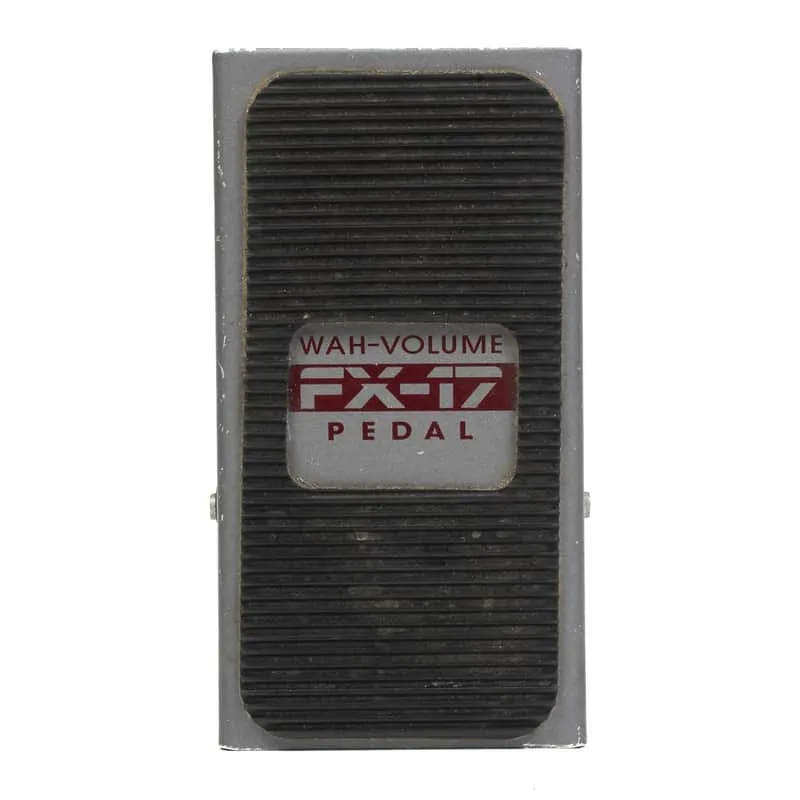
What sets the Mini Expression apart is its size and its simplicity. DOD describes it as "just the right size for your pedal board, and your wallet," built around a high-quality, high-cycle 25kΩ potentiometer for smooth expressive control, in an all-metal chassis designed to occupy minimal pedalboard space1. MusicRadar's reviewers compared its proportions to a Boss compact stompbox, noting that it echoes DOD's long-discontinued FX-17 Wah-Volume, shrunk down2.
A passive mini expression pedal
The Mini Expression is a passive controller. MusicRadar's review team confirmed that "Both pedals are passive designs, which means no power supply or batteries are required"2. For a player, that has two practical consequences: the pedal needs no spot on a power supply and no daisy chain, and there is nothing inside it to add noise to your rig. It simply changes a resistance value as you rock the treadle, and the connected gear reads that value.
The build is aimed at real-world use. MusicRadar found "Rock-solid, all-steel construction and skid-free treadle pads recall Ernie Ball's industry-standard VP Jr," and noted that "a 0.5kg weight and rubber feet mean these two aren't going anywhere when they hit the floor"2. DOD's own product page lists an all-metal chassis and an ultra-compact size as headline features1.
The design has a lineage. MusicRadar's reviewers traced its circuit back to DOD's FX-17 Wah-Volume, a pedal the company no longer makes, describing the Mini Expression as that idea "shrunk down to regular Boss compact proportions"2. For players who remember the FX-17, the Mini Expression is a return of that approach in a housing small enough for a crowded board.
The TRS/TS/RTS polarity switch
The Mini Expression's most useful feature for compatibility is its three-way selector. DOD's product page describes it as "a TRS (25kΩ)/TS (10kΩ)/RTS (25kΩ) selector, making it flexible to work with most gear" with expression pedal inputs1. In plain terms, different makers wire their expression jacks differently: some use a stereo (TRS) cable with the wiper on the ring, some use it with the wiper on the tip (RTS), and some expect a mono (TS) connection. A pedal hardwired for one scheme will not work correctly with gear expecting another.
The switch solves that. Premier Guitar's expression pedal buying guide noted that "its 3-position TRS/TS/RTS switch allows it to play nice with most expression-pedal-friendly gear"3. MusicRadar's reviewers found this went beyond theory: "We also found the Expression's three-way switch seriously handy on certain pedals that specified TRS, but in actuality functioned better as RTS"2. That is a common real-world situation, where a manual says one thing and the circuit behaves another way, and the switch lets you simply try the other positions until the sweep responds correctly.
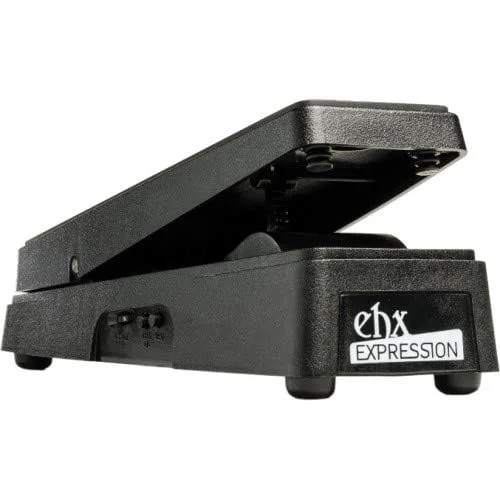
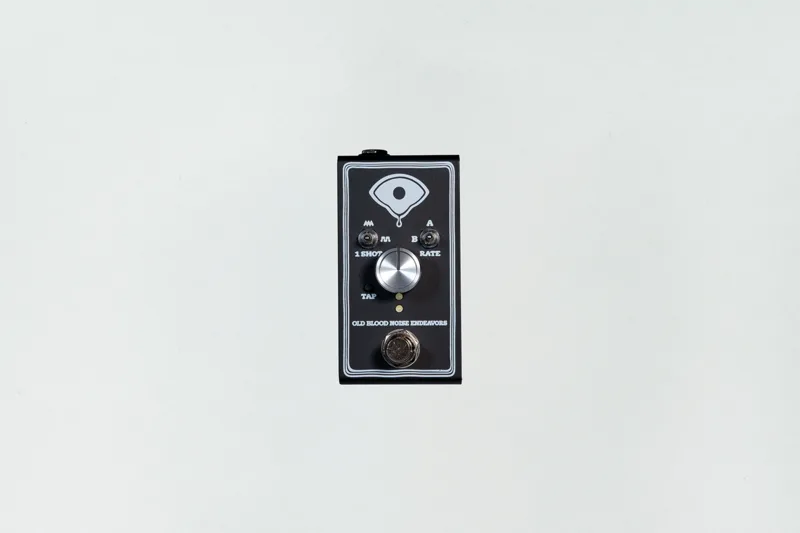
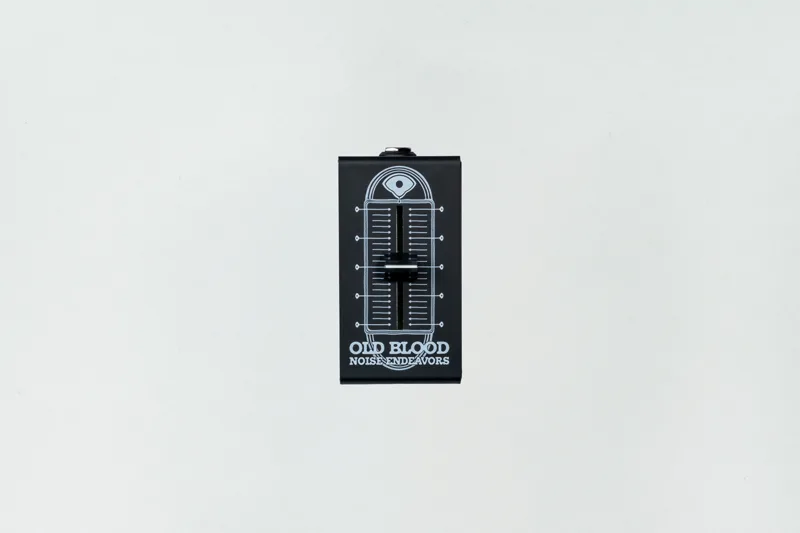
Other makers handle the same problem differently. Electro-Harmonix's expression pedals use a TRS +/- button that reverses the polarity of the jack, as on the Electro-Harmonix Single Expression Pedal, while Old Blood Noise Endeavors offers powered alternatives like the Expression Ramper, which stores two settings and moves between them, and the passive Expression Slider. The Mini Expression's approach is the simplest: a mechanical switch, no menus, no power456.
Which pedals does it work with?
Because expression control is a wiring convention rather than a single standard, compatibility is the main question with any expression pedal. The Mini Expression's three resistance settings cover the common schemes, and DOD states the selector makes it "flexible to work with most gear" with expression inputs1.
As a category, expression pedals connect to a wide range of equipment. Writing on BOSS's own site, Ed Lim noted that "They work with stompboxes, MIDI controllers, guitar amps, multi-effects units, and synthesizers"7. In practice that means delay and reverb pedals with expression inputs, modelers such as the Line 6 Helix family, and even synth pedals. Makers of competing compact expression pedals, such as Saturnworks, list compatibility with devices from EHX, Moog, Boss, Strymon, Line 6, and Eventide, which gives a sense of the range of gear that accepts an expression input8.
If a specific pedal does not respond, the troubleshooting path is short: try the other two switch positions, and check whether the target gear wants TRS, TS, or RTS wiring. MusicRadar's finding that some pedals function better on RTS than their stated TRS spec suggests the switch is worth cycling through before assuming a mismatch2.
What reviewers said
MusicRadar's review of the Mini Volume and Mini Expression pair was positive. The reviewers called the pedals compact but beautifully formed, a well-considered act by DOD, and highlighted the three-way switch as "seriously handy" in practice2. Their verdict on construction, that the all-steel build and skid-free treadle pads recall Ernie Ball's VP Jr, is about as strong a comparison as a volume or expression pedal can draw2.
"We also found the Expression's three-way switch seriously handy on certain pedals that specified TRS, but in actuality functioned better as RTS."
For a player weighing options, the Mini Expression's case rests on three things the reviewers and maker agree on: it needs no power, it fits in a small space, and its selector switch covers the wiring schemes most gear expects12.
Videos
Ryan Hogle
MaxReviews Pro
Zachary Rizer
Questions
Does the DOD Mini Expression need power?
No. It is a passive design, so it needs no power supply and no batteries. It works purely as a controller, sending a resistance value to whatever pedal, amp, or modeler it is plugged into, so it takes up no power slots on your board.
Which pedals does the DOD Mini Expression work with?
Its TRS (25kΩ), TS (10kΩ), and RTS (25kΩ) selector makes it flexible to work with most gear that has an expression pedal input, including stompboxes, multi-effects units, and modelers. If a pedal specifies one wiring scheme but responds better to another, the three-way switch lets you try each option.
How big is the DOD Mini Expression?
It is an ultra-compact pedal with a width of 3.0 inches (76mm), roughly Boss compact proportions, and it weighs 0.5kg. DOD designed it to occupy minimal pedalboard space, and its rubber feet and weight keep it planted on the floor.
Sources (8)
- DigiTech Mini Expression Pedal, DigiTech, 2025-05-26
- DOD Mini Volume and Mini Expression review, MusicRadar, 2018-06-09
- Tools for the Task: Expression Pedals, Premier Guitar, 2017-05-17
- Single Expression Pedal | Single Output Expression Pedal - Electro-Harmonix, Electro-Harmonix (ehx.com)
- Dual Expression Pedal | Dual Output Expression Pedal - Electro-Harmonix, Electro-Harmonix
- Your pedalboard's new secret weapon? Old Blood Noise Endeavours reveals the Expression Ramper | MusicRadar, MusicRadar, 2021-05-21
- Express Yourself: Expanding Creativity with the EV-1-WL, BOSS (articles.boss.info), 2021-09-02
- Expression Pedal, Saturnworks Pedals, 2026-06-27