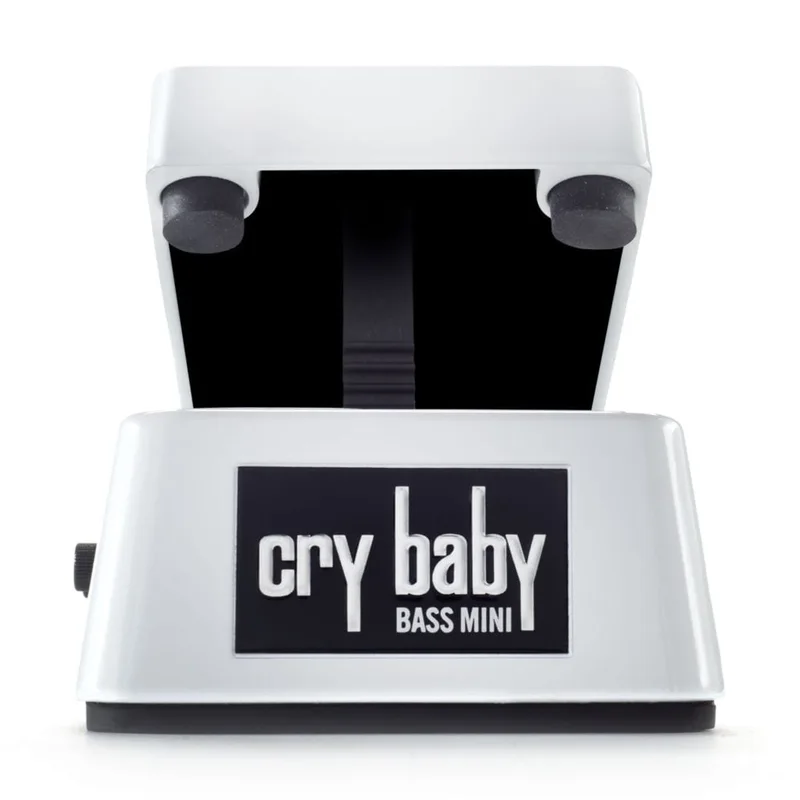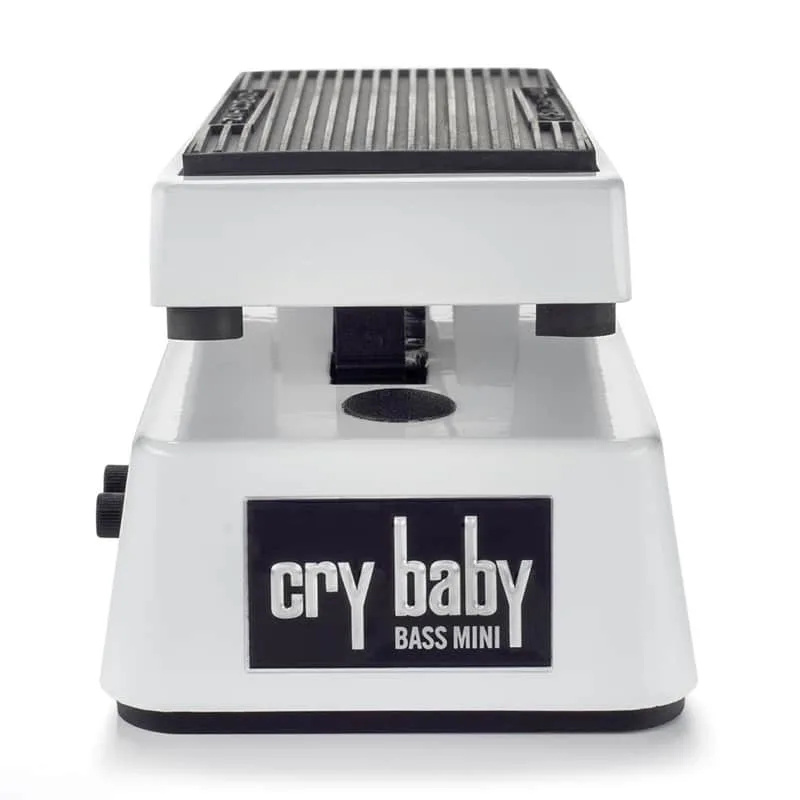



The Dunlop Cry Baby CBM105Q Mini Bass Wah is a wah pedal built for bass, and it exists to solve a space problem. Dunlop describes it as the same low-end-loving sound as the full-size 105Q Cry Baby Bass Wah with half the footprint, packaged in a lightweight aluminum housing1. Guitar World, reviewing it in 2016, put it more strongly: a mini version of the venerable 105Q that is less than half the size but delivers identical performance2.
For a bassist, the point of the design is that the wah sweeps without eating the low frequencies that a bass needs. Guitar World's reviewer found it delivers expressive, vocal-like wah effects that never sacrifice crucial bottom end frequencies2. The pedal is about half the size of a conventional Cry Baby3, and Guitar World describes it as just slightly larger than a small MXR-style pedal such as a Phase 90 or Dyna Comp2.
How it works: no footswitch, just the rocker
The Mini Bass Wah has no footswitch at all. Operation is automatic: you engage the effect by sweeping the toe of the rocker downward, and the effect bypasses when you take your foot off2. Under the hood there is a spring-loaded rocker pedal with silent auto-return switching, and an internal switch at the front of the unit that the depressed rocker presses35. Premier Guitar describes the result plainly:
"This system instantly engages the wah as the rocker control is depressed."3
There is also an internal rotary control under the bottom plate, the auto-return delay control, which determines how long the wah effect rings out after being disengaged, allowing near-seamless transitions from the effected sound back to your clean signal3. Dunlop's manual lists the delay factory preset as 290ms4.
The switching takes some adjustment. Premier Guitar's reviewer found the auto-return switching a little touchy, briefly interrupting the signal with a split second of silence3. Guitar World's reviewer, by contrast, found the pedal just as easy to use as the standard version despite its smaller size, and thought some players may actually find the smaller profile easier and more accurate to manipulate2.
Controls
Two controls sit on the outside of the pedal, and one inside.
| Control | Location | What it does |
|---|---|---|
| Q | External | Adjusts wah frequency width4 |
| VOL | External | Controls effect volume4 |
| Auto-return delay | Internal, under the bottom plate | Sets how long the wah rings out after disengaging3 |
The Q control is the one to spend time with. It adjusts the width of the wah frequencies: higher settings deliver dramatic sweeps with brighter frequencies and vocal-like qualities, while lower settings are darker with more subtle filtering3. Guitar.com's reviewer put it simply, "the higher the Q level, the brighter the effected sound," and called the Q control "the real key to getting the most out of this pedal"5.
The Volume control balances the sound level when the effect is engaged3. Dunlop's manual gives the VOL control a range of 0dB to -21 dB4, and Guitar World notes the externally mounted Volume knob doubles as a Boost switch providing up to 20dB of boost, which can restore levels lost when using fuzz or distortion or provide a significant boost for solos2.
Circuit and how it relates to the 105Q
Premier Guitar reports that the Mini Bass Wah contains similar circuitry to the 105Q3, and Dunlop's own buying guide describes it as the same low-end-loving sound as the 105Q with half the footprint1. One circuit difference is documented: the CBM105Q uses an envelope filter circuit in place of the inductor found in a traditional Cry Baby wah1.
The wah's frequency range, from Dunlop's manual, runs from 180 Hz with the rocker heel down to 1800 Hz with it toe down4. That range is tuned for bass, which is what separates this pedal from a guitar wah: the sweep stays in territory where a bass guitar's fundamentals live.
Other specifications from the manual:
Powering it
The pedal has no external power details to set up beyond what any standard wah needs, and its operation is automatic rather than footswitch based: you engage the effect by sweeping the toe downwards and bypass it by taking your foot off2. The one internal control, an auto-return delay rotary under the bottom plate, sets how long the wah effect rings out after being disengaged, allowing near-seamless transitions from effected to native signal3. It ships from the factory with the delay preset to 290ms4.
Where it came from
The Mini Bass Wah is part of Dunlop's Cry Baby family, which the company's manual bills as "THE ORIGINAL SINCE 1967"4. Dunlop's own history of the wah line records that after the release of the Cry Baby Mini Wah (the guitar version, the CBM95), the line was joined by the Cry Baby 105Q Mini Bass Wah and the Jimi Hendrix Cry Baby Mini Wah6. Premier Guitar called it the latest addition to Dunlop's Cry Baby family3.
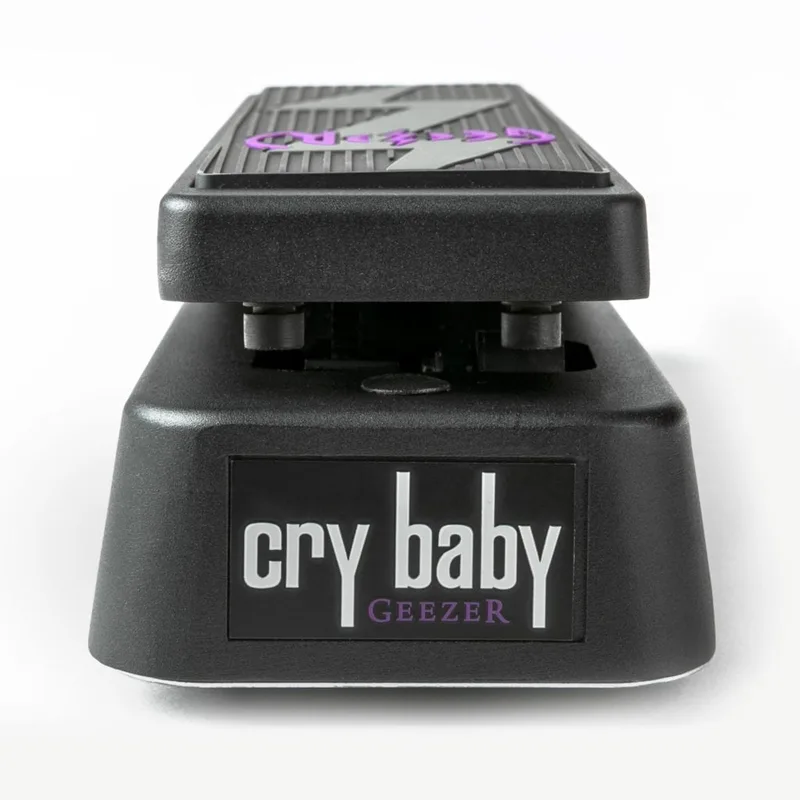
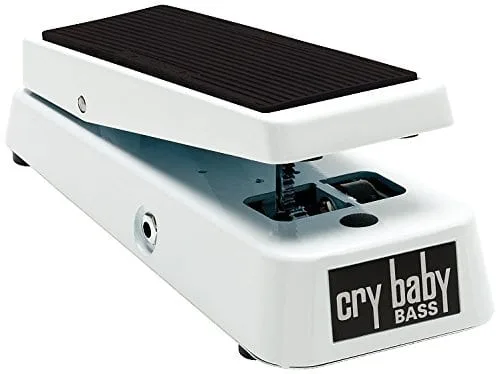
It sits in a wider family of Dunlop bass wahs. The full-size 105Q came first, and Dunlop has since added signature models including the Geezer Butler Cry Baby and the Justin Chancellor Cry Baby Wah. Guitar.com's review notes the Mini's family resemblance to its forebear, right down to the grippy rubber on the treadle section5.
What reviewers said
Guitar World gave the pedal its Gold Award in 2016, at a street price of $119.99, concluding that although the CBM105Q is much smaller than the standard version, it is just as easy to use, and some players may find the smaller profile easier and more accurate to manipulate2. Premier Guitar's 2021 verdict was similarly positive on the pedal's features and size:
"Its small footprint minimizes space on a pedalboard and it boasts features that will reward professionals to novices with pleasing tonal shaping and cool textures."3
The same review flagged the auto-return switching as the pedal's one quirk, finding it a little touchy and noting it briefly interrupted the signal with a split second of silence3. Guitar.com's review called it a fun, compact solution for bassists wanting a wah on a crowded pedalboard, with the Q control as the key to getting the most from it5.
Videos
CAM Compares
Secure Gadgets Tube
ReviewTube99
Questions
Does the Cry Baby Mini Bass Wah have a footswitch?
No. Operation is automatic and footswitch free. You engage the wah by sweeping the toe of the spring-loaded rocker downward, which presses an internal switch at the front of the unit, and the effect bypasses when you release the pedal and it springs back up. Premier Guitar's reviewer found this auto-return switching takes some getting used to.
Can the Cry Baby Mini Bass Wah run on a battery?
Yes. It runs on one 9-volt battery, which you install by removing the bottom plate, or on a 9V DC center negative adapter such as the Dunlop ECB003. Current draw is 6.7mA, so it is also easy on a pedalboard power supply.
Is the Mini Bass Wah the same circuit as the full-size 105Q?
Not identical, but close. Premier Guitar reports that the Mini Bass Wah contains similar circuitry to the 105Q, and Dunlop describes it as the same low-end-loving sound as the 105Q with half the footprint. One difference is that the mini uses an envelope filter circuit in place of the inductor.
What does the Q control do on a bass wah?
The Q control adjusts the width of the wah frequencies. Higher settings give dramatic sweeps with brighter frequencies and vocal-like qualities, while lower settings are darker with more subtle filtering. Guitar.com's reviewer called the Q control the real key to getting the most out of the pedal.
Will the Cry Baby Mini Bass Wah fit on a small pedalboard?
Yes, that is its main purpose. It is about half the size of a conventional Cry Baby, in a lightweight aluminum housing, and Guitar World describes it as just slightly larger than a small MXR-style pedal such as a Phase 90 or Dyna Comp. Premier Guitar's reviewer noted its small footprint minimizes pedalboard space.
Does the Cry Baby Mini Bass Wah have an inductor?
No. Dunlop's own buying guide states that the CBM105Q uses an envelope filter circuit in place of the inductor found in a traditional Cry Baby wah. The wah effect is still controlled by rocking the pedal with your foot.
Sources (6)
- RANGE OF EXPRESSION: FIND YOUR CRY BABY® WAH, Dunlop (lifestyle.jimdunlop.com), 2021-10-08
- Review: Dunlop Cry Baby CBM105Q Mini Bass Wah, Guitar World, 2016-08-11
- Dunlop CBM105Q Cry Baby Mini Bass Wah Review, Premier Guitar, 2017-01-13
- CBM105Q.pdf, Jim Dunlop, 2019
- Dunlop CBM105Q Cry Baby Bass Mini Wah Review, Guitar.com, 2017-10-04
- Evolution of the Cry Baby Wah at Dunlop, Dunlop (lifestyle.jimdunlop.com), 2017-04-27