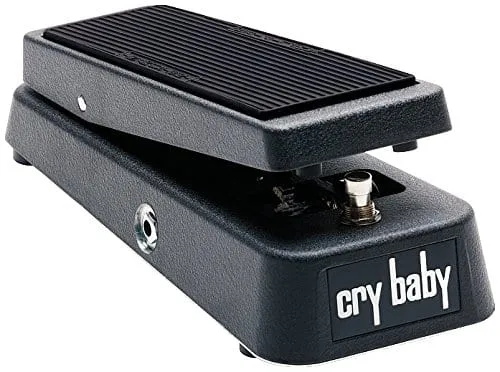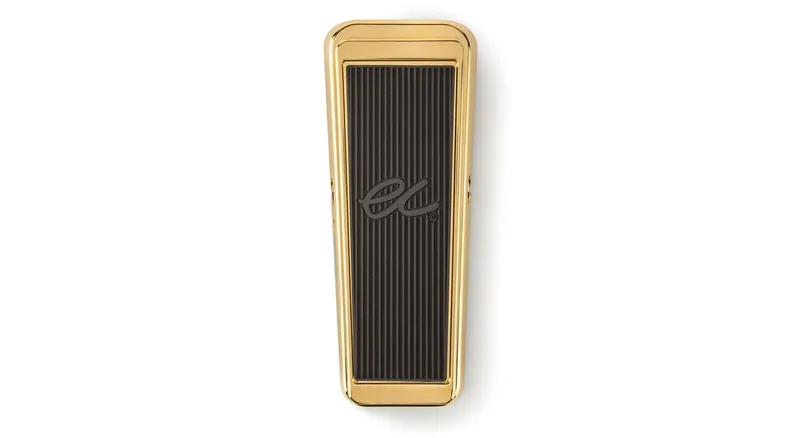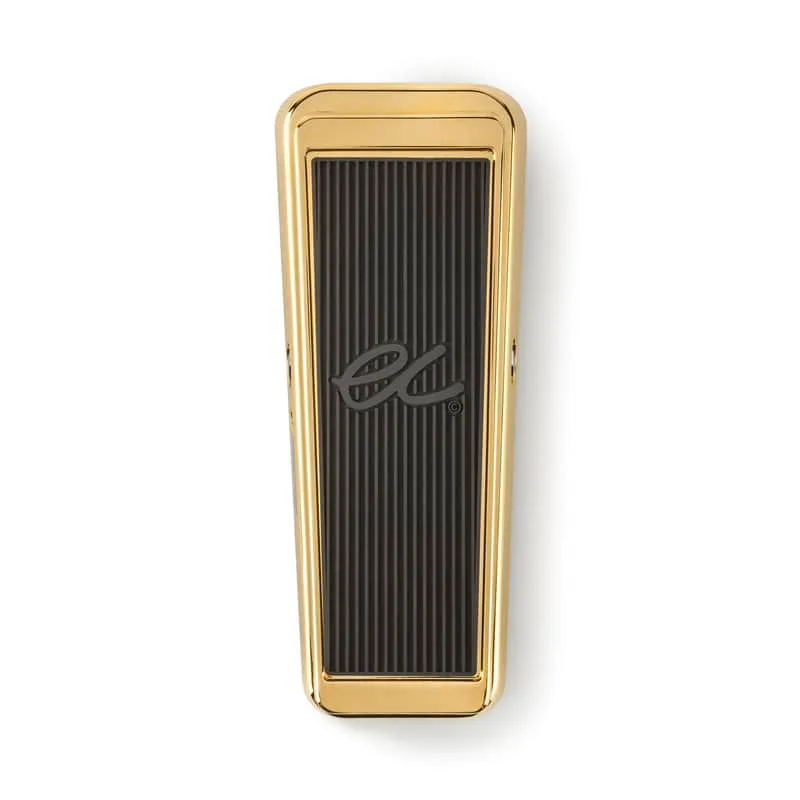
The Dunlop EC95G Eric Clapton Cry Baby Wah is a wah pedal from Dunlop, built as a gold-plated signature model honoring Eric Clapton1. It is a limited edition, and part of what makes it distinctive is that proceeds from it support Clapton's Crossroads addiction recovery center1.
Under the finish, this is familiar territory. MusicRadar reported that "the circuit is based on the GCB95 Cry Baby Standard Wah"1, the same design as the standard Cry Baby Standard. As MusicRadar's Jonathan Horsley put it, "longtime Cry Baby fans will recognise the sounds of this new Clapton signature model"1.
A Cry Baby Standard circuit in a Clapton signature model
The EC95G works like any Cry Baby wah. You rock your foot back and forth on the treadle, and the pedal changes the effect on your instrument's tone instantaneously, sweeping a frequency peak up and down as you move2. To turn the pedal on and off, push the toe of the pedal down until you feel a click2.
There are no knobs or switches to set up. The pedal's whole control surface is the treadle itself, which makes it as straightforward as a wah can be for a first pedalboard2.
The differences from the GCB95 are cosmetic and charitable rather than electronic. The enclosure is gold-plated rather than the standard finish1, and Dunlop framed the release as a tribute: "With this special limited edition Eric Clapton Cry Baby Wah, we're paying tribute to Mr Clapton's 60-year legacy"1. MusicRadar noted the price positioning directly, observing that "the Eric Clapton wah is not a cheap date at £349/$299"1, against the standard pedal it shares a circuit with.
"But this is A) Gold and B) supports Clapton's Crossroads addiction recovery centre."
Power and connections
Setting the pedal up takes two cables: one from your guitar to the EC95G's INSTRUMENT jack, and one from its AMPLIFIER jack to your amplifier2.
Power options, per Dunlop's manual2:
- One 9-volt battery, accessed via the underside of the pedal
- The Dunlop ECB003 9-volt adapter
- An MXR Brick Series power supply
At 900 μA of current draw2, the pedal is light on power, so a battery lasts a long time and it places minimal demand on a pedalboard supply.
Specifications
Dunlop's manual gives the following measured figures2:
| Specification | Value |
|---|---|
| Input impedance | 800 kΩ |
| Output impedance | 10 kΩ |
| Max input level | -8.0 dBV |
| Max output level | +10 dBV |
| Gain, toe down | +19 dB |
| Gain, heel down | +19.5 dB |
| Signal to noise, toe down | 89 dBV |
| Signal to noise, heel down | 98 dBV |
| High pass filter | 1.5 kHz to 2.5 kHz |
| Low pass filter | 350 Hz to 450 Hz |
| Current draw | 900 μA |
The signal-to-noise figures are referenced to 0 dBV = 1 VRMS, A-weighted2.
Questions
How do I turn the Dunlop EC95G on and off?
Push the toe of the pedal down until you feel a click. That click switches the effect on and off, the same toe-down switching used across the Cry Baby line. Rocking your foot back and forth on the pedal then sweeps the wah effect across your tone while the pedal is engaged.
Does the EC95G Eric Clapton Cry Baby take a battery?
Yes. The pedal is powered by one 9-volt battery, accessed via the underside of the pedal. Dunlop also lists the ECB003 9-volt adapter and the MXR Brick Series power supplies as power options, so it can run on a pedalboard power brick instead of a battery.
Is the EC95G the same circuit as the GCB95?
Yes. MusicRadar reported that the circuit is based on the GCB95 Cry Baby Standard Wah, so the electronics match the standard pedal. What sets the EC95G apart is the gold-plated finish, its limited edition status, and that proceeds support Clapton's Crossroads addiction recovery centre.
Is the EC95G Eric Clapton wah a limited edition?
Yes. Dunlop described it as a special limited edition paying tribute to Eric Clapton's 60-year legacy. It launched at $299 in the US, and a portion of proceeds supports Clapton's Crossroads addiction recovery centre.
What is the input impedance of the EC95G?
The input impedance is 800 kΩ, with an output impedance of 10 kΩ, according to Dunlop's manual. Maximum input level is -8.0 dBV and maximum output level is +10 dBV. Those figures match the pedal's GCB95-based circuit.