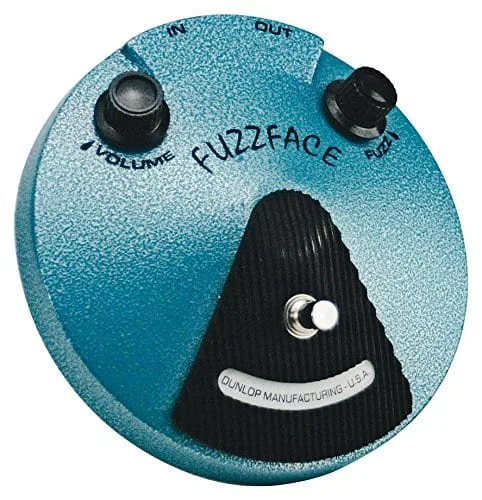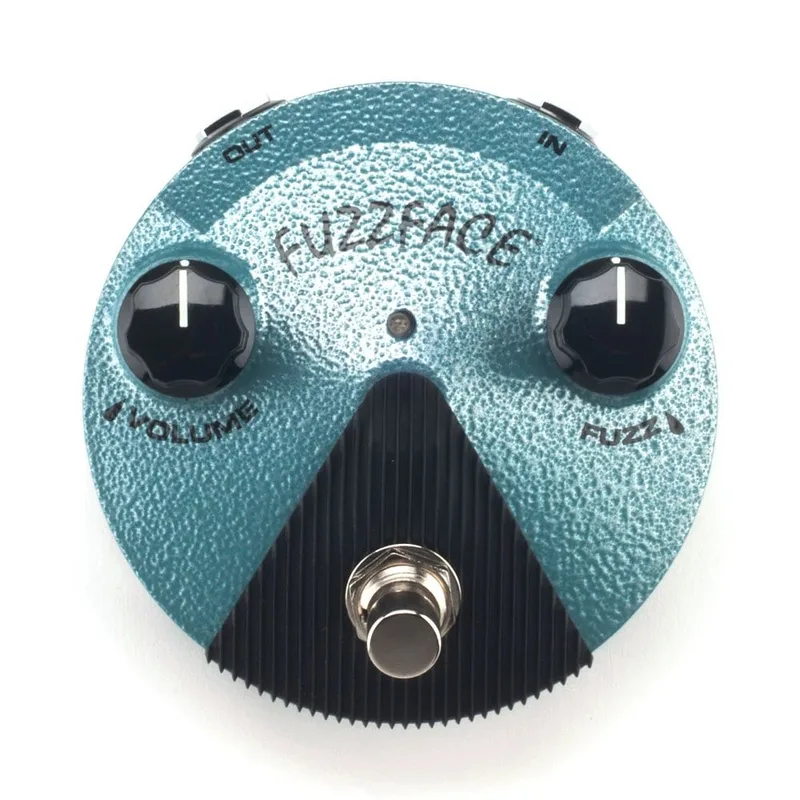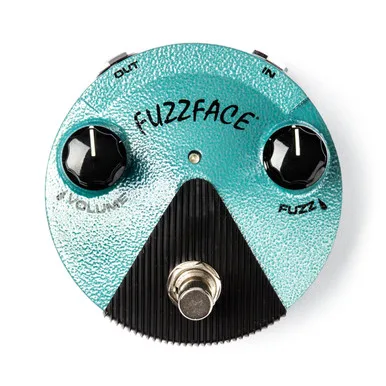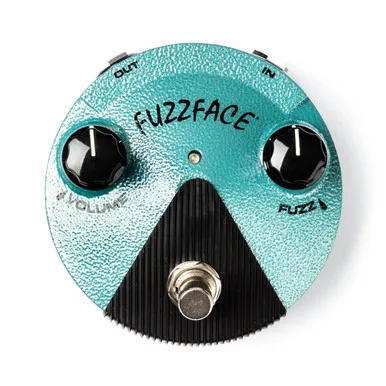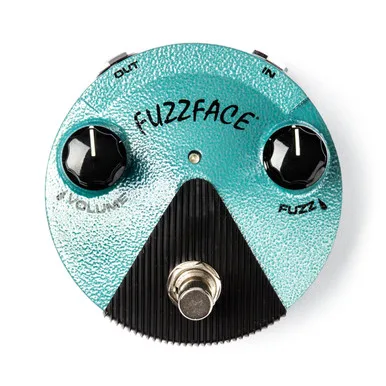


The Dunlop FFM3 Jimi Hendrix Fuzz Face Mini Distortion is a compact fuzz pedal from Dunlop, built to put the sound of the full-size Jimi Hendrix Fuzz Face into a housing that fits on a modern pedalboard. Dunlop describes the Fuzz Face Mini line as delivering "legendary Fuzz Face tones in smaller, more pedalboard-friendly housings"1, and the manual pitches it as "legendary Fuzz Face tone with pedalboard-friendly size"2.
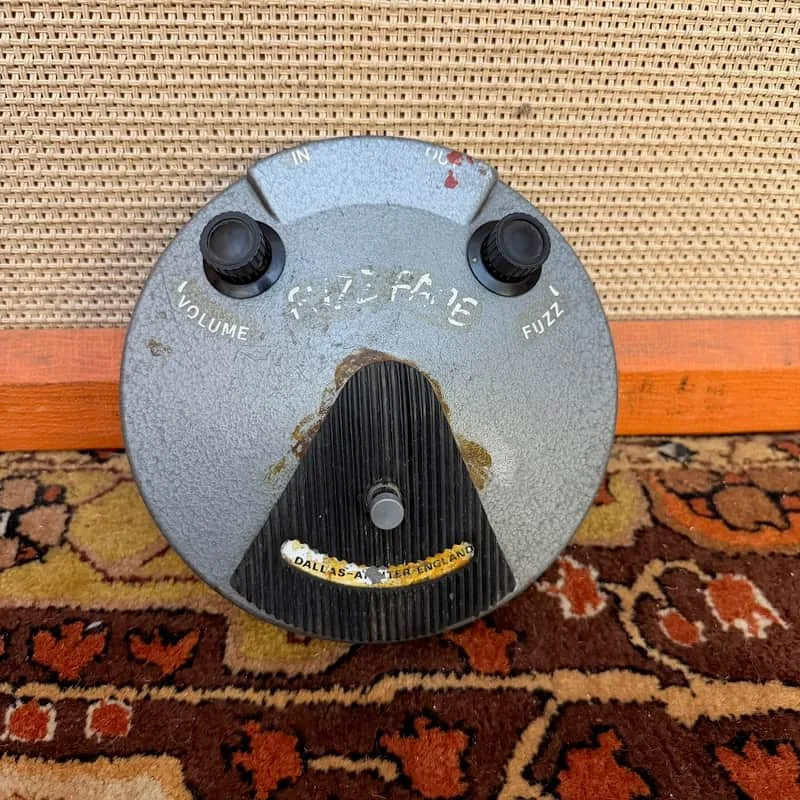
The circuit is the point of the pedal. Dunlop's product page states plainly that "the FFM3 Jimi Hendrix Fuzz Face Mini Distortion has the same circuit as the JHF1 in smaller housing"1, and the manual says it delivers "the thick, smooth Fuzz Face tone that Jimi Hendrix made famous"2. The JHF1 it is based on is, in Dunlop's words, a "meticulously faithful reproduction of Jimi's 1969-70 Dallas-Arbiter Fuzz Face"3, a BC108 silicon transistor design that MusicRadar notes "featured on much of Jimi's studio work"34.
Where it came from
The FFM3 Jimi Hendrix Fuzz Face Mini Distortion carries the same basic control scheme as its larger sibling, with a footswitch that toggles the effect on and bypass, and a blue LED that indicates when the pedal is on2.
The pedal keeps the visual identity of the original. Guitar World describes it as "presented in the same classic round chassis with the same skip-pad 'nose' of the original, albeit at less than one-third the overall size"5. So it is smaller, but it still looks like a Fuzz Face rather than a generic mini box.
The controls: Fuzz and Volume
The control set is the classic two-knob Fuzz Face layout, described in the manual2:
| Control | What it does |
|---|---|
| FUZZ | Controls the amount of fuzz |
| VOLUME | Controls the overall effect volume |
There is no tone knob. That matches the full-size JHF1, whose manual lists the same two controls doing the same jobs3. Players who want to shape the character further have to do it from the guitar's volume and tone controls or elsewhere in the chain, which is how the original pedal was always used.
The footswitch toggles the effect on and bypass, with a blue LED indicating when the pedal is on2. Guitar World's buying guide notes the Mini Jimi also carries "true-bypass switching, a laser-bright status LED, AC power jack and easy-access battery door"5.
Power: 9V, 3.4 mA
Dunlop gives several powering options. The product page says the pedal "can be powered by a 9-volt battery, a Dunlop ECB003 9-volt adapter, or the DC Brick, Iso-Brick, and Mini Iso-Brick" power supplies1, and the manual lists "a 9-volt AC adapter such as the Dunlop ECB003/ECB003EU, or a DC Brick power supply"2. MusicRadar's fuzz buying guide lists the power requirements as "9-Volt battery or AC power"6.
The current draw is 3.4 mA2, which is low enough that the pedal is easy to accommodate on almost any power supply, shared or isolated.
The battery door is a real difference from the full-size pedal. The JHF1's manual says it is "powered by one 9 volt battery (remove bottom plate to install)"3, while the FFM3 has an easy-access battery door5, so swapping a battery does not mean taking the bottom plate off.
Same circuit as the JHF1
The FFM3's reason for existing is size, not a different sound. Dunlop says it has the same circuit as the JHF11, MusicRadar's review confirms "the FFM3 Jimi Hendrix features the same circuit as the full-sized JHF1"7, and MusicRadar's buying guide calls it "a miniature version of the original JHF1"6. On That Pedal Show, Mick put it that "there's also the FFM3 Mini version that takes up waaaaay less pedalboard space" than the JHF1, and noted the two are "more or less the same price to buy"8.
For a player choosing between them, the practical differences come down to footprint and battery access. The JHF1 keeps the full-size round chassis and needs its bottom plate removed for a battery5; the FFM3 measures 3.5" x 3.5" x 2"5 and has the easy-access door5. Both run on 9 volts, both have the same two controls, and both are listed as True Hardwire bypass in their manuals23.
Specifications
| Specification | Value |
|---|---|
| Input impedance | 10 kΩ2 |
| Output impedance | 66 kΩ at mid Volume, <16 kΩ at max Volume2 |
| Max gain | 55 dB2 |
| Current draw | 3.4 mA2 |
| Bypass | True Hardwire2 |
| Dimensions | 3.5" x 3.5" x 2"5 |
What reviewers said
Guitar World's mini pedal buying guide summed up the FFM3 as a "classic Sixties-style fuzz" with an eye-catching color and shape and a pedalboard-friendly housing, while cautioning that the distortion "might be too over-the-top for some players"5. MusicRadar's review noted the true bypass switching and the shared circuit with the JHF17. On That Pedal Show, the FFM3 was compared directly against the full-size JHF1, with the mini version recommended for the space it saves at effectively the same price8.
Videos
Prymaxe
NUNU:A
Portal Gitarowy
Questions
Is the Dunlop FFM3 true bypass?
Yes. Dunlop's product page states that Fuzz Face Minis feature true bypass switching, and the manual lists the bypass as True Hardwire. MusicRadar's review also describes true bypass switching, so the maker and press agree on this point.
Does the FFM3 take a battery or only a 9V power supply?
It takes either. Dunlop says it can be powered by a 9-volt battery, a Dunlop ECB003 9-volt adapter, or the DC Brick, Iso-Brick and Mini Iso-Brick power supplies. The manual also lists a 9-volt AC adapter such as the ECB003 or ECB003EU.
How big is the Dunlop FFM3 compared with the JHF1?
Guitar World lists the FFM3's dimensions as 3.5 inches by 3.5 inches by 2 inches, and describes it as less than one-third the overall size of the original round Fuzz Face chassis. It keeps the same round shape and skip-pad nose as the full-size pedal.
Is the FFM3 the same circuit as the full-size Jimi Hendrix Fuzz Face?
Yes. Dunlop's product page says the FFM3 has the same circuit as the JHF1 in a smaller housing, and MusicRadar's review says the same. The JHF1 itself is a reproduction of Jimi Hendrix's 1969-70 Dallas-Arbiter Fuzz Face with BC108 silicon transistors.
How much current does the FFM3 draw?
According to Dunlop's manual, the FFM3 draws 3.4 mA. That is a low draw, so it places very little demand on a shared or isolated power supply.
Does the FFM3 have a tone control?
No. The FFM3 has two knobs: Fuzz, which controls the amount of fuzz, and Volume, which controls the overall effect volume. There is no separate tone control, matching the control set of the full-size JHF1.
Sources (8)
- JIMI HENDRIX® FUZZ FACE® MINI DISTORTION, Dunlop (jimdunlop.com)
- FFM3.pdf, Dunlop Manufacturing, Inc., 2019
- JHF1.pdf, Dunlop Manufacturing, Inc., 2019
- Dunlop Jimi Hendrix Band Of Gypsys FFM6 Fuzz Face Mini review, MusicRadar, 2014-12-17
- Best mini-pedals for guitarists: top space-saving stomps, Guitar World, 2020-09-25
- Best fuzz pedals: add some extra dirt to your guitar tone, MusicRadar, 2022-05-17
- Dunlop Jimi Hendrix Fuzz Face Mini FFM3 review, MusicRadar, 2013-07-08
- Big Or Small Hendrix Fuzz Face? JHF1 & FFM3, That Pedal Show, 2024-02-06